What is passive cooling? Cut Tampa Bay energy costs 30%
Many Tampa Bay homeowners believe passive cooling can completely replace their air conditioning system. While passive cooling can reduce HVAC cooling load by up to 30%, it doesn’t eliminate the need for mechanical cooling in our humid subtropical climate. This guide explains how passive cooling actually works, what you can realistically expect, and how to use it effectively alongside your existing HVAC system to maximize comfort and savings.
Table of Contents
- Introduction To Passive Cooling
- How Passive Cooling Works: The Science Behind It
- Climate Considerations For Tampa Bay Passive Cooling
- Common Misconceptions About Passive Cooling
- Effective Passive Cooling Strategies For Tampa Bay Homes
- Passive Cooling Vs Mechanical Cooling: Costs And Benefits
- Design Considerations For Maximizing Passive Cooling
- Real-World Examples Of Passive Cooling Success
- Explore Home Cooling Solutions With Home Therapist
- FAQ
Key takeaways
| Point | Details |
|---|---|
| Temperature reduction | Passive cooling lowers indoor temps by 2-6°C without using electricity |
| Energy savings | Reduces cooling energy consumption by up to 30% when properly implemented |
| Climate limitations | Tampa Bay’s high humidity significantly limits evaporative cooling effectiveness |
| Best strategies | Shading, natural ventilation, and reflective roofing work best in our climate |
| Optimal approach | Combining passive and mechanical cooling maximizes both comfort and cost savings |
Introduction to passive cooling
Passive cooling is a design approach that lowers indoor temperatures without relying on mechanical systems or electrical energy. Instead of running your air conditioner constantly, passive cooling harnesses natural heat transfer mechanisms like convection, conduction, radiation, and evaporation to remove unwanted heat from your home.
The benefits extend beyond just energy savings. You’ll enjoy lower utility bills, reduced environmental impact, and enhanced indoor comfort during Tampa Bay’s milder months. Passive cooling uses natural heat transfer mechanisms to reduce indoor temperatures without mechanical energy input, achieving 2-6°C reductions under optimal conditions.
Understanding these natural processes helps you recognize passive cooling’s potential in your home:
- Convection moves warm air out and draws cooler air in through strategic ventilation
- Conduction transfers heat through building materials, which can be managed with proper insulation
- Radiation brings solar heat through windows and roofs, controlled by shading and reflective surfaces
- Evaporation cools air through moisture, though this works poorly in humid climates like ours
Grasping how each mechanism functions sets realistic expectations for what passive cooling can achieve in Tampa Bay’s unique climate.
How passive cooling works: the science behind it
Each passive cooling principle operates on fundamental physics, but their effectiveness varies based on your home’s design and local climate conditions.
Convection enables natural ventilation by creating air movement. As indoor air warms, it rises and exits through higher openings while cooler outdoor air enters through lower ones. This continuous cycle removes heat without fans or mechanical systems. Cross-ventilation through strategically placed windows maximizes this effect.

Radiation involves solar heat entering your home through windows, walls, and roofs. Blocking this radiant heat before it penetrates your building envelope prevents indoor temperature spikes. Shading devices, trees, and reflective materials intercept radiation effectively.
Evaporation cools air as water transitions from liquid to gas, absorbing heat energy in the process. This principle works well in dry climates but struggles in Tampa Bay’s humidity. When air already contains substantial moisture, it can’t absorb much more, limiting evaporative cooling potential.
Thermal mass refers to materials like concrete, stone, or brick that absorb heat slowly during the day and release it gradually at night. This stabilizes indoor temperatures by preventing rapid swings. In Tampa’s climate, thermal mass works best when combined with nighttime ventilation to purge stored heat.
Proper design integration of passive cooling needs orientation, air flow paths, window placement, and landscape to optimize results, particularly in Tampa’s climate with up to 25% greater cooling effectiveness. Success requires thoughtful planning rather than applying generic strategies.
Pro Tip: Start by addressing your home’s biggest heat sources first, typically unshaded windows and dark roofing materials. These changes deliver the most noticeable temperature reductions.
Climate considerations for Tampa Bay passive cooling
Tampa Bay’s humid subtropical climate presents specific challenges that shape which passive cooling strategies work best here.
Our high humidity levels, often exceeding 60%, severely limit evaporative cooling effectiveness. Unlike desert regions where evaporative coolers thrive, Tampa Bay’s moisture-saturated air can’t absorb additional water vapor efficiently. This makes evaporative methods the least practical option for local homeowners.
Hot summers with intense solar radiation require aggressive shading and heat-reflective materials. Without protection, your roof can absorb tremendous heat that radiates into living spaces below. Dark surfaces amplify this problem by absorbing rather than reflecting solar energy.
Enhanced ventilation becomes crucial in humid climates to promote continuous airflow and prevent stagnant, muggy indoor conditions. Moving air feels cooler on skin and helps remove indoor heat and moisture. Strategic window placement supporting cross-ventilation makes a measurable difference.
Landscaping choices matter more in humid climates. Trees provide shade that cools not just your home but surrounding air through transpiration. Proper plant selection and placement create microclimates that reduce nearby air temperatures by several degrees.
Selecting strategies tailored to Tampa Bay’s specific climate conditions produces better results than copying approaches designed for arid or temperate regions. Understanding these local factors helps you invest in methods that actually work here.
Common misconceptions about passive cooling
Clearing up myths about passive cooling helps Tampa Bay homeowners set realistic expectations and make informed decisions.
Passive cooling completely replaces AC in Tampa Bay: This is false. While passive methods significantly reduce cooling loads, Tampa’s heat and humidity typically require mechanical cooling for consistent comfort. Passive cooling reduces cooling loads significantly but does not fully replace air conditioning in hot, humid climates like Tampa Bay.
Evaporative cooling works well in all climates: Evaporative cooling excels in dry regions but performs poorly in humid areas. Tampa Bay’s moisture-laden air limits how much additional water vapor it can absorb, reducing cooling potential dramatically.
Passive cooling means no mechanical cooling is needed: Most Tampa Bay homes benefit from combining both approaches. Passive methods reduce your HVAC system’s workload, but mechanical cooling provides reliable temperature control during peak heat and humidity.
Any passive cooling feature automatically saves money: Without proper design integration, isolated passive elements may provide minimal benefit. Effectiveness depends on how well different strategies work together and suit your specific home.
“Understanding passive cooling’s actual capabilities prevents disappointment and helps homeowners appreciate it as a valuable complement to, rather than replacement for, mechanical cooling systems.”
Education empowers you to integrate passive and active systems strategically for maximum benefit.
Effective passive cooling strategies for Tampa Bay homes
These practical, climate-appropriate techniques help Tampa Bay homeowners reduce cooling costs and enhance comfort.
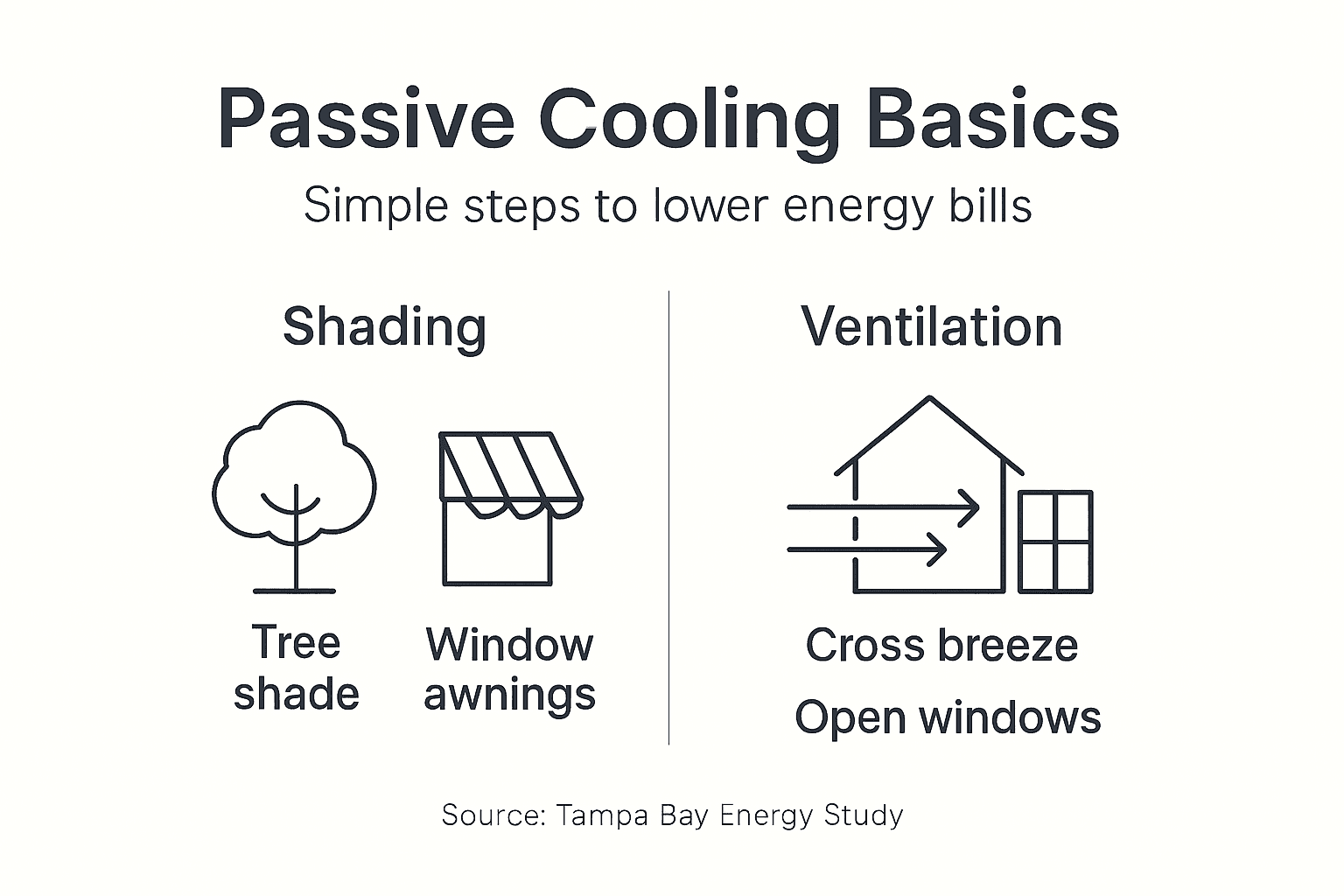
Shading prevents solar heat from reaching your home’s surfaces. Plant deciduous trees on south and west sides to block summer sun while allowing winter warmth. Install awnings or exterior shutters over windows receiving direct sunlight. External shading works better than internal blinds because it stops heat before it enters.
Cross-ventilation design positions windows to create natural airflow paths through your home. Place inlet windows on the side receiving prevailing breezes and outlet windows on the opposite side. Higher outlet positions work better since warm air rises naturally.
Reflective roofing materials can reduce roof surface temperatures by more than 30°F, significantly lowering heat transfer into your home. Light-colored or specially coated cool roofs reflect solar radiation instead of absorbing it. This single upgrade delivers substantial temperature reductions.
Thermal mass elements like tile floors, concrete walls, or stone features absorb heat during the day and release it slowly when outdoor temperatures drop. This moderates indoor temperature swings. Combine thermal mass with nighttime ventilation for best results.
Landscaping creates cooler microclimates around your home through shade and transpiration. Native plants adapted to Tampa’s climate require less water while providing cooling benefits. Position vegetation to channel breezes toward windows.
Pro Tip: Implement changes incrementally, starting with low-cost high-impact modifications like improving ventilation and adding shade. Monitor results before investing in more expensive upgrades.
Passive cooling vs mechanical cooling: costs and benefits
Comparing passive and mechanical approaches helps you understand how each contributes to home comfort and identify the optimal balance for Tampa Bay conditions.
Passive cooling requires upfront investment in design elements or retrofits but operates with zero ongoing energy costs. Shading devices, strategic landscaping, and ventilation improvements need minimal maintenance. However, passive methods alone rarely provide sufficient cooling during Tampa’s hottest months.
Mechanical air conditioning offers precise temperature control regardless of outdoor conditions. Modern systems efficiently remove both heat and humidity, crucial for Tampa Bay comfort. However, AC systems require substantial electricity, regular maintenance, and eventual replacement.
| Feature | Passive Cooling | Mechanical Cooling |
|---|---|---|
| Upfront cost | Low to moderate | Moderate to high |
| Operating cost | None | $100-$300+ monthly |
| Temperature control | Limited precision | Exact control |
| Humidity removal | Minimal | Excellent |
| Tampa Bay effectiveness | Partial solution | Complete solution |
Passive methods reduce HVAC load by up to 30%, translating to lower electricity bills and reduced carbon emissions. When your home stays cooler naturally, your AC runs less frequently and works less hard.
Passive cooling alone rarely suffices for full comfort during Tampa’s humid summers. Most homeowners need mechanical cooling at least part of the year. The sweet spot combines both approaches, using passive methods to minimize AC runtime while maintaining reliable comfort.
Best results come from viewing passive and mechanical cooling as partners rather than competitors. Each compensates for the other’s limitations while maximizing overall efficiency.
Design considerations for maximizing passive cooling
Thoughtful design choices amplify passive cooling effectiveness, whether you’re building new or retrofitting an existing Tampa Bay home.
Orientation determines how much direct sunlight hits your walls and windows. Position the longest walls facing north and south to minimize east and west exposure, which receives intense morning and afternoon sun. East-west orientations absorb more heat throughout the day.
Window placement supports natural cross-ventilation when openings align with prevailing breeze directions. Tampa Bay’s typical southeasterly winds should guide inlet window locations. Position outlet windows higher on opposite walls to maximize airflow.
Building materials with high thermal mass regulate heat by absorbing temperature spikes and releasing stored energy slowly. Concrete, brick, tile, and stone work well. In Tampa’s climate, expose thermal mass to nighttime ventilation so it releases daytime heat effectively.
Landscaping provides shade that cools both your home and surrounding air through transpiration. Home designs that optimize orientation, air flow, window placement, and landscape can achieve up to 25% greater passive cooling effectiveness. Select native trees and shrubs requiring less irrigation while delivering maximum shade.
Air flow paths need clear routes throughout your home without obstructions that create stagnant zones. Open floor plans facilitate better circulation than compartmentalized layouts. Interior doors with louvers or gaps allow continuous airflow even when closed.
Whether designing a new home or retrofitting existing construction, early planning for passive cooling delivers better results at lower cost than trying to add features later. Even modest improvements make measurable differences in comfort and energy use.
Real-world examples of passive cooling success
Documented cases from Florida homes demonstrate passive cooling’s tangible benefits when properly implemented in humid subtropical climates.
Homeowners across Florida have reported 15-25% annual electricity reductions after implementing comprehensive passive cooling strategies. These savings come from reduced AC runtime as homes maintain comfortable temperatures naturally for longer periods.
Financial benefits accumulate over time. A typical Tampa Bay household spending $200 monthly on summer cooling could save $30-$50 monthly, or $360-$600 annually, through effective passive cooling integration. Over a decade, that represents thousands in avoided utility costs.
| Passive Strategy | Reported Temperature Reduction | Estimated Energy Savings |
|---|---|---|
| Reflective roofing + shading | 4-6°F indoor reduction | 20-25% cooling costs |
| Cross-ventilation optimization | 2-4°F indoor reduction | 10-15% cooling costs |
| Thermal mass + night ventilation | 3-5°F indoor reduction | 15-20% cooling costs |
| Comprehensive integration | 6-10°F indoor reduction | 25-30% cooling costs |
Adaptations specifically tailored to humid subtropical conditions yield the best outcomes. Strategies successful in Arizona or California may underperform here without modification for Tampa’s moisture levels.
These real-world results demonstrate that passive cooling delivers measurable, practical benefits when implemented alongside mechanical systems. Success requires climate-appropriate strategy selection rather than generic application of passive principles.
Explore home cooling solutions with Home Therapist
Now that you understand how passive cooling works in Tampa Bay’s climate, consider how professional HVAC expertise can help you optimize both natural and mechanical cooling for maximum efficiency.
Combining passive strategies with modern, energy-efficient HVAC systems creates the ideal balance of comfort and cost savings. Our certified technicians help homeowners identify which passive modifications complement their existing cooling systems most effectively.

Whether you’re exploring HVAC system options or considering retrofitting upgrades to work better with passive cooling features, Home Therapist delivers expert guidance tailored to Tampa Bay’s unique climate demands. Contact our family-owned business today to discover how integrating smart cooling methods reduces your energy costs while maintaining reliable year-round comfort.
FAQ
What is the most effective passive cooling method in Tampa’s humidity?
Reflective roofing combined with strategic shading delivers the best results in Tampa Bay’s humid climate. These methods block solar heat before it enters your home without relying on evaporation, which humidity limits. Cross-ventilation ranks second by promoting continuous airflow that prevents stagnant, muggy conditions.
Can passive cooling eliminate my need for air conditioning?
No, passive cooling alone cannot fully replace air conditioning in Tampa Bay’s climate. While it significantly reduces cooling loads by 20-30%, our combination of high heat and humidity typically requires mechanical cooling for consistent comfort. View passive methods as valuable AC supplements rather than complete replacements.
How much can I expect to save on energy bills with passive cooling?
Most Tampa Bay homeowners implementing comprehensive passive cooling strategies report 15-25% reductions in annual cooling costs. Actual savings depend on your home’s design, which strategies you implement, and how effectively they integrate with your existing HVAC system. A typical household might save $360-$600 annually.
Is it expensive to retrofit my home for passive cooling?
Costs vary widely based on which strategies you choose. Simple improvements like adding window shades, planting trees, or enhancing ventilation cost hundreds to low thousands. Major retrofits like installing reflective roofing or redesigning window placement cost more but deliver proportionally greater benefits. Start with low-cost, high-impact changes first.
What maintenance is required for passive cooling features?
Passive cooling elements need minimal maintenance compared to mechanical systems. Trim trees and vegetation periodically to maintain shade patterns and airflow. Clean reflective roof coatings as recommended by manufacturers. Inspect shading devices for damage after storms. Most passive features operate maintenance-free for years once properly installed.