Can I push the fan to start it?
Using a stick to nudge spinning fan is a DIY test for bad capacitor (if it spins freely after push, capacitor confirmed bad). Don’t leave AC running this way, compressor damage.
How long can AC run without fan?
Minutes. Compressor overheats quickly, safety cutoff activates. Don’t keep resetting, call.
Indoor or outdoor fan?
Outdoor = condenser fan (rejects heat). Indoor = blower (moves air through ducts). Different motors, different prices.
Same-day fix?
Yes for capacitor (stocked in truck). Motors sometimes next-day for specific brands.
Can I push the fan to start it?
Yes, carefully and briefly. If the fan is not spinning but the compressor is humming, you can reach through the top grille with a long stick or pen and give the blade a gentle spin in its normal direction of rotation. If it starts and keeps going, the run capacitor has failed and lost enough microfarad value to prevent startup torque. The motor itself is still functional. Do not run the system like this long-term. The capacitor needs replacement before the next cycle. Call (813) 343-2212 for same-day service.
How long can AC run without fan?
Two to four minutes in Tampa summer conditions before the high-pressure cutout trips or compressor damage begins. Head pressure on a 90-degree day with no fan airflow climbs to dangerous levels very quickly. Shut the system off immediately if you confirm the condenser fan is not spinning. Do not attempt to override safety switches to keep it running.
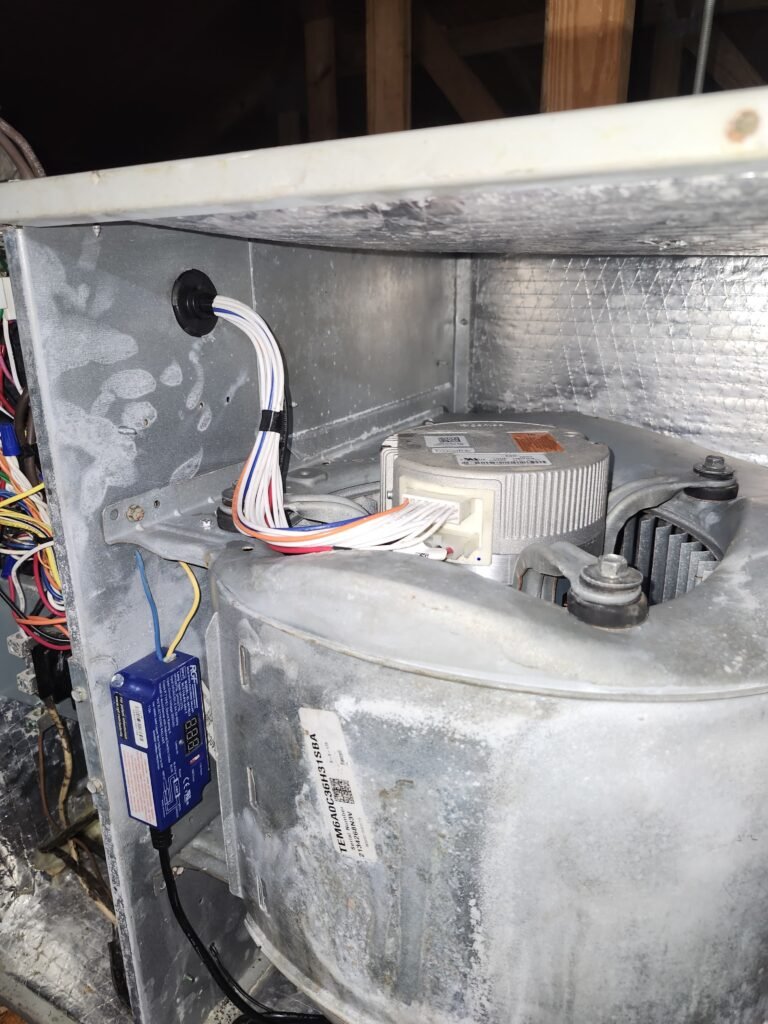
Indoor or outdoor fan?
Outdoor condenser fan failure produces warm air from supply vents because the refrigerant cannot reject heat. Indoor blower motor failure produces little or no airflow from vents even though the outdoor unit may run normally. If air is blowing from vents but the house is not cooling, look at the outdoor condenser fan first. If the system runs but airflow from vents is weak, suspect the indoor blower motor. Both are diagnosed with a FREE visit. Call (813) 343-2212.
Same-day fix?
Capacitor replacement is almost always same-day because capacitors are stocked on every service truck. Motor replacements depend on the motor spec. Common single-phase condenser fan motors are also truck-stocked. Unusual multi-speed motors or ECM motors for higher-efficiency systems may require a parts run. Call by noon most days for same-day service in Hillsborough County. (813) 343-2212. Licensed CAC1819196.
Does Florida require a permit to replace just the fan motor?
No permit is required in Hillsborough County for a like-for-like motor or capacitor replacement on an existing permitted system. The unit stays in place, the refrigerant circuit is not opened, and no structural or electrical panel changes occur. If the entire condenser unit must be replaced, a full change-out permit is required. Call (813) 343-2212. Licensed CAC1819196.
Why do fan motors fail faster in Tampa than elsewhere?
Tampa’s combination of heat, humidity, and lightning makes it unusually hard on fan motors. Outdoor motors run more hours per year because Tampa averages over 2,800 cooling hours annually. Salt air corrosion on coastal homes degrades wiring insulation and bearing seals faster than inland climates. And Tampa’s average of 100-plus lightning days per year sends voltage surges through power lines that stress motor windings. A motor that might last 12 years in a northern city often lasts 6 to 8 years in Tampa. Annual maintenance and surge protection are the two best investments to extend motor life.
Can a surge protector prevent fan motor failures from Tampa lightning?
A whole-system surge protector installed at the outdoor disconnect significantly reduces the risk of surge-related motor and capacitor damage. A good surge protector absorbs transient voltage spikes before they reach the motor windings and capacitor. Installed cost is $150 to $250. In Tampa, where the AC is the single most expensive appliance to repair and the lightning season runs June through September, this is one of the highest-ROI protective investments you can make. It does not prevent mechanical or heat-related failures, but it eliminates the surge damage that accounts for a substantial share of summer HVAC calls. Licensed CAC1819196.
My fan turns on sometimes and not other times. What does that mean?
Intermittent fan behavior almost always means the capacitor is failing but not yet dead, or the motor’s internal thermal overload protector is tripping from overheating and resetting after a cool-down period. When a capacitor weakens, it loses the ability to deliver consistent starting torque, so the motor starts on some cycles and not others depending on ambient temperature and how recently the last cycle ended. An intermittent failure is a near-term full failure. Schedule service before it stops completely, ideally before peak summer heat, when same-day availability is hardest to guarantee. Licensed CAC1819196.
Does the outdoor fan run constantly or only when the compressor runs?
The condenser fan motor runs only when the compressor is running. Both are energized by the same contactor, so when the thermostat calls for cooling, the contactor closes and both the compressor and the fan start simultaneously. The fan does not run during fan-only mode at the thermostat, which circulates indoor air using only the blower motor inside the air handler. If you set the thermostat fan to ON rather than AUTO, the indoor blower runs continuously but the outdoor unit, including its fan, is off. This distinction matters for diagnosis: if you hear indoor airflow but nothing running outside, the outdoor circuit, including the condenser fan, is not receiving power. Licensed CAC1819196.