
Open 24 hours, 7 days a week
FREE estimates and FREE diagnosis
Troubleshooting guide
Mini-Split Blinking Light or Error Codes
Short answer: A blinking or flashing light on a mini-split indoor head signals that the unit has detected a fault and entered a protection or error mode. The blink pattern (how many flashes, how fast, and which light) tells a technician exactly what failed. Do not ignore a blinking mini-split; most codes indicate a problem that will worsen if the unit keeps running.
Mini-split still blinking? Our Tampa Bay techs read the code and diagnose every mini-split brand, from Daikin to Mitsubishi.
Home Therapist serves Tampa Bay, Florida. In the area? FREE estimates and FREE diagnosis.
- Licensed CAC1819196 & CFC1431159
- 4.8 stars from 1,404 reviews
- Background-checked, drug-tested techs
- Hablamos español
At a glance
- What a blink means
- The unit found a fault and went into a protection or error mode
- How to read it
- Count the flashes before the pause, then match the pattern below
- Safe to try
- Turn it off for 30 minutes, or reset it at the breaker once
- Call the same day
- 5 flashes (refrigerant or pressure) or a fast blink with no pause
- Do not
- Repair the wiring between the indoor and outdoor units yourself
- Brands
- We service all major mini-split brands
- Diagnosis
- FREE, and you only pay if you approve the repair

Reviewed by Richard Morales, Co-Owner & FL Class B Air Conditioning Contractor (FL license CAC1819196)
What Blinking Lights on a Mini-Split Actually Mean
Mini-split systems use LED indicator lights as a diagnostic language. Unlike a simple “check engine” warning, the flash pattern encodes a specific fault code that trained technicians can read directly from the unit, without connecting a laptop. Each manufacturer uses a slightly different scheme, but the underlying fault categories are consistent across the industry: refrigerant issues, sensor failures, communication faults between indoor and outdoor units, electrical problems, and protection modes triggered by extreme conditions.
According to the U.S. Department of Energy, mini-split systems are among the most efficient cooling options available, but their diagnostic sophistication means that flashing lights should never be ignored. A protection mode is the unit’s way of preventing a minor fault from becoming a compressor failure: catching it early saves significant repair cost.
Tampa Bay’s climate creates specific triggers for error codes that homeowners in cooler climates rarely see. With outdoor temperatures regularly exceeding 95°F from June through September and indoor humidity averaging 75 percent, high-pressure protection codes and communication faults from overheated control boards are more common here than almost anywhere else in the country. The American Society of Heating, Refrigerating and Air-Conditioning Engineers (ASHRAE) recommends that mini-split systems serving high-humidity climates receive annual maintenance checks specifically to catch conditions that trigger these codes before they become failures.
How to Read Your Mini-Split’s Blink Code
Most mini-splits communicate faults through one or more of the following indicator lights on the indoor head:
- Operation light (green or blue): indicates normal run status; blinking indicates standby, timer, or fault depending on pattern
- Timer light (orange or yellow): blinks to indicate timer programming or certain error codes
- Economy/auto light: used on some models as a secondary fault indicator
The code is read by counting the number of flashes in a sequence before a pause. A “3-blink” code means the light flashes three times, pauses, then repeats. Some units show simultaneous blinking of two lights: that pattern is typically a different fault than either light alone.
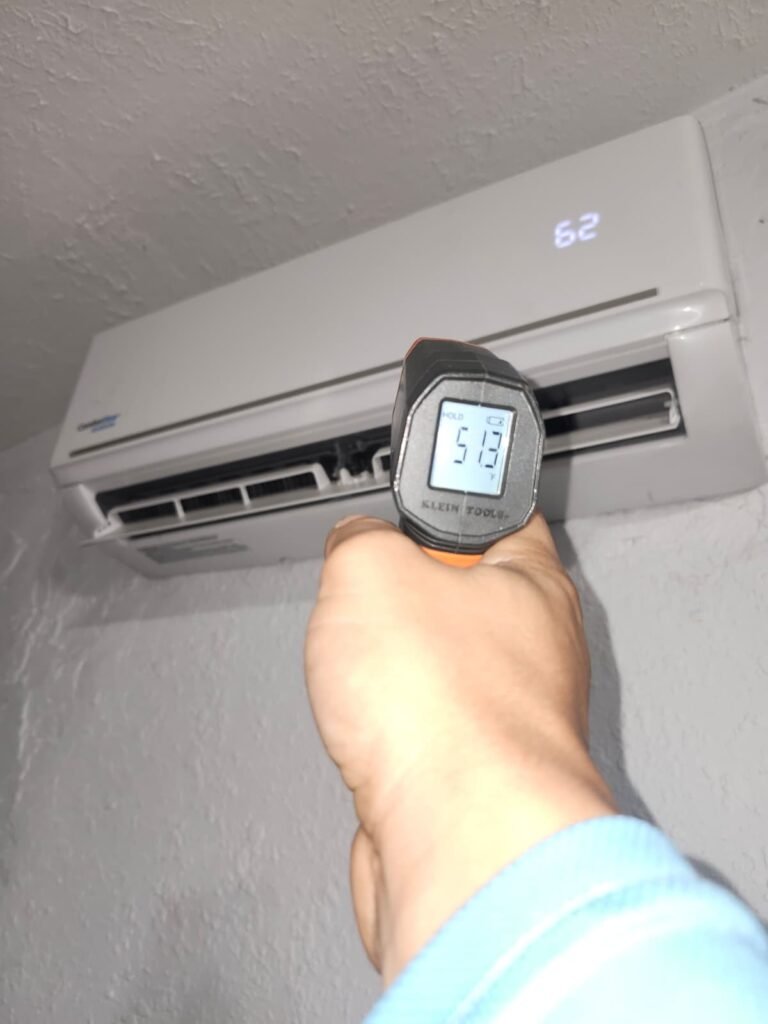
If your unit has a digital display on the remote or on the indoor head itself, it may show an alphanumeric code (E1, E3, F1, H6, P1, etc.) that is more specific than a blink count.
Common Blink Patterns and What They Mean
| Blink Pattern | Typical Fault Category | Common Meaning | Action |
|---|---|---|---|
| 1 flash (slow, repeating) | Standby / normal mode indicator | Unit is in standby or waiting to start, often not a fault at all | Check remote settings; try turning unit off and on |
| 2 flashes, pause, repeat | Indoor ambient or coil temperature sensor fault | Temperature sensor reading out of range or failed; unit shuts down to prevent damage | Turn off for 30 minutes; if code returns, call for service |
| 3 flashes, pause, repeat | Outdoor unit or outdoor sensor fault | Outdoor ambient sensor, discharge temperature sensor, or outdoor control board issue; common in high-heat Tampa summers | Check outdoor unit is running; clear debris; call if outdoor unit is not spinning |
| 4 flashes, pause, repeat | Communication fault (indoor to outdoor) | Signal wire between indoor and outdoor units is broken, corroded, or wired incorrectly; outdoor unit not receiving commands | Check that outdoor unit has power; do not attempt wiring repairs yourself; call for service |
| 5 flashes, pause, repeat | Refrigerant or pressure protection | High or low pressure detected; low refrigerant, refrigerant overcharge, dirty condenser, or restricted line | Do not keep running: compressor damage risk; call same day |
| Continuous rapid blinking (no pause) | Immediate protection / shutdown mode | Unit has detected a critical fault (compressor overcurrent, reverse phase, fan motor failure) and locked out to protect itself | Turn unit off at breaker; call for service |
| Two lights blinking alternately | Communication fault or power supply issue | Indoor and outdoor units not communicating; can indicate wiring damage, failed control board, or power phase issue | Reset at breaker once; if alternating blink resumes, call for service |
| Timer light only, flashing slowly | Timer mode active or service reminder | Often a programmed timer or a filter-cleaning reminder (common on units with hour-tracking), not a fault | Check remote for timer settings; clean filter and reset if applicable |
Common Alphanumeric Error Codes Explained
If your remote or indoor head displays letters and numbers, here are the most common codes and their meanings across popular mini-split lines. Home Therapist services all major brands.
E-Series Codes (common across many brands)
- E1: Indoor/outdoor communication error: signal wire fault or board issue
- E3: High pressure protection: dirty condenser, overcharge, or refrigerant restriction
- E4: Low pressure protection: low refrigerant charge, severe filter restriction, or outdoor fan failure
- E5: Overcurrent protection: electrical issue in compressor circuit
- E6: Communication error, variant: similar to E1 but often specific to outdoor board
F-Series Codes
- F1: Indoor coil temperature sensor failure: sensor open or shorted
- F2: Indoor ambient temperature sensor failure
- F3: Outdoor coil sensor failure: common in units with aging wiring in Florida’s UV-rich environment
H-Series and P-Series Codes (Daikin and similar)
- H6: Outdoor unit fan motor fault: fan not spinning or driver board failure
- P4: Inverter radiation fin high temperature: outdoor unit overheating, often from restricted airflow around condenser
- U4: Communication error between indoor and outdoor units
Important: Error code meanings vary by brand and model generation. The codes listed above represent the most common patterns, but always confirm with the unit’s installation manual or call Home Therapist for an accurate diagnosis. We carry diagnostic equipment for all major mini-split brands.
Mini-split showing a blinking light or error code in Tampa Bay?
Call (813) 343-2212 or book online for FREE diagnosis. We service all brands and bring diagnostic tools for same-day code reading. Licensed CAC1819196.
Why Tampa Bay Drives More Error Codes Than Average
Florida’s climate pushes mini-split systems harder than the conditions most manufacturers use for baseline testing. Several error codes appear far more often in Tampa Bay than in moderate climates:
- High-pressure codes (E3, P4): When outdoor temperatures exceed 95°F, the condenser has less temperature differential to reject heat. A condenser coil that is even 10 percent dirty can tip the system into high-pressure lockout on a hot July afternoon.
- Communication faults (E1, E6, U4): Signal wiring between indoor and outdoor units runs through exterior wall penetrations. In Tampa Bay, UV exposure and temperature cycling degrade wire insulation faster. Communication faults are more common on systems 5 years or older.
- Protection mode lockouts: High humidity means the system runs more continuously. Continuous operation in extreme heat accelerates the conditions that trigger protection codes. A system that ran without issues through a mild April may start throwing codes in mid-June when demand increases sharply.
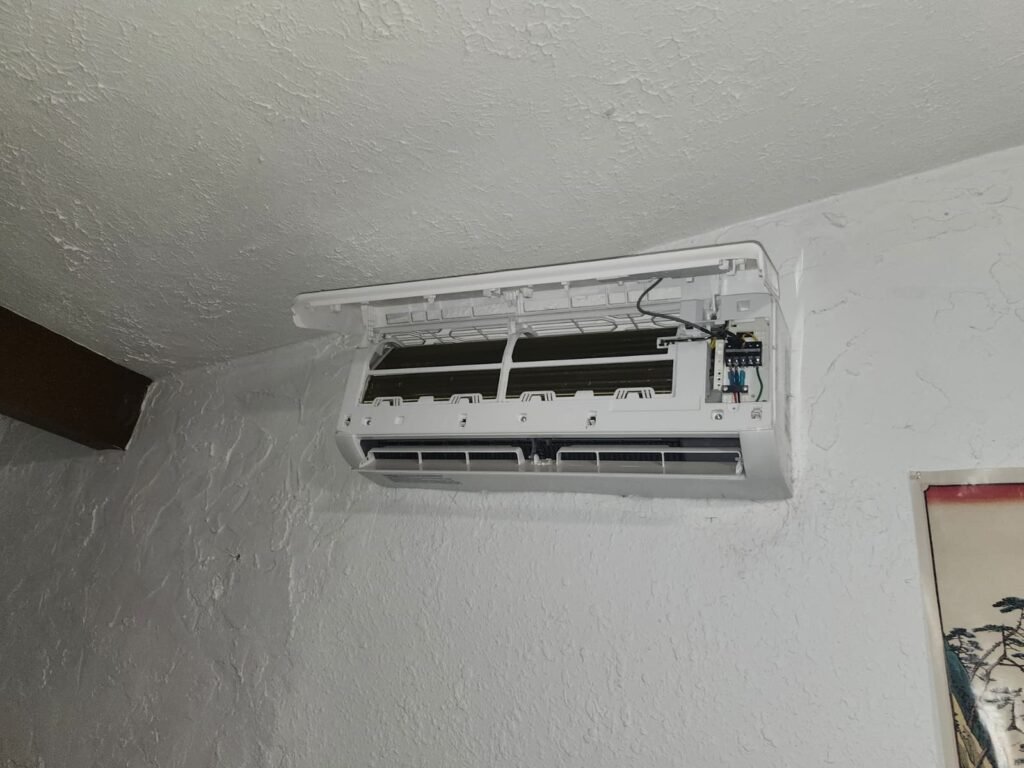
What You Should and Should Not Do
Safe to try yourself:
- Turn the unit off at the remote, wait 10 minutes, turn back on: a soft reset clears transient faults
- Check and clean the air filter
- Clear debris from around the outdoor unit (minimum 18 inches clearance)
- Check that the outdoor unit’s circuit breaker has not tripped
Call a licensed technician for:
- Any code that returns after a reset
- Any refrigerant-related code (E3, E4, pressure codes)
- Any communication fault (E1, E6, U4): do not attempt to rewire
- Continuous blinking with no cooling or heating output
- Any code after a power surge or lightning event
For more on how mini-split cooling failures progress, see our pages on mini-split not cooling and mini-split icing up.
Error code won’t clear? Don’t keep running the unit.
Call (813) 343-2212 or book online for FREE diagnosis. Home Therapist serves all of Hillsborough, Pinellas, and Pasco counties. 1,300+ five-star reviews. Licensed CAC1819196.
Related Pages
- Ductless Mini-Split Installation in Tampa Bay
- Mini-Split Not Cooling
- Mini-Split Iced Up or Frozen
- AC Repair Tampa
Home Therapist Cooling, Heating & Plumbing · License CAC1819196 (HVAC) · 1,300+ five-star reviews across Tampa Bay · (813) 343-2212
What Tampa Bay customers say
“Excellent service, quick response, and I already have air conditioning!”
“I love the communication this company has and they work with your schedule. The tech is knowledgeable and does a great job. I highly recommend AC Therapist.”
“They have been amazing from the quote to the installation. They were able to accommodate us last minute. Made all the updates needed and in less than 5hrs we had a new HVAC unit installed. We'll be using them for all of our upgrades”
4.8 from 1,404 reviews · Read more reviews
Frequently Asked Questions
- Why is my mini split blinking?
A blinking light on a mini split is the system's built-in fault alert. The indoor head flashes a pattern (number of blinks, color, or both) that maps to a specific error code: common causes include a refrigerant pressure fault, a dirty or frozen coil, a failed thermistor or sensor, a communication break between the indoor and outdoor unit, or a tripped high-pressure or low-pressure switch. Count the blinks, note the color, and match the sequence to your model's error-code chart before calling for service. Home Therapist diagnoses mini split fault codes for free on every visit in Tampa Bay.
- What does it mean when the power button on my Daikin mini split blinks?
On most Daikin mini splits, a blinking power or operation light signals an active fault code. The number of times the light flashes in a repeating cycle identifies the fault category: for example, a continuous or rapid blink often indicates a communication error between the indoor and outdoor units, while a counted sequence (such as two or five blinks) points to refrigerant pressure or sensor faults. Write down the exact blink count and call for a free diagnosis; the technician will pull the stored code with a service tool to confirm the root cause before any repair is quoted.
- How do I reset a Daikin mini split?
To reset a Daikin mini split, turn the system off at the remote or wall controller, then switch off the dedicated circuit breaker for the outdoor unit and wait a full two minutes before restoring power. This clears temporary faults caused by a brief power surge or a momentary sensor glitch. If the blinking light returns within the first cooling or heating cycle after the reset, the underlying fault is still active and the system needs a professional diagnosis. A reset does not fix a refrigerant leak, a failed sensor, or a wiring fault.
- Is there a reset button on a mini split?
Most mini splits do not have a dedicated reset button. To reset, turn the unit off at the thermostat or remote, then flip the circuit breaker off for 30 seconds and back on. If the error code returns after the reset, the underlying fault is still present and needs a technician's diagnosis.
- How do I stop my AC from blinking?
A blinking light signals a fault the unit has detected and logged. Turn the system off, reset the breaker for 30 seconds, then restart. If the blinking returns, the unit is protecting itself from a real problem. Call Home Therapist at (813) 343-2212 for a free diagnosis, open 24/7.
- What does the blinking light on my AC mean?
A blinking light is your mini split's self-diagnostic alert, indicating a fault such as a refrigerant issue, sensor failure, communication error or drainage problem. The blink pattern or error code on the display points to the specific fault. Home Therapist provides free diagnosis, any hour, at (813) 343-2212.
- Why is my Mitsubishi mini split blinking?
Mitsubishi mini splits blink to signal a stored error code, commonly a refrigerant, thermistor, drain or communication fault. Count the blink sequence or note the code on the display before calling. Home Therapist diagnoses all brands, 24/7, with no service call fee. Call or text (813) 343-2212 for a free diagnosis.
- How many square feet does a 7000 BTU mini split cover?
A 7,000 BTU mini split typically cools about 250 to 350 square feet, such as a small bedroom, office or garage nook. Tampa heat, humidity, sun-facing walls and poor insulation can shrink that, so we size by load, not just square footage. Your estimate and diagnosis are FREE.
- What does the blinking light on a Mitsubishi Mini split mean?
A blinking light on a Mitsubishi mini split means the indoor unit is signaling a fault or a status such as a dirty filter or a communication problem. The blink count differs by model, so check the manual for your pattern. We service all brands, and our diagnosis is FREE, open 24/7. Call or text (813) 343-2212.
- Why does my mini split keep blinking?
A blinking light means the unit is reporting something. It can be normal, such as defrost or startup, or a fault such as a clogged filter, a full drain, a sensor problem or a communication problem between the indoor and outdoor units. Check the filter and drain first. If it keeps blinking, we offer a FREE diagnosis.
- How to stop blinking light in Daikin AC?
Find out why it is blinking first, because the light stops only when the cause is fixed. Turn the unit off, clean the filter, make sure the outdoor unit has airflow, then restart. A Daikin that keeps blinking after that has a fault, so check the remote or indoor display for the code and call us for a FREE diagnosis.
- How do I reset my Daikin Mini split?
Turn the unit off at the remote, switch off the breaker for a few minutes, then switch it back on and restart. A reset clears a temporary glitch, but it does not fix a real fault. If the light blinks again, the problem is still there. We service all mini split brands and diagnose them FREE.
My mini-split is blinking but still cooling. Should I call?
Yes, schedule a service call even if the unit is still cooling. Many error codes (particularly refrigerant-related pressure warnings) allow the unit to continue operating at reduced capacity while the underlying problem worsens. A system running on low refrigerant accelerates compressor wear every hour it operates. A free diagnostic visit now is far less expensive than a compressor replacement later. Call (813) 343-2212 or book online.
How do I find my specific mini-split’s error code list?
The installation manual that came with your unit has the complete error code table for your model. If you do not have the manual, search the manufacturer’s website for your model number: most manufacturers publish full technical documentation online. You can also call Home Therapist: our technicians have diagnostic references for all major mini-split brands and can identify the code from your description of the blink pattern.
Will turning the unit off and on clear the error code?
A soft reset (off at the remote for 10 minutes, then on) will clear transient fault codes caused by momentary power fluctuations or brief temperature spikes. However, codes triggered by hardware faults (a failed sensor, low refrigerant, a communication wire issue) will return immediately or within the next run cycle because the underlying problem has not been fixed. If the code comes back after a reset, the unit needs professional service.
Can I diagnose the fault myself with the blink count?
You can narrow down the fault category using the blink count tables in this guide and your unit’s manual. However, accurately diagnosing the root cause requires refrigerant pressure gauges, a multimeter to test sensor resistance, and the ability to read live data from the unit’s control board. A blink count tells you the category (refrigerant issue, sensor fault, communication error) but not which specific component failed or needs replacement. Professional diagnosis is the only way to know for certain.
My mini-split started blinking after a Tampa Bay thunderstorm. What happened?
Lightning and power surges are extremely common in Tampa Bay, which ranks among the highest lightning-strike-frequency regions in the United States. A nearby strike or a surge from the utility grid can damage control boards, blow fuses inside the units, or corrupt operating parameters. After a storm event, turn the unit off at the breaker for 10 minutes before resetting. If the blinking code resumes, do not continue running the unit: call Home Therapist for a diagnostic visit. Surge damage to a control board that is caught early can often be repaired; a board that runs damaged for days may damage additional components.
Had a great experience with Home Therapist. They worked with me to stay within a budget, they communicated great, and they got the job done when they said they would. Will use…
Archer was super nice and was very helpful in explaining the process. No gimmicks and pure professionalism. They were super responsive and it was easy to get a hold of them to…
PlumbingLester is a great plumber. He is friendly, professional, and his work is outstanding. The plumbing lines were placed perfectly in the garage and the area was left clean and neat. Certainly…
Excellent service, quick response, and I already have air conditioning!
I love the communication this company has and they work with your schedule. The tech is knowledgeable and does a great job. I highly recommend AC Therapist.
Water heaterI had a great experience with Home Therapist Cooling, Heating, and Plumbing. We were getting our house ready to sell and the home inspection identified several plumbing issues that needed to be…
AC installI was in need of air conditioning for my detached garage. My AI search for the most trustworthy mini-split AC installer led me to Home Therapist; my expectations were exceeded. Scheduling a…
AC installExcellent service from Richard! He was professional, courteous, and very knowledgeable. He fixed my A/C problem quickly and explained everything clearly. I highly recommend Richard for anyone needing A/C service. had a…
AC repairI had a great experience with Home Therapist AC Repair. Alejandro arrived on time to diagnose why my AC wasn't cooling and quickly found the problem that the previous company had missed.…
Where we work
We serve the three counties of Tampa Bay from our shop at 1408 W Linebaugh Ave in Tampa.
Hillsborough County
Tampa, Brandon, Riverview, Carrollwood, Town ’n’ Country, Plant City, Ruskin, Sun City Center, Apollo Beach, Valrico, Lutz, Seffner
Pinellas County
St. Petersburg, Clearwater, Largo, Dunedin, Oldsmar, Safety Harbor, Pinellas Park, Seminole, Tarpon Springs, Treasure Island, St. Pete Beach
Pasco County
Wesley Chapel, Land O’ Lakes, New Port Richey, Holiday, Hudson, Trinity, Zephyrhills, Dade City
Get a FREE diagnosis from a licensed Tampa Bay tech
Open 24 hours, 7 days a week. The diagnosis and the estimate are FREE, and you approve the price before any work starts.
Hablamos español. Llámenos o envíenos un texto al (813) 343-2212.