

What Size Water Heater Do I Need? Sizing Guide & Chart
A water heater that’s too small leaves you shivering mid-shower. One that’s too big wastes energy and money every single month. So figuring out what size water heater do i need is one of the most practical questions you can ask before buying a replacement, and the answer depends on more than just picking the biggest tank on the shelf. Your household size, peak hot water demand, and the type of unit you choose all play a role.
The good news: sizing a water heater isn’t complicated once you know what to look at. Below, we break down the key factors, provide a straightforward sizing chart, and walk you through how to match a unit to your actual usage. As a locally owned plumbing and HVAC company serving the Greater Tampa Bay Area since 2011, the Home Therapist team installs and replaces water heaters daily, so this guide is built from real-world experience, not guesswork.
How water heater sizing works
Two numbers matter most when sizing any water heater: tank capacity in gallons and first hour rating (FHR). Tank capacity tells you how much hot water the unit stores at any given moment. First hour rating tells you how many gallons the unit can deliver during a busy one-hour window, starting with a full tank. The FHR is actually the more useful number because most households don’t draw hot water evenly throughout the day. They hit it hard in the morning when everyone is showering, running the dishwasher, and doing laundry at the same time.
Your first hour rating should match or exceed your peak hour demand – that single metric is the fastest way to avoid running out of hot water at the worst possible moment.
How household size gives you a starting point
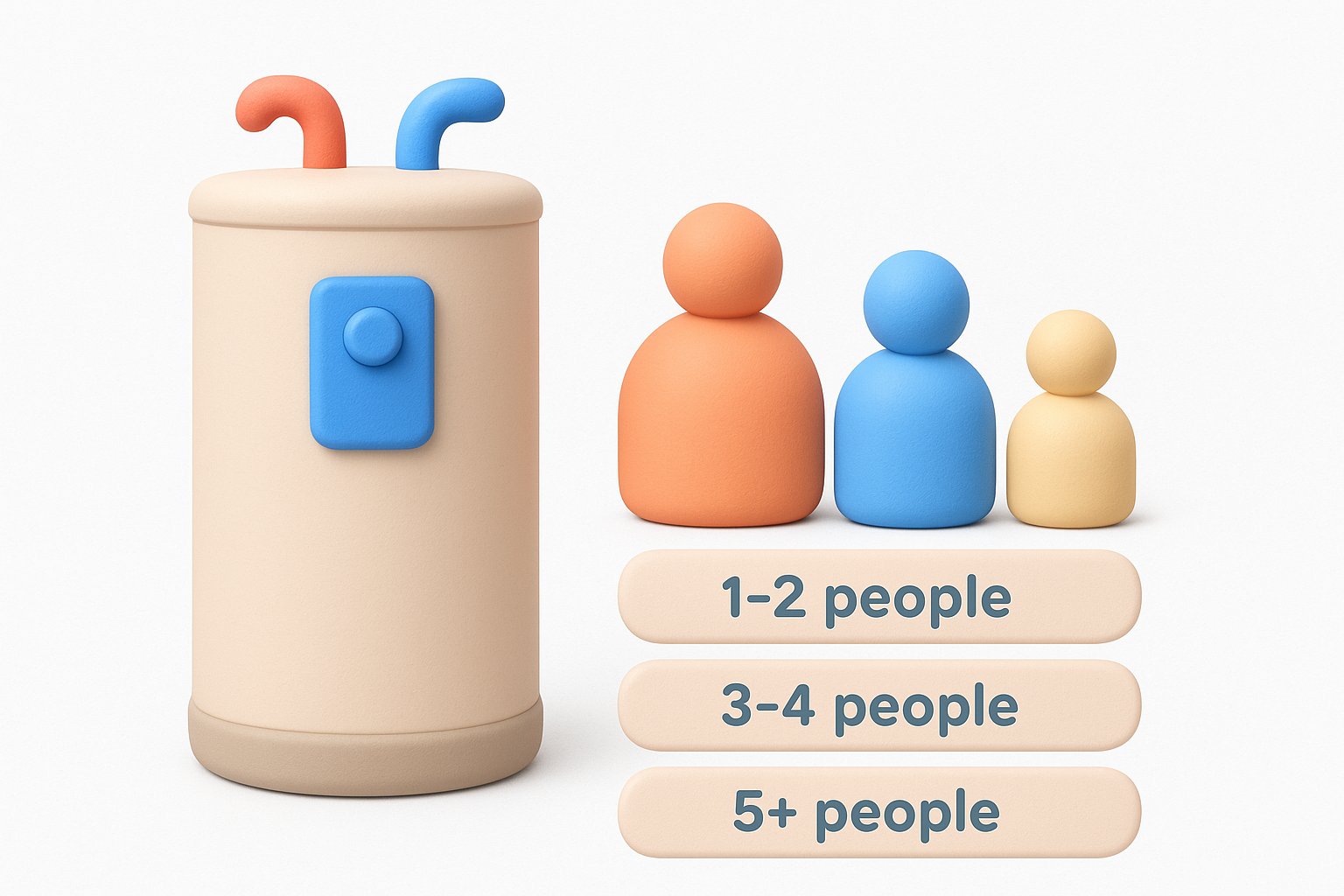
Household size is the quickest way to narrow down your options before you run any calculations. The table below shows standard guidelines based on the number of people in your home. These ranges reflect typical usage patterns and give you a reliable baseline to build from.
| Number of People | Recommended Tank Size |
|---|---|
| 1-2 people | 30-40 gallons |
| 3-4 people | 40-50 gallons |
| 5+ people | 50-80 gallons |
Keep in mind that these numbers are starting points, not final answers. A household with two people who both take long showers and run a large dishwasher daily can need more capacity than a four-person household with modest habits. Your actual peak hour demand – covered in the next step – is what pins down the right size.
Why peak demand matters more than average use
Most water heaters sit idle for large parts of the day. The real challenge is the 30-to-60-minute window when your household pulls the most hot water at once. If your water heater cannot keep up during that peak demand period, you run out of hot water regardless of how large the tank is. This is exactly why figuring out what size water heater do I need comes down to mapping your real morning or evening routine, not just counting heads in the house.
Think through a typical busy morning: a 10-minute shower uses roughly 20 gallons, a load of laundry on a warm cycle uses around 25 gallons, and running the dishwasher adds another 6 gallons. Those numbers stack up fast, and your water heater needs to handle all of them without dropping below a usable temperature.
Step 1. Estimate your peak hour hot water demand
To figure out what size water heater do I need, start by identifying your peak hour – the single one-hour window when your household uses the most hot water. For most homes, that’s the morning rush before work and school. Write down every hot water activity that happens during that window, because each fixture pulls a consistent number of gallons and those numbers add up quickly.
Add up your hot water fixtures
Every fixture in your home draws a fairly predictable amount of hot water per use. Use the table below as your reference when tallying up your peak hour total.
| Fixture / Activity | Avg. Gallons Used |
|---|---|
| Shower (8-10 min) | 20 gallons |
| Bath (full tub) | 36 gallons |
| Shaving (tap running) | 2 gallons |
| Hand or face washing | 4 gallons |
| Dishwasher (one cycle) | 6 gallons |
| Clothes washer (warm cycle) | 25 gallons |
If two people shower back-to-back and you run the dishwasher during that same hour, you are already at 46 gallons before anything else runs.
Run the numbers for your household
Once you have your list, add the gallons for every activity that realistically overlaps during your busiest hour. That total is your peak hour demand, and it becomes the benchmark you compare against a water heater’s first hour rating in the next step.
For example, a four-person household with two showers running, one load of laundry, and a hand-washing station active totals roughly 69 gallons in a single hour. Any unit you consider needs a first hour rating at or above that number to keep up without running cold.
Step 2. Pick the right tank size and first hour rating
Now that you have your peak hour demand total, you can compare it directly against a water heater’s first hour rating (FHR) to find the right match. The FHR tells you exactly how many gallons a unit delivers in the first hour of heavy use, starting from a full, hot tank. You want a water heater whose FHR meets or exceeds your calculated peak demand number.
Find the first hour rating on the label
Every new tank water heater sold in the United States carries an EnergyGuide label, and that bright yellow sticker is where you find the FHR. Look for the number listed under "Capacity (first hour rating)" in gallons per hour. If you’re shopping in a store, it’s on the front of the unit. If you’re buying online, the product spec sheet lists it under performance details.
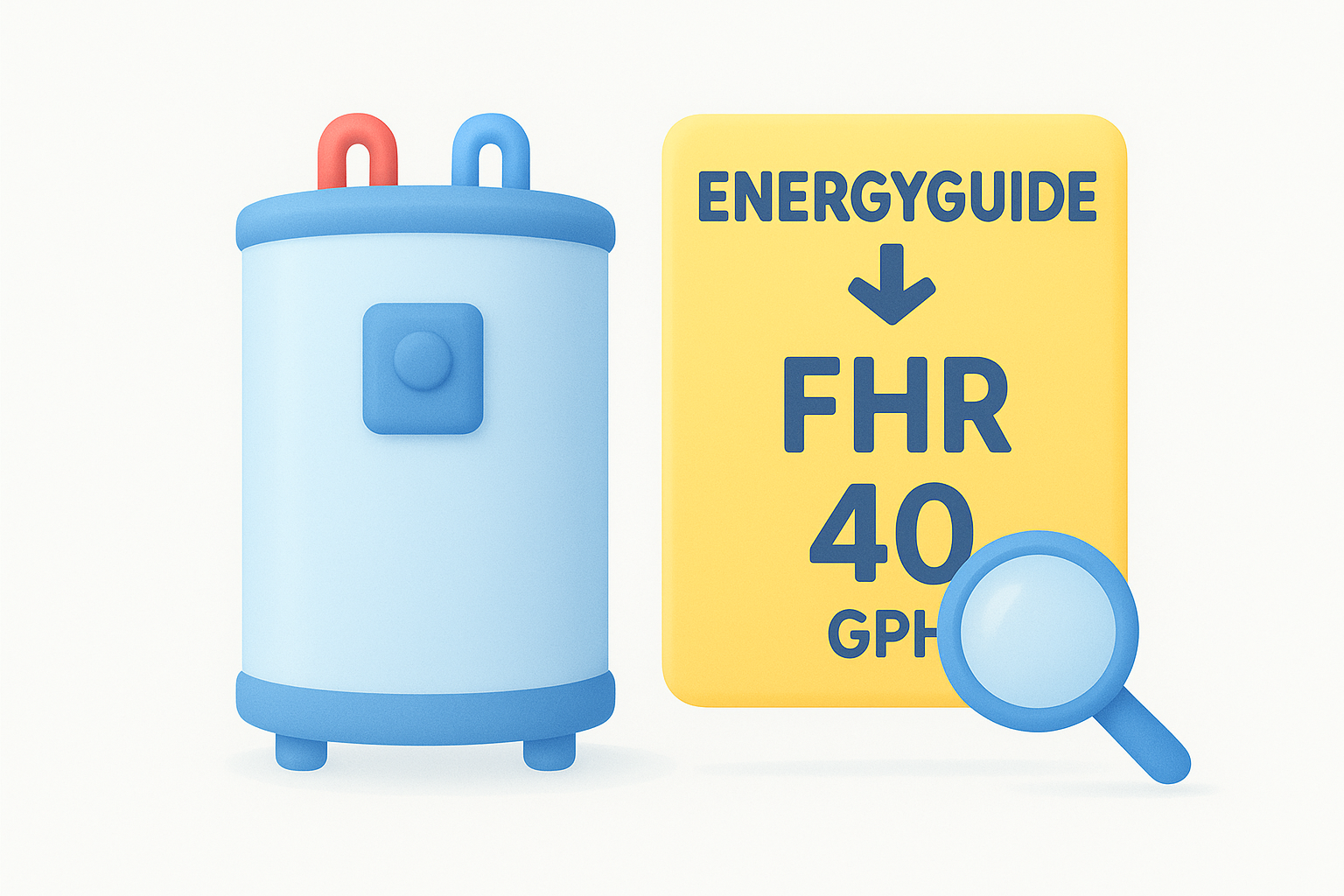
Never size a tank water heater by storage capacity alone – the FHR is the number that tells you whether the unit can actually keep up with your household.
Match your peak demand to the right unit
Once you have your peak hour demand and a shortlist of water heaters, the comparison is straightforward. Use the table below to see how common FHR ranges align with typical household sizes and usage levels.
| Peak Hour Demand | Recommended FHR | Typical Household |
|---|---|---|
| Under 40 gallons | 40-50 GPH | 1-2 people, light use |
| 40-60 gallons | 55-65 GPH | 2-3 people, moderate use |
| 60-80 gallons | 70-85 GPH | 4-5 people, heavy use |
| 80+ gallons | 90+ GPH | 5+ people or high demand |
When you’re working out what size water heater do I need, this table paired with your Step 1 calculation gives you a clear, defensible answer rather than a guess based on tank size alone.
Step 3. Size a tankless unit by gpm and temp rise
Tankless water heaters don’t store water; they heat it on demand as it flows through the unit. That changes how you size them. Instead of matching a first hour rating, you need to match two values: flow rate in gallons per minute (GPM) and temperature rise, which is the difference between your incoming groundwater temperature and the output temperature you want at the tap.
Calculate your flow rate in GPM
Start by listing every fixture you might run simultaneously during peak demand. Add up the GPM for each one to get your total simultaneous demand. The table below gives you standard flow rates to work from.
| Fixture | Avg. Flow Rate (GPM) |
|---|---|
| Shower | 1.5-2.5 GPM |
| Kitchen faucet | 1.0-2.2 GPM |
| Bathroom faucet | 0.5-1.5 GPM |
| Dishwasher | 1.0-1.5 GPM |
| Clothes washer | 1.5-3.0 GPM |
If you run two showers and a kitchen faucet at once, you are looking at roughly 5-7 GPM as your minimum requirement. Any tankless unit you consider needs to match or exceed that number at your local groundwater temperature.
Account for temperature rise in Florida
Florida groundwater typically comes in between 65°F and 72°F, which is warmer than what most northern states see. Most households target 120°F at the tap, so your required temperature rise is roughly 50°F or less. That is actually an advantage when figuring out what size water heater do I need in tankless form, because a smaller temperature rise means a given unit can handle a higher GPM output.
A unit rated at 5 GPM with a 70°F rise will deliver more flow at a 50°F rise, giving you more flexibility on unit size without spending extra on a larger model.
Choose a tankless unit rated for at least your peak GPM at your local temperature rise – going slightly above that number gives you a buffer when multiple fixtures run at once.
Common sizing mistakes and Tampa Bay notes
Even with the right framework, a few common errors can send you in the wrong direction when you are working out what size water heater do I need. Knowing where people go wrong saves you from buying a unit that disappoints you on day one.
Mistakes that lead to the wrong size
Most sizing errors come down to relying on a single number instead of using both storage capacity and first hour rating together. Shoppers often grab a 50-gallon tank because it "sounds right" for a family of four, without ever checking the FHR on the label. Another frequent mistake is forgetting to count all simultaneous fixtures, especially a clothes washer running on a warm cycle while someone showers. That single omission can push your real peak demand 25 gallons above what you planned for.
Picking a unit based on storage gallons alone is the most common sizing mistake, and it’s also the easiest one to avoid by simply reading the EnergyGuide label before you buy.
- Sizing by household headcount only, without calculating peak demand
- Ignoring the first hour rating entirely
- Forgetting the clothes washer and dishwasher in the peak hour tally
- Choosing a tankless unit without accounting for simultaneous fixture load
What changes in Tampa Bay
Florida’s warmer groundwater temperatures work in your favor here. Incoming water in the Greater Tampa Bay Area runs between 65°F and 72°F year-round, which reduces the temperature rise your unit needs to achieve. For tankless buyers, that means a mid-range unit often handles more simultaneous flow than the same model would in a colder climate. For tank buyers, it means your unit reaches target temperature faster and holds efficiency longer because it loses less heat to the surrounding environment.
Next steps
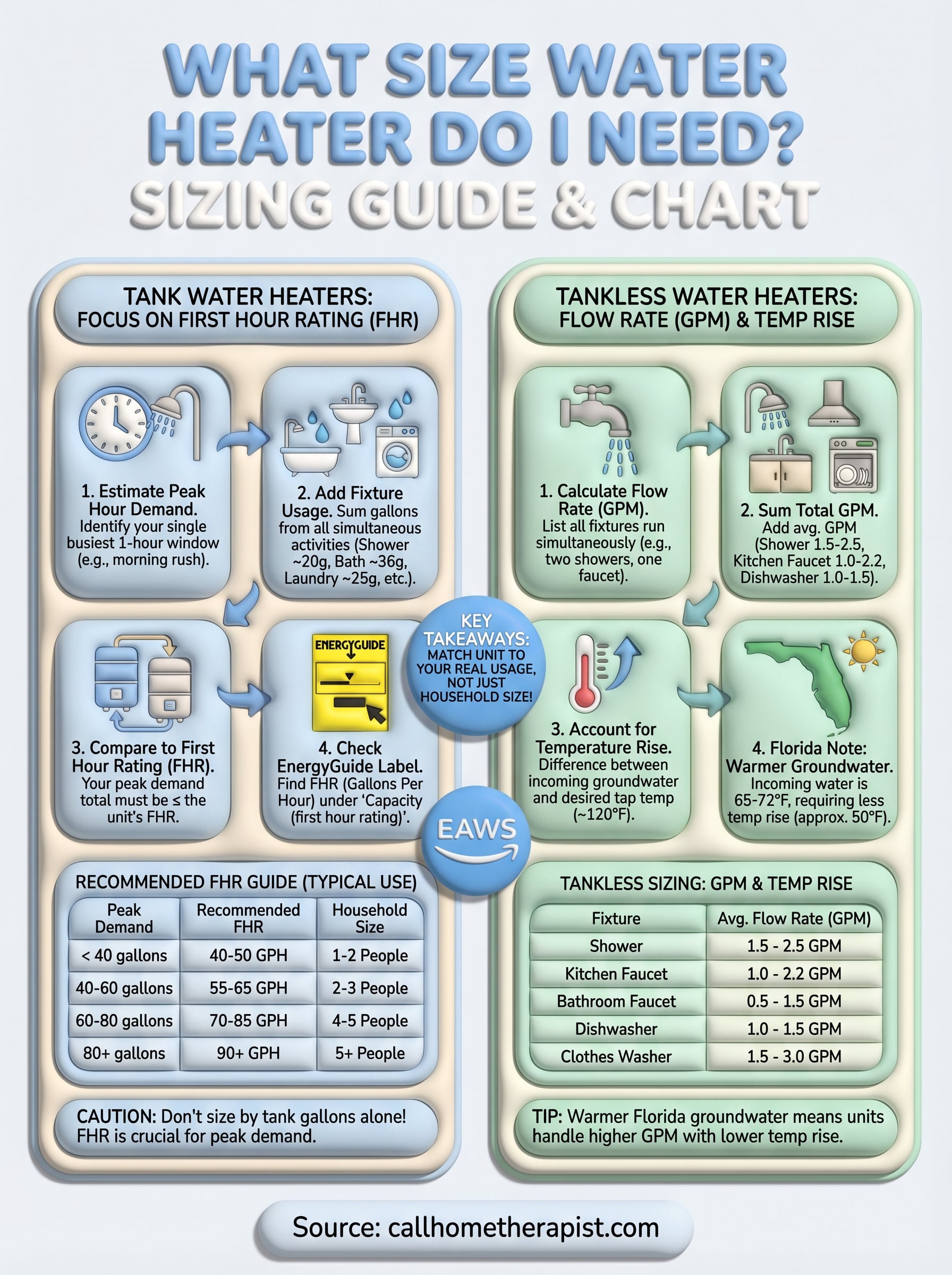
You now have everything you need to answer what size water heater do I need for your specific household. Start by mapping your peak hour demand using the fixture table in Step 1, then check the EnergyGuide label for the first hour rating on any tank unit you consider. If you are going tankless, factor in your simultaneous GPM load against Tampa Bay’s warmer groundwater temperatures to find a unit that fits without overspending.
Once you have your numbers, the next move is getting a licensed technician to confirm your sizing and handle the installation. A correct installation protects your warranty and ensures the unit performs as rated from day one. The team at Home Therapist has been installing and replacing water heaters across the Greater Tampa Bay Area since 2011, with same-day availability and upfront pricing and no hidden fees. Reach out and we will get your new unit running fast.
About This Guide
Written and reviewed by the Home Therapist Cooling, Heating & Plumbing team, a family-owned Tampa Bay HVAC and plumbing company serving the area since 2011. Our licensed techs hold Florida HVAC license CAC1819196 and Plumbing license CFC1431159, with over 1,300 five-star reviews across Tampa, St. Petersburg, Clearwater, Wesley Chapel, Lutz, Riverview, Brandon, Valrico, Apollo Beach, Palm Harbor, Land O’ Lakes, Plant City, New Port Richey, and surrounding Tampa Bay zip codes.
Honest pricing:. Upfront quotes, no high-pressure sales, no surprise fees.
Questions about your home? Call (813) 343-2212 for a real tech, or request a callback. Available 7 days a week including evenings and weekends for emergencies.
More Water Heater (Tank) Articles
- 16-Minute Water Heater Flush and Inspection on Lily Magnolia Ln: Water Heater Service in Riverview, FL 33569
- Dead Water Heater on Voyagers Pl: 50-Gallon Power Vent Replacement in Apollo Beach, FL 33572
- A.o. Smith Water Heater Warranty, a Tampa Bay Homeowner Guide
- What Voids a Water Heater Warranty in Tampa Bay (And How to Protect Your Coverage)
- Water Heater Installation New Port Richey FL: When the Tank and Shower Both Fail on Shallow Creek Court, FL 34653


