

Thermostats for efficient home climate control in 2026
TL;DR:
- Accurate thermostats, especially smart models, improve energy efficiency and comfort through precise control.
- Proper placement and professional installation are crucial to maximize thermostat performance and savings.
- Realistic savings depend on home habits, insulation, and system use, with smart thermostats benefiting variable schedules most.
Your thermostat is the most underestimated piece of equipment in your home. Most Tampa Bay homeowners set it once and forget it, yet it controls every heating and cooling decision your HVAC system makes. In Florida’s brutal heat and humidity, that single device can mean the difference between a comfortable home and a sky-high energy bill. Choosing the right thermostat and using it correctly can cut your cooling costs, extend your HVAC system’s life, and keep every room feeling exactly how you want it. This guide breaks down how thermostats work, what types are available, what savings you can realistically expect, and what smart strategies actually move the needle.
Table of Contents
- How thermostats control your home’s comfort and efficiency
- Types of thermostats: From analog to smart
- Maximizing savings: What thermostats can (and can’t) do
- Getting the most from your thermostat: Tampa Bay best practices
- Our take: Why your thermostat strategy matters more than your gadget
- Ready to upgrade your comfort? Local thermostat and HVAC experts can help
- Frequently asked questions
Key Takeaways
| Point | Details |
|---|---|
| Thermostat type matters | Choosing between analog, programmable, or smart thermostats impacts comfort and monthly energy costs. |
| Proper setup is critical | Where you install your thermostat and how you program it directly affects both comfort and efficiency. |
| Savings depend on use | Smart thermostats save the most when schedules fluctuate and occupancy-based features are used. |
| Pair with insulation | Combining thermostat upgrades with home insulation enhancements multiplies your energy savings. |
How thermostats control your home’s comfort and efficiency
Think of your thermostat as the brain of your HVAC system. It reads the indoor temperature, compares it to your target setting, and sends a signal to your air conditioner or heater to turn on or off. Simple enough on the surface, but the technology behind that process varies dramatically depending on what kind of thermostat you have.
The way thermostats and home comfort connect is more direct than most people realize. A thermostat that reads temperatures inaccurately will cause your system to run longer than needed or shut off too early. Both scenarios waste energy and leave you uncomfortable.
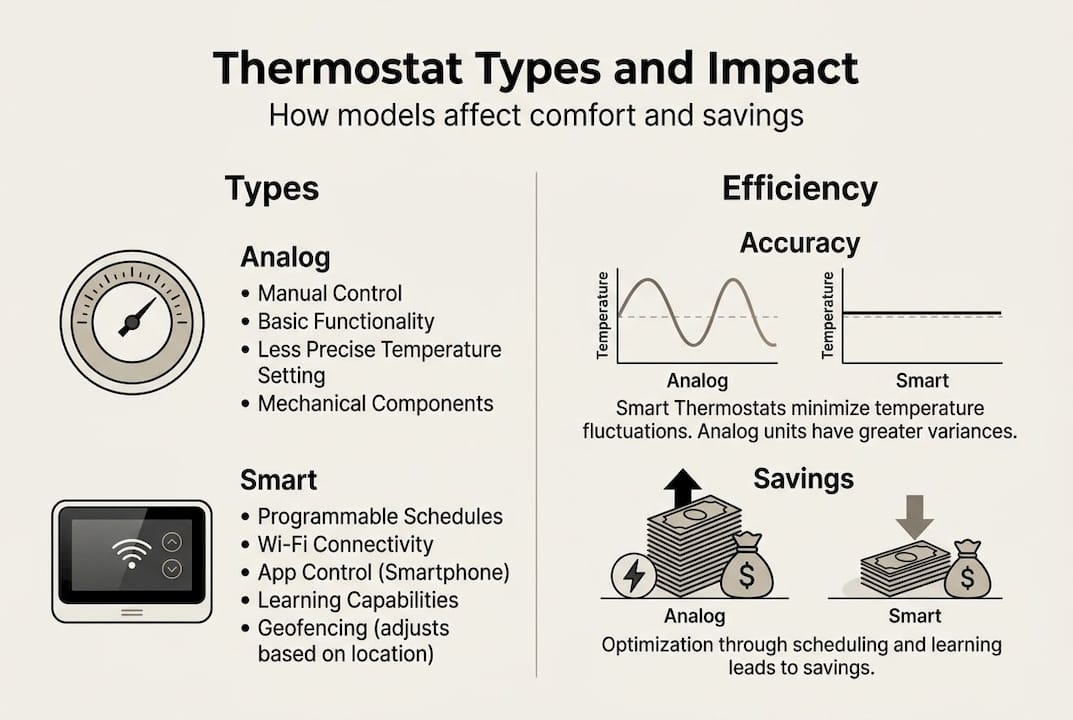
Here is a quick breakdown of how the main thermostat types differ in technology and accuracy:
| Thermostat type | Technology used | Accuracy | Best for |
|---|---|---|---|
| Analog | Bimetallic strips | ±3 to 5°F | Basic, low-cost use |
| Digital/Programmable | Thermistors/RTDs | ±1 to 2°F | Scheduled households |
| Smart | WiFi, sensors, ML | ±0.5 to 1°F | Adaptive, connected homes |
According to HVAC thermostat research, analog models use bimetallic strips with accuracy of only ±3 to 5°F, while digital and programmable models use thermistors or RTDs for ±1 to 2°F precision, and smart thermostats use WiFi, sensors, and machine learning for adaptive control.
That accuracy gap matters more than it sounds. A thermostat that reads 3 degrees off can cause your AC to run an extra 15 to 20 minutes per cycle. In Tampa Bay, where your system runs almost year-round, those extra minutes add up fast.
Smart thermostats take things further. They learn your daily patterns, adjust automatically when you leave or arrive home, and can connect to voice assistants or your phone. Smart thermostat installation in Tampa Bay homes has grown significantly as homeowners look for ways to cut cooling costs without sacrificing comfort.
Key benefits of upgrading to a more accurate thermostat include:
- Fewer wasted cooling cycles because the system responds to real temperature data
- More consistent room temperatures throughout the day
- Remote access to adjust settings when plans change
- Energy reports that show you exactly where your dollars are going
Placement also plays a huge role. Even the best smart thermostat will perform poorly if it is installed near a vent, in direct sunlight, or in a room that does not reflect your home’s average temperature.
Types of thermostats: From analog to smart
Understanding the basic mechanisms sets the stage for comparing your thermostat options. Not every household needs the most advanced model, and not every budget allows for it. Knowing where each type shines helps you make a smarter choice.
| Thermostat type | Upfront cost | Key advantage | Key limitation |
|---|---|---|---|
| Analog | $15 to $35 | Simple, no setup | Low accuracy, no scheduling |
| Programmable | $30 to $100 | Set schedules in advance | Requires manual programming |
| Smart | $150 to $300 | Learns habits, remote control | Needs C-wire, WiFi setup |
Here is when each type makes the most sense:
- Analog works fine for vacation homes, rental units, or spaces where you just need basic on/off control without any scheduling needs.
- Programmable suits households with consistent daily routines, like families who leave at the same time every morning and return in the evening.
- Smart is the best fit for busy families, frequent travelers, or anyone who wants hands-off energy management without thinking about it daily.
That said, common smart thermostat issues trip up a lot of Tampa Bay homeowners during installation. The most frequent problems come from poor placement, missing wiring, or system incompatibility. Poor placement near sun, drafts, or vents causes inaccurate readings, and missing a C-wire requires an adapter that not every installer mentions upfront.
Programmable thermostats are also widely underused. Studies show that many homeowners never set a schedule at all, which means they are paying for features they never use. This is actually one reason smart thermostats outperform programmable ones in real-world savings.
These are the most common HVAC problems tied to thermostat issues:
- Sensor drift causing temperature swings
- Short cycling from an oversized AC paired with a slow-responding thermostat
- Humidity sensor failure in older digital models
- Incompatible wiring causing error codes or no response
Pro Tip: Before purchasing any new thermostat, take a photo of your current wiring setup and check whether your system has a C-wire. Many older Tampa Bay homes were built without one, and skipping this step leads to thermostat installation headaches that could have been avoided.
Maximizing savings: What thermostats can (and can’t) do
With an understanding of each thermostat’s features, let’s clarify what you can truly expect in terms of savings and comfort. The honest answer is: it depends on your habits, your home, and how you use the device.

Manufacturer claims often advertise savings of 20 to 30%, but independent studies put savings at 8 to 15% when thermostats are used optimally. Smart thermostats only beat programmable ones if you are the type of person who forgets to set a schedule. In well-insulated or always-occupied homes, the savings gap nearly disappears.
Research on occupancy-based control shows the biggest savings come from systems that detect when no one is home and adjust automatically, cutting energy use by up to 12.9%. However, those gains are fragile. Overriding the schedule, opening windows, or ignoring the settings erases most of the benefit quickly.
What actually drives thermostat savings:
- Matching your schedule so the system is not cooling an empty house
- Using occupancy sensors to detect real-time presence
- Pairing your thermostat upgrade with better insulation or zoning
- Letting the learning mode run for at least two weeks before judging results
Pro Tip: Pair your thermostat upgrade with a home insulation check. In Tampa Bay’s heat, a poorly sealed attic or leaky ductwork can cancel out every dollar of thermostat savings. Check out energy-efficient HVAC examples to see what a full-system approach looks like.
For context, here is a realistic savings estimate based on home type:
| Home scenario | Expected savings |
|---|---|
| Frequently empty during the day | 12 to 15% |
| Mixed occupancy, inconsistent schedule | 8 to 12% |
| Always occupied, well-insulated | 0 to 5% |
| Older home, poor insulation | Varies widely |
Looking at improving home comfort as a whole system, rather than just the thermostat, is what separates homeowners who see real results from those who feel disappointed after an upgrade. You can also explore HVAC economizer savings as a complementary strategy for reducing load on your system.
Getting the most from your thermostat: Tampa Bay best practices
Having set realistic expectations, focus on practical steps you can apply immediately and pitfalls to avoid. Tampa Bay’s climate is not like most of the country. Your AC runs longer, works harder, and deals with humidity levels that most thermostats were not specifically designed for.
Where to place your thermostat:
- Interior walls only, away from exterior walls that absorb outdoor heat
- At least 5 feet from any supply or return air vent
- Out of direct sunlight at all times of day
- Away from the kitchen, laundry room, or other heat-generating spaces
- In a room that represents your home’s average temperature
Poor placement near vents or sunlight is the single most common reason homeowners feel like their thermostat is lying to them. It is not a malfunction. It is a location problem.
Here is a simple programming routine that works well for Tampa Bay homes:
- Set a slightly warmer temperature (78 to 80°F) during work hours when the house is empty.
- Program a pre-cool cycle 30 minutes before you typically arrive home.
- Use a nighttime setback of 74 to 76°F for sleeping comfort without overcooling.
- Enable humidity control if your thermostat supports it. Florida’s moisture levels make this feature especially valuable.
- Review your energy reports monthly and adjust based on your actual patterns.
“Professional installation ensures proper wiring, sensor placement, and system compatibility, which are the factors most likely to affect long-term performance and savings.” Expert research on home energy savings
DIY installation is tempting, but installation problems in Tampa are common when wiring is mismatched or sensors are placed incorrectly. A professional setup takes less than an hour and protects your investment from day one.
Pro Tip: If you are considering a smart thermostat upgrade, schedule it alongside a duct inspection. Leaky ducts in Tampa Bay homes are widespread and can offset every efficiency gain your new thermostat provides.
Our take: Why your thermostat strategy matters more than your gadget
We have seen it many times. A homeowner spends $250 on the latest smart thermostat, installs it in the same spot as the old one, never sets a schedule, and wonders why their bill barely changed. The gadget was not the problem. The strategy was.
The truth is, a $50 programmable thermostat used correctly will outperform a $300 smart model that nobody bothers to configure. Smart thermostats only beat programmable ones when users forget to set schedules, and homes that are always occupied or well-insulated may see almost no benefit from upgrading at all.
What actually moves the needle in Tampa Bay is the combination of correct placement, proper wiring, a realistic schedule, and a system that is sized and sealed correctly. Technology is a tool. Without the right setup and habits behind it, even the smartest thermostat is just an expensive wall decoration.
Our advice: invest in a professional assessment before you invest in hardware. Understanding your home’s actual needs, from duct condition to insulation gaps, will tell you more about your potential savings than any product spec sheet. The right approach to thermostats for savings starts with knowing your home, not just your options.
Ready to upgrade your comfort? Local thermostat and HVAC experts can help
If this guide has you thinking about your current setup, you are already ahead of most homeowners. Knowing what to look for is half the battle. The other half is having the right team make it happen correctly.
At Home Therapist Cooling, Heating, and Plumbing, we help Tampa Bay homeowners choose, install, and configure thermostats that actually deliver results. Whether you want to explore your options with our HVAC guide for Tampa Bay, get a professional thermostat installation, or just want to start with a solid HVAC maintenance plan, our certified technicians are ready to help. Call us today and let’s get your home running the way it should.
Frequently asked questions
How do smart thermostats save money compared to older models?
Smart thermostats save money by learning your schedule and reducing unnecessary heating and cooling cycles, with independent studies showing 8 to 15% savings when used correctly. They outperform programmable models mainly for households that would otherwise forget to set a manual schedule.
Does thermostat placement affect home comfort and HVAC performance?
Yes, placement near vents or sunlight causes inaccurate temperature readings, which forces your HVAC system to run longer or shorter than it should. Moving a thermostat to a neutral interior wall can noticeably improve both comfort and efficiency.
What is the most common mistake when upgrading to a smart thermostat?
The most common issue is missing or incompatible wiring, specifically the absence of a C-wire that requires an adapter for most smart models to function properly. Checking your wiring before purchasing saves time, money, and frustration.
Will every home benefit equally from a smart thermostat?
No. Homes that are always occupied or well-insulated may see little to no extra savings from a smart thermostat compared to a basic programmable model. The biggest gains come in homes with variable schedules and older, less efficient setups.
Recommended
- Why replace thermostats in Tampa Bay homes in 2026
- 7 Inspiring Examples of Energy-Efficient HVAC for Homes
- Smart Thermostats Installation with Free Estimates | Home Therapist Cooling, Heating, and Plumbing
- 7 Reasons Tempstar HVAC Is a Smart, Sustainable Home Choice Home Therapist Cooling, Heating, and Plumbing


