

How Much Does AC Repair Cost? Average Prices & Factors
Your AC breaks down on a 95°F Tampa afternoon, and the first question that hits is: how much does ac repair cost? The answer isn’t one-size-fits-all. Depending on the problem, a failed capacitor, a refrigerant leak, a burnt-out compressor, you could be looking at anywhere from $100 to $2,000 or more.
Several factors drive that range, including the type of repair, the age of your system, the parts involved, and who you hire to do the work. Understanding these variables puts you in a stronger position to evaluate quotes and avoid overpaying. That’s something we care about at Home Therapist, we’ve provided upfront, transparent pricing on AC repairs across the Greater Tampa Bay Area since 2011.
This guide breaks down average AC repair costs by component, explains what influences your final bill, and helps you figure out whether a repair or replacement makes more financial sense.
Why AC repair costs vary so much
When you ask how much does ac repair cost, you’re really asking several questions at once. The final number depends on multiple overlapping variables, and a $150 capacitor swap is a completely different job from a $1,500 compressor replacement. Knowing what drives those differences helps you make sense of any quote you receive and catch anything that looks off before you sign anything.
The type of repair needed
The specific component that failed is the biggest cost driver. Minor electrical repairs like replacing a capacitor or contactor typically run between $100 and $300, while major mechanical failures involving the compressor or evaporator coil can push costs into four figures. Labor time also scales with complexity; a technician can swap a capacitor in under 30 minutes, but replacing a coil or compressor often takes several hours.
Some repairs require additional steps that add cost. Any repair involving refrigerant leaks requires a certified technician to recover the existing refrigerant, fix the source of the leak, and fully recharge the system, which adds both time and materials to your bill.
The repair type alone can swing your total cost by hundreds of dollars, which is why a proper diagnosis matters before any work begins.
Your system’s age and condition
Older systems tend to cost more to repair for two reasons: parts are harder to source, and aging equipment often has secondary problems that surface during the repair. A 15-year-old unit may need a capacitor replaced, but the technician might also find corroded wiring or a refrigerant line that has been slowly leaking for years.
Your system’s refrigerant type also plays a role here. Units still using R-22 face much higher refrigerant costs because the EPA phased it out due to environmental concerns. Systems using R-410A or the newer R-454B have lower refrigerant costs and are significantly easier to service.
Labor rates and service fees
Labor rates vary by company, region, and timing. In the Greater Tampa Bay Area, hourly labor rates for HVAC technicians typically range from $75 to $150 per hour. Most companies also charge a diagnostic or service call fee ranging from $50 to $150 just to dispatch a technician to your home, regardless of whether any repair work gets done.
Emergency and after-hours calls usually carry a premium rate. If your system fails on a weekend or holiday, expect to pay 25% to 50% more than a standard weekday appointment. Scheduling routine repairs during normal business hours is one of the simplest ways to reduce your total cost.
System size and efficiency rating
Your unit’s size, measured in tons or BTUs, directly affects parts and labor costs. A 5-ton residential system has larger, heavier components than a 2-ton unit, and those components cost more to replace and require more labor time to handle. Larger systems also hold more refrigerant, so any leak repair involves a bigger recharge.
Systems with a higher SEER2 efficiency rating use more advanced components, which can push individual part costs above what you’d pay for equivalent parts in a standard-efficiency unit. Higher-efficiency systems save money on utility bills long-term, but their repair costs tend to run slightly higher when something does go wrong.
Average AC repair costs by problem and part
When you’re trying to understand how much does ac repair cost, having real numbers tied to specific repairs gives you a much clearer starting point than a broad range alone. Below are typical cost ranges for the most common residential AC repairs in the US, including parts and labor.
Common repairs and what they typically cost
The part that failed determines most of your bill. Capacitors and contactors are among the cheapest fixes, usually running between $100 and $300 because the parts themselves are inexpensive and installation is fast. A refrigerant recharge without a leak repair typically costs $100 to $350, but if a technician needs to locate and fix a leak before recharging, your total can climb to $550 or more.
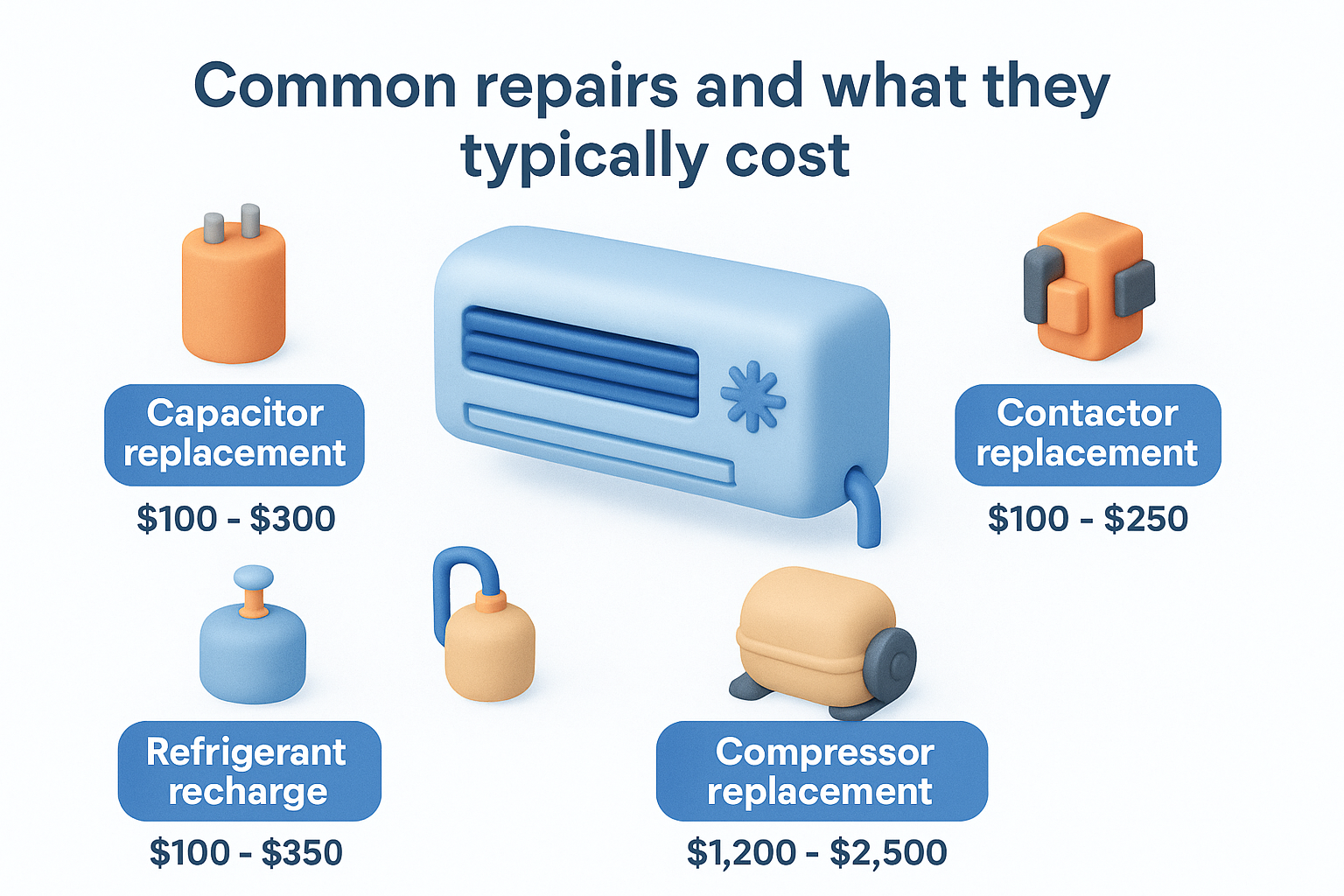
Compressor replacements are one of the most expensive single repairs your AC can need, often running $1,200 to $2,500 depending on system size.
| Repair Type | Typical Cost Range |
|---|---|
| Capacitor replacement | $100 – $300 |
| Contactor replacement | $100 – $250 |
| Refrigerant recharge (no leak) | $100 – $350 |
| Refrigerant leak repair + recharge | $400 – $1,500 |
| Evaporator coil replacement | $800 – $1,800 |
| Condenser coil replacement | $600 – $1,500 |
| Compressor replacement | $1,200 – $2,500 |
| Fan motor replacement | $300 – $700 |
| Thermostat replacement | $150 – $500 |
| Circuit board replacement | $400 – $1,000 |
Labor and diagnostic fees
Labor and service fees stack on top of parts costs, so understanding both line items separately helps you evaluate whether a quote is fair. Most HVAC companies charge a diagnostic fee between $50 and $150 to send a technician to your home, and that fee often applies toward the total repair cost if you move forward with the work.
Hourly labor rates typically run between $75 and $150 in most US markets. Complex repairs that require several hours, such as an evaporator coil or compressor replacement, will see labor charges that rival or even exceed the cost of the part itself. Always ask your technician to break out parts and labor separately on any written estimate before approving the job.
What changes your AC repair price in Tampa Bay
Living in Tampa Bay means your AC runs harder and longer than systems in most other parts of the country. That constant workload affects both how often your system needs repairs and what those repairs cost when something finally goes wrong. Several local factors push prices above or below national averages, and knowing them helps you understand your quote before you commit.
Florida’s climate accelerates component wear
Your AC in Tampa Bay runs for roughly 10 to 12 months out of the year, compared to five or six months in cooler climates. That extended runtime puts serious stress on capacitors, fan motors, and refrigerant lines, which means those parts fail more frequently here. High humidity also accelerates corrosion on coils and electrical components, which can turn what looks like a simple repair into a more involved job once a technician opens the unit.
Year-round operation means Tampa Bay homeowners typically spend more on AC maintenance and repairs over a system’s lifetime than homeowners in northern states.
Peak season demand affects pricing and availability
Summer in Tampa Bay is the busiest season for HVAC technicians, which creates real scheduling pressure from June through September. When demand spikes, some companies charge higher rates or longer wait times for non-emergency appointments. Booking repairs in spring, before the heat peaks, gives you more scheduling flexibility and puts you in a better position to compare quotes without the pressure of a broken unit in 95-degree weather.
Local permit requirements add to certain job costs
Florida requires permits for specific HVAC repairs and replacements, particularly full system swaps and refrigerant system modifications. In Hillsborough and Pinellas counties, pulling a permit adds a fee to your total bill, but it also ensures the work gets inspected and meets local code. Skipping permits to cut costs is a risk that can create problems when you sell your home or file an insurance claim, so factor that cost into your budget when comparing quotes.
Repair vs replace: simple rules homeowners can use
Once you know how much does ac repair cost for your specific situation, the next decision is whether that repair is actually worth making. Spending $1,400 to fix a 14-year-old system that will likely need another major repair in a year is a different financial call than spending $300 to keep a well-maintained 7-year-old unit running smoothly. Two straightforward rules help most homeowners cut through that uncertainty without needing an engineering degree.
Use the 50% rule as your baseline
The 50% rule is the most practical starting point: if the estimated repair cost exceeds 50% of what a new comparable system would cost, replacement usually makes more financial sense. A new mid-range residential AC system in the Tampa Bay area typically runs between $4,000 and $8,000 installed, so if a repair quote hits $2,500 or more, you’re in replacement territory by most standards.

Applying the 50% rule alongside your system’s age gives you a much clearer picture than repair cost alone.
Your system’s age matters alongside the dollar figure. A repair that costs 40% of replacement value might still make sense on a 5-year-old system, but the same repair on a 16-year-old unit that has already hit its expected lifespan puts you at risk of sinking money into a system that is already on borrowed time.
Watch for patterns that signal a failing system
A single repair on an otherwise healthy system is not a red flag. Repeated repairs within 12 to 24 months are a different story. If your unit has needed two or three service calls in recent seasons, those individual costs may look manageable, but they add up fast and signal that the system is degrading broadly, not just dealing with one isolated problem.
Other warning signs that point toward replacement include significantly higher energy bills without a change in usage, uneven cooling across rooms despite repairs, and a system that still runs R-22 refrigerant. At that point, parts availability and refrigerant costs alone make continued repairs an expensive and shrinking option.
How to get a fair AC repair quote and avoid surprises
Getting a fair price on AC repair starts before any technician sets foot in your home. Knowing what to ask and what to look for gives you enough use to compare quotes accurately and spot pricing that does not hold up. The homeowners who end up overpaying are usually the ones who skip this step under the stress of a broken system.
Ask for itemized estimates before approving anything
A trustworthy HVAC company will provide a written estimate that separates parts costs from labor costs before the repair begins. Never approve a single lump-sum quote without understanding what you are actually paying for. Ask the technician to list each component being replaced, the cost of that part, and the estimated labor hours required. This breakdown lets you cross-check part prices against manufacturer or distributor pricing to confirm the markup is reasonable.
When figuring out how much does ac repair cost for your specific situation, get at least two quotes if the job involves a major repair like a compressor or evaporator coil. On smaller repairs under $300, a second quote may not be worth the extra diagnostic fee, but on large jobs, a second opinion can save you several hundred dollars or confirm that the first quote was fair.
Any company that pressures you to approve a repair on the spot, before you have a written estimate in hand, is a company worth walking away from.
Know what a legitimate technician will always do first
A qualified technician runs a full diagnostic before recommending any repair, not just a visual inspection. That diagnostic identifies the root cause of the failure rather than just the symptom, which matters because replacing one part when two parts have failed means a callback within weeks. Ask the technician to explain what test results indicate the specific component has failed.
You should also verify the company holds a valid Florida state contractor license before scheduling service. Licensed contractors carry insurance that protects your property, and their work must meet state code. Checking license status through the Florida Department of Business and Professional Regulation takes under two minutes and removes real risk from your decision.
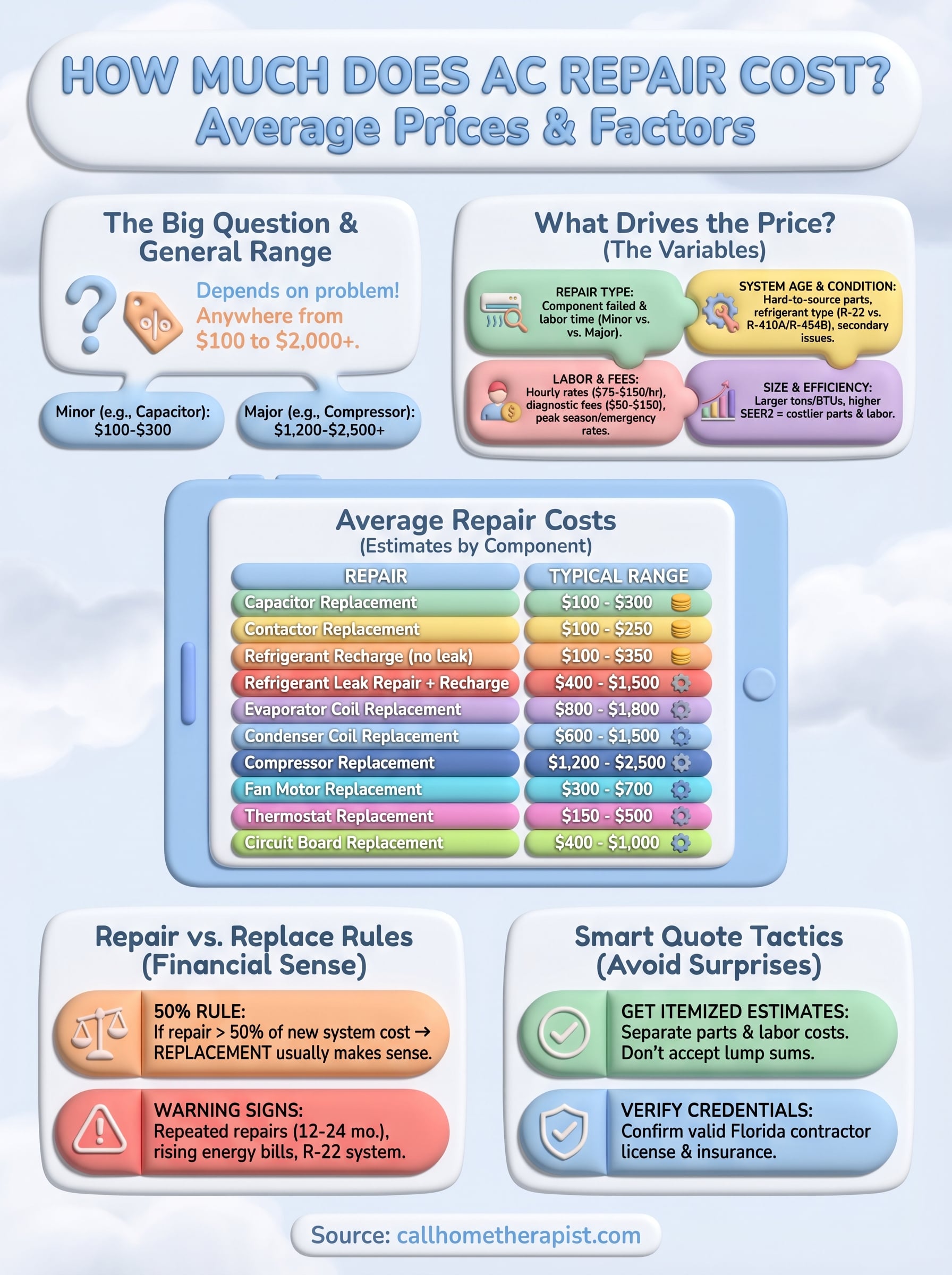
Final takeaways and next step
Understanding how much does ac repair cost comes down to knowing the specific repair, your system’s age, and what local factors like Florida’s climate and peak-season demand add to your bill. Minor repairs can stay under $300, while major jobs involving compressors or coils regularly push into four figures. Use the 50% rule alongside your system’s age to decide whether a repair or full replacement makes better financial sense.
Before you approve any work, get a written, itemized estimate that breaks out parts and labor separately, confirm the technician ran a proper diagnostic, and verify the company holds a valid Florida contractor license. Those three steps protect you from overpaying and from repairs that miss the actual problem.
If your AC is struggling right now, the Home Therapist team in Tampa Bay offers same-day service, upfront pricing, and no hidden fees so you know exactly what you’re paying before anyone picks up a wrench.
About This Guide
Written and reviewed by the Home Therapist Cooling, Heating & Plumbing team, a family-owned Tampa Bay HVAC and plumbing company serving the area since 2011. Our licensed techs hold Florida HVAC license CAC1819196 and Plumbing license CFC1431159, with over 1,100 five-star reviews across Tampa, St. Petersburg, Clearwater, Wesley Chapel, Lutz, Riverview, Brandon, Valrico, Apollo Beach, Palm Harbor, Land O’ Lakes, Plant City, New Port Richey, and surrounding Tampa Bay zip codes.
Honest pricing:. Upfront quotes, no high-pressure sales, no surprise fees.
Questions about your home? Call (813) 343-2212 for a real tech, or request a callback. Available 7 days a week including evenings and weekends for emergencies.
More AC Repair Articles
- AC Not Cooling in Tampa Bay? A Same-Day Triage Checklist Before You Call
- AC Repair Near Me: What It Costs in Tampa Bay and How to Pick the Right Company
- AC Shut Off Switch Failure Symptoms in Tampa Bay: When Your Disconnect Is the Problem
- Why This Sunridge Palms AC Wouldn’t Start: An 11-Minute Capacitor Replacement in Tampa, FL 33617
- AC Contactor vs Relay: How to Tell Which One Is Failing in Your Tampa AC


