

Sizing Your AC: What Size Air Conditioner Do I Need? (BTUs)
An oversized AC short-cycles, drives up your electric bill, and leaves your home feeling clammy. An undersized unit runs nonstop and still can’t keep up on a 95°F Tampa afternoon. Either way, you’re uncomfortable and spending more than you should. So what size air conditioner do I need? The answer comes down to matching your home’s cooling load, measured in BTUs or tons, to the right equipment.
Getting that match right isn’t just about square footage, though that’s a solid starting point. Factors like ceiling height, insulation quality, window exposure, and Florida’s relentless humidity all play a role. Skip these details, and you risk buying a system that wastes energy or wears out early, two problems we see regularly on service calls across the Greater Tampa Bay Area.
This guide walks you through the full sizing process step by step. You’ll learn how to estimate BTUs for your space, understand what tonnage means, and know when a professional Manual J calculation makes more sense than a quick chart. At Home Therapist, we’ve been installing and servicing residential AC systems since 2011, so we’ll share what actually matters when choosing the right size, and what you can safely ignore.
What AC size means in BTUs and tons
When you ask what size air conditioner do I need, the answer always comes back to two units of measurement: BTUs and tons. Both describe the same thing, which is cooling capacity, just at different scales. Understanding what these numbers mean helps you compare systems, read spec sheets, and talk with contractors without confusion or guesswork.
BTUs: the basic unit of cooling power
A BTU (British Thermal Unit) measures the amount of heat an AC system can remove from your home in one hour. The higher the BTU rating, the more cooling power the unit delivers. Most window and portable units are rated in BTUs directly, typically ranging from 5,000 BTUs for a small bedroom up to 25,000 BTUs or more for larger open spaces.
Here’s a quick reference for common BTU ranges and the spaces they typically cover:
| BTU Rating | Typical Space |
|---|---|
| 5,000, 8,000 | Small bedroom (up to 350 sq ft) |
| 8,000, 12,000 | Medium room (350, 550 sq ft) |
| 12,000, 18,000 | Large room or open area (550, 1,000 sq ft) |
| 18,000, 25,000 | Very large room or small apartment |
Tons: how central AC capacity is measured
Central air conditioning systems use tons instead of BTUs. One ton of cooling equals 12,000 BTUs per hour, a unit that historically referenced how much heat a ton of melting ice could absorb over a full day. For a typical Tampa Bay home, you’ll encounter systems rated between 2 tons and 5 tons, which translates to 24,000 to 60,000 BTUs per hour of heat removal.
A 3-ton central AC system removes 36,000 BTUs of heat from your home every hour, and that number needs to match your home’s actual cooling load to run efficiently and last.
Most residential systems come in half-ton increments: 2, 2.5, 3, 3.5, 4, and 5 tons. Choosing between these increments is where accurate sizing becomes critical. Jumping up by one half-ton when you don’t need to can mean higher upfront costs, excess indoor humidity, and a compressor that short-cycles, which shortens its lifespan significantly.
Why bigger is not better with AC
Many homeowners assume a larger system always cools better, but oversizing causes real problems. A unit that’s too large reaches the set temperature too quickly, shuts off before it completes a full humidity-removal cycle, and leaves your home feeling sticky and uncomfortable. In Florida’s climate, where humidity is often the bigger source of discomfort, this problem is more noticeable than it would be in a drier region.
Step 1. Measure the space you need to cool
Before you can answer what size air conditioner do I need, you need an accurate square footage number. Guessing or rounding up "to be safe" leads to the same oversizing problems described above. Grab a tape measure and spend ten minutes getting the numbers right before you look at a single spec sheet.
Measuring a single room or zone
For a single room or dedicated zone, multiply the length by the width to get square footage. A room that is 15 feet by 20 feet equals 300 square feet, which becomes your starting point for the BTU estimate in the next step.
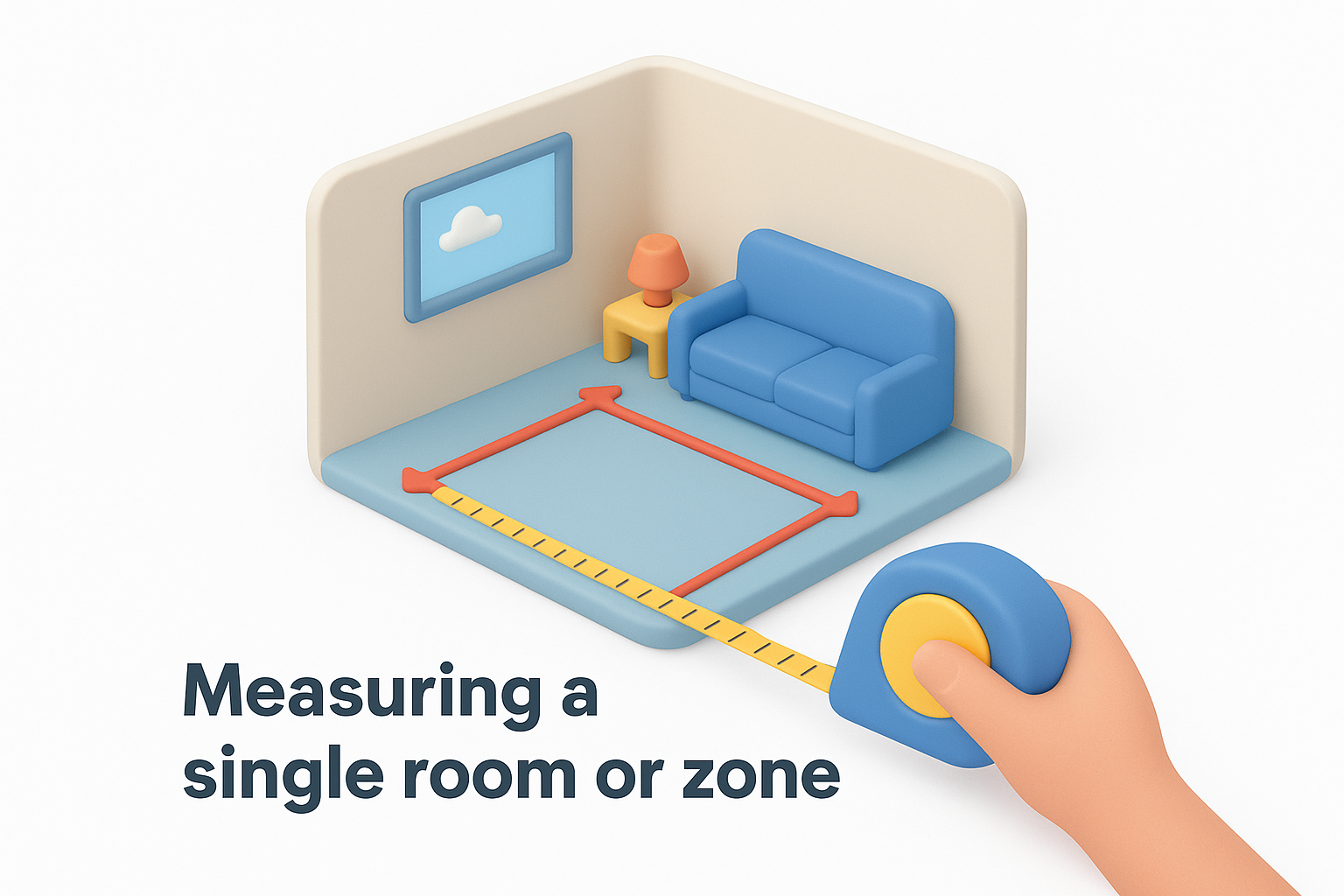
- Measure length and width in feet at the longest points
- Multiply length x width for total square footage
- For L-shaped or irregular rooms, break the space into separate rectangles and add the totals together
Measuring your whole home for a central AC system
If you are sizing a central AC system, you need the total conditioned square footage of your home, not the entire building footprint. Exclude unconditioned spaces like garages, unfinished attics, and crawl spaces. Those areas do not need cooling, and including them inflates your calculation and pushes you toward a larger, more expensive system than you actually need.
Only count the square footage your AC system will actively condition. Garages and unfinished attics should never factor into your BTU estimate.
Check your home’s floor plan if you have one, or measure each room individually and add the totals. For a two-story home, include both floors. If your second floor runs noticeably hotter than the ground floor, which is common in Florida due to heat rising through the roof, make note of that for the adjustment step coming up next.
Step 2. Estimate BTUs with a quick rule of thumb
Once you have your square footage, you can get a working BTU estimate in about 30 seconds. The standard starting point is 20 BTUs per square foot of conditioned living space. This figure won’t give you a final answer, but it puts you in the right ballpark before you account for the adjustments in the next step.
The 20 BTU per square foot baseline
To use the rule, multiply your total square footage by 20. A 1,500-square-foot home starts at 30,000 BTUs, or 2.5 tons. A 2,000-square-foot home starts at 40,000 BTUs, which falls between a 3-ton and 3.5-ton system. The table below shows common home sizes and their baseline estimates.
| Home Size (sq ft) | Baseline BTUs | Approximate Tonnage |
|---|---|---|
| 1,000 | 20,000 | 1.5, 2 tons |
| 1,500 | 30,000 | 2.5 tons |
| 2,000 | 40,000 | 3, 3.5 tons |
| 2,500 | 50,000 | 4 tons |
| 3,000 | 60,000 | 5 tons |
These baseline numbers assume average conditions. Florida’s climate almost always pushes your actual requirement above this starting point.
When to push the estimate higher or lower
Several factors pull your real cooling load away from the baseline number. Homes with ceilings above 8 feet, large south- or west-facing windows, or poor attic insulation need more BTUs than the simple multiplication suggests. A room with standard 8-foot ceilings, solid insulation, and minimal direct sun exposure might land right at baseline or slightly under it.
Use this number as a floor, not a final answer when working out what size air conditioner do I need for your home. The next step covers the specific adjustments that matter most in Tampa Bay’s climate.
Step 3. Adjust for Florida sun, humidity, and your home
Your baseline BTU estimate from Step 2 assumes average conditions across the country. Tampa Bay is not average. The combination of intense sun exposure, high humidity, and year-round cooling demand means your home’s actual cooling load almost always runs higher than the raw square footage calculation suggests. These adjustments move you from a rough estimate to a number worth using.
Florida-specific factors that increase cooling load
Florida’s climate adds measurable BTU demand that a national baseline ignores. Direct sun through south- and west-facing windows can add thousands of BTUs to your cooling load on its own. High humidity forces your AC to work harder to remove moisture from the air, which means dehumidification capacity matters as much as raw cooling power in this region.
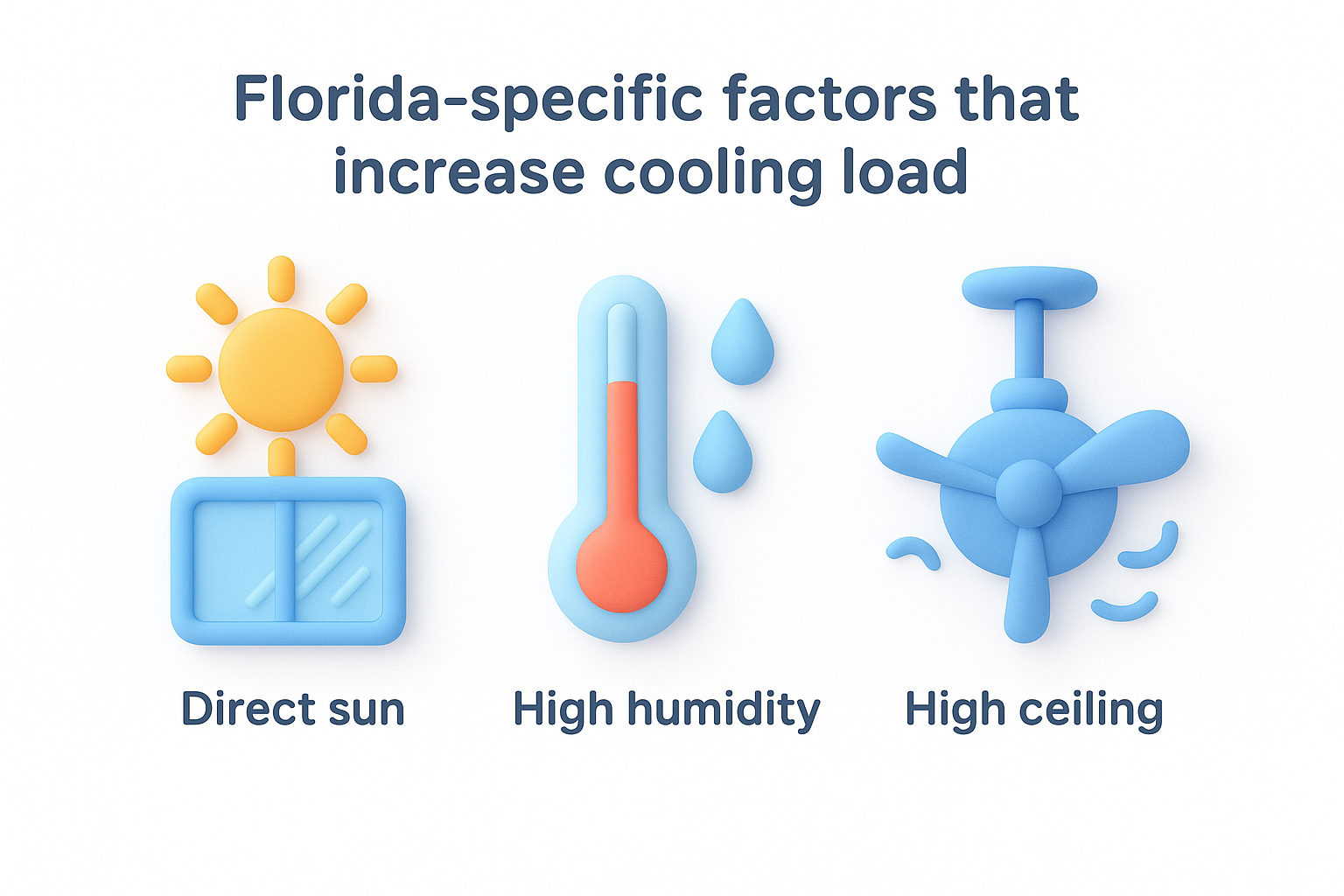
If your home sits in direct sun for most of the day with limited shade from trees or overhangs, add at least 10% to your baseline BTU estimate before moving forward.
Apply these common adjustments to refine your number:
- Sunny, south- or west-facing rooms: add 10% to BTU estimate
- Heavily shaded or north-facing rooms: subtract up to 10%
- High humidity with poor vapor control: size up by half a ton
- Ceiling height above 9 feet: add 10% per additional foot above standard
Home-specific factors that shift your estimate
Beyond climate, your home’s construction and insulation quality have a direct effect on how hard your AC works. A home with poor attic insulation in Florida absorbs significant heat through the roof, which is one of the most common reasons homeowners ask "what size air conditioner do I need" and end up undersizing. Sealed ductwork, recent insulation upgrades, and double-pane windows can each reduce your required BTUs by 5 to 10 percent.
Check these before you finalize any number:
- Attic insulation R-value (R-30 or higher is recommended in Florida)
- Window type and glazing: single-pane windows add meaningful heat gain
- Age of the home: older construction often has air leaks that raise cooling demand
- Duct condition: leaky ducts in an unconditioned attic can reduce system efficiency by 20% or more
Step 4. Convert BTUs to tons and pick the right setup
Once you have your adjusted BTU estimate from Step 3, the conversion to tons is straightforward. Divide your total BTU number by 12,000 to get the tonnage you need. A 42,000 BTU requirement divides to 3.5 tons. Round to the nearest half-ton increment, and you have a concrete number to bring to any contractor or use when comparing system specs.
Converting your adjusted BTU number to tons
The math is simple, but knowing which half-ton to round toward matters. If your calculation lands between increments, lean toward the lower option unless you have multiple factors from Step 3 pointing to higher load. Oversizing is the more common mistake, and it causes real problems in Florida’s humid climate.
| Adjusted BTUs | Divide by 12,000 | System Size |
|---|---|---|
| 24,000 | 2.0 | 2-ton |
| 30,000 | 2.5 | 2.5-ton |
| 36,000 | 3.0 | 3-ton |
| 42,000 | 3.5 | 3.5-ton |
| 48,000 | 4.0 | 4-ton |
| 60,000 | 5.0 | 5-ton |
If your number sits at 38,000 BTUs after adjustments, a 3-ton system is usually the right call unless you have significant unaddressed heat gain factors.
Choosing between a central system and a ductless mini-split
Your tonnage number answers what size air conditioner do I need, but you still need to match that capacity to the right equipment type. Homes with existing ductwork in good condition are strong candidates for a central split system. Homes with additions, sunrooms, or rooms that run persistently hot often do better with a ductless mini-split, which delivers targeted cooling without depending on duct distribution. A licensed technician can confirm which setup fits your specific layout and adjusted BTU load before you commit to a purchase.
A simple plan to get the size right
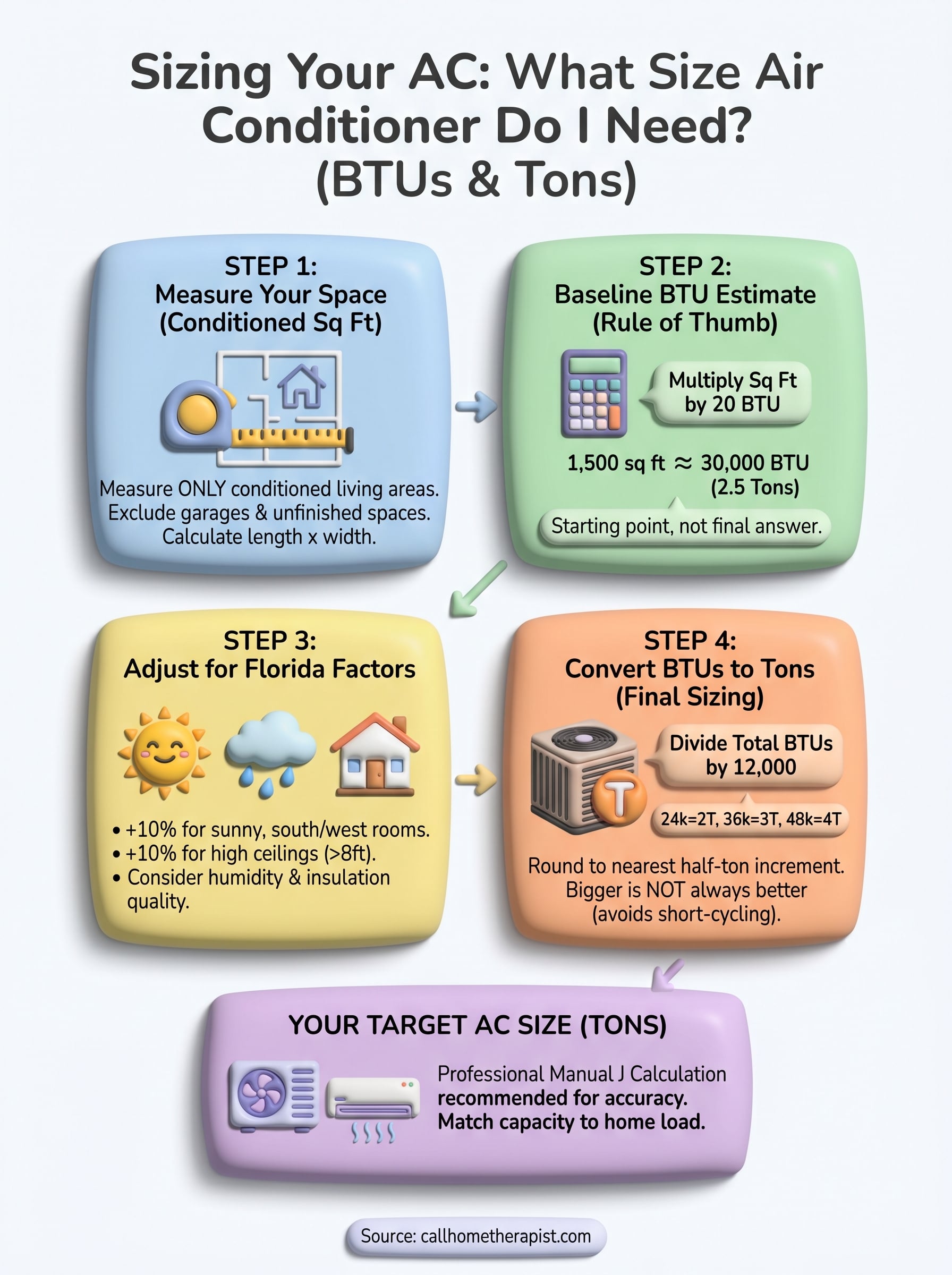
You now have a four-step process to answer what size air conditioner do I need with confidence. Start with your conditioned square footage, apply the 20 BTU per square foot baseline, adjust for Florida’s sun and humidity, then divide by 12,000 to land on your tonnage. That sequence gives you a real number to work with, not a guess.
Keep in mind that these steps get you close, but a professional Manual J load calculation gives you the most accurate result before any major installation. Factors like duct layout, home orientation, and local shading interact in ways a chart cannot fully capture. Getting the size wrong costs you money in energy bills and equipment wear for years after installation.
If you want the job done right the first time, contact the Home Therapist team for a professional AC sizing assessment and same-day service across the Greater Tampa Bay Area.
More Related Articles
- 16-Year-Old Trane With Moisture Concerns: AC Maintenance and Inspection on Wegmann Dr, Tarpon Springs, FL 34689
- 15-Year-Old System Still Running on River Briar Blvd: AC Tune-Up in Ruskin, FL 33570
- Water Heater Flush Couldn’t Happen, Here’s Why: HVAC Maintenance Visit on Deerfield Dr, Tampa, FL 33619
- Duct Cleaning + UV Light Install on 85th Terrace N: Better Indoor Air in Pinellas Park, FL 33781
- Air Conditioner Installation Repair Tampa FL Bay FL Services Review from Bonnie Wakefield


