
Ductwork Troubleshooting
Ductwork Rattling?
Bang or rattle from ducts when AC runs? Several easy causes. CAC1819196.
Quick Answer
Duct rattling = (1) loose mounting straps (Tampa attic sagging, $79 fix per section), (2) thermal expansion pops (normal brief noise), (3) debris inside duct (rare, cleaning $180 Elite), (4) high static pressure pushing duct walls (airflow issue). Call (813) 343-2212.
Rattling Causes
Loose Mounting Straps
Symptom: Ducts sagging + hitting attic framing.
Re-secure straps $79+.
Thermal Expansion
Symptom: Metal ducts pop briefly when heating/cooling.
Normal. Severe: expansion joints.
Debris in Duct
Symptom: Construction leftovers, rodents, etc.
Elite duct cleaning $180.
High Static Pressure
Symptom: Too much airflow squeezing through small ducts.
Duct enlargement or blower adjustment.
Sound by Timing: What the Rattle Tells Us About the Cause
A Tampa attic duct system makes a lot of noises, but the timing of the rattle is the single best diagnostic clue before we even pull the attic ladder. Here is the timing chart we use on every ductwork rattling call.
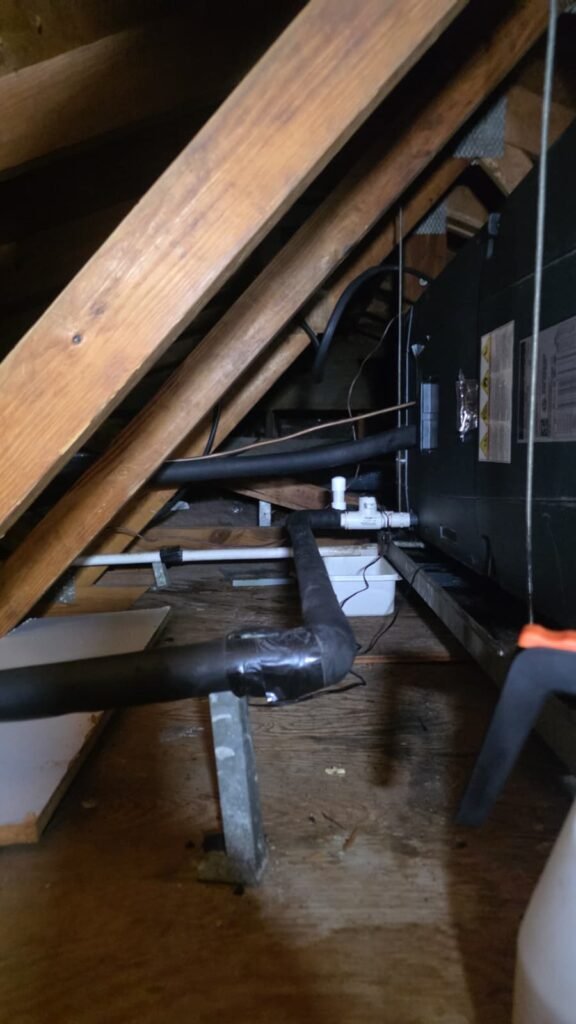
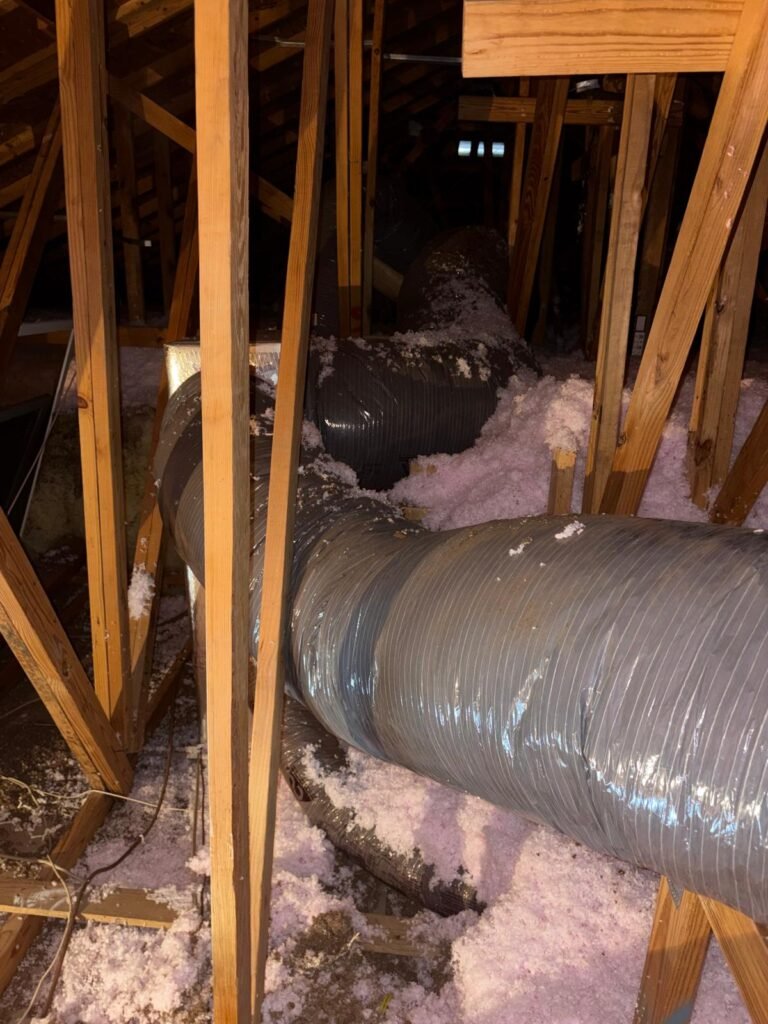
| When the Rattle Happens | Likely Cause | Severity |
|---|---|---|
| At startup only (first 5 seconds) | Metal damper snapping open, thermal expansion pop in sheet metal trunk, plenum panel flexing as static pressure builds. | Usually harmless. If the pop is sharp and consistent every cycle, we check damper mounting. |
| During full run (continuous) | Loose flex strap slapping a truss, disconnected takeoff at the plenum, partially collapsed flex line, debris rolling inside a duct, loose sheet metal screw vibrating. | Attic inspection needed. A disconnected takeoff can leak 30 percent of your conditioned air into the attic. |
| At shutdown | Pressure equalization, damper returning to rest position, flex line settling. A loud bang usually means an unsecured access panel or plenum cap. | Harmless unless you hear a metallic bang. |
| Random during run | Rodent activity inside ductwork, intermittent debris movement, undersized return duct causing trunk flex under load, loose hanger strap screws. | Check for droppings near the air handler. Random scratching with no pattern is almost always rodents. |
Ready to get this fixed? FREE diagnosis. No trip charge.
You only pay if you approve the repair. Same-day service across Tampa Bay.
Call (813) 343-2212 Book OnlineLicensed CAC1819196 (HVAC) | CFC1431159 (Plumbing) | 1,300+ Five-Star Reviews
Audio Descriptors Our Techs Listen For
- Marble rolling: hard debris (drywall chunk, screw, insulation clump) loose inside a metal trunk duct.
- Sheet metal thunder: a flat panel on the plenum or trunk flexing under static pressure, like a kick drum.
- Strap slap: a flex duct hanging too low and tapping a roof truss every time airflow pushes it.
- Scratching or skittering: rats or squirrels inside or on top of a flex line. Evening and overnight are peak hours.
Why Tampa Attic Heat Destroys Ductwork Faster Than the Rest of the Country
Tampa attics hit 130 to 140 degrees from June through September. That is not an exaggeration, we measure it on every service call. Northern states never see those temperatures, which is why generic online ductwork advice misses the biggest cause of rattle in our market.
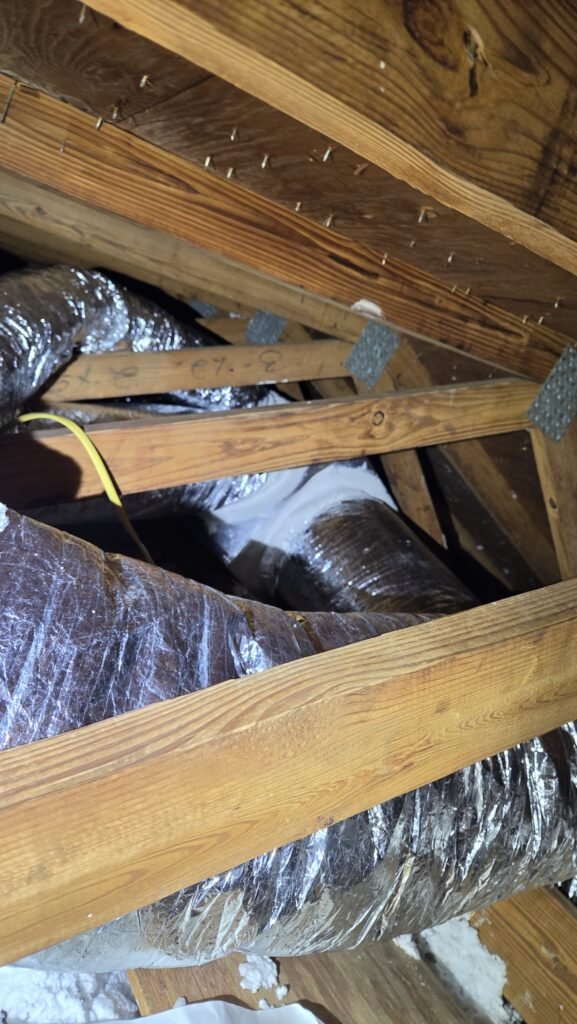
Here is what that heat does to your system over a single summer:
- R6 flex insulation degrades. The outer vapor jacket gets brittle, the inner liner sags, and the strap points lose their grip.
- Plastic collars and joints warp. The takeoff boots at the plenum deform slightly, opening small gaps that whistle or rattle under load.
- Metal fasteners loosen. Sheet metal screws and hanger straps expand and contract every single cycle. After two or three summers the mounting points are noticeably looser.
- Flex line sag creates hammocks. Water vapor pools in the low spots and causes condensation rattles, plus it chokes airflow on the run serving that room.
West-facing attic runs almost always fail first. The afternoon sun loads the roof deck on that side for three to four extra hours per day, so the ductwork on the west half of the attic ages faster than the east half.
Attic Inspection Timing
If you want to look yourself, go up on a cool morning before 8 AM during June through September. The attic will still be in the low 90s but survivable for 10 minutes. Bring a good flashlight and look for hanging straps, collapsed sections, disconnected takeoffs at the plenum, and any flex line with a visible dip more than a few inches. If you are not comfortable in the attic, we handle the inspection on our FREE diagnosis visit.
Rodent Damage: The Tampa Attic Differentiator
Rats and squirrels love Tampa attics, and they love ductwork even more because the flex jacket is soft to chew and the insulation is perfect nesting material. Signs rodents are in your ducts:
- Scratching or skittering sounds, usually worst at dusk and again around 3 to 5 AM.
- Droppings on top of the air handler, near the attic hatch, or on top of plenum wrap.
- Chewed or torn insulation on flex duct, often with exposed inner liner.
- Musty or ammonia smell coming from vents, caused by urine soaking into insulation.
Rodent Remediation Pricing
- Duct sanitizing plus minor repair: $399 to $899 depending on run count and contamination level.
- Metal sleeve replacement for chewed flex: $499 to $999 per run.
- Exclusion work (sealing entry points at the soffit, gable, or roof line) is usually handled alongside our repair, but heavy infestations need a dedicated pest contractor first.
Oversized Blowers on Undersized Trunks: The Manual D Problem
This is the one nobody warns Tampa homeowners about. When you replace an older single-stage AC with a modern variable-speed system, the new blower moves more air at peak than the old one. The existing duct system was sized for the old blower using (or often not using) the ACCA Manual D standard. Drop a new high-static blower into old ductwork and the trunk starts to flex, the returns starve, and you get chronic rattle that was not there before.
Typical symptoms we see:
- Rattle started or got significantly worse after a recent AC replacement.
- Total external static pressure reads above 0.8 inches water column at high stage.
- Blower motor runs hotter than spec and the variable-speed module logs high static faults.
- One or two rooms always run warm because the air cannot physically get there.
The fix is a duct redesign using Manual D calculations, typically $1,200 to $3,500 depending on how much trunk and return work we have to rebuild.
What Causes Ductwork to Rattle, Bang, or Pop in Tampa Homes
Sheet-metal ductwork is not supposed to be noisy. When it starts rattling, banging, or making a repetitive popping sound, something in the system has changed. After years of HVAC work across Tampa Bay, we find the same causes again and again. Here they are ranked by frequency.
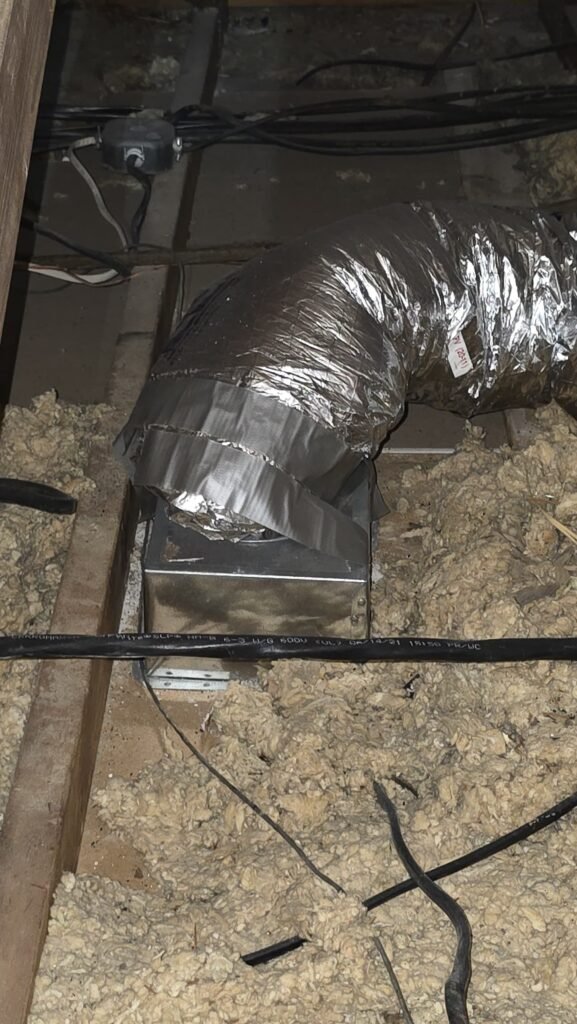
1. Sheet-metal “oil canning” from thermal expansion and contraction. The most common source of ductwork noise in Tampa homes, and the one most homeowners mistake for a structural problem. When the air handler kicks on, cool 55-degree supply air flows through ducts that were sitting at 85 to 90 degrees in an unconditioned attic. The sheet metal contracts rapidly and then expands again when the system shuts off. The result is a series of loud pops or a booming bang from the ductwork, especially in large flat return plenums and main trunk lines. Florida’s extreme attic temperatures, which regularly hit 130 to 150 degrees in summer, make thermal cycling especially pronounced compared to more temperate climates. This noise is often loudest at system startup and shutdown rather than during steady-state operation.
2. Loose duct connections, straps, or hangers. Flexible duct and sheet-metal sections connect at collar fittings that are sealed with mastic or foil tape and secured with sheet-metal screws. Over time, in Tampa’s attic heat, foil tape adhesive fails, screws back out from vibration, and flexible duct sags off its collar. A loose section vibrates against adjacent framing, insulation batts, or other ductwork every time air flows through it. The rattle is rhythmic and tied directly to the blower running. Duct hangers that support the weight of longer flex duct runs also loosen from joist movement, allowing the duct to sway and contact the attic floor or rafters.
3. High static pressure from undersized return grilles or a dirty air filter. This is a cause most homeowners do not think about but that we find on a meaningful percentage of rattle calls. When the return side of the system is restricted, the blower works harder to pull air through, and the increased velocity and turbulence vibrate the duct walls. A clogged 1-inch filter can double or triple the static pressure on the return side within 60 to 90 days in a Tampa home with pets or construction dust. Undersized return grilles, a common design issue in tract homes built across Riverview, Ruskin, and Wesley Chapel in the 1990s and 2000s, create the same turbulence problem permanently. The rattling in these cases is louder at high fan speed and quieter or absent at low speed.
4. Loose or rattling dampers inside the duct system. Volume dampers are metal plates inside branch ducts used to balance airflow between rooms. Manual dampers have a handle that can vibrate loose from its set position. Motorized zone dampers have actuator arms that click or rattle when the gear wears or the blade fits loosely in the damper housing. A single loose damper blade creates a distinctive flapping or buzzing sound that starts and stops with the system and is often localized to one area of the house.
5. Debris inside the ductwork. Nails, screws, wire nuts, insulation fragments, and occasionally pieces of dried mastic compound make their way into duct sections during original construction or during attic work. These loose objects rattle against the duct walls whenever airflow passes over them. In older Tampa homes where ductwork has never been accessed since original installation, we sometimes find bird or rodent debris inside open duct sections in the attic.
6. Duct undersizing causing high velocity turbulence. A duct system that was originally sized for a smaller air handler, or one where the air handler has been replaced with a higher-capacity unit without resizing the ductwork, runs at higher air velocity than the sheet metal was designed for. High velocity creates turbulence at every elbow, transition fitting, and grille boot, which translates to vibration and noise throughout the system. This is a design issue rather than a failure, and it often coexists with comfort problems like uneven temperatures and high energy bills.
Florida Code Corner: Ductwork Permits and HVAC Licensing in Tampa
Ductwork repairs and replacements in Florida require a CAC-licensed HVAC contractor. Here is what Hillsborough County requires for the most common duct scenarios:
- Duct strap repair or reconnection (no new duct material): No permit required. Must be performed by or under the supervision of a licensed HVAC contractor. Our license is CAC1819196.
- Replacing a duct run or section of flex duct: Permit required if the new duct run connects to a new register location or exceeds a threshold length. Filed at the Hillsborough County Land Use Services Hub on Falkenburg Road.
- Full duct system replacement or Manual D redesign: Permit required. Inspection required before attic access is sealed. In Tampa, inspectors access duct systems through the attic hatch and document insulation levels and connection integrity.
- Home sale implication: Buyers’ inspectors in Tampa routinely photograph sagging, disconnected, or pest-damaged flex duct in attic spaces. Unpermitted duct replacement can create lender objections. Permitted work with a CAC contractor signature documents a clean repair history.
Tampa Seasonal Timing: When Duct Rattle Gets Worse
- April through June (pre-season thermal shock): The first days of sustained 90-degree-plus heat cause flex duct to expand significantly after a mild winter. Straps that held through cool months can slip under this thermal load. This is the best time for a pre-season attic inspection before peak-demand scheduling begins.
- June through September (peak attic heat): Tampa attics regularly hit 140 to 160 degrees Fahrenheit in summer. Flex duct inner liners become pliable, and sagging sections that partially collapse under their own weight reduce airflow to rooms. New rattling during peak summer almost always points to heat-related duct movement.
- October and November (pest season transition): Rodents that sheltered in attics during summer often chew through flex duct jackets as cooler weather arrives. Post-hurricane-season attic inspections frequently reveal new pest entry points. Rattling or whistling that appears in fall should prompt an inspection before winter heating cycles begin.
- January and February (heating cycle expansion): Tampa’s intermittent cold snaps trigger heat strips or heat pumps. The sharp increase in supply air temperature causes metal plenum and trunk components to expand rapidly. Thermal expansion pops during the first few heating cycles of the year are normal. A continuous rattle that persists all winter is a loose connection, not just expansion noise.
What You Can Check Before Calling
A few observations and one simple maintenance step will help us diagnose your ductwork noise quickly and accurately.
Change the air filter first. Before anything else, pull your air filter and check its condition. A filter loaded with dust and debris dramatically increases static pressure, which is one of the leading causes of duct rattle. Replace it with a fresh filter of the same size and MERV rating. Run the system for 15 minutes and note whether the noise changes. If the rattling decreases noticeably with a clean filter, high static pressure from a restricted return is at least a contributing factor. This is also important information for our technician when we arrive.
Identify the pattern of the noise. Thermal expansion pops happen at system startup and shutdown. Steady rattling or vibrating during system operation points to a loose connection, a loose damper, or debris. A noise that intensifies at higher fan speeds suggests airflow turbulence from high static or high velocity. A noise that comes from one specific area of the ceiling or wall consistently points to a local loose connection or hanger rather than a system-wide issue. Note where in the home the sound is loudest and when it occurs: startup only, during operation, shutdown, or all three.
Check any visible supply and return grilles. Loose grille screws, bent grille fins, or a grille that is vibrating against drywall creates a buzzing rattle at the register level that can sound like it is coming from inside the duct. Tighten the screws on any grille that feels loose. Remove the grille entirely and run the system briefly to confirm whether the noise stops with the grille off. If it does, the grille itself is the noise source, not the duct.
Look at accessible flex duct runs in the attic or under the home. If you have attic access and it is safe to enter, look at the first few feet of flexible duct runs coming off the main plenum. Flex duct that has sagged off its collar fitting, that is kinked sharply, or that is resting against a rafter without a hanger is a likely noise source. Do not attempt to reconnect a separated duct section yourself if you cannot reach it safely; note its location and our tech will access it with proper equipment.
Repair Options and Cost
Here are the real 2026 Tampa Bay HVAC service prices for ductwork noise diagnosis and repair. Every visit begins with a FREE diagnosis; we identify the noise source and quote the fix before any work starts.
- Static pressure test and filter evaluation: Included in our standard diagnostic visit at no charge. We measure supply and return static pressure with a manometer, identify whether high static is contributing to the noise, and check filter condition and sizing. This single test often explains rattle complaints that turn out to be airflow-related rather than physical duct issues.
- Duct connection re-securing (attic or accessible area): $195 to $495 depending on the number of connections and attic access difficulty. Includes re-seating separated flex duct sections onto collars, re-taping failing foil connections with professional UL-listed foil tape, replacing missing sheet-metal screws at joints, and re-hanging sagging flex duct runs. Tampa attic work in summer is priced to account for the heat conditions our techs work in.
- Expansion noise damping (stiffener ribs or expansion joints): $295 to $695. For persistent oil-canning in large flat return plenums or trunk lines, adding sheet-metal stiffener ribs across the flat panel face reduces the range of thermal flex and quiets the expansion pop significantly.
- Damper repair or replacement: $195 to $395 per damper for a loose or failed volume damper, including accessing the duct section, resetting or replacing the damper blade and hardware, and testing operation.
- Return air system upgrade (undersized grilles or ductwork): $595 to $1,895 to add a return grille, enlarge an existing return opening, or add a supplemental return duct run. Addresses the root cause of turbulence-driven rattle in homes where the return side was never sized correctly for the system.
- Full duct system inspection with static pressure mapping: $295 to $495. Recommended for homes where the rattle has been ongoing for more than one season, or where comfort problems (hot rooms, cold rooms, humidity issues) accompany the noise. Includes a written report on static pressure, duct condition, insulation status, and any identified deficiencies.
FREE diagnosis and FREE estimate on every visit. No trip fee, no diagnostic charge. Licensed CAC1819196. Call (813) 343-2212.
What to Do Right Now
- Note when rattle happens (startup, run, shutdown).
- Listen for bangs from specific section.
- Call for FREE inspection.
Strap re-secure: $79+. Duct clean: $180. Airflow balancing: $279+.
Get a FREE Diagnosis From a Licensed Tampa Bay Tech
No diagnostic fee. No trip charge. We tell you exactly what is wrong and what it costs before you approve anything.
Call (813) 343-2212 Book Online
Available 7 days a week | Same-day service | Licensed & insured
FAQ
Normal or problem?
Occasional brief pops at startup: normal. Continuous rattle: problem. Diagnose.
Can I fix myself?
Attic work in Tampa heat is risky. Pros do it quickly.
Rats in ducts?
Possible in older homes. Cleaning + duct sealing + pest control combo.
Why does my ductwork rattle more at night?
Thermal contraction. Your attic drops from 130 degrees in the afternoon to around 70 overnight, and the sheet metal, fasteners, and flex jacket all shrink slightly as they cool.
Is rattling ductwork an emergency?
Rarely an emergency, but it is often expensive to ignore. A disconnected flex run leaks roughly 30 percent of the conditioned air for that branch straight into the attic.
How much does duct strap repair cost?
Duct strap repair runs $199 to $399 per strap, depending on attic access and whether we need to rehang a sagging run at the same time.
Can I tighten a duct strap myself?
If you have safe attic access and the run is only sagging (not disconnected), yes. Use a proper duct hanger strap, never wire or zip ties alone.
What is Manual D?
Manual D is the ACCA engineering standard for residential duct design. It accounts for blower CFM, friction loss per fitting, static pressure targets, and room-by-room load.
Why does my ductwork rattle only in summer?
Because attic heat is doing the damage. The expansion and contraction cycle between a 135 degree afternoon and a 75 degree night stresses every fastener, strap, and joint in the system.
Do new homes get this problem?
Yes, and more often than people expect. Rushed production builds sometimes leave flex straps spaced too far apart, takeoffs only partially sealed, or plenum panels loose.
How often should I inspect ductwork?
Once a year at your AC tune-up is the baseline. Call (813) 343-2212 and we will get a tech out for a FREE diagnosis.
Is ductwork popping at startup a sign of a serious problem?
Startup and shutdown popping is almost always thermal expansion, which is a physical property of sheet metal rather than a structural failure. The duct is not cracking or breaking; it is contracting and expanding with temperature. That said, repeated thermal cycling over years can fatigue sheet-metal joints and eventually cause a connection to work loose, so chronic loud popping is worth having a technician look at. In Tampa’s extreme attic temperatures, we see thermal expansion noise in virtually every home with older sheet-metal ductwork. Adding stiffener ribs to flat panel surfaces is the most effective long-term fix for homes where the noise is disruptive.
Can a dirty air filter really cause ductwork to rattle?
Yes, and it is one of the more surprising findings for homeowners. A clogged filter forces the blower to work harder to pull air through the restriction, which increases air velocity in the return duct. Higher velocity means more turbulence at every elbow and transition, which vibrates the duct walls. In extreme cases, a completely clogged filter creates enough negative pressure in the return plenum to cause flat duct surfaces to flex inward rhythmically with the blower cycling. Replacing the filter and running the system again is always the first step in any ductwork rattle diagnosis. In Tampa Bay’s dusty environment, 1-inch filters should be checked monthly and replaced every 30 to 60 days in most homes.
My ductwork rattles but my AC is still cooling fine. Should I still have it checked?
Yes. Ductwork that rattles is often working loose at connections, and a loose connection that vibrates today becomes a separated connection tomorrow. Separated duct connections in the attic dump conditioned air into the unconditioned attic space instead of delivering it to the room it is supposed to serve. In Tampa’s climate, a single separated duct section can increase cooling costs by 15 to 25 percent and cause one or two rooms to lose cooling entirely during peak summer heat. Finding and re-securing a loose connection costs far less than running an inefficient system all summer or dealing with a humidity problem in the rooms that lost airflow.
How do I know whether my duct noise is from the ductwork itself or from the air handler?
Air handler noise (squealing, grinding, or rattling from the mechanical components) tends to come from a single fixed location, which is wherever the air handler is installed, typically the garage, a closet, or the attic in a dedicated platform. Ductwork noise travels through the house and appears to come from multiple ceiling locations, specific rooms, or from the attic as a whole. A rattling noise that follows you from one room to the next as you walk the house is ductwork. A rattling noise that is loudest near the air handler and diminishes further away is more likely a blower wheel, motor mount, or cabinet panel issue at the unit itself.
Does Home Therapist offer FREE ductwork noise diagnosis?
Yes. Our HVAC technician checks your air filter, measures static pressure on both the supply and return sides, listens at all accessible duct runs, identifies the noise pattern, and gives you a written assessment and estimate at no charge. No trip fee, no diagnostic fee. Licensed CAC1819196. Call (813) 343-2212.
My ductwork rattles worse after my AC was replaced. Did the new system cause it?
Very likely yes. A new air handler installed without a duct system airflow analysis often has a higher or different blower speed than the old unit. An air handler replaced with a higher-SEER variable-speed system running at high-speed mode can push significantly more air through ductwork originally sized for a lower-capacity unit. The higher velocity causes turbulence at every fitting, which creates rattle and vibration that never happened with the old system. This is a Manual D sizing issue: the new equipment should be commissioned to run at a speed the duct system can support without exceeding its design static pressure. A static pressure test after any equipment replacement is the diagnostic starting point. Licensed CAC1819196.
Is flex duct in the attic more prone to rattling than sheet-metal duct in Tampa?
Yes, for different reasons. Flexible duct is lighter and less rigid than sheet metal, so it vibrates more easily against adjacent framing when airflow velocity is elevated. Flex duct also sags between hanger points, and a saggy section that rests against a rafter or truss chord creates a contact rattle tied directly to the blower cycle. Sheet-metal trunk lines are prone to oil-canning (thermal expansion pops) but are generally more stable during airflow. Most Hillsborough County residential systems built since the 1990s use flex duct for branch runs off sheet-metal trunks. The flex runs are the most common rattle location in Tampa attic systems. Licensed CAC1819196.
Can ductwork rattling increase my energy bill?
Not directly, but the conditions that cause rattling often do. Rattling from high static pressure means the blower motor is working harder than designed, increasing electricity use per hour of runtime. Rattling from a loose or separated duct connection means conditioned air is escaping into the attic rather than reaching the room it was intended for, and the system runs longer to compensate. A separated duct connection in an attic in Tampa summer can add 15 to 25 percent to the cooling load on that zone. If your energy bills have increased alongside new ductwork noise, there is likely a connection worth investigating. Licensed CAC1819196.
★★★★★PlumbingFast within hr of call. And fast service on fix also explained all he was going to do and did. Showed me the outside water meter was,shut off and how it works…
★★★★★Easy to setup. Fare price. Knows the job.
★★★★★They made the entire process quick and easy from start to finish. Someone was able to come out the same day, and their communication was excellent throughout the whole process. I never…
★★★★★PlumbingI had a great experience with Alejandro from Home Therapist Cooling, Heating, and Plumbing. He repaired two toilets and installed the water line to my new refrigerator after the delivery team refused…
★★★★★AC repairAmazing service from start to finish. My AC system completely stopped working, and they were able to come out the same day, which was a huge relief. The technician was professional, knowledgeable,…
★★★★★Water heaterAs an engineer/fabricator/assembler, I have high standards from my contractors. This guy Sam, he fulfilled all my requests and installation needs. He took pride of his work, and left me with a…
★★★★★PlumbingA big THANK YOU to Home Therapist Cooling, Heating and Plumbing for running sewer pipes to our RV and shed! Samuel was beyond amazing! He was prompt, professional, and his communication style…