

Water Heater Maintenance Workflow: Tampa Bay Guide
TL;DR:
- Tampa Bay homeowners should perform annual water heater flushing to prevent sediment buildup.
- Safety checks like TPR valve testing are manageable DIY tasks, but some repairs require professionals.
- Regular maintenance is vital due to Tampa Bay’s humid, hard water environment speeding up tank deterioration.
Your morning starts with a cold shower you never expected. No warning, no gradual cooling off, just ice-cold water because a water heater that got zero attention finally gave out. In Tampa Bay, where humidity stays high and the occasional cold snap catches older tanks off guard, skipping routine maintenance is a gamble that rarely pays off. This guide walks you through a practical, step-by-step maintenance workflow built specifically for Tampa Bay homeowners. You’ll learn what to look for, how to flush your tank, which safety checks matter most, and when it’s smarter to pick up the phone than grab a wrench.
Table of Contents
- Assessing your water heater: Signs and prerequisites
- Flushing your water heater: Step-by-step workflow
- Safety checks: TPR valve test and leak detection
- When to call a professional: Limits of DIY and annual inspections
- Why Tampa Bay homeowners shouldn’t skip annual water heater checks
- Streamline your water heater upkeep with expert help
- Frequently asked questions
Key Takeaways
| Point | Details |
|---|---|
| Recognize warning signs | Leaks, rust, odd noises, and inconsistent hot water are reliable indicators your water heater needs attention. |
| Follow efficient workflow | Prepare with the right tools, flush regularly, and do step-by-step safety checks for optimal results. |
| Annual professional inspection | Especially for gas units and older tanks, an annual inspection ensures longevity and efficiency. |
| Weather matters | Tampa Bay climate increases risk for leaks, so schedule maintenance around local weather extremes. |
| DIY vs. expert tasks | Homeowners can handle basic maintenance, but complex tasks and gas unit checks require professional help. |
Assessing your water heater: Signs and prerequisites
Before you touch a single valve, you need to know what you’re dealing with. Walking past your water heater every day doesn’t mean you’re actually inspecting it. Most homeowners only notice something is wrong when they’re already in trouble.
Here are the most common visual and audible warning signs that your water heater is asking for attention:
- Rust or discoloration on the tank exterior or in your hot water
- Puddles or moisture around the base of the unit
- Popping or rumbling sounds during heating cycles, a classic sign of sediment buildup on the tank floor
- Inconsistent water temperatures, where you get hot then lukewarm without changing settings
- Higher energy bills without any change in usage
Tampa Bay’s climate adds some unique pressure to your system. The region’s hard water accelerates mineral deposits inside your tank. On top of that, routine maintenance can extend life of your water heater significantly, and Tampa Bay weather reports have shown that cold snaps stress older tanks to the point of causing sudden leaks or failures.
Before starting any maintenance, gather these tools:
| Tool | Purpose |
|---|---|
| Garden hose | Drain sediment from tank |
| Flathead screwdriver | Open drain valve |
| Work gloves | Protect hands from hot water |
| Bucket | Catch any overflow |
| Anode rod wrench | Rod inspection (if applicable) |
| Flashlight | Inspect hard-to-see areas |
Prepping your tools before you start keeps the workflow moving without interruptions. Nothing slows you down like stopping midway to search for the right wrench. For a deeper breakdown of what in-home water heater maintenance actually involves, we’ve put together additional guidance to help you stay ahead of any issue.
Once you have your tools ready and you’ve completed your visual inspection, you’re set to move into the hands-on part of the workflow.
Flushing your water heater: Step-by-step workflow
Sediment is your water heater’s worst enemy. Over time, minerals from Tampa Bay’s water supply settle at the bottom of your tank, creating a layer of gunk that forces your heater to work harder, use more energy, and wear out faster. Flushing removes that buildup and restores efficiency.
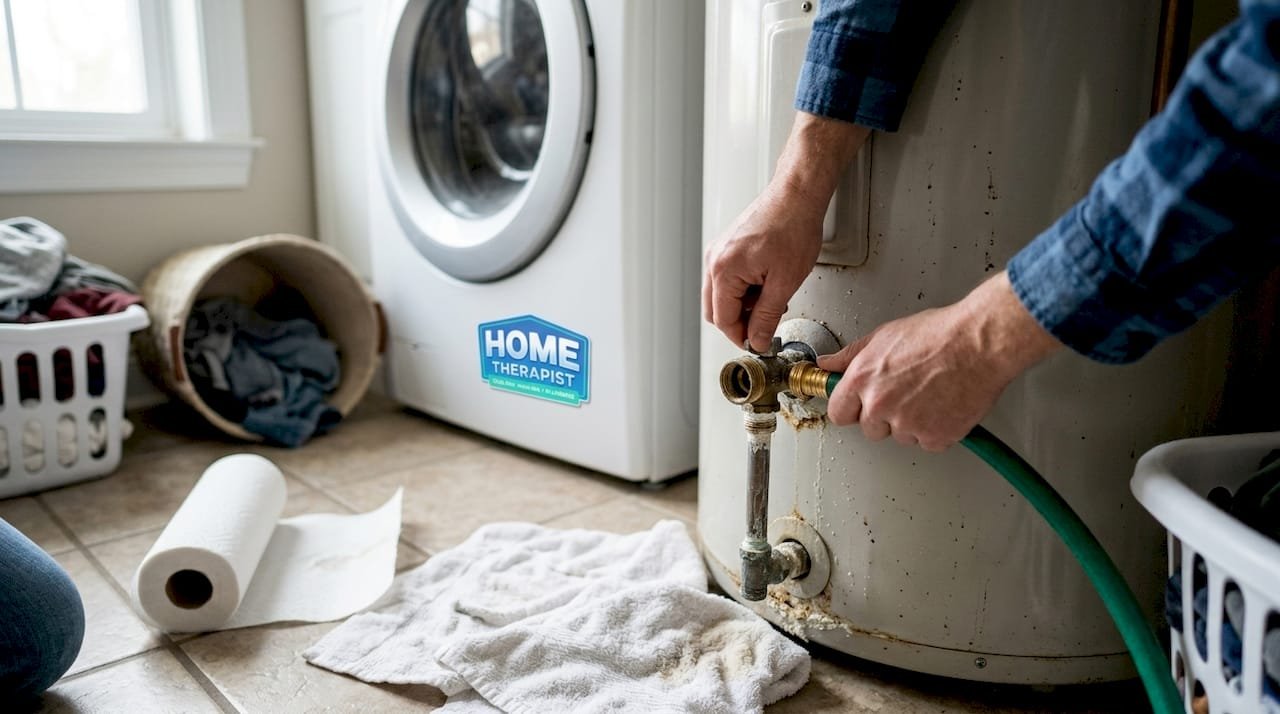
According to an annual water heater maintenance checklist, DIY flushing and TPR valve testing are absolutely manageable for most homeowners, though anode rod replacement often needs a pro due to the torque and access required. Annual professional inspection is also recommended for gas units.
Here’s how to flush your tank safely:
- Turn off the power. For electric heaters, flip the breaker. For gas units, set the thermostat to the “pilot” setting.
- Shut off the cold water supply valve at the top of the tank.
- Connect a garden hose to the drain valve near the bottom of the tank and run it to a floor drain or outside.
- Open a hot water faucet somewhere in your home to prevent a vacuum from forming.
- Open the drain valve and let the water flow until it runs clear. This usually takes 20 to 30 minutes.
- Close the drain valve, remove the hose, and turn the cold water supply back on.
- Restore power or re-light the pilot once the tank is full.
| Task | Estimated Time | Recommended Frequency |
|---|---|---|
| Full tank flush | 30 to 45 minutes | Once a year |
| Quick sediment check | 10 minutes | Every 6 months |
| Professional inspection | 1 to 2 hours | Annually for gas units |
Pro Tip: Wear thick rubber gloves and keep a towel nearby. Even when you’ve turned off the heater, residual water inside the tank stays dangerously hot for longer than you’d expect.
Sticking to annual water heater maintenance pays off fast in Tampa Bay homes where sediment builds up quicker than average. You can also explore scheduling water heater inspections to pair professional checks with your DIY routine.
Safety checks: TPR valve test and leak detection
With the tank flushed, the next critical task is running your safety checks. The temperature-pressure relief valve, known as the TPR valve, is one of the most important safety components on your water heater. It’s designed to release pressure if the tank overheats or builds up too much internal pressure. If it fails, the risks include serious water damage and in rare cases, catastrophic tank rupture.
Safety reminder: Hot water can cause severe burns in under two seconds. Before testing the TPR valve, make sure you know where the water will discharge. Keep children and pets away from the area. If the valve leaks continuously after testing, do not attempt to reseal it yourself. Call a professional immediately.
Here’s how to test your TPR valve:
- Locate the TPR valve on the side or top of the tank. It has a small lever and a discharge pipe running down or away from the unit.
- Place a bucket below the discharge pipe to catch any water.
- Lift the lever briefly for two to three seconds and then release it. You should hear a slight rush of water or steam, then silence when you let go.
- Watch the valve for 60 seconds after releasing. If it drips or keeps flowing, it needs replacement.
- Check the discharge pipe for signs of prior dripping, which could mean the valve has been relieving pressure on its own.
For leak detection beyond the TPR valve, do a systematic visual scan. Check all pipe connections at the top of the tank, look for moisture stains on the wall or floor near the unit, and run your fingers along the fittings. Even a slow drip left unattended in Tampa Bay’s humid environment can lead to mold and structural damage surprisingly fast.
DIY flushing and TPR testing are well within reach for most homeowners, but if anything looks unusual during your checks, connecting with professional water heater services is always the safer call.
When to call a professional: Limits of DIY and annual inspections
Even with careful attention to routine tasks, some aspects of water heater maintenance are best left to expert hands. Knowing your limits isn’t a weakness. It’s actually the smartest part of any maintenance workflow.
Here’s when you should call a professional instead of going it alone:
- Anode rod replacement: This magnesium or aluminum rod protects the tank from corrosion by sacrificing itself over time. Removing and replacing it requires significant torque and sometimes a breaker bar. Many residential tanks are installed in tight spaces that make this near impossible without professional tools.
- Gas unit inspection: For gas-powered water heaters, an annual pro inspection is strongly recommended. Gas connections, burner assemblies, and exhaust venting need trained eyes to catch issues that aren’t visible during a casual check.
- Continuous leaks: If water is pooling or a fitting keeps dripping after you’ve tightened it, stop. Repeated fixes without resolving the root cause leads to bigger damage.
- Error codes or pilot light issues: These signal control or ignition problems that go beyond routine maintenance.
- Water discoloration that doesn’t clear: Persistent rust or murky water after flushing often means the tank interior is deteriorating.
Pro Tip: Keep a simple maintenance log. Write down the date of each flush, the results of your TPR test, any unusual sounds or smells, and who you called if you needed help. This record is invaluable when you’re troubleshooting later or when a technician needs context.
For Tampa Bay homeowners, annual service plans are worth the investment. Our local humidity and occasional cold fronts create conditions that push water heaters harder than in milder climates. Checking annual maintenance coverage in Tampa can help you understand what’s included and plan accordingly.
Why Tampa Bay homeowners shouldn’t skip annual water heater checks
Here’s something we’ve seen firsthand: homeowners who skip annual checks don’t usually regret it right away. Weeks pass, months pass, and the heater keeps running. That’s exactly what makes this habit so dangerous. The problems are building quietly inside that tank, and by the time you notice, the repair bill is three times what a checkup would have cost.
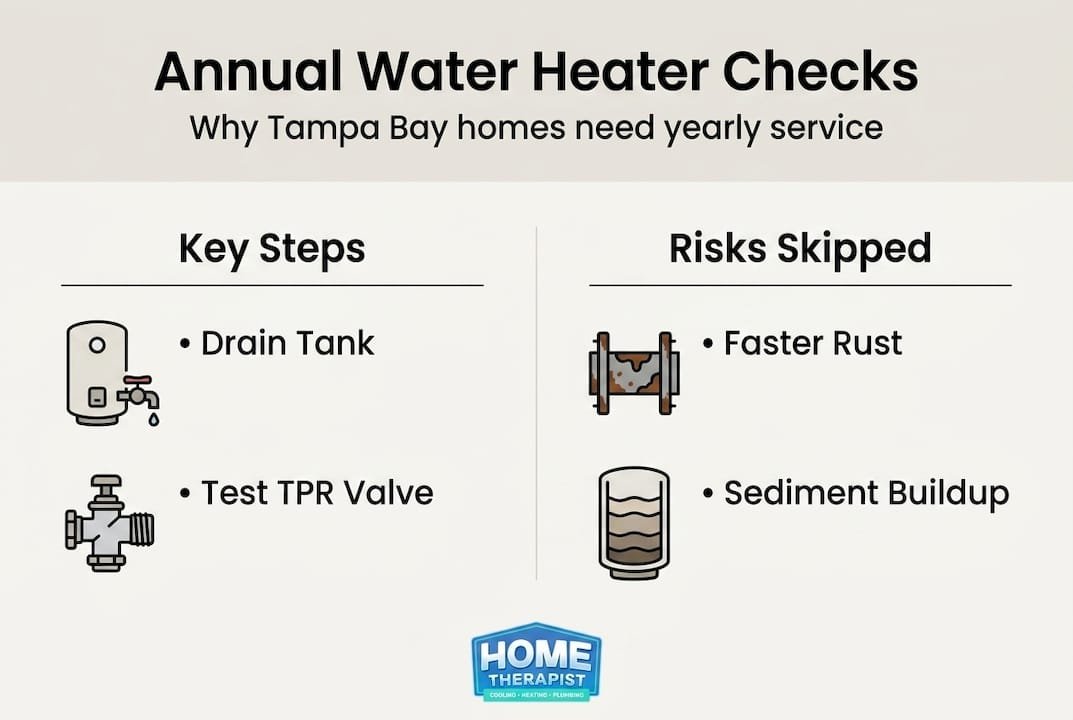
Tampa Bay is not a forgiving environment for water heaters. High humidity accelerates rust. Hard water speeds up sediment. The occasional cold front drops temperatures fast enough to shock older tanks into failure almost overnight. There’s also a stubborn myth that a working water heater doesn’t need attention. That logic is backwards. A working heater is the best time to maintain it.
We also see homeowners underestimate what water heater installation and inspection can reveal. An inspection isn’t just about fixing problems. It’s about catching the ones you didn’t know existed before they become emergencies. Annual checks consistently prove their value in lower energy bills, avoided repairs, and extended equipment life.
Streamline your water heater upkeep with expert help
Having a solid workflow is a great start, but knowing when to hand things off to a professional makes all the difference in keeping your system running without surprises.
At Home Therapist Cooling, Heating, and Plumbing, our certified technicians are ready to help Tampa Bay homeowners with everything from plumbing leak inspection services to full plumbing repiping service when your pipes need serious attention. Whether you need a quick checkup or a full annual service, getting water heater maintenance estimates from our team is simple and straightforward. We’re a family-owned business that treats your home like our own. Contact us today.
Frequently asked questions
- What are the steps involved in water heater maintenance?
Water heater maintenance involves six steps: flush the tank to clear sediment, test the pressure-relief valve, inspect the anode rod and replace it if heavily corroded, check the thermostat setting, inspect all connections for leaks, and verify the burner flame or heating element. In Tampa Bay's hard, mineral-rich water, sediment builds faster than in cooler climates, so flushing is the most critical step. Home Therapist performs all six steps on every maintenance visit and provides a FREE diagnosis of any issues found.
- What is the maintenance schedule for a water heater?
Flush the tank and test the pressure-relief valve once a year. Inspect the anode rod every one to two years and replace it when it is more than 50% depleted. Tampa Bay's high humidity and warm groundwater accelerate anode rod corrosion, so annual inspections are strongly recommended here. A full professional tune-up once a year keeps the unit efficient and extends its service life. Home Therapist has completed 323 jobs in Tampa and offers FREE estimates on every visit.
- Can I do water heater maintenance myself?
Homeowners can safely flush the tank and visually inspect connections, but testing the pressure-relief valve, inspecting the anode rod, and checking gas or electrical components carry real safety risks and are best left to a licensed plumber. In Florida, any repair that involves the gas line or pressure-relief system must be performed by a licensed contractor. Home Therapist holds plumbing license CFC1431159 and provides FREE diagnosis on every visit so you know exactly what needs attention.
- Are you supposed to get your water heater serviced every year?
Yes. Manufacturers and plumbing professionals recommend annual professional service for tank water heaters. In Tampa Bay, the combination of hard water, high ambient temperatures, and year-round heavy use makes yearly service especially important because sediment accumulates faster and anode rods deplete sooner than in cooler regions. Skipping annual service is the leading cause of premature tank failure. Home Therapist's 1,300+ five-star reviews reflect the value homeowners see in routine maintenance.
How often should I flush my water heater in Tampa Bay?
Flushing once a year is the standard recommendation to keep sediment from building up, and Tampa Bay’s hard water makes that annual flushing schedule especially important for maintaining efficiency.
What signs indicate my water heater needs maintenance?
Look for rust-colored water, puddles near the base, popping sounds during heating, or inconsistent temperatures. These are clear signals your heater needs attention before a sudden cold snap makes things worse.
Should I call a professional for all maintenance tasks?
Not for everything. Flushing and TPR valve testing are DIY-friendly, but anode rod replacement and gas unit inspections require professional tools and training.
Does Tampa Bay weather affect water heater maintenance frequency?
Absolutely. Cold snaps stress older tanks, and Tampa Bay’s humidity keeps conditions tough year-round, making annual or even biannual checks a smart move.
What safety precautions should I follow during maintenance?
Always shut off power and water supply before starting, wear rubber gloves, and follow each step in sequence. DIY safety during flushing and TPR testing depends on preparation and patience above all else.
Recommended
- Water Heater Maintenance and Plumbing Decisions in Tampa, FL 33625 | Home Therapist
- Water Heater Maintenance in Tampa, FL: What Are My Options? Home Therapist Cooling, Heating, and Plumbing
- Water Heater Maintenance Services Project in Tampa FL 33604 Home Therapist Cooling, Heating, and Plumbing
- Water Heater Maintenance Tampa FL Services FAQ Home Therapist Cooling, Heating, and Plumbing
- Dishwasher Maintenance Workflow for Reliable Performance – Expert Appliance
More Water Heater (Tank) Articles
- Noisy AC Traced to a Failing Water Pump: 53-Minute Repair on W Grace St, Tampa, FL 33607
- Skip the Flush? Why Adalberto Made the Right Call on This E New Orleans Ave Water Heater Inspection in Tampa, FL 33610
- 9-Minute Water Heater Flush on Violet Periwinkle Dr: Sediment Cleared in Land O Lakes, FL 34637
- Noisy AC Traced to a Failing Water Pump in 53 Minutes on W Grace St, Tampa, FL 33607
- Water Heater Installation New Port Richey FL: When the Tank and Shower Both Fail on Shallow Creek Court, FL 34653


