

Air Conditioner Replacement Cost: 2026 Price Range Guide
Replacing your AC in the Tampa Bay area isn’t a small decision, and the air conditioner replacement cost can range anywhere from $3,800 to $12,000 or more depending on your home and the system you choose. That’s a wide gap, and without a clear breakdown, it’s easy to overpay or pick the wrong unit. Most homeowners start searching for answers only after their current system dies in the middle of a Florida summer, which makes the pressure to decide quickly even worse.
At Home Therapist, we’ve been installing and replacing air conditioning systems across the Greater Tampa Bay Area since 2011. We see the quotes our customers get from other companies, and we hear the confusion that comes with them, tonnage, SEER2 ratings, ductwork modifications, and labor fees that seem to change from one estimate to the next. The reality is that replacement costs depend on several specific factors, and understanding those factors puts you in a much stronger position before you sign anything.
This guide breaks down the real costs behind an AC replacement in 2026, including equipment, labor, permits, and the variables that push your total up or down. We’ll also cover when replacement actually makes more sense than repair and what to look for in a quote so you’re not caught off guard. Whether you’re planning ahead or dealing with a failing unit right now, this page gives you the numbers and context you need to make a confident call.
Why AC replacement costs vary in 2026
The air conditioner replacement cost in 2026 isn’t what it was five years ago, and several specific forces are responsible for that shift. Federal efficiency requirements, regional labor markets, and supply chain adjustments have all changed what you pay for a new system. Understanding why prices land where they do helps you spot a fair quote and avoid getting overcharged for equipment or labor that doesn’t match your actual needs.
Federal efficiency standards raised the equipment baseline
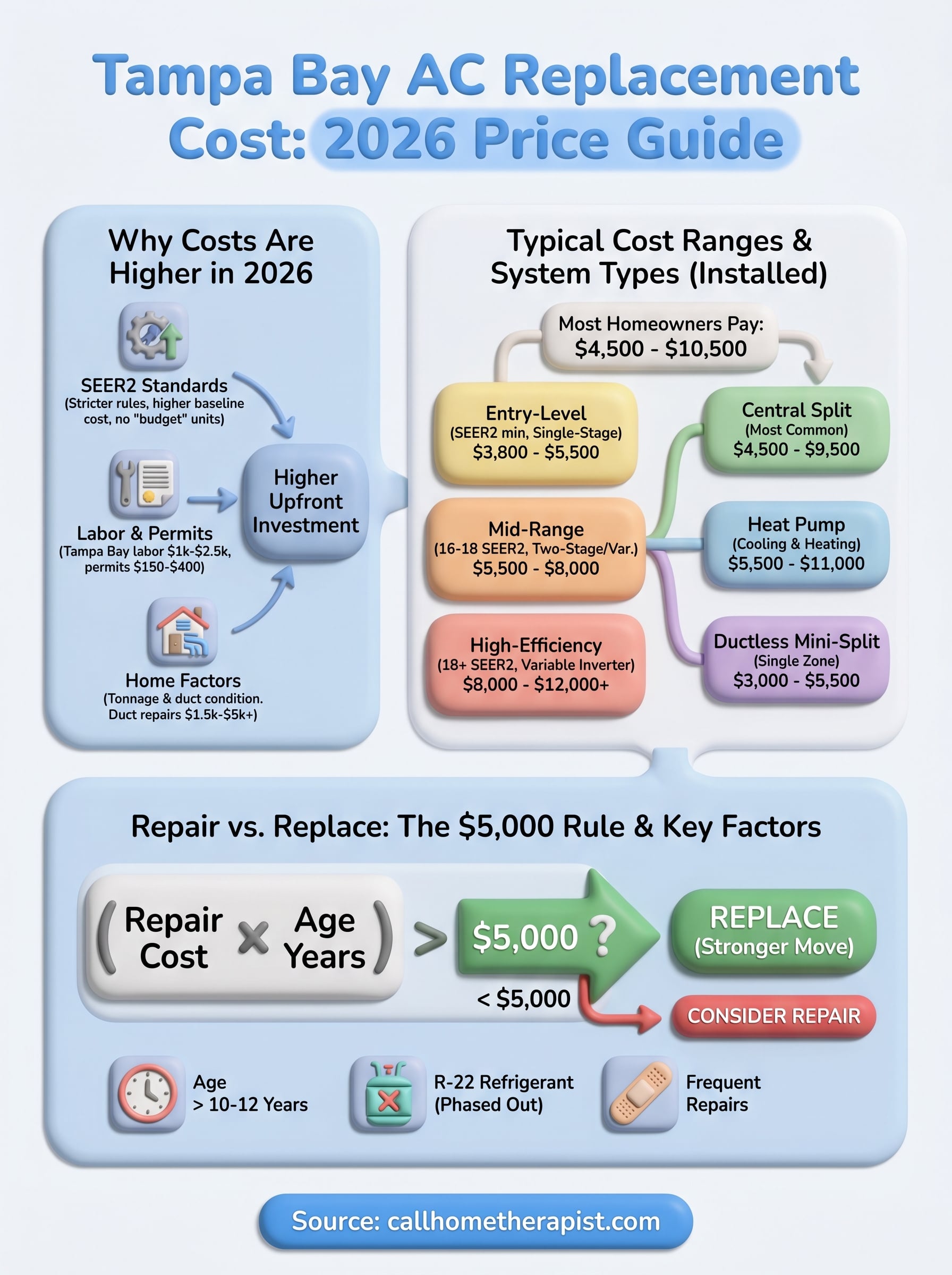
In January 2023, the U.S. Department of Energy enforced new minimum efficiency standards that replaced the old SEER (Seasonal Energy Efficiency Ratio) rating system with SEER2, a stricter testing protocol that reflects real-world performance more accurately. Manufacturers had to redesign equipment to meet these requirements, and those redesigns cost money that passed to homeowners. Systems previously sold at lower price points now require more advanced components to meet the minimum SEER2 threshold of 15.2 for split systems in the Southeast region, which includes Florida.
Units sold before 2023 can still be installed if they’re already in the supply chain, but contractors are increasingly working with SEER2-compliant inventory, which generally costs more upfront.
What this means for you is that true budget equipment has effectively been removed from the legal market for Florida homes. You’re buying a more efficient system than you would have three years ago, but you’re also paying a higher price for that efficiency from day one.
Labor and permitting costs reflect local demand
Florida’s HVAC labor market has stayed tight since 2022, and installation labor in the Tampa Bay area typically runs between $1,000 and $2,500 depending on the complexity of the job. Replacing a system in a straightforward single-story home costs less than a job involving cramped attic access, ductwork modifications, or an electrical disconnect upgrade. Permit fees also factor in, and Hillsborough, Pinellas, and Pasco counties each set their own permit rates for HVAC replacements.
Contractors who pull permits properly add that cost to your invoice, and that’s a good sign, not a reason to find someone cheaper. Work done without permits can create serious problems when you sell your home or file an insurance claim, and the liability falls on you as the homeowner.
System size and home layout affect the total
Choosing the right tonnage for your home is one of the biggest variables in your final cost. An undersized unit runs constantly and fails early, while an oversized unit short-cycles and creates humidity problems. A proper Manual J load calculation accounts for your square footage, ceiling height, insulation quality, window placement, and local climate data to determine the correct system size. Skipping this step is a shortcut that leads to expensive mistakes down the road.
Your home’s existing ductwork condition also plays a significant role. If your ducts are leaking, undersized, or deteriorating, replacing the AC unit without addressing them means running a new system through a compromised delivery network. Duct repairs or full replacements can add $1,500 to $5,000 or more to your total project cost depending on how much of the system needs attention, which is a variable many online cost estimates leave out entirely.
Typical air conditioner replacement cost ranges
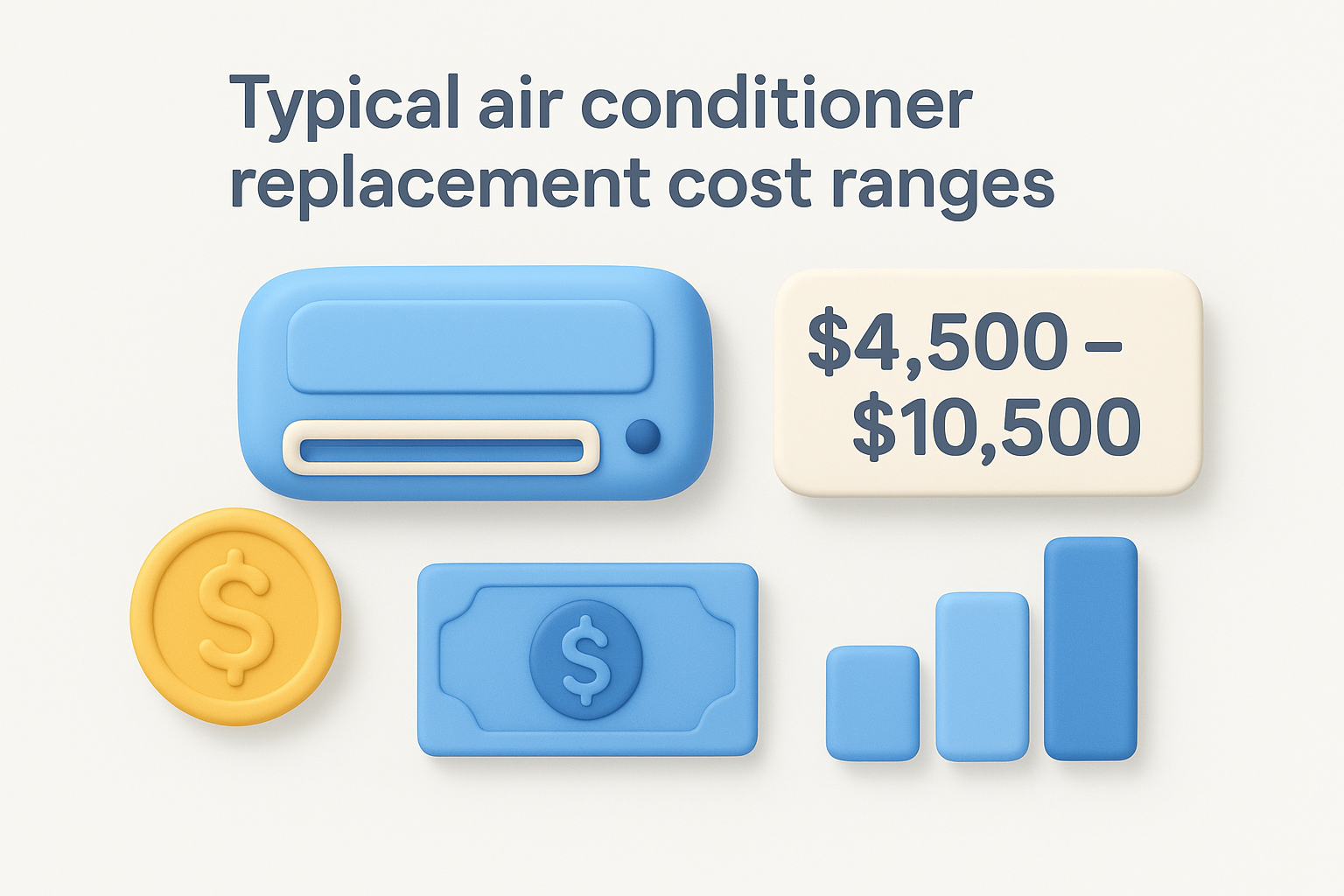
The air conditioner replacement cost in Tampa Bay lands in a wide range, but that range follows a predictable pattern tied to equipment tier and installation complexity. Most homeowners in the area pay between $4,500 and $10,500 for a full system replacement, with costs on either end of that range driven by system size, efficiency rating, and the condition of existing ductwork and electrical components.
Entry-level and mid-range system costs
Entry-level systems that meet the current SEER2 minimums for Florida typically run $3,800 to $5,500 fully installed for a standard 2- to 3-ton single-stage unit in a home with existing, functional ductwork. These systems do the job, but they run at one speed and cycle on and off more frequently in the Florida heat, which puts more wear on the equipment over time.
Mid-range systems with 16 to 18 SEER2 ratings and two-stage or variable-speed compressors fall between $5,500 and $8,000 installed. These units adjust their output based on demand rather than switching fully on or off, which keeps your home more comfortable on the high-humidity days that define a Tampa Bay summer. They also tend to have longer manufacturer warranties and lower monthly utility costs that can offset the higher upfront price within a few years.
A two-stage or variable-speed system often makes more financial sense in Florida than a single-stage unit because it handles humidity control better, which is as important as temperature in this climate.
High-efficiency and premium system costs
High-efficiency systems with SEER2 ratings of 18 or above generally start around $8,000 installed and can reach $12,000 or more for larger homes or premium brand models. These units use variable-speed inverter technology that runs almost continuously at low capacity, which delivers the most consistent temperatures and the lowest energy bills of any central AC option. For homeowners planning to stay in their home for ten or more years, the utility savings and comfort improvements make this tier worth serious consideration.
Premium costs also apply when your job requires electrical panel upgrades, new refrigerant line sets, or significant ductwork modifications, since those additions stack on top of the base equipment and labor price regardless of the system tier you choose.
Cost by system type for Florida homes
Florida’s year-round heat and high humidity eliminate some system types that work well in cooler climates, but they also make certain systems a better fit here than almost anywhere else in the country. The type of equipment you install is one of the biggest drivers of your total air conditioner replacement cost, and knowing what each system type costs and how it performs in Tampa Bay’s specific conditions helps you make the right call before you commit.
Central split systems
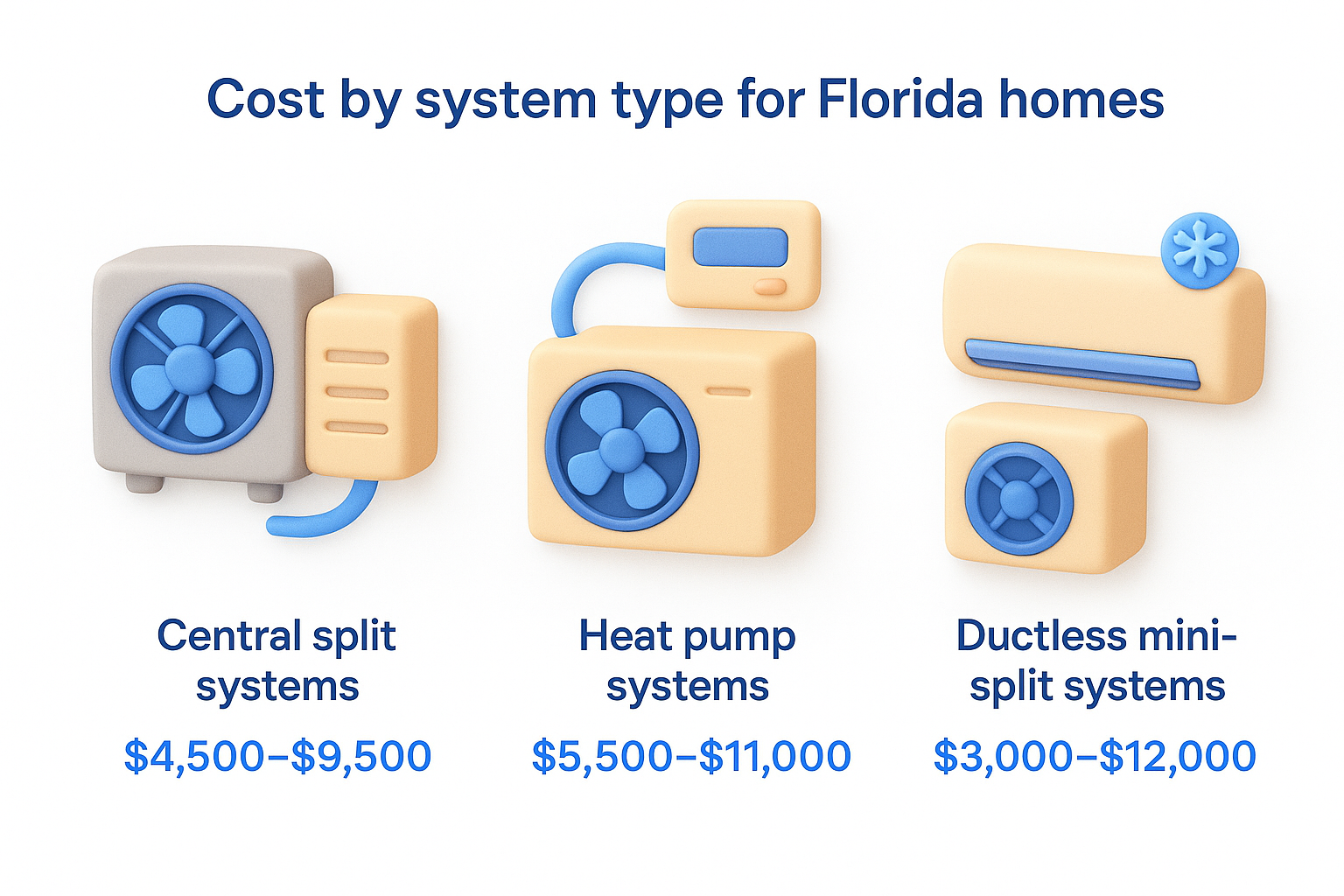
The central split system is the most common setup in Tampa Bay homes. It uses an outdoor condenser unit and an indoor air handler connected through refrigerant lines, with cooled air delivered through your existing ductwork. A standard central split replacement in the Tampa Bay area typically costs $4,500 to $9,500 installed, depending on the tonnage you need and the efficiency rating you choose. This is the system type most homeowners replace like-for-like, which keeps installation complexity lower when your ductwork is already in good condition.
If your home already has functional ductwork, a central split system replacement is almost always the most straightforward and cost-effective path forward.
Heat pump systems
A heat pump handles both cooling and heating from a single unit, which makes it a practical choice for Florida homes that rarely see freezing temperatures. Because Tampa Bay winters stay mild, a heat pump operates efficiently year-round without the performance drop that affects the same systems in colder climates.
Installed costs for a heat pump system typically run $5,500 to $11,000, with variable-speed models sitting at the higher end of that range. The dual-function design also means you’re replacing your heating system at the same time, which reduces the likelihood of a second major equipment expense in the near future.
Ductless mini-split systems
Mini-split systems work without ductwork by delivering conditioned air directly to one or more indoor air handlers mounted on your walls or ceiling. They work best in room additions, converted garages, or areas of your home that your central system doesn’t reach effectively.
A single-zone mini-split installation typically costs $3,000 to $5,500, while a multi-zone system with two or more indoor units can run $7,000 to $12,000 or more depending on how many zones you need. Mini-splits also let you set different temperatures in different spaces, which is useful when certain rooms heat up faster due to sun exposure or limited insulation.
Key factors that change your final price
Your total air conditioner replacement cost isn’t determined by the equipment price alone. Several variables pull that number up or down in ways that a single online estimate can’t capture, and knowing what those variables are helps you evaluate quotes accurately before you commit to a contractor.
Home size and system tonnage
Larger homes need more tonnage to maintain consistent temperatures, and each additional ton adds to both equipment and labor costs. As a general rule, Florida homes need roughly one ton of cooling capacity per 400 to 500 square feet, though that figure shifts based on ceiling height, insulation quality, and the number and size of windows. A proper load calculation is the only way to confirm the right size for your specific home.
Skipping that calculation is a shortcut that costs you more in the long run. An oversized system short-cycles, meaning it cools the space quickly but shuts off before removing enough humidity, which is a significant problem in Tampa Bay’s climate. An undersized unit runs constantly and wears out faster, which cancels out any upfront savings you might have gotten by choosing a smaller unit.
The right tonnage for your neighbor’s home may be wrong for yours, even if the square footage is similar.
Equipment brand and warranty tier
Brand selection affects both the upfront price and the long-term protection you get on parts and labor. Entry-level brands from reputable manufacturers carry standard warranties in the range of five to ten years on parts, while premium product lines from the same manufacturers often include 10-year or even lifetime compressor coverage when registered within the required window after installation. That difference in coverage can shift your decision on which tier makes financial sense.
Installation complexity and site conditions
The physical conditions of your installation site matter as much as the equipment you choose. Difficult attic access, outdated electrical panels, deteriorated refrigerant lines, and existing ductwork problems all add time and material costs to what might look like a straightforward swap. Jobs that require a disconnect box upgrade or refrigerant line set replacement add several hundred dollars to the total before the new unit is even running.
Your contractor should walk through the installation site before providing a final quote. Any estimate given without a site inspection is based on assumptions, and those assumptions tend to get corrected on the invoice.
How to estimate your own replacement cost
Getting a rough number before you call a contractor gives you a baseline that’s harder to talk you away from. You don’t need contractor-level knowledge to build a working estimate. You need your home’s square footage, a general sense of your ductwork condition, and a clear picture of what system tier fits your needs and budget.
Start with your home’s square footage and system size
Most Tampa Bay homes need one ton of cooling per 400 to 500 square feet of conditioned space. A 2,000 square foot home will typically land in the 4- to 5-ton range, though ceiling height and window exposure can shift that. Once you know your likely tonnage, you can map it to the cost tiers covered earlier in this guide: entry-level systems run roughly $4,500 to $5,500 installed, mid-range systems land between $5,500 and $8,000, and high-efficiency units start around $8,000 for standard home sizes.
Use the U.S. Department of Energy’s guidance on cooling load calculations as a starting point if you want to understand the variables a contractor should account for.
Write down your estimated equipment tier cost and tonnage range before you request any quotes. That gives you a point of comparison when contractors present their numbers.
Add likely add-on costs before you call
Your base equipment estimate won’t capture every line item on your final invoice. Add a buffer for permit fees, which typically run $150 to $400 in Hillsborough, Pinellas, and Pasco counties, and factor in at least $500 to $800 for potential refrigerant line set replacement if your current lines are aging. If you know your ductwork has leaks or was installed more than 15 years ago, budget an additional $1,500 to $3,000 for duct repairs.
Use this simple framework to build your own number:
- Base equipment and labor cost (based on your tonnage and efficiency tier)
- Permit fees: $150 to $400
- Refrigerant line set if needed: $500 to $800
- Ductwork repairs if needed: $1,500 to $3,000
- Electrical disconnect or panel upgrade if needed: $300 to $800
Adding these figures together gives you a realistic air conditioner replacement cost range to work with before a single contractor walks through your door. When quotes come in, you’ll know immediately whether the numbers make sense or whether someone is padding the line items.
Repair vs replace: practical decision rules
Deciding whether to fix your current system or commit to a full air conditioner replacement cost is one of the most practical questions you can answer before calling a contractor. The answer isn’t always obvious, but a few straightforward rules give you a clear framework that holds up in most situations.
Use the $5,000 rule to test repair costs
One of the most reliable methods for making this call is multiplying the estimated repair cost by your unit’s age in years. If that number exceeds $5,000, replacement almost always makes more financial sense than continuing to invest in an aging system. For example, a $600 repair on a 12-year-old unit produces a score of $7,200, which points clearly toward replacement.
The $5,000 rule doesn’t account for every situation, but it gives you a consistent reference point that keeps emotion out of a decision that’s easy to second-guess.
This rule works because older systems carry compounding repair risks. A repair that fixes one failing component today doesn’t prevent the next component from failing six months later, and repair costs on systems over 10 years old tend to escalate quickly once the first major breakdown occurs.
Factor in your system’s age and refrigerant type
Florida’s heat runs AC systems harder than most climates, which means the average lifespan of a central AC unit in Tampa Bay runs closer to 10 to 12 years rather than the 15-year figure often quoted for cooler regions. If your system is within a few years of that range, a major repair is a short-term fix on a system that’s already near the end of its useful service life.
Refrigerant type is another critical factor. Systems that use R-22 refrigerant, which the EPA phased out, can no longer be recharged with new refrigerant and require a full replacement. Even if the unit still runs, the refrigerant situation alone makes continued repairs impractical from a cost and availability standpoint.
If your system is over 10 years old, requires a repair costing more than $1,500, runs on R-22, or has needed multiple repairs in the past two years, replacement is the stronger financial move in most cases. A new system comes with a manufacturer warranty and current efficiency standards, which eliminates the unpredictability that defines the final years of an aging unit.
Your next steps
You now have a complete picture of what drives air conditioner replacement cost in the Tampa Bay area, from federal efficiency requirements and equipment tiers to the specific variables that push your final invoice higher or lower. Use the estimation framework in this guide to build your own baseline number before any contractor walks through your door, so you’re comparing quotes from an informed position rather than accepting the first number that sounds reasonable.
If your system is aging, struggling to keep up with Florida’s heat, or has already needed multiple repairs, the next step is getting an accurate, on-site assessment from a licensed technician who will measure your actual installation conditions rather than guess at them. Home Therapist offers free estimates with upfront pricing and no hidden fees, and our team has served the Greater Tampa Bay Area since 2011. Schedule your free AC replacement estimate and get a number you can trust before you decide.
More AC Installation Articles
- Air Conditioner Replacement Estimate: Costs, Factors & Tips
- Air Conditioning Installation Tampa FL, What Tampa Bay Homeowners Should Expect
- Crane-Set Goodman 2 Ton AC Install on Andover Pl S, Sun City Center, FL 33573
- Hurricane Pad, R32 Daikin, and 150-MPH Tie-Downs: AC Installation on Pennsbury Dr, Tampa FL 33624
- Air Conditioner Installation Repair Tampa FL Bay FL Services Review from Bonnie Wakefield


