
Open 24 hours, 7 days a week
FREE estimates and FREE diagnosis
Buying Guide
Navien vs Rinnai Tankless
Two top tankless brands. Both good. Our preferred install is Rheem, but Navien and Rinnai are excellent alternatives. Here’s the real comparison.
Choosing a tankless for your Tampa home? We install and service Navien, Rinnai and Rheem, our preferred brand, and check your gas line and venting before we quote.
Home Therapist serves Tampa Bay, Florida. In the area? FREE estimates and FREE diagnosis.
- Licensed CAC1819196 & CFC1431159
- 4.8 stars from 1,398 reviews
- Background-checked, drug-tested techs
- Hablamos español
At a glance
- Our pick
- Rheem condensing tankless, for local parts availability and warranty support
- Navien
- Best cold-water starts; ComfortFlow models add a buffer tank and recirculation
- Rinnai
- Fires at a lower flow and has wide parts supply; needs polypropylene vent
- Minimum flow to fire
- Navien 0.5 GPM, Rinnai 0.4 GPM
- Venting
- Navien can run on PVC; Rinnai’s polypropylene vent is quoted in writing
- Gas line
- Condensing tankless needs a 3/4-inch line; any upgrade is quoted in writing
- Upkeep
- A descaling flush once a year in Tampa hard water, $89
- Estimate
- FREE in-home quote; we check gas, venting and demand first

Reviewed by Alejandro Morales, Co-Owner & FL Certified Plumbing Contractor (FL license CFC1431159)
Cold-Water Sandwich Behavior
The cold-water sandwich effect is one of the most frustrating quirks of any tankless water heater, and understanding how each brand handles it makes a real difference in Tampa Bay homes. A cold-water sandwich happens when you turn the hot water off briefly (say, to soap up in the shower or rinse a dish), then turn it back on. The residual hot water in the pipe comes out first, followed by a slug of cold water that was sitting in the heat exchanger while the unit was off.
Navien attacks this problem head-on with their ComfortFlow-equipped series, which includes a built-in buffer tank and internal recirculation pump as standard equipment. The small internal reservoir holds a few cups of pre-heated water that gets pushed out first when flow resumes, eliminating the cold sandwich entirely.
Rinnai takes a different approach. The standard RU and RUR series do not include a buffer tank, so to get the same sandwich-free experience you need to add either the Circ-Logic feature with a dedicated return line or an aftermarket under-sink recirculation pump with a crossover valve. Retrofitting a return line in a slab-on-grade Tampa home is often impractical without opening walls, so the under-sink pump becomes the default workaround at an extra $400 to $700 installed.
Minimum Flow Rate Activation
Every tankless water heater needs a minimum flow rate across its flow sensor before the burner fires. Fall below that threshold and the unit thinks no hot water is being called for, so it shuts down.
Navien NPE units activate at 0.5 GPM. Rinnai RU and RUR series activate at 0.4 GPM. On paper that is a tiny 0.1 GPM gap, but in practice Tampa homes are now full of WaterSense-certified 1.5 GPM bathroom faucets, 1.8 GPM rain showerheads, and low-flow kitchen aerators that put you right on the edge of that activation threshold.
If your home is loaded with WaterSense low-flow fixtures, Rinnai’s 0.4 GPM activation point gives you meaningful headroom.
Vent Material Requirements
Vent material is one of the biggest hidden cost drivers in a tankless install, and the two brands diverge sharply here.
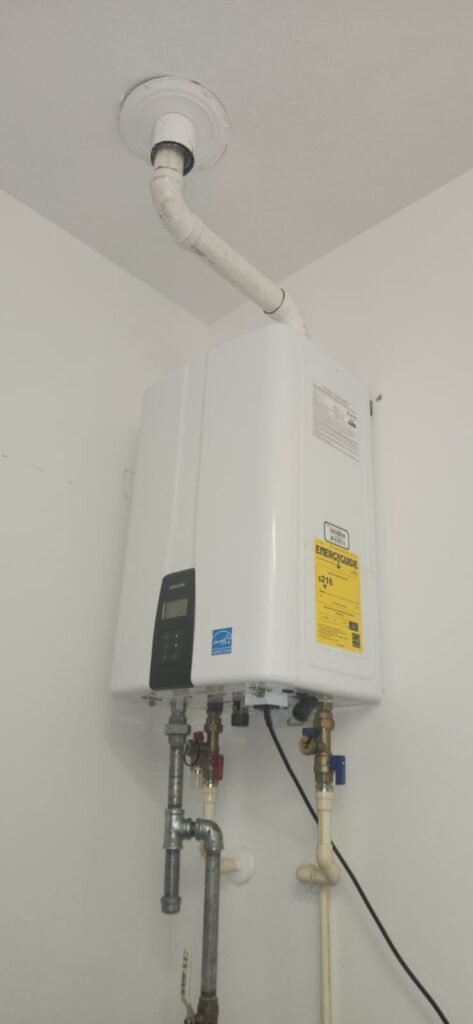
Navien’s condensing tankless units are certified for Schedule 40 PVC, CPVC, and polypropylene. In Tampa Bay, that means we can run 2-inch or 3-inch PVC straight from the nearest Home Depot or Ferguson. Material cost for a typical 15-foot run sits around $60 to $90.
Rinnai requires UL-1738 listed polypropylene (PPs) vent systems such as Centrotherm InnoFlue or M&G DuraVent PolyPro. PPs is a high-temperature engineered plastic with gasket-sealed joints. Material alone runs $25 to $45 per foot plus specialty fittings, adding $300 to $500 to the install compared to PVC.
Rheem Performance Platinum: The Third Option
We install plenty of Navien and Rinnai units when a customer specifically requests them, but the brand we actively recommend to most Tampa Bay homeowners is Rheem. The Rheem Performance Platinum condensing tankless line, available in natural gas and liquid propane configurations, is our preferred install.
On spec, Rheem’s Performance Platinum condensing tankless line delivers up to 9.5 GPM at a 35-degree temperature rise, which is plenty for a 3-bath Tampa home running two showers and a dishwasher simultaneously. Uniform Energy Factor (UEF) sits at 0.94, matching Navien and beating most Rinnai condensing models by a hair. The heat exchanger is commercial-grade stainless steel with a 12-year warranty, tying Rinnai’s top-tier warranty and beating Navien’s 10-year coverage by two full years.
The real difference is parts availability and local service infrastructure. Rheem is the dominant water heater brand in Florida. Ferguson on Hillsborough Avenue stocks Rheem flow sensors, igniters, gas valves, and heat exchangers as counter items. When a Navien flow sensor fails on a Sunday morning, we are looking at a 2 to 5 business day wait for overnight shipping from the distributor in Irvine. When a Rheem sensor fails, we pick up the part before lunch and have you showering by dinner.
Installed cost for Rheem’s Performance Platinum condensing tankless line runs $3,654 to $4,066 depending on vent routing, gas line condition, and condensate drain access. FREE estimates and FREE diagnosis on every quote.
Install Costs and Tampa Gas Line Realities
A typical Tampa Bay gas tankless install runs $2,938 to $4,660, from a Rheem (Premium) at the low end to a Navien (Elite) at the top.
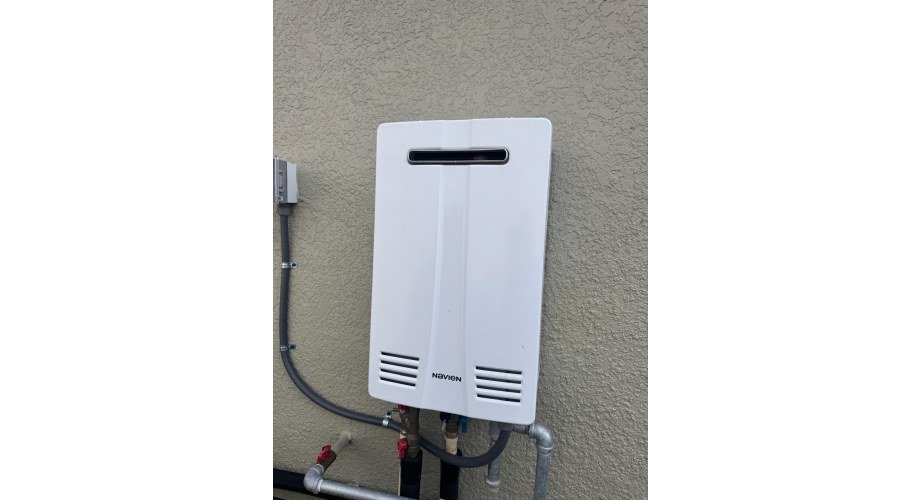
Most Tampa homes built between 1980 and 2005 were plumbed with 1/2-inch black iron gas line running to a 40,000 BTU tank water heater. A condensing tankless needs 180,000 to 199,000 BTU, which demands 3/4-inch line from the meter to within a few feet of the unit. Upgrading that line through a Tampa slab home typically runs $600 to $1,200.
Vent routing is the other variable. Exterior sidewall termination through the garage wall is the fastest and cheapest path. Roof termination through the attic adds roughly $400 for flashing, storm collar, and the longer vent run.
Permits run through Hillsborough County, Pinellas County, or the City of Tampa building department, and the permit fee is billed separately.
What Tampa Bay customers say
“I had the best experience with this company. From the free estimate to everything in between. I have my beautiful new water heater and more room under my sink when he took the old broken one out. Lester was wonderful and explained everything to me. Highly recommend them.”
“Happy with the service and excellent communication with Home Therapist for help with a plumbing/ drain issue. Can recommend!”
4.8 from 1,398 reviews · Read more reviews
Where we work
We serve the three counties of Tampa Bay from our shop at 1408 W Linebaugh Ave in Tampa.
Hillsborough County
Tampa, Brandon, Riverview, Carrollwood, Town ’n’ Country, Plant City, Ruskin, Sun City Center, Apollo Beach, Valrico, Lutz, Seffner
Pinellas County
St. Petersburg, Clearwater, Largo, Dunedin, Oldsmar, Safety Harbor, Pinellas Park, Seminole, Tarpon Springs, Treasure Island, St. Pete Beach
Pasco County
Wesley Chapel, Land O’ Lakes, New Port Richey, Holiday, Hudson, Trinity, Zephyrhills, Dade City
Water heaterI had the best experience with this company. From the free estimate to everything in between. I have my beautiful new water heater and more room under my sink when he took…
Water heaterI had a great experience with Home Therapist Cooling, Heating, and Plumbing. We were getting our house ready to sell and the home inspection identified several plumbing issues that needed to be…
MaintenanceGreat Team. Arrive on Time and do complete maintenance on our system. Recommend to anyone looking for quality service.
PlumbingHappy with the service and excellent communication with Home Therapist for help with a plumbing/ drain issue. Can recommend!
AC repairI have the Service Maintenance Plan with them for my a/c and plumbing, their visit was pleasant making sure all was clean and functioning properly. I pay monthly $20 of which is…
PlumbingExcellent service and fair pricing from Home Therapist. Their quote was $180 less than similar plumbing company for simple disposal replacement. Plumber arrived promptly, worked efficiently, and answered all of my questions…
AC installI was in need of air conditioning for my detached garage. My AI search for the most trustworthy mini-split AC installer led me to Home Therapist; my expectations were exceeded. Scheduling a…
AC installExcellent service from Richard! He was professional, courteous, and very knowledgeable. He fixed my A/C problem quickly and explained everything clearly. I highly recommend Richard for anyone needing A/C service. had a…
AC repairI had a great experience with Home Therapist AC Repair. Alejandro arrived on time to diagnose why my AC wasn't cooling and quickly found the problem that the previous company had missed.…