
Open 24 hours, 7 days a week
FREE estimates and FREE diagnosis
Buying Guide
Single-Stage vs Two-Stage vs Variable-Speed AC
Compressor technology affects everything: efficiency, humidity control, quiet operation, and equipment lifespan. Here’s what each means for Tampa homes.
Choosing a new AC for a humid Tampa home? We size your house with a Manual J load calc and price single-stage, two-stage and variable-speed side by side.
Home Therapist serves Tampa Bay, Florida. In the area? FREE estimates and FREE diagnosis.
- Licensed CAC1819196 & CFC1431159
- 4.8 stars from 1,398 reviews
- Background-checked, drug-tested techs
- Hablamos español
At a glance
- Our pick
- Two-stage (Goodman Premium), for better humidity control than single-stage
- Single-stage (Goodman Value)
- $7,459 installed for a 3-ton system
- Two-stage (Goodman Premium)
- $9,331 installed for a 3-ton system
- Variable-speed (Daikin Elite)
- $15,500 to $15,925 installed for a 3-ton system
- Humidity control
- Single-stage basic, two-stage better, variable-speed best
- Refrigerant
- New Goodman and Daikin systems use R-32
- Permit
- We pull it; the permit fee is billed separately
- Estimate
- FREE in-home estimate with a Manual J load calc

Reviewed by Richard Morales, Co-Owner & FL Class B Air Conditioning Contractor (FL license CAC1819196)
Compressor Staging Explained: How Each Type Modulates Capacity
Stage count is just a fancy way of saying how many speeds your outdoor compressor can run at. That single spec drives almost everything you feel inside the house: humidity, temperature swings, noise, and how often the unit kicks on and off. After 15+ years working Tampa Bay attics and equipment pads, here is how each one actually behaves under our climate load.
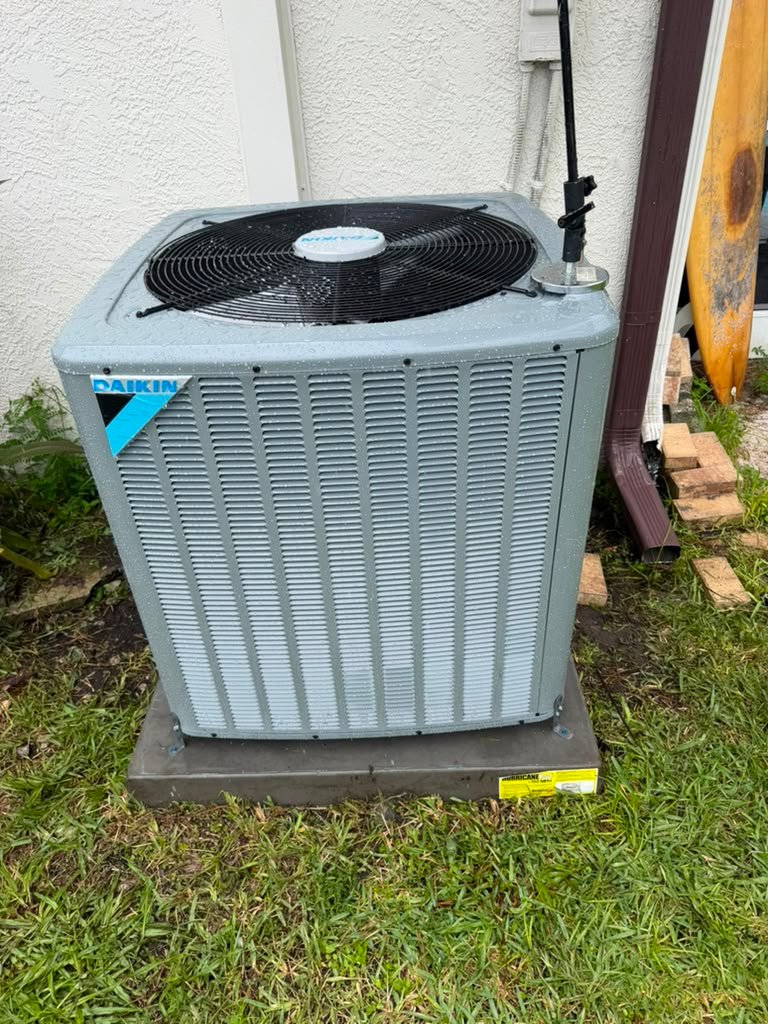
Single-stage uses a fixed-speed scroll compressor. It is either running at 100% capacity or it is off. There is no middle gear. When the thermostat calls for cool, the compressor slams on at full tilt, drives the indoor temp down fast, then shuts off. In Tampa shoulder season (March, October, mild April mornings), a properly sized single-stage 3-ton will short cycle 12 to 18 times per hour because it overshoots the setpoint and clicks off before the coil has time to wring real moisture out of the air. In peak August heat with a heavy load, the same unit will only cycle 4 to 6 times per hour because the house never catches up.
Two-stage uses the same scroll compressor but adds an unloader valve (or a second compressor head on some platforms). It runs at roughly 67% capacity on low stage and 100% on high stage. The thermostat lets it cruise on low for the first 8 to 12 minutes of each call, then ramps to high only if the house is not catching up. In Tampa, a two-stage spends roughly 70% of its annual runtime on the low stage, which means longer, gentler cycles and better moisture removal than single-stage gives you.
Variable-speed (inverter) uses a rotary or scroll inverter compressor driven by a variable frequency drive (VFD). Instead of two preset speeds, it modulates from about 30% all the way to 100% in roughly 1% increments. The system reads supply air temperature, return temperature, indoor humidity, and outdoor temperature, then settles into whatever output exactly matches the load. On most Tampa days, a variable-speed AC will run continuously at 40 to 60% capacity for hours at a time. The compressor never slams on, never slams off, and the indoor coil stays cold long enough to pull serious water out of the airstream.
What We Recommend (and Why)
Pick two-stage (Goodman Premium) for most Tampa homes: $9,331 installed for 3-ton. Significantly better humidity control than single-stage. 2-4 year payback on efficiency gains.
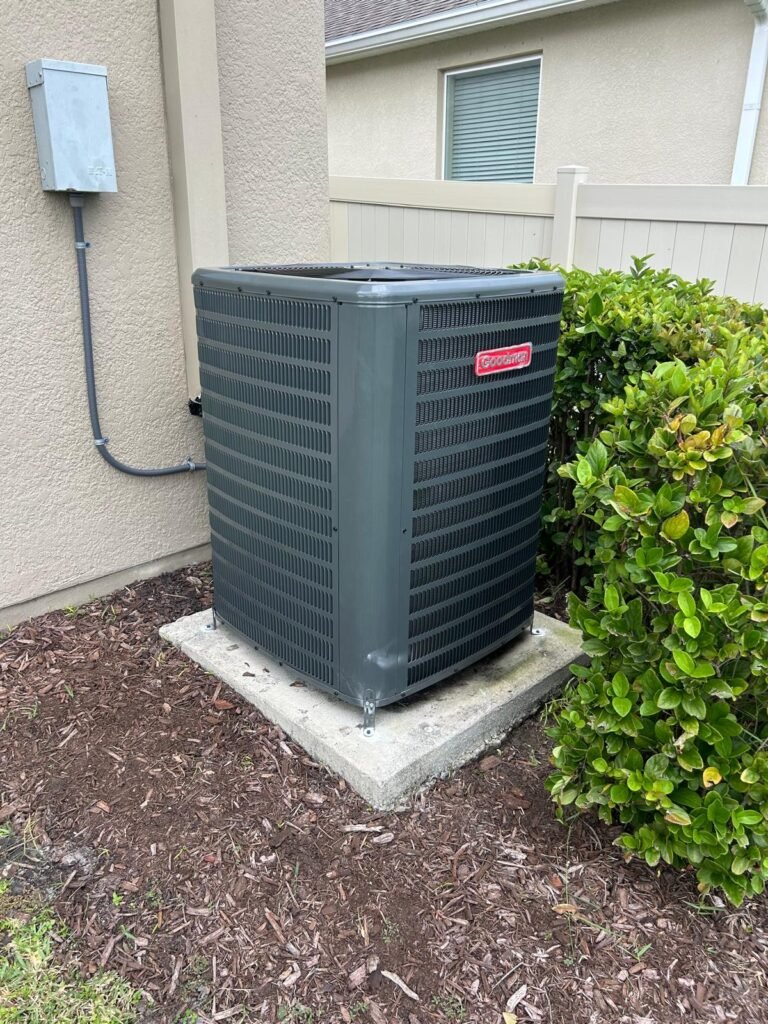
Pick variable-speed (Daikin Elite) if: coastal location, humidity-sensitive family (asthma, allergies), quiet operation matters, staying 15+ years. $15,500 to $15,925 installed. Industry-best warranty.
Pick single-stage (Goodman Value) if: budget-tight, short-term owner, small home. Still meets Florida code, still installed with 10-year parts warranty. Fine choice for the right situation.
What Tampa Bay customers say
“Great Team. Arrive on Time and do complete maintenance on our system. Recommend to anyone looking for quality service.”
“They have been amazing from the quote to the installation. They were able to accommodate us last minute. Made all the updates needed and in less than 5hrs we had a new HVAC unit installed. We'll be using them for all of our upgrades”
4.8 from 1,398 reviews · Read more reviews
Where we work
We serve the three counties of Tampa Bay from our shop at 1408 W Linebaugh Ave in Tampa.
Hillsborough County
Tampa, Brandon, Riverview, Carrollwood, Town ’n’ Country, Plant City, Ruskin, Sun City Center, Apollo Beach, Valrico, Lutz, Seffner
Pinellas County
St. Petersburg, Clearwater, Largo, Dunedin, Oldsmar, Safety Harbor, Pinellas Park, Seminole, Tarpon Springs, Treasure Island, St. Pete Beach
Pasco County
Wesley Chapel, Land O’ Lakes, New Port Richey, Holiday, Hudson, Trinity, Zephyrhills, Dade City
MaintenanceGreat Team. Arrive on Time and do complete maintenance on our system. Recommend to anyone looking for quality service.
PlumbingHappy with the service and excellent communication with Home Therapist for help with a plumbing/ drain issue. Can recommend!
AC repairI have the Service Maintenance Plan with them for my a/c and plumbing, their visit was pleasant making sure all was clean and functioning properly. I pay monthly $20 of which is…
PlumbingExcellent service and fair pricing from Home Therapist. Their quote was $180 less than similar plumbing company for simple disposal replacement. Plumber arrived promptly, worked efficiently, and answered all of my questions…
Water heaterI had the best experience with this company. From the free estimate to everything in between. I have my beautiful new water heater and more room under my sink when he took…
Water heaterI had a great experience with Home Therapist Cooling, Heating, and Plumbing. We were getting our house ready to sell and the home inspection identified several plumbing issues that needed to be…
AC installI was in need of air conditioning for my detached garage. My AI search for the most trustworthy mini-split AC installer led me to Home Therapist; my expectations were exceeded. Scheduling a…
AC installExcellent service from Richard! He was professional, courteous, and very knowledgeable. He fixed my A/C problem quickly and explained everything clearly. I highly recommend Richard for anyone needing A/C service. had a…
AC repairI had a great experience with Home Therapist AC Repair. Alejandro arrived on time to diagnose why my AC wasn't cooling and quickly found the problem that the previous company had missed.…