

Tankless Vs Tank Water Heater: Pros, Cons, Costs & Lifespan
Your water heater accounts for roughly 20% of your home’s energy costs, and if it’s time for a replacement, the choice between a tankless vs tank water heater matters more than most homeowners realize. Pick the wrong one, and you’re stuck with higher utility bills or an upfront cost that doesn’t pay off for your household size and hot water habits.
Both systems have clear strengths and real drawbacks. A traditional tank water heater costs less to install, but a tankless unit can last nearly twice as long and cut energy use significantly. The right call depends on your home’s demand, your budget, and how long you plan to stay in the house.
At Home Therapist, we’ve installed and serviced both types across the Greater Tampa Bay Area since 2011. We’ve seen what works, and what homeowners regret, in Florida’s unique climate. This guide breaks down the pros, cons, costs, and lifespan of each system so you can make a confident, informed decision before scheduling your installation.
Why the difference matters for Tampa Bay homes
Tampa Bay’s climate and water conditions create specific factors that make the tankless vs tank water heater decision different from what you’d face in colder northern states. Florida’s heat, high humidity, and hard water supply all affect how each system performs, how long it lasts, and what it costs to run month after month. Understanding those local factors first helps you make a smarter choice before you spend a dollar on equipment.
Florida’s year-round heat changes the energy math
In colder climates, a tank water heater fights "standby heat loss" constantly, reheating stored water as it cools against the surrounding air. In Tampa Bay, ambient temperatures rarely drop below 60°F, even in January, which means your tank loses less heat overnight than it would in a northern home. That explains why energy savings from tankless units are real here but sometimes fall short of the national averages manufacturers advertise.
Florida homeowners run air conditioning for most of the year, though, and every bit of waste heat your water heater produces adds to your cooling load. A tankless unit generates heat only when you turn on a tap, so it puts less residual warmth into your living space, which your AC then doesn’t have to remove.
In Tampa Bay’s climate, the long-term advantage of a tankless system isn’t only hot water efficiency. It’s also reducing the heat your cooling system has to offset throughout the year.
Hard water shortens equipment life faster here
Tampa Bay’s municipal water supply carries high concentrations of calcium and magnesium. These minerals deposit inside water heaters over time through a process called scaling. Inside a tank unit, sediment collects at the bottom, reducing heating efficiency and speeding up corrosion. Inside a tankless unit, scale forms on the heat exchanger and restricts flow, which can trigger overheating or automatic shutdowns.
Both systems need maintenance to handle mineral buildup, but tankless heaters are more sensitive to it. An annual descaling flush is not optional in Tampa’s water environment. Skip it for a few years and you’ll cut the lifespan of a tankless unit well below the 20-year mark manufacturers promise. A tank heater tolerates neglect better, but it still benefits from a yearly drain and flush to clear accumulated sediment.
Household size and simultaneous demand shift the comparison
Florida households frequently run multiple fixtures at the same time, especially during morning routines or when guests are staying over. Tank water heaters store a fixed supply, typically 40 to 80 gallons, and once that runs out, you wait 30 to 45 minutes for recovery. A tankless system delivers hot water continuously with no storage limit, but it has a flow rate ceiling measured in gallons per minute.
If your home regularly runs two showers alongside a dishwasher, a single standard tankless unit may struggle to keep up without a noticeable drop in temperature. Larger Tampa Bay homes sometimes need two tankless units or a higher-output model, which adds to the upfront cost. Sizing the system correctly for your actual peak demand, rather than your average use, is what separates a water heater that performs well from one that frustrates you every morning.
How tank and tankless water heaters work
Before you can make a smart choice in the tankless vs tank water heater debate, you need to understand what’s actually happening inside each unit. The two systems heat water through completely different processes, and those differences explain everything from their energy consumption to their hot water delivery limits, installation requirements, and long-term maintenance needs.
How a tank water heater works
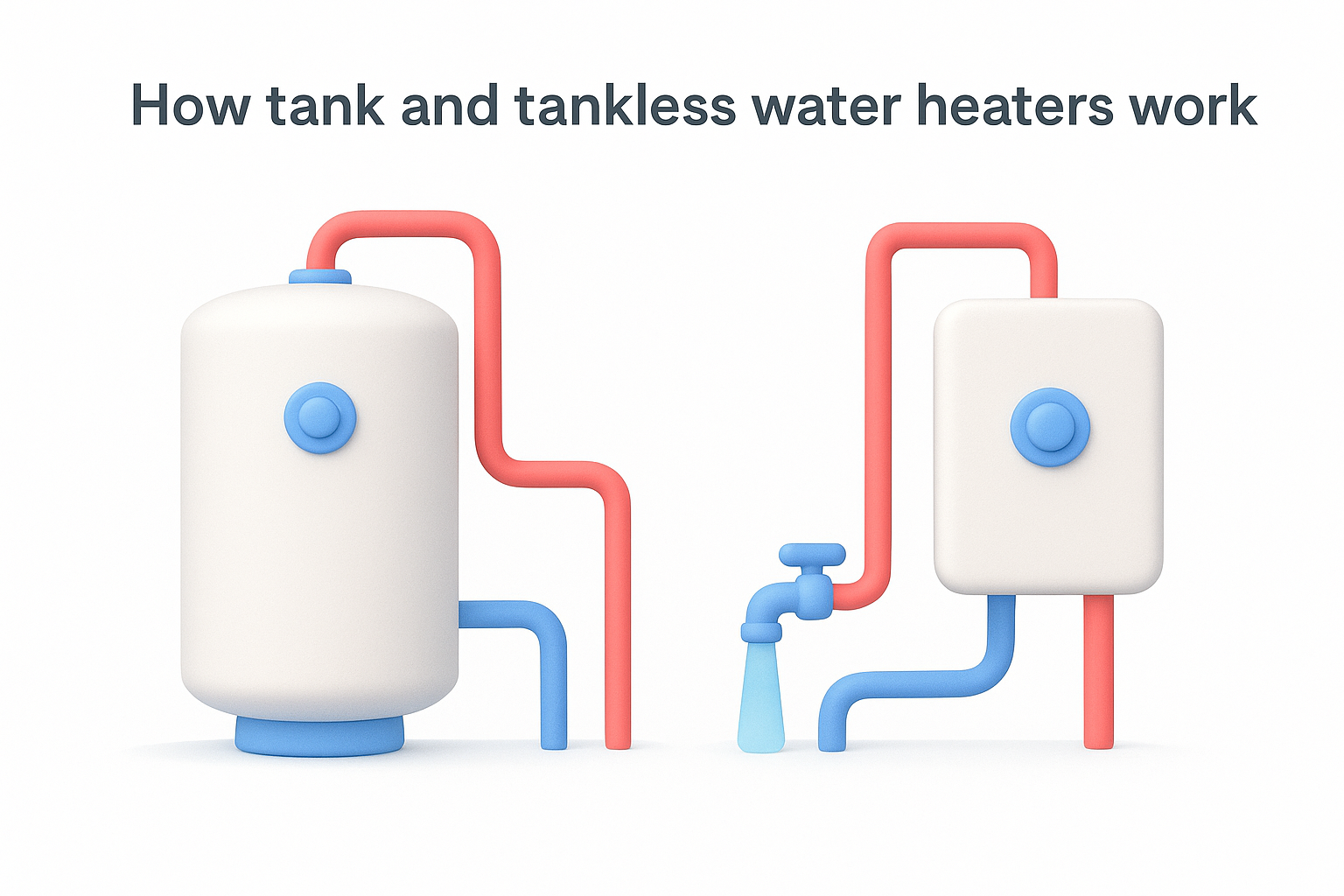
A tank water heater stores a large volume of water, typically between 40 and 80 gallons, inside an insulated steel tank. A heating element or gas burner cycles on periodically to maintain your set temperature, usually around 120°F. When you open a hot tap, preheated water flows out of the top of the tank while cold water enters the bottom to replace it.
The biggest limitation here is recovery time. Once you drain the stored supply, your tank needs 30 to 45 minutes to reheat the incoming cold water before you get reliable hot flow again. The advantage is that delivery pressure and temperature stay consistent and predictable because the water is already at temperature before you ever turn on the faucet.
How a tankless water heater works
A tankless unit, also called an on-demand water heater, stores nothing. When you open a hot tap, cold water flows directly through the unit and passes over a high-powered heat exchanger that brings it to your target temperature in seconds. The moment you close the tap, the system shuts off completely with no stored water left to lose heat overnight.
Because a tankless heater only fires when you need hot water, it eliminates the standby energy loss that a tank heater produces 24 hours a day.
This design delivers continuous hot water with no storage ceiling, but it requires enough flow rate capacity to handle simultaneous demand in your home. Tankless units carry a gallons-per-minute rating, and a model sized for a two-person household may struggle to keep pace with a larger family running two showers and a dishwasher at the same time. Matching the unit’s output to your actual peak demand, rather than just your average use, determines whether the system performs reliably or frustrates you daily.
Upfront costs and installation factors
When you weigh the tankless vs tank water heater decision on price alone, the gap is significant. A traditional tank unit costs less to buy and less to install, which makes it the default choice for homeowners on a tight budget or a short timeline. But the full installation cost isn’t just the price tag on the unit itself. Labor, permits, and any upgrades to your existing gas line or electrical panel can push both systems well beyond their advertised prices.
What a tank water heater costs to buy and install
A standard 40- to 50-gallon gas or electric tank water heater runs between $400 and $900 for the unit, depending on brand, fuel type, and efficiency rating. Add licensed installation labor in the Tampa Bay area, and your total installed cost typically lands between $700 and $1,500. That range assumes your existing connections are in good shape and no code upgrades are needed, which is the case for most straightforward replacements.
If your current unit is a standard tank heater being replaced like-for-like, installation is usually straightforward and can often happen the same day.
One cost many homeowners overlook is the expansion tank, which Florida plumbing code now requires in closed water systems. If your home doesn’t already have one, your installer will add it during the replacement, which typically adds $50 to $150 to the final bill.
What a tankless water heater costs to buy and install
Tankless units carry a noticeably higher purchase price, with quality gas-powered models ranging from $700 to $1,800 before installation. Electric tankless heaters cost less upfront but often require a panel upgrade to support the additional electrical load, which can add $500 to $1,500 on its own. Gas models may also need a larger supply line to handle the higher BTU demand the unit requires during peak flow.
Total installed costs for a tankless system in Tampa Bay commonly fall between $1,500 and $3,500, depending on what your existing infrastructure supports. That gap compared to a tank replacement is real, and it’s worth calculating carefully against your projected long-term savings before you commit to the upgrade.
Energy use and monthly operating costs
Both systems heat water, but they do it through completely different processes, and that difference shows up on your utility bill every month. In the tankless vs tank water heater comparison, energy use is where most homeowners expect the biggest gap, and while tankless units do win on efficiency, your actual monthly savings depend heavily on household consumption habits and the fuel type powering your unit.
How each system consumes energy
A tank water heater runs its burner or heating element repeatedly throughout the day and night to maintain water temperature inside the tank, even when nobody is home and no hot water is being used. This constant reheating is called standby heat loss, and the U.S. Department of Energy estimates it accounts for 10 to 20 percent of a home’s total water heating costs.
Tankless units eliminate standby loss entirely because they only fire when you open a tap. Gas-powered tankless heaters carry a significantly higher energy factor than standard tank models, and the Department of Energy estimates they can be 24 to 34 percent more energy efficient for homes that use less than 41 gallons of hot water per day.
For households using over 86 gallons daily, the efficiency advantage narrows to around 8 to 14 percent, so your real savings depend on how much hot water your family actually uses.
What to expect on your monthly utility bill
For a typical Tampa Bay household running a 40-gallon gas tank heater, you’re looking at roughly $25 to $40 per month in water heating costs. A comparable gas tankless system can bring that figure down to $18 to $28 per month, depending on your usage patterns and current gas rates.
Electric tankless heaters often look attractive on paper, but electricity rates in Florida mean the monthly operating cost can match or even exceed a gas tank heater, especially if your household runs multiple fixtures simultaneously. Checking your current utility rates and calculating the break-even point against the higher upfront installation cost before choosing a fuel type keeps you from making a decision you’ll regret once the bills start arriving.
Performance and sizing for your household
Performance in the tankless vs tank water heater debate comes down to one core question: how much hot water does your household need at the same time, not just over the course of a day? Both systems can meet your daily hot water demand, but they fail in very different ways when you push them beyond their design limits. Understanding peak demand versus average daily use is what separates a system that performs reliably from one that leaves someone in a cold shower.
Flow rate and peak demand with tankless systems
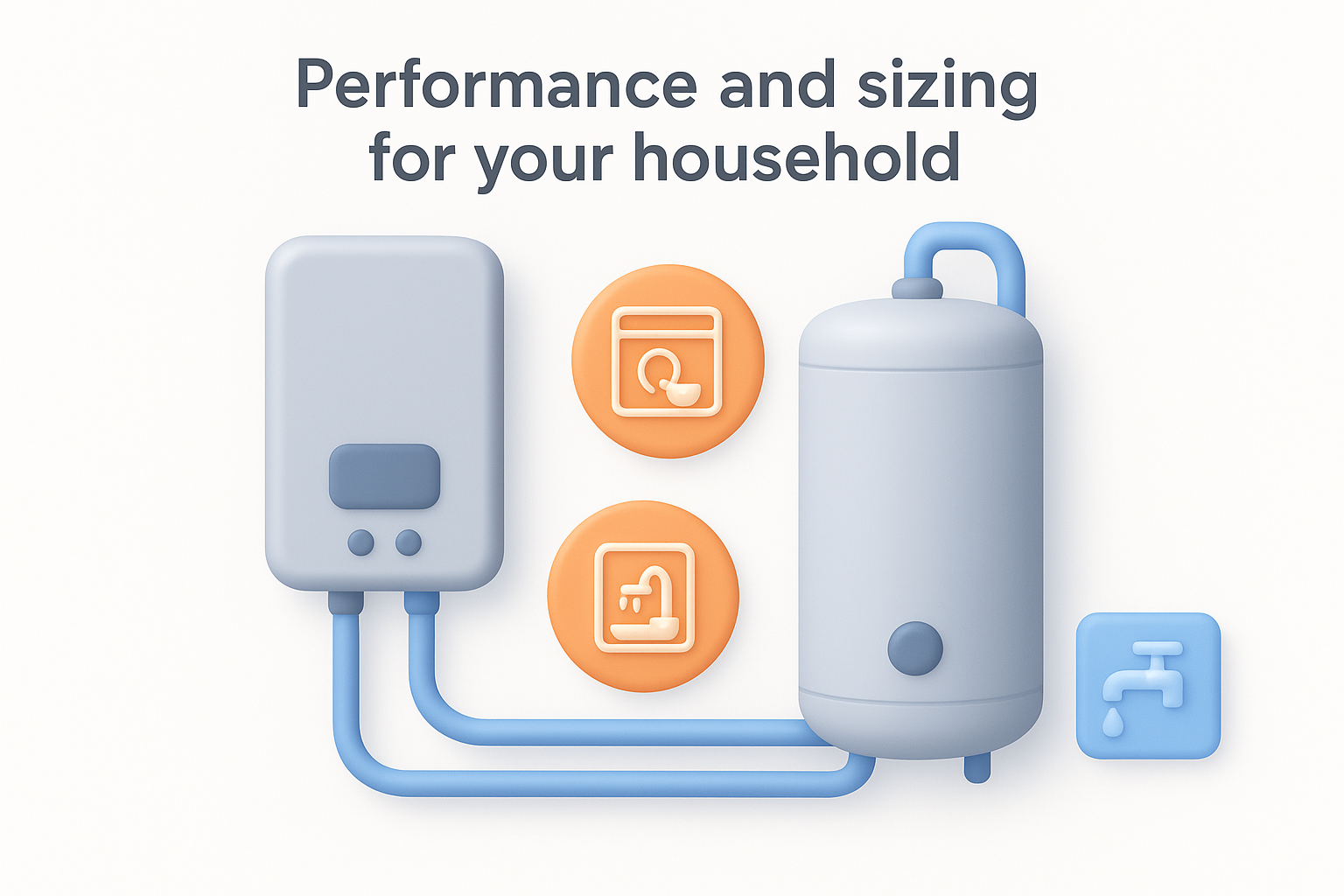
A tankless water heater delivers hot water continuously, but it only heats as much as it can process at one time. Flow rate, measured in gallons per minute (GPM), is the number that determines whether your unit keeps up when multiple fixtures run simultaneously. A standard shower uses about 2 GPM, and a dishwasher adds another 1 to 2 GPM on top of that. A tankless unit rated at 6 to 8 GPM handles most households comfortably, but larger homes with four or more occupants regularly running simultaneous fixtures may need a higher-output model or a second unit installed in parallel.
Sizing a tankless unit to your average daily use instead of your peak simultaneous demand is one of the most common mistakes homeowners make before installation.
Tank size and recovery rate for storage systems
Tank water heaters rely on stored volume and recovery speed rather than live flow rate. A 40-gallon tank suits a one- or two-person household without much strain. Families of three to four typically need a 50-gallon unit, and larger households should look at 75- to 80-gallon options to avoid running out during busy morning routines. Recovery rate matters just as much as tank size. A faster first-hour rating means your tank replenishes hot water more quickly after heavy use, which reduces the wait time between back-to-back showers.
Choosing the right tank size for your actual household size prevents the two most common complaints: running out of hot water with a tank that’s too small, or paying to heat water you never use with one that’s too large.
Lifespan, maintenance, and common issues
In the tankless vs tank water heater comparison, lifespan and maintenance are where the long-term math really plays out. A system that costs more upfront but lasts twice as long changes the value equation significantly, but only if you stay on top of the maintenance that keeps it running at full capacity.
How long each system lasts
Tank water heaters typically last 8 to 12 years with standard use and basic annual maintenance. Once you start seeing rust-colored water, inconsistent temperatures, or pooling around the base of the unit, those are reliable signs the tank is nearing the end of its service life. In Tampa Bay’s hard water environment, sediment buildup accelerates corrosion at the bottom of the tank, often pushing replacements closer to the 8-year mark for homeowners who skip annual flushes.
Tankless water heaters last considerably longer, with most quality gas-powered units reaching 18 to 20 years under normal use. That extended lifespan factors directly into the total cost of ownership. Over a 20-year period, you’d likely replace a tank unit two or three times at the cost of a single tankless installation.
Lifespan estimates from manufacturers assume proper annual maintenance. In Tampa Bay’s hard water conditions, skipping that maintenance can cut years off either system.
Maintenance requirements and common issues
Both systems require annual attention to perform reliably, but the type of maintenance differs between them. A tank water heater needs a yearly drain and flush to clear settled minerals from the bottom, along with an anode rod inspection every two to three years. The anode rod is a sacrificial metal component inside the tank that absorbs corrosion before it reaches the steel shell. Replacing it on schedule can add years to the tank’s usable life.
Tankless units require an annual descaling flush using a food-grade descaling solution circulated through the heat exchanger to dissolve mineral deposits. In Tampa Bay specifically, skipping this step allows calcium buildup to restrict water flow, trigger error codes, and eventually crack the heat exchanger entirely. Inlet filters on the cold water supply line also need periodic cleaning to prevent debris from entering the unit and causing premature wear.
Final takeaways
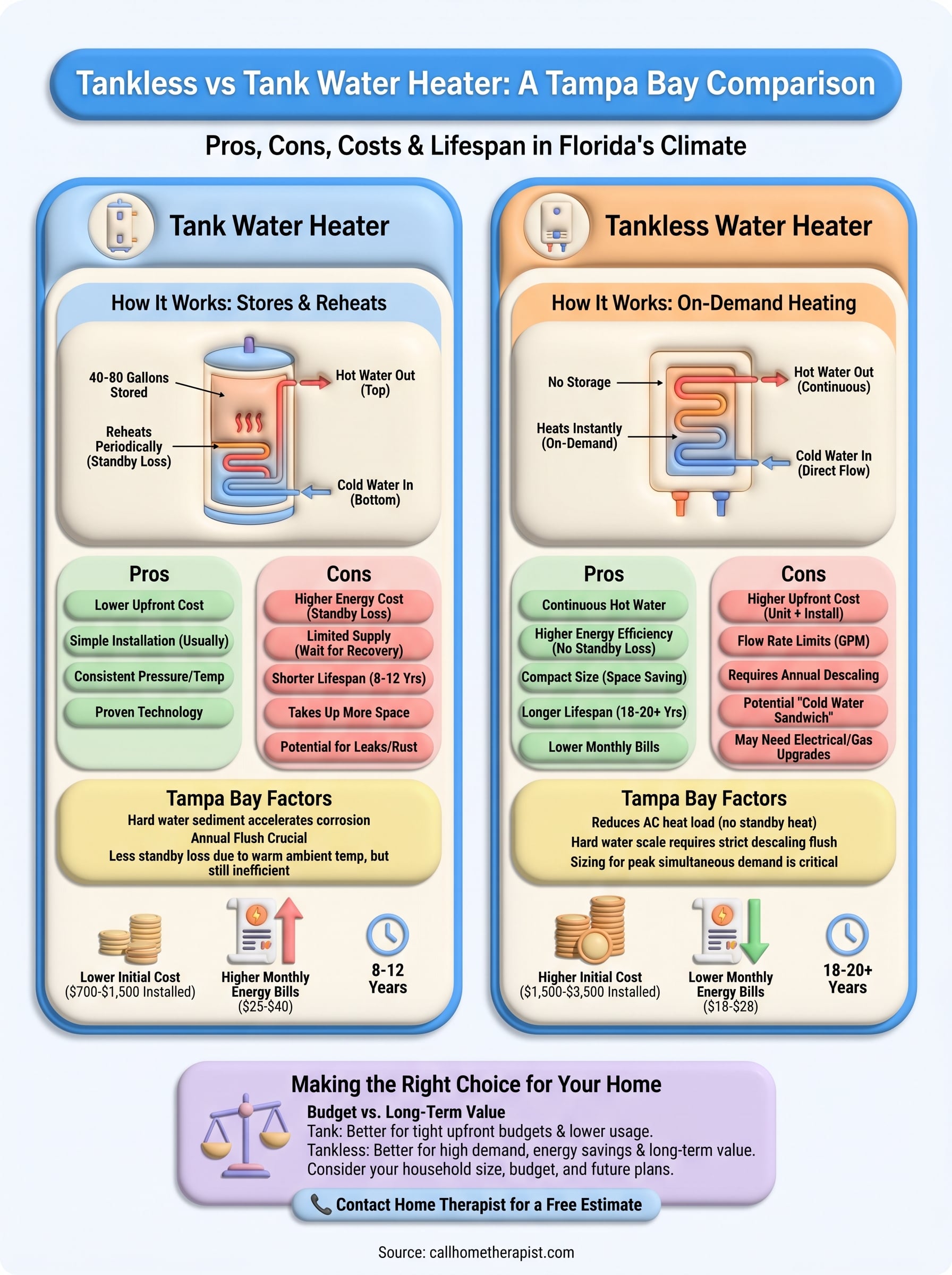
The tankless vs tank water heater decision comes down to your household size, your budget, and how long you plan to stay in your home. Tank units cost less upfront and work well for smaller households with predictable hot water habits. Tankless systems demand a higher initial investment but pay back that difference through lower energy bills and a lifespan that often doubles what a tank unit delivers.
For Tampa Bay homeowners, hard water and year-round cooling costs make the maintenance schedule and energy efficiency of your choice more impactful than they would be in other regions. Whichever system fits your situation, proper sizing and annual maintenance determine whether it performs reliably for years or frustrates you within the first few.
Ready to move forward? Contact Home Therapist to get a free estimate on water heater installation from a licensed technician serving the Greater Tampa Bay Area.
More Tankless Water Heater Articles
- No Flush Valves Found: Tankless Water Heater Descaling Visit on Bruton Road, Plant City, FL 33565
- Proactive Descaling on E Mcewen Ave: Tankless Water Heater Maintenance in Tampa, FL 33612
- How To Flush A Tankless Water Heater With Vinegar
- Same Element Failed Twice: Warranty Tankless Water Heater Replacement + PRV Fix on Stephen Foster Dr, Largo FL 33771


