

What is refrigerant? A homeowner’s guide to HVAC efficiency
TL;DR:
- Refrigerant in HVAC systems circulates in a closed loop and doesn’t get used up naturally.
- New refrigerants like R-32 and R-454B are environmentally friendly and meet recent regulations.
- Detecting leaks and proper maintenance are crucial to system efficiency and longevity.
Refrigerant is one of the most talked about yet least understood parts of your home’s HVAC system. Many homeowners believe refrigerant gets used up over time, the same way your car burns through gasoline, but that’s simply not true. Refrigerant circulates in a closed loop and should never need “topping off” under normal conditions. If your system is running low, something is wrong, and knowing the difference could save you from a costly repair down the road. This guide covers what refrigerant actually is, which types are now standard, how it affects your home’s comfort and energy bills, and what Tampa Bay homeowners need to know right now as the industry goes through major regulatory changes.
Table of Contents
- What is refrigerant? The basics explained
- Types of refrigerants: Past, present, and future
- How refrigerant impacts your HVAC performance and efficiency
- Regulations, safety, and what Tampa Bay homeowners must know
- Our take: Rethinking refrigerant myths and Tampa Bay best practices
- Keep your Tampa Bay home efficient with expert HVAC guidance
- Frequently asked questions
Key Takeaways
| Point | Details |
|---|---|
| Refrigerant explained | Refrigerant is a heat-moving fluid essential for HVAC and does not need regular replacement if no leaks exist. |
| New regulations matter | Only low-GWP refrigerants are allowed in new residential systems since 2025, making old types obsolete. |
| Efficiency and safety linked | The correct refrigerant improves efficiency, system lifespan, and requires modern safety features. |
| Leaks require repair | Low refrigerant levels signal leaks which must be fixed, not just refilled, for safe and effective operation. |
| Ask your tech questions | Understanding refrigerant helps you make smarter maintenance and upgrade decisions with your HVAC service provider. |
What is refrigerant? The basics explained
Refrigerant is a specialized fluid that cycles continuously inside your HVAC system, shifting between liquid and gas states to move heat from one place to another. It doesn’t generate cold air from nothing. Instead, it picks up heat from the air inside your home and carries it outside, leaving cooler air behind. In a heat pump, it can reverse that process entirely during winter, pulling heat from the outside air and bringing it indoors.
The process follows what’s called the vapor compression cycle, where refrigerant absorbs heat in the evaporator as a low-pressure liquid turning to gas, gets compressed into a hot high-pressure gas, releases that heat through the condenser as it turns back to liquid, and then expands back to low pressure through a metering device before starting all over. That loop runs thousands of times a season, never consuming the refrigerant itself.
Here is why that matters to you as a homeowner:
- Refrigerant is not fuel. It doesn’t get burned or used up.
- A properly sealed system will hold the same refrigerant charge for decades.
- If your technician says levels are low, the real issue is almost certainly a leak somewhere in the system.
- “Topping off” without fixing the leak just delays a bigger, more expensive problem.
- Understanding the role of refrigerant in AC systems helps you have smarter, more informed conversations with your HVAC technician.
Pro Tip: Before agreeing to any refrigerant recharge service, always ask your technician to check for leaks first. A reputable technician will always look for the source before adding anything.
Types of refrigerants: Past, present, and future
Not all refrigerants are created equal. The type your system uses affects everything from environmental impact to what a service call costs you. The HVAC industry has gone through several refrigerant generations over the past few decades, driven largely by environmental regulations and evolving technology.
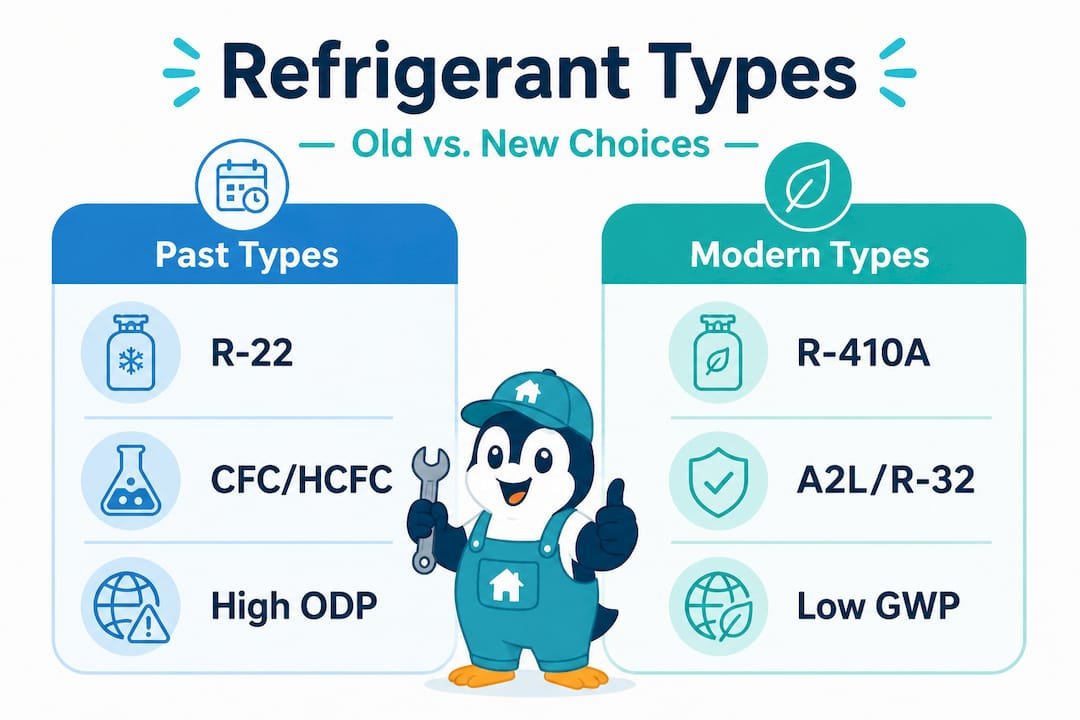
R-22 was the industry standard for decades. It’s an HCFC (hydrochlorofluorocarbon), and it was effective at cooling but terrible for the ozone layer. The U.S. phased out R-22 production and import completely in 2020. If your older system still uses R-22, servicing it now requires expensive reclaimed refrigerant, which is why replacement often makes more financial sense than repair on those older units.
R-410A replaced R-22 and became the dominant residential refrigerant for the last 15 or so years. It doesn’t harm the ozone layer, which was a big win. However, it carries a global warming potential (GWP) of 2088, meaning it traps significantly more heat than carbon dioxide if it escapes into the atmosphere. That’s why the EPA began phasing it down under the AIM Act.
R-32 and R-454B are the new generation. They fall into a category called A2L refrigerants, which are mildly flammable but far better for the environment. R-32 has a GWP of 675, and R-454B comes in even lower at 466. Both are now in new residential systems.
| Refrigerant | Type | GWP | Status |
|---|---|---|---|
| R-22 | HCFC | ~1,810 | Fully phased out |
| R-410A | HFC | 2,088 | Being phased down |
| R-32 | A2L HFC | 675 | Current standard |
| R-454B | A2L HFC | 466 | Current standard |
| HFOs (e.g., R-1234yf) | HFO | Under 1 | Emerging option |
Stat to know: Since 2025, new residential HVAC systems in the U.S. must use refrigerants with a GWP below 700. That effectively rules out R-410A for any new equipment leaving the factory.
When you’re comparing systems for a new installation, refrigerant type directly affects air conditioner efficiency ratings like SEER2. Newer refrigerants in modern equipment help manufacturers hit higher efficiency targets. Also, if your old system ever needs a major component replaced, check whether it still uses R-410A and plan accordingly, because supply is shrinking fast. And if you’re replacing a system, learn how proper refrigerant recycling protects you legally and environmentally.
Pro Tip: Your outdoor unit should have a label near the service valves that tells you exactly which refrigerant the system uses. Take a photo of it and share it with your technician before any service visit.
How refrigerant impacts your HVAC performance and efficiency
Think of refrigerant as the blood of your HVAC system. When everything is running right, you don’t notice it at all. When something goes wrong, the whole system suffers. Refrigerant directly affects how well your system cools, how much energy it uses, and how long the equipment lasts.
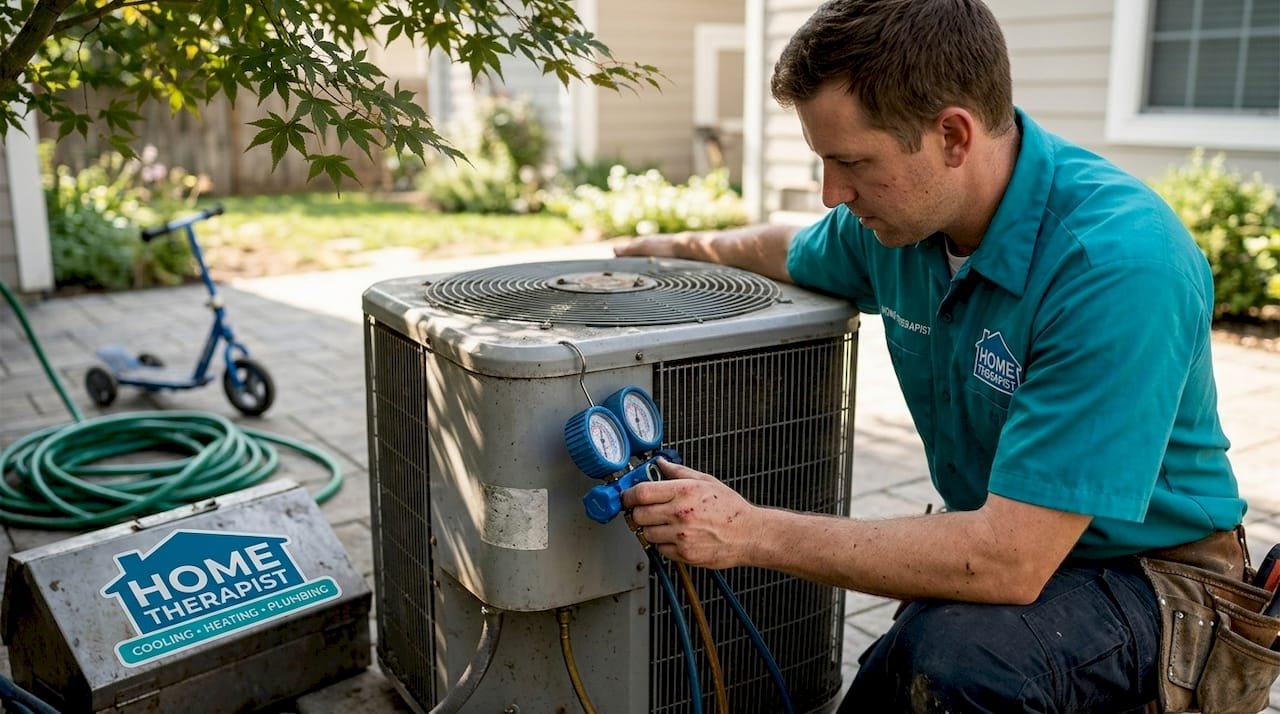
The most important thing to understand is that refrigerant levels in a closed system should never drop. Any drop signals a leak that needs repair, not just a refill. Running a system with low refrigerant forces the compressor to work harder than it should, which drives up your energy bills and can eventually cause the compressor to fail. Compressor replacement is one of the most expensive HVAC repairs, often costing more than half the price of a brand new system.
Here’s how refrigerant issues show up in real life for Tampa Bay homeowners:
- Warm air from vents even though the system is running
- Ice forming on the evaporator coil or the refrigerant lines near the air handler
- Higher than normal energy bills with no obvious cause
- System running constantly without reaching the set temperature
- Hissing or bubbling sounds near the outdoor unit
| System condition | Likely refrigerant status | What it means for your home |
|---|---|---|
| Cools perfectly, low bills | Correct charge | System operating as designed |
| Weak cooling, high bills | Possibly low due to leak | Repair leak, then recharge |
| Freezing coil | Low refrigerant or airflow issue | Immediate service needed |
| Short cycling | Possible overcharge or leak | Professional diagnosis required |
New low-GWP refrigerants like R-454B also change how technicians service your system. Equipment using A2L refrigerants requires leak detection sensors and proper ventilation in the equipment room, features that are now built into modern HVAC units. Reviewing a solid HVAC maintenance checklist before the cooling season is one of the smartest habits you can build as a Tampa Bay homeowner, because a small refrigerant issue caught in spring costs a fraction of what a failed compressor costs in August.
Regulations, safety, and what Tampa Bay homeowners must know
Federal regulations around refrigerants have changed significantly in the last few years, and they affect every homeowner who owns or is replacing an HVAC system. Here’s what you need to understand.
- The AIM Act matters to you. The EPA’s AIM Act regulations phase down the production and import of high-GWP HFCs like R-410A. New residential HVAC equipment since 2025 must use refrigerants with a GWP below 700, and R-454B and R-32 are the primary replacements.
- Leak monitoring thresholds are real. Licensed technicians must keep leak rates within EPA-monitored thresholds, typically between 10 and 30 percent annually for commercial systems. Residential systems face their own standards.
- Reclaimed refrigerant must meet purity standards. If a technician services your older R-22 or R-410A system using reclaimed refrigerant, that refrigerant must meet EPA purity requirements before it can legally be reused.
- A2L refrigerants require safety upgrades. Per ASHRAE Standard 15, R-32 and R-454B are classified as A2L, meaning mildly flammable. ASHRAE classifies refrigerants by both toxicity and flammability, and A2L refrigerants require leak detection sensors and proper ventilation wherever equipment is installed.
- Only use licensed professionals. Handling refrigerant without EPA Section 608 certification is illegal. Always verify your technician is certified before allowing any refrigerant work on your system.
“Handling or venting refrigerants improperly can result in federal fines. Tampa Bay homeowners should always verify that their HVAC service provider is EPA Section 608 certified before scheduling any refrigerant-related work.”
Knowing how to handle safe refrigerant recovery and being able to recognize signs of a refrigerant leak early puts you ahead of most homeowners. In Tampa Bay’s hot, humid climate, the faster a leak gets caught and repaired, the better your system performs and the lower your risk of a full breakdown during peak summer heat.
Our take: Rethinking refrigerant myths and Tampa Bay best practices
Here’s something we see often in this business: a homeowner calls because their system isn’t cooling well, and someone told them they just needed a “refrigerant top-off.” They’ve done this two or three summers in a row. Each time, the tech adds refrigerant and leaves. By the time they call us, the compressor is struggling, the refrigerant lines show oil residue from a slow leak, and what could have been a $300 repair has now grown into a $1,500 or higher situation.
The myth that refrigerant slowly depletes over time is genuinely harmful. It leads homeowners to treat refrigerant like engine oil, something that naturally runs low and just needs replenishing. That mental model causes real financial damage. A sealed system that loses refrigerant has a breach somewhere. Period. Finding and fixing that breach is always the right first step.
We also want to push back on the idea that the shift to A2L refrigerants is just a government compliance issue. Yes, the regulations are real, but these newer refrigerants are genuinely better for your home’s efficiency. Systems designed around R-454B or R-32 run more efficiently and will likely have longer service intervals as the supply chain stabilizes around these products.
Tampa Bay’s climate adds another layer to all of this. Humidity accelerates wear on refrigerant lines and connections. Systems in our area work harder and longer than systems in cooler climates, which means leak risks can increase faster here than in other parts of the country. Staying on top of your HVAC maintenance with annual service visits isn’t just good practice. In this climate, it’s essential protection for one of your home’s most valuable mechanical systems.
Ask your technician directly: What refrigerant does my system use? Are you certified to handle A2L refrigerants? Have you checked for leaks, not just the refrigerant level? Those three questions alone will tell you a lot about who you’re working with.
Keep your Tampa Bay home efficient with expert HVAC guidance
Understanding refrigerant is one thing. Knowing who to call when something needs attention is another. The refrigerant regulations changing in 2025 and beyond mean that not every technician is equally prepared to service the newest systems or navigate the transition from R-410A to low-GWP alternatives.
At Home Therapist Cooling, Heating, and Plumbing, our certified technicians stay current on every regulation, refrigerant type, and safety requirement so you don’t have to. Whether you need a leak inspection, help understanding your HVAC system, or a full system upgrade to meet the latest standards, we bring the kind of expertise that keeps Tampa Bay homes comfortable year-round. Ready to simplify your home HVAC maintenance and stay ahead of the regulations? We also help with refrigerant recycling in Tampa Bay when you’re upgrading or replacing equipment. Call us today and let’s make sure your system is ready for whatever the Florida heat throws at it.
Frequently asked questions
What happens if my HVAC system runs low on refrigerant?
Low refrigerant almost always means there is a leak somewhere in the system. As HVAC experts confirm, refrigerant doesn’t disappear in a closed system, so the right fix is to find and repair the leak before recharging.
Is it legal to use R-22 refrigerant in Tampa Bay homes?
R-22 has been fully phased out and cannot be used in new systems. Only reclaimed R-22 from recovered supplies is legally available, and it can only be used to service existing older equipment that already contains it.
How do I know which refrigerant my HVAC uses?
Check the label on your outdoor condenser unit near the service ports. It will list the refrigerant type. If the label is worn or missing, a licensed HVAC technician can identify it quickly during a service visit.
Are the new refrigerants like R-32 safe?
Yes, when systems are properly installed and maintained. ASHRAE classifies R-32 as A2L, meaning mildly flammable, which is why modern equipment using these refrigerants includes built-in leak detection and ventilation features for safe operation.
Do I need to upgrade my HVAC for the new refrigerant regulations?
If your system uses R-410A or older refrigerants and needs major component repairs, upgrading may be the most practical path forward. The EPA’s AIM Act has set a GWP limit below 700 for new equipment since 2025, so any replacement system will already meet the standard. A licensed technician can help you weigh repair costs against upgrade benefits.
Recommended
- Refrigerant Recycling: What Tampa Bay Homeowners Need
- HVAC Retrofitting Explained: Enhancing Home Comfort Home Therapist Cooling, Heating, and Plumbing
- What Is HVAC Economizer? Energy Savings at Home
- Beginner HVAC Maintenance Guide for Homeowners Made Easy
- 2025 Refrigerant Changes: Can You Still Use R-410A AC Units?
More Refrigerant & Diagnostics Articles
- AC Refrigerant Low Coil Leak Valrico FL: 3 Pounds Missing on Benson St, 33594
- Copper Refrigerant Line Reinstall on W Mississippi Ave: Scope Review Visit in Tampa, FL 33629
- How your AC’s expansion valve keeps Tampa Bay cool
- Dead Blower Motor on Bitter Orange Ave: 220V Universal Motor + Disconnect Switch Replacement in Tampa, FL 33625


