

Ductless mini splits: efficient cooling and heating solutions
TL;DR:
- Many Tampa Bay homeowners overestimate the need for ductwork and central air systems, leading to unnecessary costs. Ductless mini splits provide targeted, energy-efficient heating and cooling without ducts, ideal for older homes, additions, and areas with humidity issues. Properly sized and installed mini splits offer superior comfort, air quality, and long-term savings tailored to the region’s climate.
Most Tampa Bay homeowners assume that if they want reliable, whole-home comfort, they need a full central air system with ductwork running through every wall and ceiling. That assumption costs people thousands of dollars every year in unnecessary installations, energy waste, and repairs. Ductless mini splits offer a powerful, flexible alternative that skips the ductwork entirely while delivering targeted, efficient comfort in any room. Whether you’re cooling a new addition, upgrading an older bungalow in St. Pete, or just tired of one room always feeling warmer than the rest, understanding how these systems work could completely change how you think about home comfort.
Table of Contents
- What is a ductless mini split system?
- How ductless mini splits work: Key components and operation
- Why Tampa Bay homes are ideal for ductless mini splits
- Benefits and drawbacks: What homeowners need to know
- Getting started: What to consider before installing a ductless mini split
- The overlooked role of ductless mini splits in modern Tampa Bay living
- Expert help for Tampa Bay homeowners: Start your ductless journey
- Frequently asked questions
Key Takeaways
| Point | Details |
|---|---|
| Ductless defined | A ductless mini split provides heating and cooling without traditional ductwork. |
| Ideal for Tampa Bay | Mini splits work best in Tampa’s humid climate and older homes lacking central ducts. |
| High efficiency | Mini splits deliver energy savings and targeted comfort via zoned cooling and heating. |
| Installation tips | Professional installation and proper sizing are key for optimal mini split performance. |
| Balanced pros and cons | Before choosing mini splits, weigh factors like upfront cost, looks, and mild heating limits. |
What is a ductless mini split system?
A ductless mini split is a type of heating and cooling system that conditions the air in specific rooms or zones without needing any ductwork. The name “mini split” comes from how the system is built: it splits the function between two main units, one inside and one outside, connected by a slim conduit rather than bulky air ducts.
Here’s what makes up a basic ductless mini split:
- Outdoor unit: Houses the compressor and condenser, and sits outside your home on a wall mount or concrete pad.
- Indoor unit: Mounts on a wall or ceiling inside the room you want to condition. This is what blows cool or warm air directly into your space.
- Conduit: A small bundle running through a 3-inch hole in the wall that connects the two units. It carries refrigerant tubing, electrical wiring, and a condensate drain line.
- Remote or smart controller: Lets you adjust temperature, fan speed, and mode without touching the unit itself.
The system operates on a heat pump principle, meaning it can both cool and heat depending on the season. Operating using a refrigeration cycle, in cooling mode the indoor unit evaporates refrigerant to absorb heat from the room, the compressor pressurizes it, and the outdoor unit releases that heat outside. In heating mode, a reversing valve flips the process, pulling warmth from the outdoor air and delivering it inside.
A ductless mini split system moves heat rather than generating it, which is why it uses significantly less electricity than a traditional electric resistance heater or a furnace-based system. This makes it one of the most energy-efficient comfort solutions available today.
How ductless mini splits work: Key components and operation
Now that you know what a mini split is, let’s walk through exactly how these components work together every time you press “cool” on your remote.
- You set your desired temperature. The thermostat signal goes to both the indoor and outdoor units.
- The indoor unit draws in room air. A blower fan pulls warm, humid air from the room across the indoor evaporator coil.
- Refrigerant absorbs the heat. Liquid refrigerant flowing through the evaporator coil absorbs heat from the air and evaporates into a gas.
- The conduit carries refrigerant outside. The now-warm gas travels through the refrigerant tubing inside the conduit to the outdoor unit.
- The compressor increases pressure. The outdoor compressor pressurizes the hot gas refrigerant, raising its temperature further so it can release heat efficiently.
- The condenser releases heat outdoors. The outdoor condenser coil and fan expel that heat into the outside air.
- The expansion valve drops the pressure. The key component expansion valve, located between the two coils, rapidly drops the refrigerant’s pressure and temperature so it can absorb heat again when it returns indoors.
- The cycle repeats until your room reaches the set temperature.
For heating, the outdoor unit’s reversing valve switches the direction of refrigerant flow, effectively pulling warmth out of the outdoor air (even cool outdoor air holds usable heat energy) and delivering it inside.
Mini split vs. central air: a quick comparison
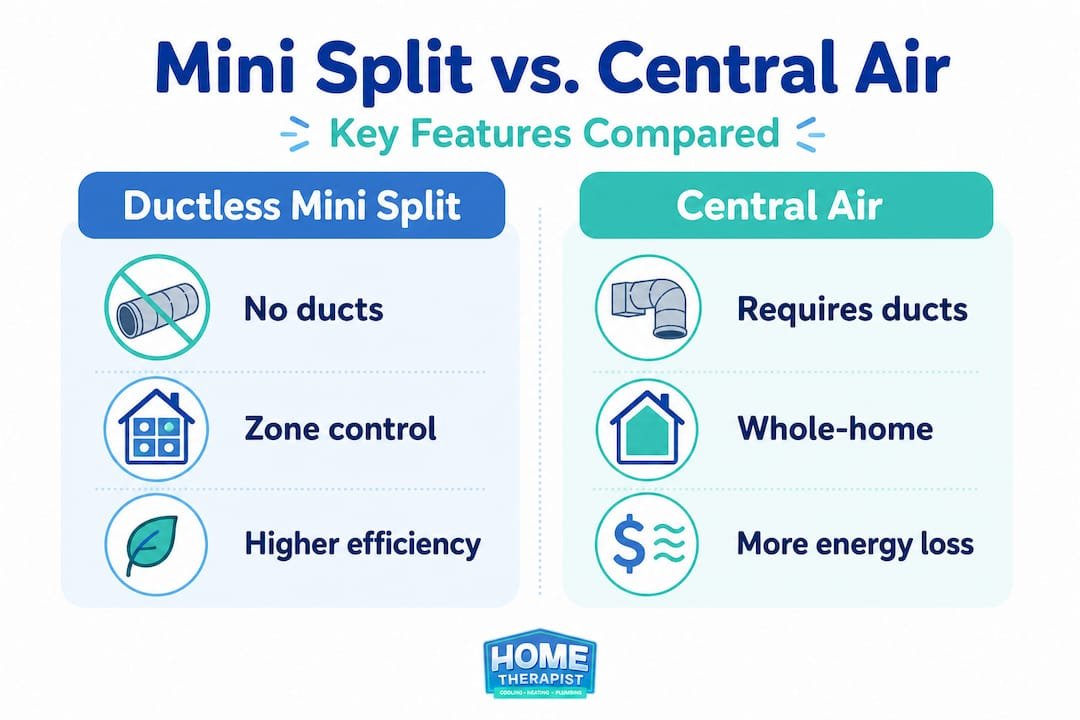
| Feature | Ductless mini split | Central air system |
|---|---|---|
| Ductwork required | No | Yes |
| Zone control | Yes (each unit controls one zone) | Limited without upgrades |
| Installation complexity | Low (3-inch wall penetration) | High (full duct installation) |
| Energy efficiency | Very high | Moderate (duct losses reduce efficiency) |
| Best fit | Specific rooms, older homes, additions | Whole-home, new construction |
| Upfront cost | Moderate per unit | High (includes ductwork) |
Studies have found that duct losses account for 25 to 30% of energy consumption in homes with forced-air systems, which means every central AC system is essentially wasting a significant portion of what you’re paying for. Mini splits sidestep that problem entirely.
Why Tampa Bay homes are ideal for ductless mini splits
Tampa Bay’s heat isn’t just hot, it’s relentlessly humid from spring through fall. That combination creates unique problems for traditional duct-based systems that ductless mini splits handle much better.
Here’s why mini splits are a particularly strong fit for Tampa Bay:
- Humidity control is built in. Mini splits dehumidify while they cool, pulling moisture directly out of the room air. In a ducted system, humid air can linger inside poorly sealed ducts, creating conditions ripe for mold growth.
- Older homes in Tampa and St. Pete rarely have ductwork. Bungalows, craftsman-style homes, and historic properties throughout the Bay area were built before central air was standard. Retrofitting ductwork into those homes is invasive and expensive. A mini split requires just a small hole in the wall.
- New additions and converted spaces. Finished garages, sunrooms, bonus rooms, and in-law suites often fall outside a home’s central air zone. A ductless unit covers those spaces without reconfiguring the whole system.
- Better air quality indoors. With no ducts to collect dust, debris, or mold spores, the air circulating through a mini split passes through filters directly in the indoor unit, which are easy to clean.
When you explore the types of AC units in Tampa, you’ll find that mini splits consistently stand out for their flexibility in the region’s climate. The Tampa Bay HVAC system types guide covers this in more detail too, and it’s worth reviewing if you’re comparing your full range of options.
Pro Tip: Set up multiple indoor units connected to one outdoor unit (called a multi-zone system) and you can cool only the rooms you’re actually using. This alone can cut your daily cooling costs significantly compared to blasting central air through a whole house when only two rooms are occupied.

As for cold weather, mini splits handle Tampa Bay winters without any issue. Heat pump function provides mild heating but may underperform during rare Florida cold snaps that fall below the system’s operating limit, typically around 5°F. Given that Tampa Bay almost never sees temperatures that extreme, this limitation is largely irrelevant for most homeowners here.
System suitability for Tampa Bay climate
| System type | Humidity control | Zoning | Duct requirement | Tampa Bay rating |
|---|---|---|---|---|
| Ductless mini split | Excellent | Yes | No | ★★★★★ |
| Central air | Good | Limited | Yes | ★★★☆☆ |
| Window AC | Poor | No (single room) | No | ★★☆☆☆ |
Benefits and drawbacks: What homeowners need to know
No system is perfect for every situation. Here’s an honest breakdown of what mini splits do well and where they fall short.
Benefits:
- Energy efficiency. Mini splits are among the most efficient systems available. No duct losses, inverter-driven compressors that adjust speed instead of cycling on and off, and zoned operation all add up to serious savings on your electric bill.
- Quiet operation. The compressor sits outside, and the indoor unit runs at whisper-quiet levels. Central air systems push air through vents and can rattle and rumble. Mini splits just hum softly in the background.
- Targeted comfort. Every room can have its own temperature. One person likes it cool, another likes it warm. Multi-zone mini splits solve that without an argument.
- Improved air quality. Multi-layer filters in the indoor unit trap dust, allergens, and even some bacteria. No ductwork means no hidden mold colonies blowing air through your house.
- Quick installation. A single-zone system can often be installed in one day, without the days of construction work that ductwork requires.
Drawbacks:
- Higher upfront cost per zone. Each indoor unit and the outdoor unit costs more than a basic window AC. The per-room investment is real, though the long-term savings usually offset it.
- Aesthetic considerations. The indoor wall-mounted unit is visible. Some homeowners find this less appealing than invisible duct vents. Ceiling cassette models help, but the unit is still present.
- Heating limits in extreme cold. As mentioned, performance can dip in very cold temperatures, though this is rarely relevant in Tampa Bay.
- Professional installation required. Unlike window units you can install yourself, mini splits need licensed HVAC technicians to handle the refrigerant lines and electrical connections safely.
If you want to dig deeper into the most common questions homeowners ask before buying, the mini split FAQs Tampa page covers a lot of ground. You’ll also want to understand mini split maintenance in Tampa so you know what’s involved in keeping the system running well long-term.
Pro Tip: Look for ENERGY STAR-rated mini split models when shopping. These units meet strict efficiency guidelines and often qualify for utility rebates through Tampa Electric (TECO) or Duke Energy Florida, which can take a meaningful bite out of the upfront cost.
Getting started: What to consider before installing a ductless mini split
Thinking about making the move? Before you call a technician, there are a few things worth working through on your own first.
- How many rooms do you need to condition? Single-zone systems work for one room or space. Multi-zone systems run multiple indoor units off one outdoor unit. Map out your needs before getting quotes.
- What’s the square footage and sun exposure of each room? Sizing matters enormously. An undersized unit won’t cool your room, and an oversized one will short-cycle (turn on and off too quickly), wasting energy and reducing humidity control.
- Where will the outdoor unit go? It needs airflow clearance, shade from direct afternoon sun if possible, and a surface that can handle the vibration and weight. Avoid placing it in tight, enclosed spaces.
- Is your electrical panel ready? Each mini split needs a dedicated circuit. Older Tampa Bay homes sometimes have panels that need upgrading before a mini split install can happen safely.
- Who will do the installation? The refrigerant lines must be handled by an EPA 608-certified technician. Always verify credentials before hiring. Check for local experience too since Florida building codes have specific requirements.
- What’s the warranty situation? Many manufacturers require professional installation to keep the warranty valid. The refrigeration cycle requires precise refrigerant charge levels, and an improperly charged system can fail well before its time.
If you’re researching whether installation makes sense for your specific home, the installation and repair guide from Home Therapist walks through what the process looks like start to finish.
The overlooked role of ductless mini splits in modern Tampa Bay living
Here’s something most HVAC articles won’t say directly: the push toward central air in Tampa Bay often has more to do with habit than with what actually makes sense for a particular home.
We see homeowners default to central air because that’s what they grew up with, what their neighbors have, or what a big-box contractor quoted them first. The assumption is that bigger equals better. But in a city where many homes are older, rooms are used selectively, and the electricity bill is a constant monthly stress point, “bigger” often just means “more expensive to run.”
A thoughtfully placed ductless system can outperform a central air retrofit in an older Tampa home every single time, because it works with the house instead of forcing invasive changes into it. When we work with homeowners on choosing an HVAC system, the conversation almost always shifts once people realize how much flexibility mini splits offer compared to what they imagined.
The “bigger is better” mindset also leads people to oversize systems, which is one of the most common HVAC mistakes we see. An oversized unit cools a room fast but shuts off before it’s had time to properly dehumidify the air. In Tampa Bay, where humidity is the real comfort killer, that’s a significant problem. A correctly sized mini split running longer cycles will almost always leave you more comfortable than an oversized central system that blasts and stops every few minutes.
Expert help for Tampa Bay homeowners: Start your ductless journey
Understanding the technology is a great first step, but knowing whether a ductless mini split is the right call for your specific home, layout, and budget takes a real conversation with someone who knows Tampa Bay homes.

At Home Therapist Cooling, Heating, and Plumbing, we help Tampa Bay homeowners evaluate their options with honesty and zero pressure. Whether you need a professional mini split help consultation, a full HVAC system evaluation Tampa, or you’re exploring whether air handler and duct replacement makes more sense for your situation, our certified technicians bring local expertise and honest recommendations. As a family-owned business, we’re invested in your long-term comfort, not just the next installation. Reach out today and let’s figure out the best path forward for your home.
Frequently asked questions
How is a ductless mini split different from central air?
A ductless mini split cools or heats individual rooms without ductwork, while central air uses an extensive duct network to distribute conditioned air throughout the entire home. The refrigeration cycle is the same, but delivery is direct and zone-specific with a mini split.
Can ductless mini splits heat a Tampa Bay home in winter?
Yes, mini splits with built-in heat pumps provide reliable heating through Tampa Bay’s mild winters, though heat pump performance can dip below operating limits during rare extreme cold snaps near 5°F, which almost never occurs here.
Are ductless mini splits more energy-efficient than window AC units?
Generally, yes. Mini splits avoid duct losses, use inverter-driven compressors that run at variable speeds, and offer zoned control. The outdoor compressor and condenser design is simply more efficient than the self-contained motor and coil assembly inside a window unit.
Do ductless mini splits improve indoor air quality?
Yes. Built-in multi-layer filters in the indoor unit trap dust and allergens directly at the source, and without any ductwork in the equation, there’s no hidden breeding ground for mold or accumulated debris blowing through your living space.
Recommended
- Ductless Mini Split Installation and Electrical Upgrade in St. Petersburg, FL 33710 | Home Therapist
- Ductless Mini Split Maintenance Visit in Tampa, FL 33605
- 7 Inspiring Examples of Energy-Efficient HVAC for Homes
- Mini Split Installation Recommendations for Hotels in Tampa, FL Home Therapist Cooling, Heating, and Plumbing


