

Stay cool and save energy in your Tampa Bay home
TL;DR:
- In Tampa Bay, effective summer cooling relies on proper thermostat settings, humidity management, and regular HVAC maintenance. Combining strategies like programmable thermostats, dehumidifiers, ceiling fans, and system upkeep can reduce energy costs by over 30%. Addressing both temperature and moisture levels ensures comfort, prevents mold growth, and optimizes system performance during peak heat.
Tampa Bay summers are brutal. With heat indexes routinely pushing past 105°F and relative humidity hovering near 90%, simply setting your thermostat to a low temperature and hoping for the best is a losing strategy. The real challenge for homeowners here isn’t just the heat; it’s the combination of heat and moisture that makes your AC work overtime, drives up energy bills, and still leaves you feeling sticky and uncomfortable. The good news is that a set of proven, practical strategies can help you stay genuinely comfortable while keeping your monthly cooling costs under control.
Table of Contents
- Optimize your thermostat settings for maximum savings
- Manage indoor humidity for better comfort and lower bills
- Prioritize seasonal HVAC maintenance for reliable cooling
- Enhance room comfort with ceiling fans
- Comparison table: Cooling methods and their impact in Tampa Bay
- Our perspective: What Tampa Bay homeowners often overlook in summer cooling
- Get help with summer cooling and efficiency upgrades
- Frequently asked questions
Key Takeaways
| Point | Details |
|---|---|
| Smart thermostat savings | Adjusting your thermostat and using setbacks can reduce cooling bills by up to 10 percent annually. |
| Humidity is critical | Controlling indoor humidity is just as important as cooling for Tampa Bay comfort and energy savings. |
| Maintenance matters | Seasonal HVAC checkups and regular upkeep prevent breakdowns and boost system efficiency. |
| Ceiling fans add comfort | Proper fan use lets you set the thermostat higher while feeling cooler without extra energy use. |
| Combine strategies | The best results come from combining thermostat adjustment, humidity control, maintenance, and fan use. |
Optimize your thermostat settings for maximum savings
Your thermostat is the control center of your entire cooling system, and most Tampa Bay homeowners aren’t using it to its full potential. A programmable or smart thermostat gives you the power to automate setbacks, meaning you let the temperature rise slightly when no one is home, then cool back down before you return. This one habit alone can make a noticeable difference on your bill.
The U.S. Department of Energy confirms that turning back 7, 10°F for 8 hours can save as much as 10% per year on heating and cooling costs. For Tampa Bay homeowners running their AC nearly year-round, that’s real money.
So what are the right numbers? Florida Power and Light recommends setting thermostats to 75, 78°F while you’re home and up to 82°F when you’re away. Every degree you raise the thermostat saves roughly 3, 5% on your monthly cooling costs. That adds up fast over a four to five month cooling season.
Here’s a simple comparison of thermostat settings and their impact:
| Setting | When to use | Estimated monthly savings |
|---|---|---|
| 75°F | Occupied, high comfort needed | Baseline |
| 78°F | Occupied, moderate comfort | 9, 15% vs. 75°F |
| 82°F | Away or asleep | 15, 25% vs. 75°F |
| 85°F+ | Extended absence | Maximum savings |
A few practical actions to get the most from your thermostat:
- Install a programmable or smart thermostat if you haven’t already
- Program weekday and weekend schedules separately, since your routines likely differ
- Avoid manual overrides during peak afternoon heat (3, 6 PM), when grid demand and electricity rates are highest
- Keep the thermostat away from heat sources like lamps or direct sunlight, which can cause it to read high and overcool your home
Pro Tip: Never drop the thermostat dramatically when you get home thinking it will cool the house faster. Your AC cools at the same rate regardless of how low you set it. All you do is risk overcooling and wasting energy. Stick to your programmed schedule for consistent, efficient results.
For more strategies focused on reducing cooling costs specific to Tampa Bay homes, including tips on shade, insulation, and window treatments, there’s a lot more to explore beyond the thermostat alone.
With thermostat strategies covered, let’s focus on humidity, the hidden driver of discomfort and costs in Florida summers.
Manage indoor humidity for better comfort and lower bills
Here’s something most homeowners don’t realize: in Tampa Bay, your air conditioner may not be winning the battle against humidity on its own. Research from Green Building Advisor shows that in humid climates, AC handles only 50, 70% of the total dehumidification load your home needs. That gap is what makes you feel damp and uncomfortable even when the thermostat reads 76°F.
The common reaction is to lower the thermostat further. Bad idea. According to UF/IFAS extension research, if your system doesn’t provide adequate dehumidification, lowering the thermostat increases your cooling bills by up to 8% for every degree you drop. You’re paying more and still feeling muggy.
“In humid climates, the air conditioner can handle only 50% to 70% of the dehumidification needed.” – Green Building Advisor
The ideal indoor humidity level for comfort and health is between 40, 60% relative humidity. Here’s how to actually achieve that in a Florida home:
- Run a whole-home or portable dehumidifier alongside your AC, especially in the shoulder months of spring and fall when the AC doesn’t run as frequently
- Seal duct leaks because leaky ducts pull humid, unconditioned air from attics and crawl spaces directly into your living area
- Improve airflow by ensuring supply and return vents are unobstructed, which helps your system remove moisture more effectively
- Use exhaust fans during cooking and showering, and run them for at least 15 minutes after you finish to push moisture out of the house
- Check your AC’s filter monthly because a clogged filter restricts airflow, reducing the system’s ability to dehumidify
| Strategy | Cost | Humidity reduction | Comfort impact |
|---|---|---|---|
| Portable dehumidifier | Low to moderate | Moderate | High |
| Whole-home dehumidifier | Moderate to high | High | Very high |
| Sealing duct leaks | Moderate | Moderate to high | High |
| Improved ventilation | Low | Moderate | Moderate |
| Regular filter changes | Very low | Low to moderate | Moderate |
Pro Tip: If your home feels cool but clammy, check your indoor humidity with a simple digital hygrometer available at most hardware stores for under $20. If the reading is above 60%, your AC is losing the dehumidification battle, and a supplemental dehumidifier will help far more than dropping the thermostat.
For a deeper look at understanding humidity and how it affects your home’s comfort level throughout the year, the interaction between temperature and moisture is more nuanced than most people expect.
Now that humidity control strategies are clear, the next piece of the puzzle is system maintenance, making sure your HVAC is ready for heavy summer use.
Prioritize seasonal HVAC maintenance for reliable cooling
Your air conditioner works harder during a Tampa Bay summer than it would almost anywhere else in the country. That kind of sustained, heavy use means preventive maintenance isn’t optional. It’s the difference between a system that performs reliably all season and one that breaks down during a July heat wave when you need it most and repair appointments are booked solid.
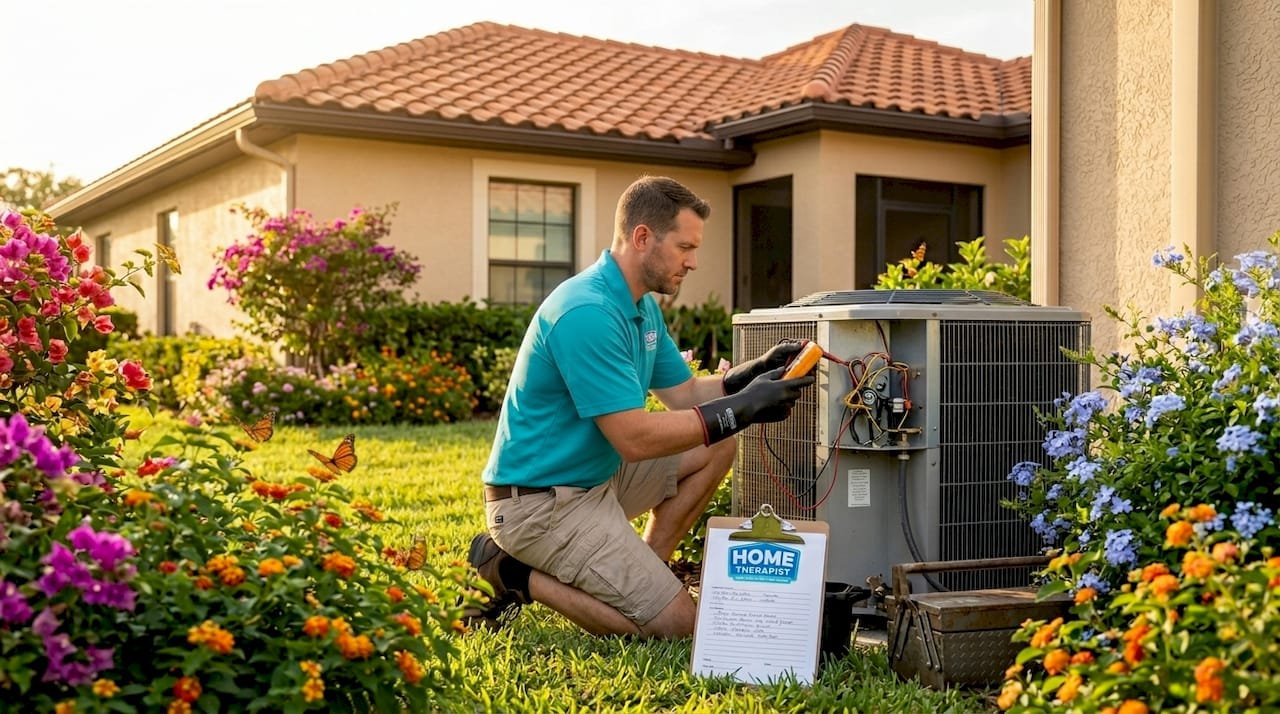
The Department of Energy is clear that structured setback and maintenance schedules consistently deliver meaningful annual savings compared to reactive or unplanned approaches. Getting ahead of the season is far cheaper than emergency repairs.
Here’s a practical pre-season maintenance sequence every Tampa Bay homeowner should follow:
- Replace the air filter before the season starts and then every 1, 3 months depending on your home (pets, occupants, and dust levels all affect how fast filters clog)
- Clean the outdoor condenser coils because grass clippings, dirt, and debris accumulate over winter and restrict airflow, forcing the compressor to work harder
- Clear a two-foot perimeter around the outdoor unit so nothing obstructs airflow, including plants, fencing, or stored items
- Check refrigerant levels during a professional inspection because low refrigerant reduces cooling capacity and increases energy use significantly
- Inspect and seal ductwork for leaks, particularly in attic sections where extreme heat causes the most expansion and contraction damage
- Test the thermostat calibration to confirm it’s reading and responding accurately
- Flush the condensate drain line to prevent clogs that can cause water damage and trigger safety shutoffs during peak cooling season
Pro Tip: Schedule your annual HVAC inspection in March or April, before the heat fully arrives. Once May and June hit, technicians are fully booked, and you’re likely to wait days or weeks for service. Early scheduling also means you have time to address any issues without rushing into costly decisions.
Use a dedicated HVAC summer checklist to make sure nothing gets skipped. For ongoing performance between annual visits, following a set of seasonal AC maintenance tips can help you catch minor issues before they become major failures. And for a full breakdown of what local homeowners should cover each season, a guide to seasonal HVAC steps specific to Tampa is worth bookmarking.
Even with the best thermostat and maintenance routines, Tampa Bay homes benefit from additional cooling aids. Let’s look at how fans can amplify comfort without raising costs.
Enhance room comfort with ceiling fans
Ceiling fans don’t actually lower the air temperature in a room. What they do is create a wind-chill effect that makes the air feel cooler against your skin, and that difference is more significant than most homeowners realize.
According to FPL data reported in the Miami Herald, ceiling fans make rooms feel up to 3, 4°F cooler at the same thermostat setting. That means you can raise your thermostat by 3, 4°F and feel just as comfortable, translating directly into 9, 20% energy savings on your cooling bill without any sacrifice in personal comfort.
Here’s how to use ceiling fans the right way in Florida:
- Set rotation to counterclockwise in summer (when looking up at the fan). This pushes air straight down, creating that cooling wind-chill effect. Most fans have a small switch on the motor housing to change direction.
- Turn fans off when you leave the room. Fans cool people, not spaces. Running a fan in an empty room wastes electricity without any benefit.
- Pair fans with your thermostat strategy. Use fans to allow your thermostat to stay at 78°F rather than 74°F. The combined effect delivers the comfort of a lower temperature at a fraction of the energy cost.
- Check fan size relative to room size. A fan that’s too small for a large room won’t generate enough airflow to make a meaningful difference. A 52-inch fan is generally appropriate for rooms up to 225 square feet.
Pro Tip: If you’re unsure which direction your fan is spinning, stand directly beneath it on a hot day. If you feel a direct, noticeable breeze, it’s in the right counterclockwise direction for summer. If you feel nothing, flip the direction switch and try again.
For a complete list of home cooling methods that work specifically for Tampa Bay homes, ceiling fans are just one piece of a broader strategy.
Now that we’ve covered the big-ticket strategies, let’s summarize their effectiveness with a clear comparison.
Comparison table: Cooling methods and their impact in Tampa Bay
UF/IFAS research reinforces that combining thermostat setbacks with humidity control rather than relying on temperature alone is the best-practice approach for Tampa Bay’s hot, humid climate.
| Cooling strategy | Upfront cost | Monthly savings potential | Comfort impact | Best for |
|---|---|---|---|---|
| Thermostat setbacks | Low | 10, 20% | High | All homes |
| Humidity control | Low to high | 8, 15% | Very high | Florida homes especially |
| HVAC maintenance | Low to moderate | 5, 15% | High | All homes |
| Ceiling fans | Low to moderate | 5, 20% | High | Occupied rooms |
| Combined approach | Moderate | 20, 40%+ | Maximum | Most Tampa Bay homes |
Each strategy works on its own, but the biggest gains come from using them together. A well-maintained system, properly set thermostat, active humidity control, and ceiling fans working in combination can cut your summer cooling costs by 30% or more compared to the average Tampa Bay household that relies on the AC alone.
Our perspective: What Tampa Bay homeowners often overlook in summer cooling
After years of working in Tampa Bay homes, we’ve seen the same pattern over and over. Homeowners focus entirely on temperature and largely ignore humidity. They crank the AC down when they feel uncomfortable, their bills climb, and they still feel sticky. The thermostat gets blamed when moisture is the real problem.
What makes this particularly frustrating is that the solution often doesn’t require expensive new equipment. It requires understanding that sensible and latent cooling loads are two separate problems. Sensible load is the actual air temperature. Latent load is the moisture content of that air. Your AC addresses both, but in humid climates it often handles the sensible load well before it’s made a real dent in the latent load. You feel cooler in terms of temperature, but the air is still damp.
The issue we rarely see discussed openly is mold risk. When indoor humidity stays above 60% for extended periods, even if the temperature feels acceptable, you’re creating conditions where mold and mildew can grow in wall cavities, ductwork, and behind furniture. This isn’t just a comfort issue; it’s a health and structural issue.
The other frequently overlooked factor is proper HVAC sizing. An oversized system cools quickly but short-cycles, meaning it shuts off before it has time to remove adequate humidity from the air. An undersized system runs constantly and can’t keep up during peak heat. Neither extreme is good. Correct sizing, combined with proper humidity control expertise applied to your specific home, is where lasting comfort actually comes from.
Our honest advice: don’t just replace a failing system with the same size unit without having a proper load calculation done first. And if your home consistently feels humid despite a functioning AC, a professional evaluation is the fastest path to solving the real problem.
Get help with summer cooling and efficiency upgrades
If these strategies sound like exactly what your home needs, but the implementation feels like a lot to take on alone, that’s where we come in.
At Home Therapist Cooling, Heating, and Plumbing, we specialize in helping Tampa Bay homeowners get the most out of their cooling systems without overpaying on energy bills. Whether you need a thorough HVAC maintenance in Tampa evaluation to identify efficiency losses, air handler and duct service to address leaks and airflow problems, or a full guide to HVAC retrofitting in Tampa Bay for a longer-term upgrade, our certified technicians are ready to help. As a family-owned business, we treat every home like our own. Contact us today to schedule your service.
Frequently asked questions
What is the ideal thermostat setting for Florida summer?
The ideal setting is 75, 78°F while home and up to 82°F when away, with each degree raised saving approximately 3, 5% on monthly cooling costs.
Can ceiling fans help lower cooling costs?
Yes, ceiling fans create a perceived 3, 4°F cooling effect, which lets you raise the thermostat without sacrificing comfort and saves meaningful energy over the season.
Why is humidity control important for summer cooling?
When your AC doesn’t control humidity adequately, you feel uncomfortable and end up lowering the thermostat, which increases your cooling bills by up to 8% per degree rather than solving the actual moisture problem.
How often should I schedule HVAC maintenance?
Schedule pre-season maintenance once a year, ideally in early spring, and supplement it with monthly filter checks and periodic duct inspections to keep performance strong throughout the summer.
Recommended
- Top Ways to Reduce Cooling Costs for Tampa Bay Homes
- Boost AC Efficiency and Cut Cooling Costs in Tampa Bay
- Top Winter Home Heating Tips for Comfort and Lower Bills
- Home energy audits in Tampa Bay: comfort and savings
More AC Maintenance Articles
- Visit #5 on Kensington Park Ave: Both Water-Source Units Stay Clean, AC Maintenance in Riverview, FL 33578
- Elevated Amps and a Flagged Condenser Fan Motor: Commercial AC Maintenance on N 59th St, Tampa, FL 33610
- Energy-saving tips for Tampa homes: lower bills and stay cool
- Heavily Soiled Metal Ducts Found During Visit #3 AC Maintenance in Belleair Bluffs, FL 33770
- Blower Motor Dead, Float Switch Gone, Drain Line Cracked: Alejandro Restores a Rooftop HVAC System on Johns Rd, Tampa FL 33634


