

Why Is My AC Not Cooling? 7 Quick DIY Checks & Fixes Today
Your AC is running, the thermostat is set, but the air coming out feels about as cool as a Tampa afternoon in July. If you’re wondering why is my AC not cooling, you’re not alone, it’s one of the most common calls we get at Home Therapist, especially once temperatures start climbing across the Greater Tampa Bay Area.
The good news? Not every cooling problem requires a service call. Some issues are straightforward enough to diagnose and fix yourself in under an hour, saving you time and money. Others, though, point to deeper mechanical or refrigerant problems that need a licensed technician.
This guide walks you through 7 specific checks you can do right now to figure out what’s going on with your system. We’ll cover the simple stuff first, filters, thermostat settings, vents, then move into issues that signal it’s time to call in a professional for a proper diagnosis. Let’s get your home comfortable again.
1. Call Home Therapist for same-day AC help
Before diving into the DIY checks below, it’s worth knowing when skipping the troubleshooting is the smarter call. If your system is showing serious warning signs, spending time on filters and thermostat settings won’t fix the problem, and in some cases, running a failing system causes additional damage that drives repair costs higher than they need to be.
Signs you should stop troubleshooting now
Some symptoms tell you clearly that your problem goes beyond a filter swap or a settings adjustment. If you’re trying to figure out why your AC is not cooling and you notice ice buildup on the refrigerant lines or the indoor unit, hear loud grinding or banging from the blower, or smell burning from any part of the system, shut the unit off at the thermostat and call right away. You should also stop and call if your circuit breaker keeps tripping every time you reset it, or if you see water actively leaking from the air handler onto your ceiling or floor.
Running an AC unit with a refrigerant leak or electrical fault won’t just fail to cool your home, it can turn a moderate repair into a full system replacement.
What a same-day diagnostic visit typically covers
When a Home Therapist technician arrives, they run a full system inspection rather than just checking the obvious. That means measuring refrigerant pressure and charge levels, testing electrical components like capacitors and contactors, inspecting the evaporator and condenser coils, and checking airflow through the duct system. You get a clear explanation of what’s wrong and upfront pricing before any repair begins, so there are no surprises when the invoice arrives.
What to do while you wait for service in Florida heat
Florida heat is not something you wait out comfortably without a plan. Close your blinds and curtains on the south and west-facing windows to cut down on solar heat gain inside the house. Run ceiling fans on the counterclockwise setting to push air down and make rooms feel cooler without extra strain on a struggling system. Keep interior doors open so air circulates evenly, and avoid oven or stovetop use until the technician has your system running again. If anyone in your home is elderly, very young, or managing a health condition, move to a cooler location until the repair is complete.
2. Check thermostat mode, setpoint, and batteries
The thermostat is the first place to look when you’re asking why is my AC not cooling. Before opening any panels or touching equipment, spend two minutes at the thermostat because a wrong setting is one of the most common reasons a system runs without actually cooling the house.
DIY check 1: Confirm cool mode and fan auto
Look at your thermostat display and confirm the system mode is set to COOL, not HEAT, OFF, or a generic AUTO. Also check the fan setting, which should be on AUTO, not ON. When the fan runs on ON, it blows air constantly even when the system isn’t in an active cooling cycle, which means you’ll feel airflow from the vents but the air won’t be cold.
DIY check 2: Verify setpoint, schedules, and power
Check that your setpoint is at least 3 to 5 degrees below the current room temperature. If the set temperature is too close to the actual indoor reading, the system won’t trigger a cooling cycle at all. Also review any programmed schedules that might have bumped the setpoint up without you noticing. If your thermostat screen is dim or blank, swap the batteries before doing anything else.
A thermostat running on weak batteries can misread indoor temperatures and send incorrect signals to your AC system, causing it to short-cycle or not run at all.
Fixes you can do in under 5 minutes
Switch the mode to COOL, set the fan to AUTO, and lower the setpoint by 5 degrees. Replace old batteries with fresh AA or AAA alkaline batteries, checking your thermostat manual for the correct size. Give the system 3 to 5 minutes to respond before moving on to the next check.
3. Replace the air filter and clear airflow paths
A dirty or blocked air filter is one of the most frequent causes behind why your AC is not cooling properly, and it’s also one of the fastest fixes you can make. When airflow through your system drops, the evaporator coil can’t absorb heat effectively, and your home stays warm even though the unit is running.
DIY check 3: Replace a clogged or wrong-size filter
Pull your filter out and hold it up to a light source. If you can’t see light through it, the filter is overdue for a replacement. Most Florida homes should swap filters every 30 to 60 days because dust, pet dander, and humidity load filters faster here than in drier climates. Also confirm the filter size printed on the frame matches your air handler’s slot exactly. An undersized filter lets unfiltered air bypass the media entirely, which restricts coil performance over time.
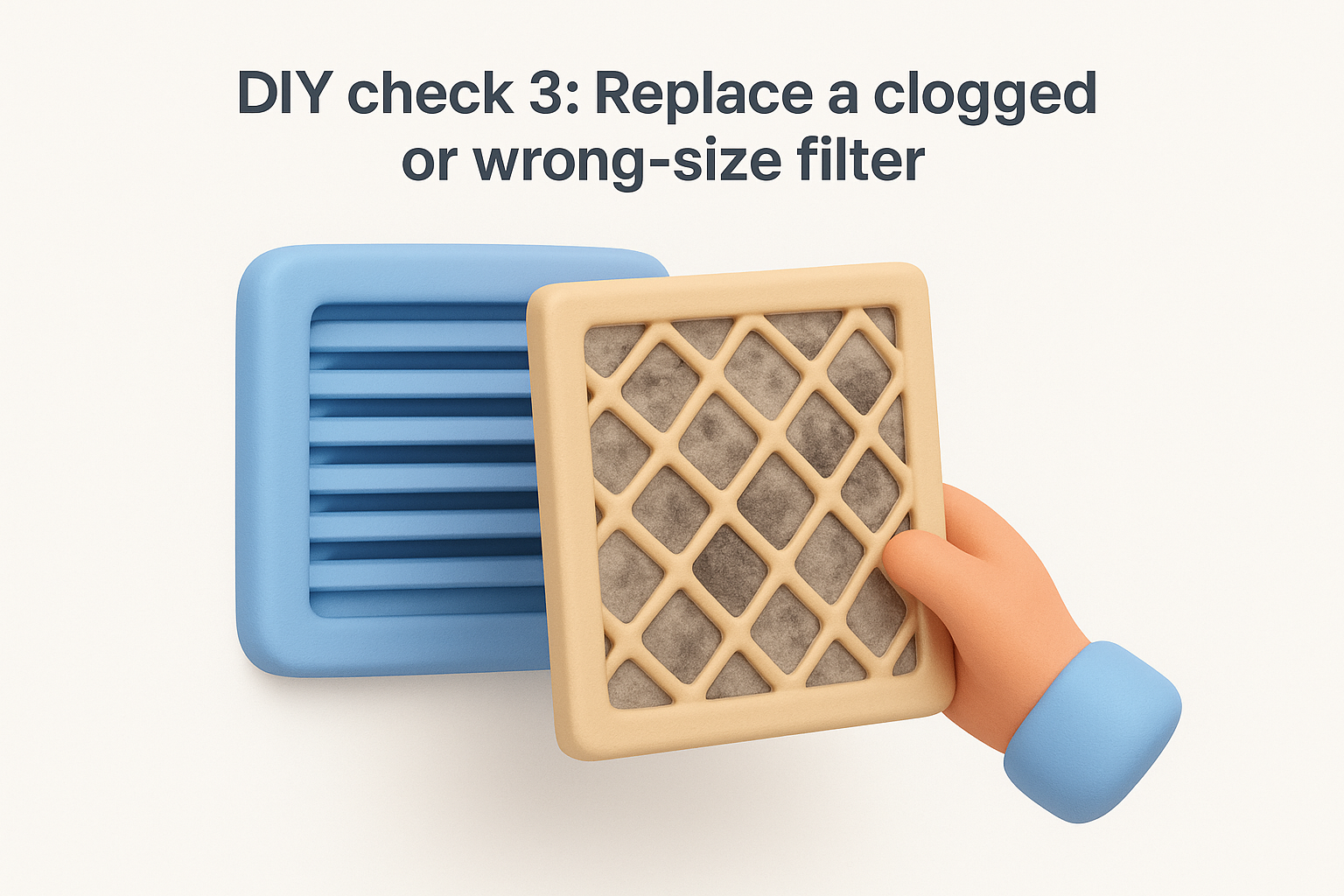
A filter with a MERV rating above 13 can restrict airflow just as much as a dirty one on standard residential systems, so stick with MERV 8 to 11 unless your system is rated for higher.
DIY check 4: Open supply vents and unblock returns
Walk through your home and check that every supply vent is fully open and not covered by furniture, rugs, or curtains. Then locate your return air grilles, usually larger grates on walls or ceilings, and make sure nothing is blocking them. Closing vents in unused rooms doesn’t save energy on most systems; it raises static pressure and forces your AC to work harder.
What airflow problems feel like at the vents
When airflow is restricted, you’ll notice weak air pressure at supply vents even when the system is running. Rooms farther from the air handler tend to feel the warmest first. If some vents blow reasonably well but others barely move air, you may have a duct leak or blockage beyond a simple filter fix, which a technician should inspect.
4. Check for a frozen evaporator coil
A frozen evaporator coil is another common answer to why is my ac not cooling, and it’s one you can spot without opening any panels. When the coil freezes over, refrigerant can’t absorb heat from your indoor air properly, so your system runs but barely cools the house.
DIY check 5: Spot ice on the indoor coil or copper line
Start by checking the copper refrigerant line that connects your outdoor unit to the wall near your air handler. Ice or frost on that line is a clear sign the evaporator coil inside has frozen over.
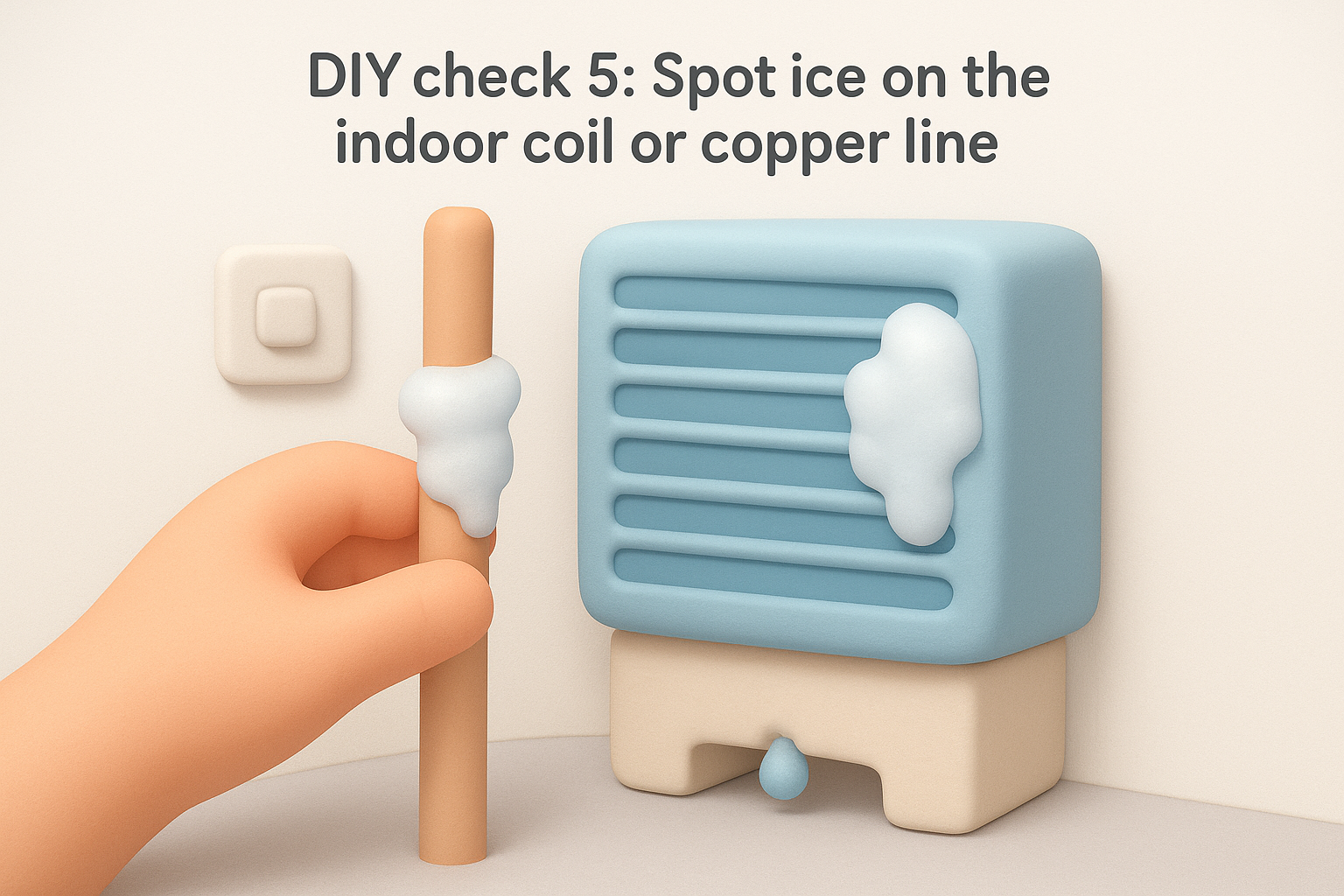
You can also look at the base of your air handler cabinet for water pooling on the floor. When a frozen coil starts to thaw during off cycles, that meltwater often spills outside the drain pan and onto the floor below the unit.
How to thaw the system without damaging it
Turn the thermostat to OFF or FAN ONLY and let the blower run without a cooling cycle. Room-temperature air moving across the coil gradually melts the ice without stressing the compressor. Most coils thaw fully within one to three hours, so set towels around the base of the air handler to catch drip water during that time.
Never chip or scrape ice off the evaporator coil. Doing so can puncture the coil itself, turning a fixable freeze into a costly refrigerant leak repair.
What freezing usually points to
A frozen coil almost always traces back to restricted airflow or low refrigerant charge. If the coil refreezes after you’ve confirmed a clean filter and open vents, that repeat freeze signals a refrigerant problem that only a licensed technician can properly diagnose and correct.
5. Inspect the condensate drain and safety switch
Your AC pulls humidity out of the air as it cools, and that moisture drains out through a condensate line. When that line clogs, water backs up into the drain pan, and many systems have a float safety switch that shuts cooling off entirely to prevent water damage to your ceiling or floor.
DIY check 6: Look for a full drain pan or water shutoff
Check the drain pan sitting beneath your air handler for standing water. A pan with visible water in it tells you the condensate line is blocked and the float switch may have already cut your cooling cycle short. This is one of the less obvious answers to why is my ac not cooling when the system appears to be running normally otherwise.
If your thermostat shows the system is calling for cooling but the compressor isn’t engaging, a tripped float switch is a likely cause. Locate the switch on or near the drain pan and confirm it isn’t stuck in the raised position.
Safe steps to clear minor clogs and restore cooling
Pour one cup of distilled white vinegar into the condensate drain access port, which is typically a capped PVC pipe near the air handler. Let it sit for 30 minutes to break down algae and debris, then flush with water. Reset the float switch if it has a manual reset button, and give the system a few minutes to resume normal operation.
When a drain issue signals a bigger problem
Recurring clogs within the same season usually point to a structural problem in the drain line, not just a one-time debris buildup.
Repeated backups, water stains on your ceiling near the air handler, or a cracked drain pan all point to issues a technician needs to assess in person. Those conditions also create the right environment for mold growth inside the air handler, which affects your indoor air quality well beyond the original cooling problem.
6. Clean and clear the outdoor condenser unit
Your outdoor condenser unit releases heat from your home to the outside air, so when it’s packed with debris or surrounded by overgrown plants, heat transfer drops significantly and your system struggles to keep pace. This is a frequently overlooked factor in why your AC is not cooling on otherwise hot, sunny days.
DIY check 7: Remove debris and rinse coils the right way
Turn your system off at the thermostat before touching anything outside. Clear leaves, grass clippings, and any debris from around the cabinet, and trim back vegetation to leave at least two feet of clearance on all sides. To rinse the coils, use a standard garden hose on a gentle spray setting and work from the inside out so dirt pushes away from the fins rather than deeper into them.
Avoid pressure washers on condenser coils. The aluminum fins bend easily under high water pressure, and bent fins block airflow in ways that require professional tools to correct.
Quick checks for outdoor fan operation and airflow
Stand near the unit while it runs and confirm the top fan is spinning and pulling air upward through the cabinet. A fan that stutters or barely moves air points to a failing capacitor or motor that a technician needs to replace safely.
- Fan blade not spinning while the compressor runs
- Fan hums loudly or vibrates during operation
- Little to no hot air exhausting from the top of the cabinet
Red flags that point to refrigerant or electrical trouble
If the outdoor unit hisses or produces unusual odors near the refrigerant lines, refrigerant loss is likely the cause. A visibly burned or corroded disconnect box mounted near the unit signals electrical problems that go well beyond cleaning.
- Hissing or bubbling sounds from the refrigerant lines
- Ice forming on outdoor copper connections after cleaning
- Circuit breaker tripping each time the compressor starts
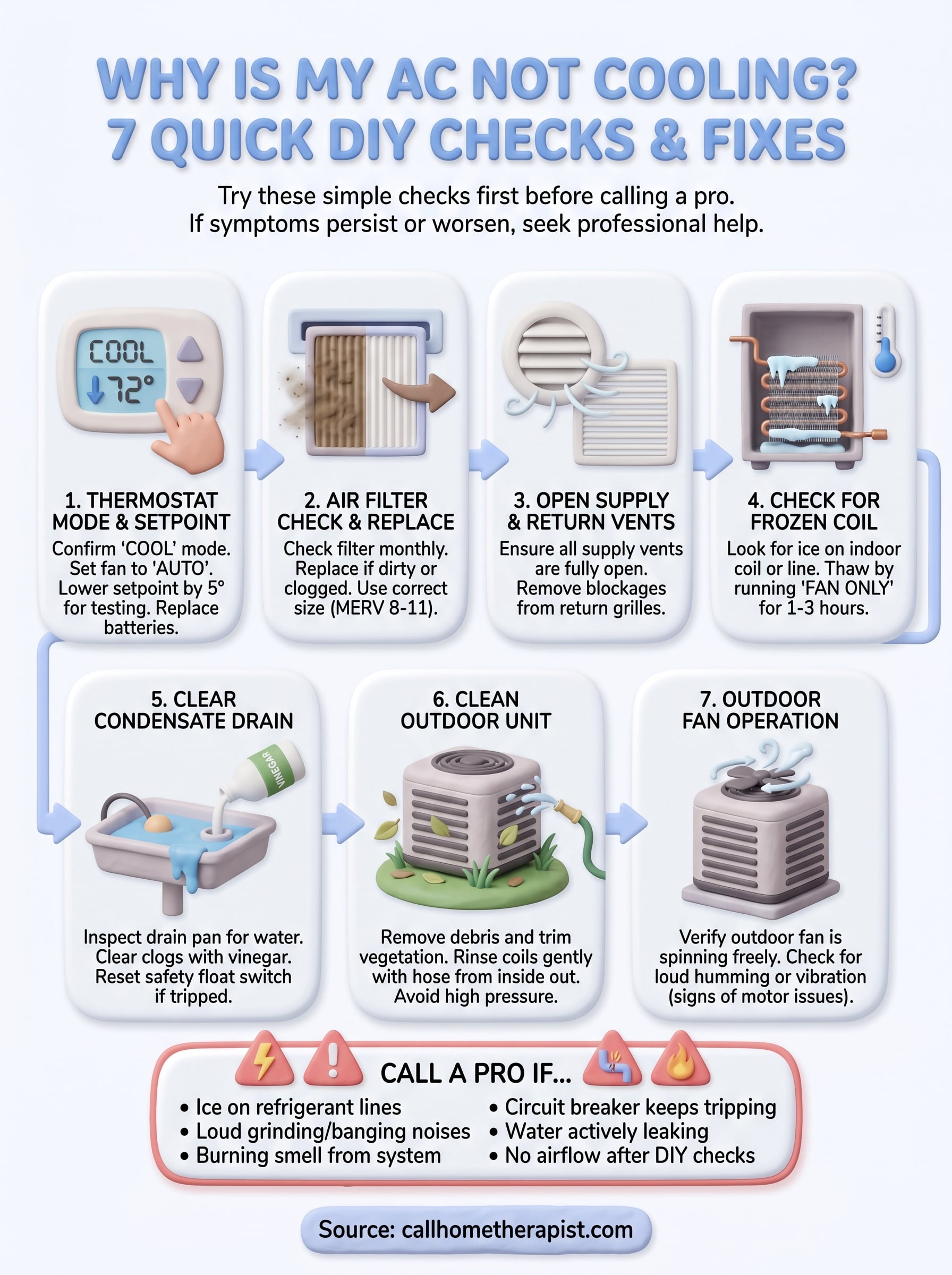
Your next steps
You now have seven specific checks to run the next time you’re asking why is my ac not cooling. Work through them in order: thermostat settings, filter, airflow, frozen coil, condensate drain, and then the outdoor unit. Most of these take under 30 minutes total and cost nothing beyond a replacement filter or a cup of vinegar.
If you run through every check and your system still won’t cool properly, or if you spot any of the red flags covered in section one, stop running the unit and call a licensed technician. Continuing to operate a failing system often turns a straightforward repair into a much larger bill. The Home Therapist team serves the Greater Tampa Bay Area with same-day availability, upfront pricing, and no hidden fees. Schedule your AC diagnostic today and get your home back to a comfortable temperature without the guesswork.
More AC Repair Articles
- AC Repair Plant City FL: Frayed Low-Voltage Wire Stopped the Condenser on Emerson Pl, 33566
- Why This Sunridge Palms AC Wouldn’t Start: An 11-Minute Capacitor Replacement in Tampa, FL 33617
- Why Is My AC Freezing Up? 5 Causes & Fixes For Florida
- What a 45-Minute Tune-Up Reveals When the Blower Motor Was Already Replaced: AC Maintenance in Zephyrhills, FL 33541
- AC Contactor vs Relay: How to Tell Which One Is Failing in Your Tampa AC


