

Why Balancing Home Humidity Matters for Tampa Bay Comfort
TL;DR:
- Tampa Bay homes often exceed optimal humidity levels, leading to mold, dust mites, and structural damage.
- Maintaining indoor relative humidity between 45% and 55% improves comfort, health, and energy efficiency.
- Active humidity management with monitoring, dehumidifiers, and proper HVAC maintenance is essential for home health.
Your air conditioner is running, your home feels cool, and yet something still feels off. That sticky, heavy air creeping in despite the AC is not your imagination. Tampa Bay homes routinely struggle with hidden moisture problems that even the best cooling systems cannot fully fix. Invisible humidity is silently affecting your health, your sleep quality, your furniture, and your monthly energy bills. This guide breaks down exactly why humidity balance matters, what the right numbers look like for our specific climate, and what practical steps you can take right now to breathe easier at home.
Table of Contents
- What is balanced humidity and why does it matter?
- How Tampa Bay’s climate challenges home humidity
- Health and comfort: The real-life benefits of balanced humidity
- How to monitor and maintain the right humidity in your home
- Debunking myths: Is higher humidity ever okay?
- Why Tampa homeowners need to rethink humidity control
- Get professional help to master home humidity
- Frequently asked questions
Key Takeaways
| Point | Details |
|---|---|
| Ideal humidity range | Keep your home’s relative humidity between 45 and 55 percent for best comfort and health. |
| Tampa climate risks | Year-round high humidity in Tampa makes intervention essential to avoid mold and discomfort. |
| AC is not enough | Air conditioning alone rarely maintains healthy humidity. Whole-home solutions are needed. |
| Monitor and maintain | Use a hygrometer and proper HVAC settings to detect and control indoor moisture. |
| Higher RH flexibility | Some Tampa homes can safely allow up to 60 percent RH, if you avoid condensation. |
What is balanced humidity and why does it matter?
Relative humidity, or RH, is the percentage of moisture in the air compared to how much moisture the air could hold at a given temperature. When people talk about humidity and home comfort, they are usually talking about RH. Cool air alone does not guarantee comfort because air that is 72°F but loaded with moisture can still feel miserable to breathe.
The EPA sets a clear standard: optimal indoor RH for homes sits between 30% and 50% year-round. This range is not arbitrary. Below 30%, air becomes too dry, causing irritated sinuses, cracked wood floors, and static electricity. Above 50%, and especially above 60%, your home becomes a breeding ground for mold, dust mites, and airborne allergens.
Here is a quick reference for what the numbers mean in practice:
| RH Level | What It Means | Risk |
|---|---|---|
| Below 30% | Too dry | Dry skin, respiratory irritation (rare in Tampa) |
| 30% to 50% | EPA recommended range | Healthy, comfortable baseline |
| 45% to 55% | Tampa-specific ideal | Cooler feel, reduced AC load |
| 55% to 60% | Elevated, monitor closely | Possible mold if sustained |
| Above 60% | Too humid | Mold growth, dust mites, wood rot |
High RH brings a cascade of problems that go well beyond discomfort. Here is what you are actually dealing with when your home’s moisture levels stay too high:
- Mold and mildew growth on walls, ceilings, and inside ductwork
- Dust mite explosions since these microscopic pests thrive above 50% RH
- Wood rot and warping in floors, cabinets, and window frames
- Worsened allergies and asthma from spores and mite waste particles in the air
- Musty odors that seem impossible to eliminate
- Structural damage to drywall and insulation over time
Low RH is uncommon in Tampa, but if you ever run aggressive dehumidification without monitoring, you can tip too far in the other direction, causing dry throat, itchy skin, and increased susceptibility to respiratory infections.
How Tampa Bay’s climate challenges home humidity
Now that you understand the RH framework, it is important to recognize that Tampa Bay is not a typical climate. The Gulf Coast brings persistent moisture year-round. Summers are intensely humid, and even our mild winters rarely drive indoor RH low enough to worry about dryness.
The numbers tell the story clearly. Tampa indoor RH often exceeds 60% without any intervention, creating ideal conditions for mold, dust mites, wood rot, and worsened allergy and asthma symptoms. Compare that to cities in drier climates where the struggle is often adding moisture, not removing it.
| City | Average Summer RH | Common Challenge |
|---|---|---|
| Tampa, FL | 75% to 85% outdoor | Removing excess moisture |
| Phoenix, AZ | 25% to 40% outdoor | Adding moisture |
| Denver, CO | 40% to 55% outdoor | Balanced, modest control needed |
| Houston, TX | 70% to 80% outdoor | Similar to Tampa, high removal need |
| Chicago, IL | 55% to 70% outdoor | Seasonal swings, both directions |
For Tampa homeowners, the practical target is tighter than the standard EPA guidance. The ideal local RH is 45% to 55%, which makes your home feel several degrees cooler without lowering the thermostat and reduces the workload on your AC system.
“Tampa homes often exceed 60% relative humidity without active intervention. Standard benchmarks are a starting point, but local conditions demand localized targets. Aiming for 45% to 55% RH is not optional here. It is essential.”
This is also where preventing mold in your HVAC system becomes critical. Ductwork that runs through humid attic spaces is especially vulnerable to mold growth when home RH stays elevated.
Pro Tip: Even rooms that feel cool to the touch can have dangerously high humidity. A bedroom with the door closed and minimal airflow can sit at 65% RH while your living room reads 52%. Do not assume your whole home is balanced just because your main thermostat area feels fine. Check multiple rooms, especially bathrooms, closets, and bedrooms.
Understanding Tampa indoor air quality as a whole system, not just temperature, is the first real step toward a genuinely comfortable home.
Health and comfort: The real-life benefits of balanced humidity
Getting your RH into the 45% to 55% range is not just about avoiding problems. There are real, noticeable benefits you will feel within days of correcting your home’s moisture balance.
From a health standpoint, balanced RH reduces airborne irritant suspension and limits mold viability. In contrast, very low RH actually increases the amount of time that dust particles and other irritants float in the air, making things worse for allergy sufferers. Keeping RH in the right range keeps more contaminants settled and out of your breathing zone.
Humidity also changes how temperature feels on your skin. Humid air holds heat against your body and slows down your natural cooling through perspiration. At 78°F and 70% RH, your home will feel closer to 84°F. Drop that RH to 50%, and the same 78°F feels genuinely comfortable. That is why mold prevention tips and energy savings often go hand in hand with humidity control.
The benefits you will notice when your home hits its ideal RH range:
- Better sleep quality because your body can regulate temperature more effectively overnight
- Fewer musty odors since mold and mildew have less opportunity to grow
- Reduced respiratory issues including morning congestion and nighttime coughing
- Preserved wood furniture, floors, and cabinetry from the swelling and warping that excess moisture causes
- Lower energy bills because your AC does not have to work as hard to compensate for humidity
- Less condensation on windows and cold surfaces, which itself causes water damage over time
Pro Tip: Buy a digital hygrometer for around $15 to $20 and place it in your most-used living space. Do not guess your home’s moisture level. These small devices give you accurate, real-time RH readings so you can respond before problems develop rather than after.
How to monitor and maintain the right humidity in your home
Knowing what the right RH is only gets you halfway there. The other half is actively managing it, and in Tampa, that requires a more deliberate approach than most guides suggest.
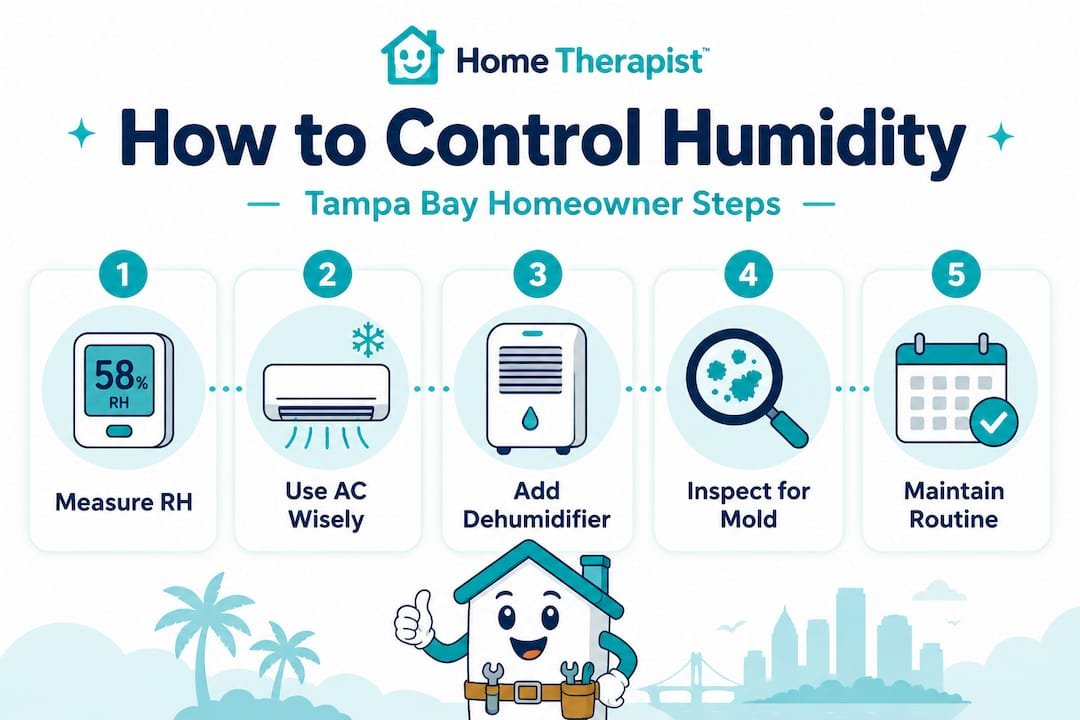
Start with measurement. A basic digital hygrometer placed in the center of your main living area gives you an honest picture of your home’s current condition. For a more thorough view, check multiple rooms. Smart sensors that connect to your phone are also available and allow you to track trends over time.
Once you know where your RH stands, follow these key steps to bring it into range:
- Monitor consistently using at least one hygrometer in your main living area and one in your primary bedroom
- Run a dehumidifier if your readings consistently exceed 55%, starting with a portable unit in problem areas
- Seal air leaks around doors, windows, and attic hatches to prevent humid outdoor air from infiltrating your home
- Schedule regular HVAC maintenance since a poorly maintained system removes far less moisture than a tuned one
- Use exhaust fans in bathrooms and kitchens every time you cook or shower, and leave them running for 10 to 15 minutes after you finish
Why your AC alone is not enough
Here is a truth many Tampa homeowners discover too late. Air conditioners are designed primarily to cool air, not to dehumidify it. They do remove some moisture as a byproduct of the cooling process, but this only works when the AC is running long cycles.
Oversized AC units, which are unfortunately common because homeowners and even some contractors assume bigger equals better, actually short cycle. They reach the set temperature so fast that they shut off before removing meaningful moisture from the air. The result is a cool but clammy home. Whole-house dehumidifiers integrated with your HVAC system can remove up to 15 gallons of water per day, making them far superior to portable room units for managing Tampa’s persistent humidity challenges.
Proper HVAC maintenance also plays a direct role in humidity control. A clogged filter restricts airflow, reducing the system’s ability to pull moisture from the air. A dirty evaporator coil is even worse, as it loses its ability to cool and dehumidify effectively.
Additional preventative practices that make a real difference:
- Keep interior doors open to allow airflow throughout the home
- Avoid drying laundry indoors without proper ventilation
- Check crawl spaces and attics for moisture accumulation seasonally
- Install vapor barriers in crawl spaces if your home has them
Pro Tip: Never set your thermostat fan to ON. This constant fan setting recirculates air even when your AC is not actively cooling, which means it also pushes already-humid air back into your living space without removing moisture. Always use the AUTO setting so the fan only runs when the AC is actively cooling and dehumidifying. Per HVAC humidity management guidance, this one change can make a noticeable difference in how effectively your system manages moisture.
For a full breakdown of what to check and when, review our HVAC maintenance guide to build a consistent routine.
Debunking myths: Is higher humidity ever okay?
One of the more interesting debates in home climate science right now involves whether the strict 50% ceiling is truly necessary in all situations. The short answer is that it depends on your home’s specific conditions, not just the number on your hygrometer.
A recent thermodynamic building study found that RH up to 60% can be safe and even energy-smart during the cooling season, provided that surfaces in the home remain above the dew point and no condensation forms. When surfaces stay warm enough that moisture does not collect on them, the risk of mold growth drops significantly even at higher ambient RH.
“Cooling-season research shows that allowing RH to reach 60% can reduce AC energy consumption without triggering health or material risks, as long as surface temperatures remain above the dew point and no visible condensation appears.”
That said, this is not a license to let your home run at 65% and call it fine. The practical takeaway is that the threshold has some flexibility for energy-conscious homeowners during Tampa’s long hot season. If you can maintain 55% to 60% RH without seeing condensation on windows, walls, or air vents, you are likely in a safe zone while also saving on cooling costs.
The warning signs that tell you it is time to bring RH down regardless of the number:
- Condensation forming on windows, mirrors, or pipes
- Musty or earthy odors in any room or closet
- Visible mold or dark spots in corners and grout lines
- A persistently sticky or heavy feeling in the air
Understanding the nuance around humidity levels explained for Tampa Bay specifically helps you make smarter decisions rather than just chasing a rigid target that may not reflect your home’s actual conditions.
Why Tampa homeowners need to rethink humidity control
After years of working in Tampa Bay homes, one pattern stands out above all others. Homeowners invest heavily in their AC systems and assume that if the temperature is comfortable, everything else must be fine. That assumption is costing them in ways they cannot always see.
Your air conditioner was engineered to manage temperature. It was not engineered to serve as your primary humidity management tool, especially in a climate as persistently wet as Tampa Bay. When we examine homes with chronic mold issues, persistent musty smells, or rising allergy symptoms, the root cause is almost always excess moisture that the AC never fully addressed. The regional humidity challenges here are genuinely different from what most HVAC systems are calibrated to handle on their own.
The homeowners who get this right are the ones who treat humidity as its own system, not a side effect. They invest in proper monitoring tools, schedule proactive HVAC maintenance, and understand when a whole-home dehumidifier makes more sense than just dropping the thermostat. The result is lower energy bills, fewer repair calls, healthier air, and a home that genuinely feels comfortable rather than just cool.
Reactive management, waiting until you see mold or smell something off, means you are already dealing with a problem that costs significantly more to fix than it would have cost to prevent. Invisible moisture degrading your air quality is not a minor inconvenience. Over time, it affects your health, your structure, and your bottom line.
Get professional help to master home humidity
Managing home humidity in Tampa Bay is not a DIY guessing game. Getting it right means understanding your home’s specific layout, duct system, and moisture entry points, and then applying the right tools to address them.
At Home Therapist Cooling, Heating, and Plumbing, our certified technicians assess your home’s actual humidity levels, identify whether your HVAC comfort solutions are properly sized and maintained for Tampa’s climate, and recommend dehumidification upgrades that make a measurable difference. We have helped hundreds of Tampa Bay homeowners stop guessing and start breathing easier. Whether you are starting fresh or troubleshooting a persistent problem, our HVAC maintenance for beginners resources and local expertise are ready to help. Reach out today to schedule your home comfort assessment and take the first step toward genuinely balanced air.
Frequently asked questions
What is the ideal indoor humidity level for Tampa Bay homes?
Experts recommend 45% to 55% relative humidity for Tampa Bay homes specifically, as this range supports comfort, reduces AC load, and prevents mold growth more effectively than the broader national 30% to 50% guideline.
Does my air conditioner control humidity in my home?
Your AC removes some moisture, but AC alone is often insufficient in Tampa’s climate, particularly when units are oversized and short cycle before completing meaningful dehumidification.
How can I tell if my home has too much humidity?
Watch for musty odors, condensation on windows or cold surfaces, visible mold spots in corners or grout, and that persistent sticky feeling in the air even when your AC is running.
Is it safe to let my home humidity rise above 50%?
Up to 60% RH can be safe if surfaces stay dry and show no condensation, per thermodynamic cooling-season research, but visible moisture or musty odors are signs that you need to bring the level down immediately.
What is the best way to lower humidity in a Tampa home?
A whole-house dehumidifier combined with regular HVAC maintenance and proper ventilation is the most effective approach, as whole-house systems can remove up to 15 gallons per day where portable units and AC alone fall short.
Recommended
- Air balancing: boost HVAC efficiency and comfort
- Role of HVAC in Comfort, What Tampa Homeowners Need
- Essential Smart Thermostat Features for Humidity in Tampa | Home Therapist
- Role of Home Comfort Systems in Tampa Bay Homes
- How to Deal with Humidity Problems in Jersey Shore Homes
More Indoor Air Quality Articles
- Coil Clean, UV Light Install, and AC Diagnosis on Half Moon Lake Road, Tampa, FL 33625
- 12 Air Purification System Reviews: Whole-Home & Portable
- Why change air filters? Boost HVAC efficiency now
- Pet hair HVAC cleaning tips for Tampa Bay pet owners
- Mini Split Installation for Florida Rooms and Garages in Tampa, FL: What to Expect


