

HVAC Retrofit in Tampa Bay: When to Upgrade vs Replace
An HVAC retrofit in Tampa Bay makes sense when your system is under about 10 years old and the bones are solid: you upgrade ducts, controls, or a single failed component instead of replacing the whole system. Once a unit passes 12 to 15 years, runs on phased-out refrigerant, or needs a compressor, full replacement almost always wins on cost and reliability. Here is how to decide.
Should I retrofit or replace my HVAC system in Tampa?
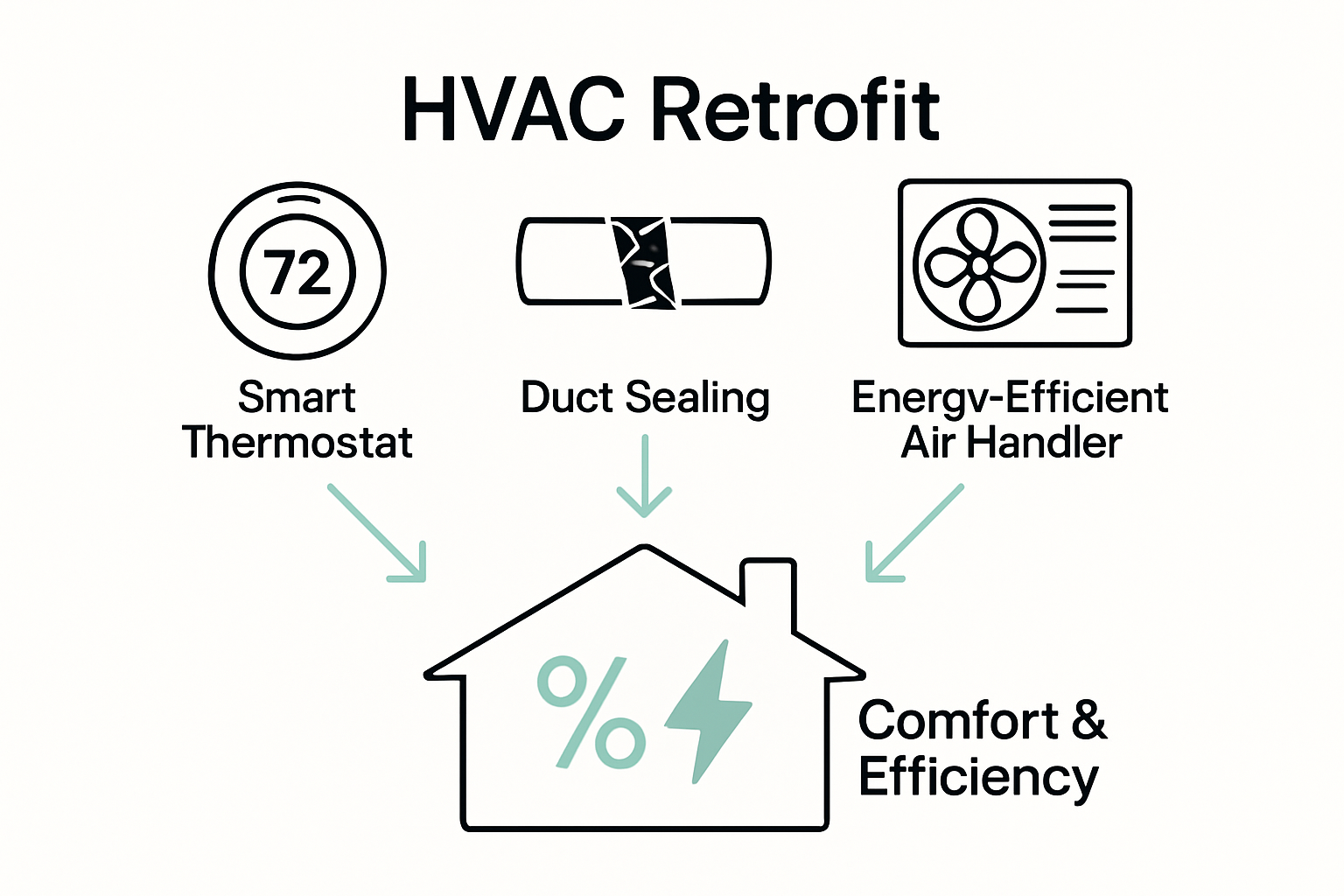
This is the question we get on most aging-system calls in Tampa, Brandon, and Wesley Chapel. A retrofit keeps your existing equipment and improves it: sealing leaky ductwork, adding a smart thermostat, swapping a worn blower motor, or upgrading insulation. A replacement swaps the condenser and air handler for a new matched system.
The honest answer depends on three things: the age of your equipment, the refrigerant it uses, and what is actually failing. In Tampa Bay, where systems run nearly year-round and coastal salt air corrodes coils faster than inland Florida, equipment ages quicker than the national average. That shifts the break-even point toward replacement sooner than homeowners expect.
Our techs always start with a repair-versus-replace inspection and a FREE estimate before recommending either path. There is no diagnostic fee for that visit, and we never push a replacement when a targeted retrofit will do.
When is an HVAC retrofit in Tampa Bay worth it?
A retrofit is the smart money when the core system is healthy but one or two elements drag down comfort or efficiency. The most common Tampa Bay retrofits we perform pay for themselves through lower bills and steadier cooling.
- Duct sealing and insulation: Leaky attic ducts are the single biggest hidden waste in Florida homes. The U.S. Department of Energy notes that sealing and insulating ducts can significantly improve forced-air system efficiency.
- Smart thermostat upgrade: Adds scheduling, humidity awareness, and remote control without touching the equipment.
- Blower motor or capacitor replacement: Restores airflow and startup on an otherwise sound unit.
- Insulation and attic sealing: Reduces the cooling load so the existing system keeps up during a 95-degree afternoon.
If your system is roughly 6 to 10 years old, uses current refrigerant, and just feels weak or uneven, a retrofit usually restores performance for a fraction of replacement cost. Pair it with a look at our ductwork and air quality services to find the real bottleneck.
When does full HVAC replacement make more sense?
Replacement wins when the math stops favoring patches. We recommend leaning toward a new system in these situations:
- Age past 12 to 15 years. Efficiency drops, parts get scarce, and a retrofit dollar buys less life.
- Failed compressor. A new compressor on an old condenser often costs nearly as much as a full unit, with none of the warranty.
- Obsolete refrigerant. Systems built on R-22 or being phased away from R-410A face rising service costs. Per the U.S. EPA, the industry is transitioning to lower-global-warming refrigerants like R-454B, so an old charge becomes a liability.
- Repeated repairs in one season. Two or three calls a summer signals a system on borrowed time.
When replacement is the call, we install Goodman and Daikin systems sized to your home with a proper load calculation. See our AC replacement in Tampa page for what a right-sized install includes, or the broader HVAC installation guide for Tampa Bay.
Retrofit vs replacement: a Tampa Bay cost snapshot
Real numbers vary by home, but here is how the two paths typically compare for a single-family Tampa Bay home. These are general ranges, not a quote.
| Option | Typical Tampa Bay range | Best when |
|---|---|---|
| Duct sealing and insulation | $$ (mid hundreds to low thousands) | System healthy, bills high, rooms uneven |
| Smart thermostat retrofit | $ (low hundreds installed) | Manual or failing thermostat |
| Blower motor or capacitor | $$ (parts plus labor, $279 on approved repair) | Weak airflow, hard starts, unit under 10 years |
| Full system replacement | $$$$ (several thousand and up) | Age 12 years plus, compressor failure, old refrigerant |
Our $279 figure is the labor on approved repair work only, never a charge to come look. Diagnosis and estimates are always FREE.
Key takeaways
- An HVAC retrofit in Tampa Bay fits systems under about 10 years old with solid core equipment.
- Duct sealing, a smart thermostat, and blower or capacitor work are the highest-value retrofits in Florida homes.
- Replace when the system is 12 to 15 years old, the compressor fails, or it runs on phased-out refrigerant.
- Coastal salt air and year-round runtime age Tampa Bay systems faster, moving the replace line earlier.
- Home Therapist gives a FREE estimate and FREE diagnosis before recommending either path.
HVAC retrofit FAQs for Tampa Bay homeowners
Sources: ENERGY STAR, ACCA.
Questions to ask before you commit to an HVAC retrofit or full replacement in Tampa
Before you approve any scope, ask the contractor three things. First, will a refrigerant or coil upgrade qualify for the IRS Section 25C tax credit (up to 00 on qualified components) or the Duke Energy or TECO rebate programs? A retrofit that qualifies keeps more money in your pocket. Second, will the new equipment or retrofit require a Hillsborough County permit, and is the contractor pulling it? A permitted job protects your homeowner insurance and your resale. Third, what is the warranty on parts and labor separately? A manufacturer warranty covers the part; the contractor warranty covers the install. Knowing both before you sign prevents surprises if something fails in year two.
For a straight comparison of the economics on a full swap, our AC replacement cost guide shows the installed ranges for the Hillsborough County market.
Is an HVAC retrofit cheaper than replacement in Tampa?
Usually yes, when the core system is healthy. Retrofits like duct sealing, a smart thermostat, or a blower motor cost far less than a new matched system. The savings disappear once the equipment is past 12 to 15 years or needs a compressor.
How do I know if my refrigerant is being phased out?
Check the data plate on your outdoor unit or ask during a FREE diagnosis. Older systems use R-22 or R-410A, and the industry is moving toward lower-impact refrigerants such as R-454B, which raises long-term service costs on legacy charges.
Will a retrofit help with high humidity in my Tampa home?
It can. Sealing leaky ducts and adding humidity-aware controls help an existing system pull moisture out more effectively. If humidity stays above 60 percent after a retrofit, the system may be oversized or undersized and worth a load review.
Does Home Therapist charge to assess my system?
No. Diagnosis and estimates are FREE. Our $279 applies only to labor on an approved repair, never to the visit or the quote. Call (813) 343-2212 to schedule.
More Related Articles
- HVAC Indoor Air Quality Tampa: How Your System Affects the Air
- How Often to Schedule HVAC Maintenance in Tampa Bay
- HVAC Troubleshooting in Tampa: 5 Checks Before You Call
- What Counts as an HVAC Emergency in Florida?
- Air Conditioner Installation Repair Tampa FL Bay FL Services Review from Bonnie Wakefield


