

Attic ventilation: Boost comfort and cut cooling costs in Tampa Bay
TL;DR:
- Many Tampa Bay homeowners waste energy and risk roof damage by neglecting attic ventilation. Proper airflow reduces attic temperatures, cuts cooling costs by up to 25 percent, and prevents moisture-related issues like mold and wood rot. A balanced system of ridge and soffit vents, installed with care, offers optimal performance in Florida’s demanding climate.
Many Tampa Bay homeowners spend thousands on air conditioning every summer while ignoring the single biggest factor driving those bills up: a poorly ventilated attic. Without proper airflow up there, attic temperatures can soar past 150°F, turning your ceiling into a radiator that forces your AC to work overtime. The good news is that fixing this problem can cut your cooling costs by up to 25%, extend your roof’s life, and make every room in your home feel noticeably more comfortable, all without replacing your HVAC system.
Table of Contents
- How attic ventilation impacts comfort, energy, and health
- Common ventilation methods and what works best in Tampa Bay
- Ventilation gone wrong: Risks of poor airflow and common mistakes
- Advanced solutions: Alternatives, insulation, and special considerations
- Our take: Attic ventilation is about precision, not just airflow
- Ready for better attic airflow and a cooler home?
- Frequently asked questions
Key Takeaways
| Point | Details |
|---|---|
| Lower cooling costs | Proper attic ventilation helps reduce AC bills by up to 25 percent during Tampa Bay summers. |
| Prevent moisture damage | Ventilation curbs mold, mildew, and wood rot by limiting trapped humidity in your attic. |
| Boost roof longevity | Good airflow can extend shingle life by preventing extreme attic heat and insurance issues. |
| Code compliance matters | Florida homes require balanced intake and exhaust vents to meet safety and energy standards. |
| Custom solutions exist | Special systems like spray foam or hot roofs may suit unique homes but require expert design. |
How attic ventilation impacts comfort, energy, and health
Now that you know why attic ventilation is far from optional, let’s explore its specific impacts on everyday comfort, expenses, and air quality in Tampa homes.
Think of your attic as a pressure cooker sitting directly above your living space. During a typical Tampa summer, solar heat radiates through your roof deck and gets trapped in the attic cavity. Without a way for that hot air to escape, it builds up fast. That heat then conducts straight through your ceiling insulation and into the rooms below, raising the temperature your AC has to fight against, all day long.
The energy impact is measurable. Proper attic ventilation can drop attic temperatures by 20 to 40°F and reduce cooling costs by 6 to 25 percent. For a Tampa homeowner paying $250 a month in summer electric bills, that’s a savings of $15 to $62 every single month, just from better airflow.
The heat problem is only half the story. Tampa Bay’s humidity is relentless, and moisture is just as damaging as heat. Daily human activity produces roughly 0.75 gallons of water vapor per person inside a home, and all of that moisture eventually migrates up into the attic. Without ventilation to flush it out, that moisture condenses on rafters, roof decking, and insulation, creating the perfect conditions for mold, mildew, and wood rot.
Here’s what poor attic ventilation can cause over time:
- Mold and mildew growth on rafters and roof decking, which can spread into living areas
- Compressed or wet insulation that loses its R-value (thermal resistance) and stops working
- Wood rot in the structural framing of your roof
- Higher AC runtime as the system struggles against a heat-saturated attic
- Reduced indoor air quality as mold spores circulate through ductwork
If you want to prevent mold in your home, attic ventilation is one of the first places to start. Similarly, poor attic sealing often creates air leaks that kill efficiency; learning to reduce air leaks for efficiency goes hand in hand with upgrading your attic’s airflow.
| Attic condition | Summer temperature | Cooling cost impact | Moisture risk |
|---|---|---|---|
| No ventilation | 150°F or higher | Up to 25% higher bills | Very high |
| Partial ventilation | 130 to 140°F | 10 to 15% higher bills | Moderate |
| Balanced ventilation | 110 to 120°F | Optimal efficiency | Low |
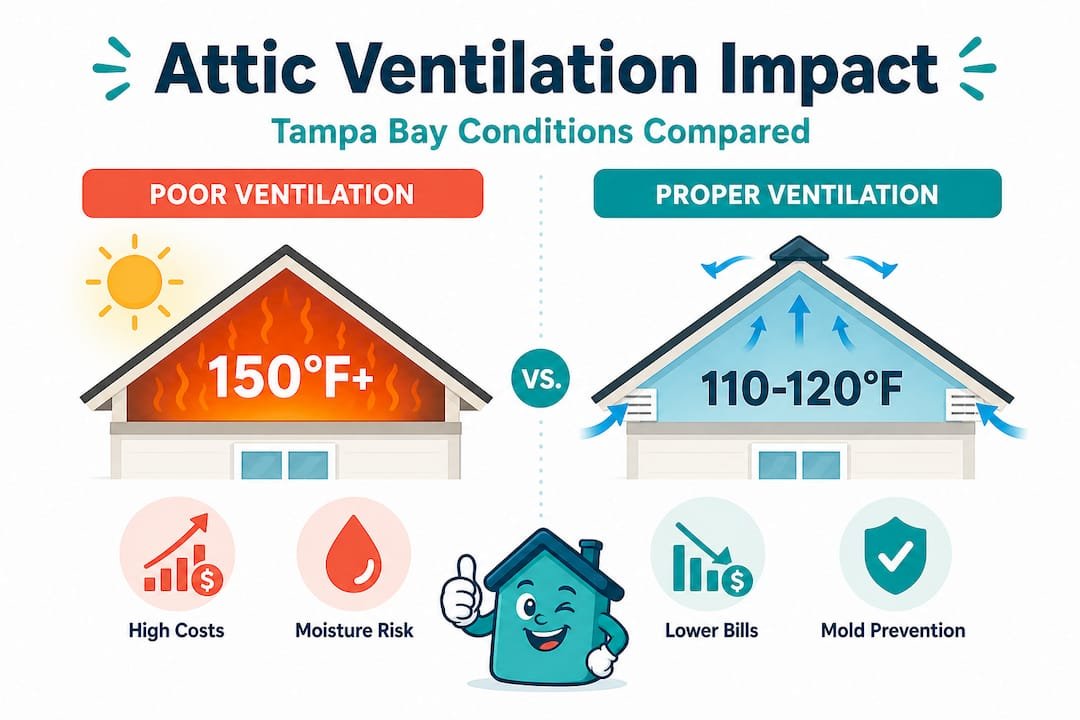
The table above shows why “some” ventilation is not the same as “proper” ventilation. A few box vents scattered on the roof may technically count as venting, but they rarely create enough airflow to make a real difference in Tampa’s climate.
Common ventilation methods and what works best in Tampa Bay
Understanding the “why” behind attic venting, it’s time to see which methods work best for Tampa’s unique weather and which are likely to fall short.
There are several types of attic vents, and they are not interchangeable. Each works on a different principle, and some pair together while others should never be combined.
Types of attic vents explained:
- Ridge vents run along the peak of the roof and exhaust hot air continuously as it naturally rises.
- Soffit vents sit under the roof eaves and pull in cooler outside air at the lowest point of the attic.
- Box vents (static vents) are fixed openings cut into the roof deck, relying entirely on wind to move air.
- Gable vents sit at the triangular ends of the attic and can act as either intake or exhaust depending on wind direction, which makes them inconsistent.
- Powered attic fans use electricity to force air out, but they can depressurize the attic and pull conditioned air from your living space, defeating the purpose.
The system that consistently performs best in Tampa Bay is a continuous soffit and ridge combination. Here’s why it works so well: hot air rises naturally (this is called the stack effect), exits through the ridge vent at the top, and draws in fresh outside air through the soffit vents at the bottom. This creates a steady, convection-driven airflow that doesn’t depend on wind direction or electricity.
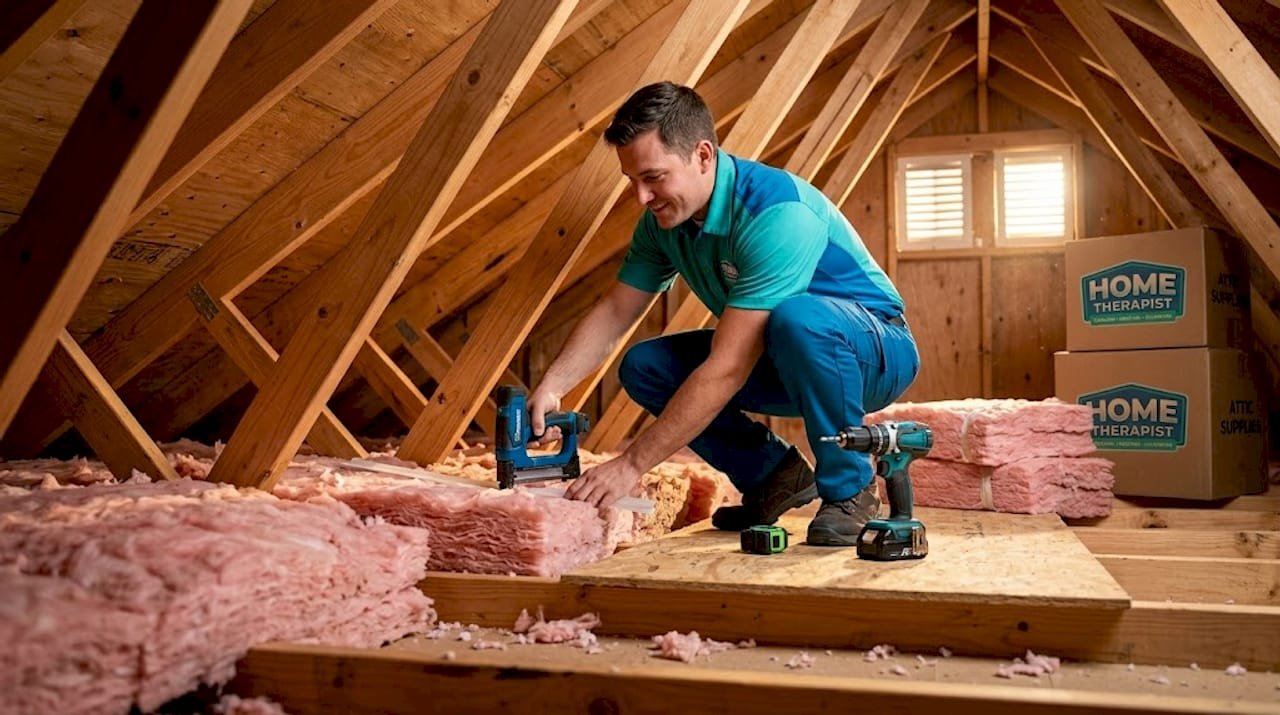
For this system to function correctly, rafter baffles (also called vent chutes) must be installed to keep attic insulation from blocking the soffit intake area. Without baffles, insulation piles up at the eaves and chokes off the air supply, negating everything the soffit vents are supposed to do.
Florida’s building code requirements state that attics need one square foot of net free ventilation area (NFVA) for every 150 to 300 square feet of attic floor space. When the ventilation is balanced equally between intake and exhaust, you can use the 1:300 ratio. If intake and exhaust are not balanced, you fall back to the stricter 1:150 standard. Understanding Tampa installation code requirements helps ensure your upgrades are compliant from the start.
Pro Tip: When installing a ridge and soffit system, make sure the total soffit vent area is equal to or greater than the total ridge vent area. If exhaust capacity exceeds intake, the system pulls replacement air from gaps in the roof itself, which can introduce moisture and pests.
You can see how these principles play out in a real situation by reviewing a completed attic insulation and tune-up project in Tampa, where balanced ventilation made a measurable difference in both comfort and energy use.
Ventilation gone wrong: Risks of poor airflow and common mistakes
Now, having examined how good ventilation works, let’s turn to what can go terribly wrong when airflow is neglected or installation is botched.
Most homeowners don’t realize that inadequate ventilation is one of the most common reasons roofing warranties get voided. Major shingle manufacturers require proper ventilation as a condition of their product warranties, and poor ventilation can shorten shingle life by 20 to 30 percent by baking them from the underside. When an attic hits 150°F, the adhesive strips on shingles soften and the tabs warp, causing premature cracking and granule loss.
The real cost of neglect: A full roof replacement in Tampa Bay can run $10,000 to $20,000 or more. If poor ventilation is identified as the cause of moisture damage during an insurance claim, your insurer may deny the claim entirely. That’s not a risk worth taking.
Here are the most common ventilation mistakes Tampa homeowners and contractors make:
- Mixing ridge vents with gable vents: Gable vents can short-circuit the ridge vent system by pulling air across the top of the attic rather than through it, leaving lower zones stagnant.
- Adding more exhaust without more intake: This creates negative pressure in the attic, drawing conditioned air out of your living space and inflating your energy bills.
- Covering or blocking soffit vents during a re-roofing job: This is shockingly common and immediately kills the intake side of your ventilation system.
- Installing powered fans without sealing the attic floor: Fans depressurize the attic aggressively, and if there are gaps in the floor (around light fixtures, ductwork, etc.), they pull cold air up from your living space.
- Relying on gable vents alone in a long attic: Gable vents only ventilate the middle portion of the attic; the areas near the eaves remain stagnant.
Moisture-related issues are particularly destructive in Tampa Bay because the problem compounds silently over months and years. Understanding the ways attic mold forms can help you catch warning signs before they become expensive structural problems. Look for dark staining on rafters, a musty smell in upstairs rooms, or insulation that looks matted or discolored.
Pro Tip: Before any roofing or insulation project, take a flashlight into your attic on a sunny day and look for daylight coming through the soffit area. If you can see light, airflow is possible. If it’s all dark near the eaves, your soffits are blocked and need immediate attention.
Advanced solutions: Alternatives, insulation, and special considerations
For those seeking extra efficiency or with challenging home designs, consider these advanced or alternative attic solutions that go beyond basic venting.
Not every home is suited to a traditional vented attic. Some architectural styles, particularly those with very low-slope roofs, complex rooflines, or homes that have integrated HVAC equipment in the attic, may benefit more from what’s called a hot roof or unvented attic system.
Here’s how unvented attic systems work and when they make sense:
- Spray foam insulation is applied directly to the underside of the roof deck, sealing the attic from outside air entirely.
- The attic space becomes conditioned, meaning it stays at or near indoor temperature rather than outdoor extremes.
- HVAC ducts and air handlers in the attic are no longer exposed to 150°F air, dramatically improving system efficiency and reducing duct losses.
- Moisture intrusion from outside is blocked at the roof deck level, eliminating the condensation risk from humid exterior air entering the space.
- The system must meet specific code requirements, including minimum R-values for the foam and verification that no vapor barriers are incorrectly placed.
The benefits of spray foam insulation are especially significant when HVAC equipment lives in the attic, which is common in Florida homes. When ducts run through a 150°F space, you can lose 20 to 30 percent of your cooling capacity before the air even reaches your vents. Encapsulating that space with spray foam eliminates that loss entirely.
The tradeoff is upfront cost. Spray foam encapsulation costs significantly more than adding ridge and soffit vents. It also requires careful installation by a qualified contractor, because improperly applied foam can trap moisture inside the roof assembly and cause the exact rot it’s supposed to prevent. Wind-driven rain events, common during Tampa’s hurricane season, are also a consideration in system design and flashing details. This is absolutely a job for a professional with Florida-specific experience.
Our take: Attic ventilation is about precision, not just airflow
Stepping back, let’s share our seasoned perspective on what really matters if you want attic ventilation that delivers in Tampa’s demanding climate.
After working in Tampa Bay homes for years, we’ve seen one pattern repeat itself constantly: homeowners add vents and expect results, only to find their cooling bills barely budge. The reason is almost always the same. They added exhaust without balancing intake, or they combined vent types that work against each other, or they had perfectly good vents that were blocked by settled insulation.
Attic ventilation is not a “more is better” situation. It’s a precision system. A roof with 10 box vents and no soffit intake is actually worse than a roof with fewer vents that are properly balanced. The box vents create low-pressure zones that pull from wherever they can, including through your ceiling and into your conditioned space.
We also see a lot of older Tampa Bay homes that were built with gable-only systems. Those systems worked reasonably well in the era before modern insulation standards, when attics were leakier and airflow happened somewhat naturally. Today, with tighter construction and thicker insulation, gable-only systems leave large dead zones in the attic where heat and moisture accumulate unchecked.
Our honest recommendation: before you buy a single vent or roll of insulation, have a professional assess what you currently have. Measure your existing NFVA, check for blocked soffits, and identify whether your current vent types are compatible. You can see exactly what a thorough assessment and upgrade looks like in a real-world attic tune-up case from a Tampa neighborhood. The results speak for themselves, and the investment is almost always recovered quickly through lower energy bills.
The bottom line: attic ventilation done right is one of the highest-return home improvements available to Tampa Bay homeowners. Done wrong, it’s an expensive frustration. Precision and professional guidance make all the difference.
Ready for better attic airflow and a cooler home?
If you’ve been fighting high cooling bills or noticed musty smells and hot spots in your Tampa home, your attic is very likely part of the problem. Understanding HVAC basics for Tampa Bay helps you see how every component of your home’s comfort system connects, including what happens in that hot space above your ceiling.

At Home Therapist Cooling, Heating, and Plumbing, our certified technicians evaluate attic ventilation as part of a whole-home comfort approach. Whether you need a full HVAC retrofitting guide to modernize your system or just want to follow an easy HVAC upkeep routine that keeps your attic performing well season after season, we’re here to help. As a family-owned Tampa Bay business, we give you straight answers and honest recommendations. Call us today to schedule an attic and HVAC assessment tailored to your home’s specific needs.
Frequently asked questions
- How much does it cost to improve attic ventilation?
Attic ventilation improvement costs vary by scope. Adding or replacing a ridge vent, soffit vents, or a powered attic fan are common fixes, and the right solution depends on your attic size and current airflow. Home Therapist provides a FREE estimate and FREE diagnosis on every visit so Tampa homeowners know exactly what they need before spending a dollar. With 321 jobs completed in Tampa and 1,300+ five-star reviews, we size ventilation correctly for Tampa Bay's intense heat and high humidity.
How much can attic ventilation lower cooling bills in Tampa Bay?
Proper attic ventilation can reduce cooling costs by 6 to 25 percent during Tampa’s hottest months, depending on your current setup and the improvements made.
Will better attic ventilation stop mold and mildew?
Yes, proper ventilation removes the moisture that feeds mold and mildew growth, which is especially important in Tampa’s climate where daily water vapor from household activity adds up to significant moisture accumulation.
Does attic ventilation affect roof shingle life?
Absolutely. Inadequate ventilation can shorten shingle life by 20 to 30 percent because heat baking the shingles from underneath accelerates cracking, granule loss, and adhesive failure.
What’s the Florida attic ventilation code requirement?
Florida’s building code requires one square foot of net free ventilation area per 150 to 300 square feet of attic floor, with balanced intake through soffit vents and exhaust through ridge or other top vents.
Can I DIY attic venting upgrades or should I hire a pro?
Basic tasks like cleaning debris from existing vents are fine to handle yourself, but properly sizing, balancing, and designing attic ventilation systems requires a professional to ensure correct airflow, code compliance, and long-term performance.
Recommended
- Preventing air leaks: boost comfort & cut Tampa Bay bills
- Essential Home Cooling Methods 2025 for Tampa Homeowners
- Energy Saving HVAC Tips for Lower Tampa Bay Home Bills
- Air balancing: boost HVAC efficiency and comfort
- HVAC energy saving tips: Lower bills and breathe easier in Avondale
- Seasonal HVAC Tune-Ups: Protecting Florida Homes
More Ductwork & Airflow Articles
- Two Bathroom Exhaust Duct Connections on 62nd Ave NE: Code-Required Venting Done Right in St. Petersburg, FL 33702
- Rat-Damaged Ducts Found During Duct Relocation Inspection on E 18th Ave, Tampa, FL 33605
- 7 Best Duct Cleaning Companies Near Me In Tampa Bay (2026)
- Home ventilation improvement guide for Tampa Bay homes
- AC Tune-Up and Ductwork Inspection on Blossom Ave: What Barbaro Found in Tampa, FL 33614


