

12 Air Purification System Reviews: Whole-Home & Portable
Not all air purifiers perform the same, and the wrong choice can leave you breathing the same dust, allergens, and VOCs you were trying to eliminate. That’s exactly why honest air purification system reviews matter more than marketing claims on a box. Whether you’re comparing portable units for a single room or evaluating a whole-home system tied to your HVAC, the differences in filtration technology, airflow capacity, and long-term costs are significant.
At Home Therapist, we’ve installed and serviced air purification systems across the Greater Tampa Bay Area since 2011. Florida’s climate, humidity, pollen, mold spores, makes indoor air quality a year-round concern, not a seasonal one. That hands-on experience with both portable and whole-home units gives us a practical perspective that goes beyond spec sheets. We know what actually holds up in real homes.
This guide breaks down 12 air purification systems across both categories. You’ll find performance details, pros and cons, pricing context, and clear recommendations based on room size and use case. The goal is straightforward: help you pick the right system for your home without overspending or underperforming. Each review covers what matters and skips the filler.
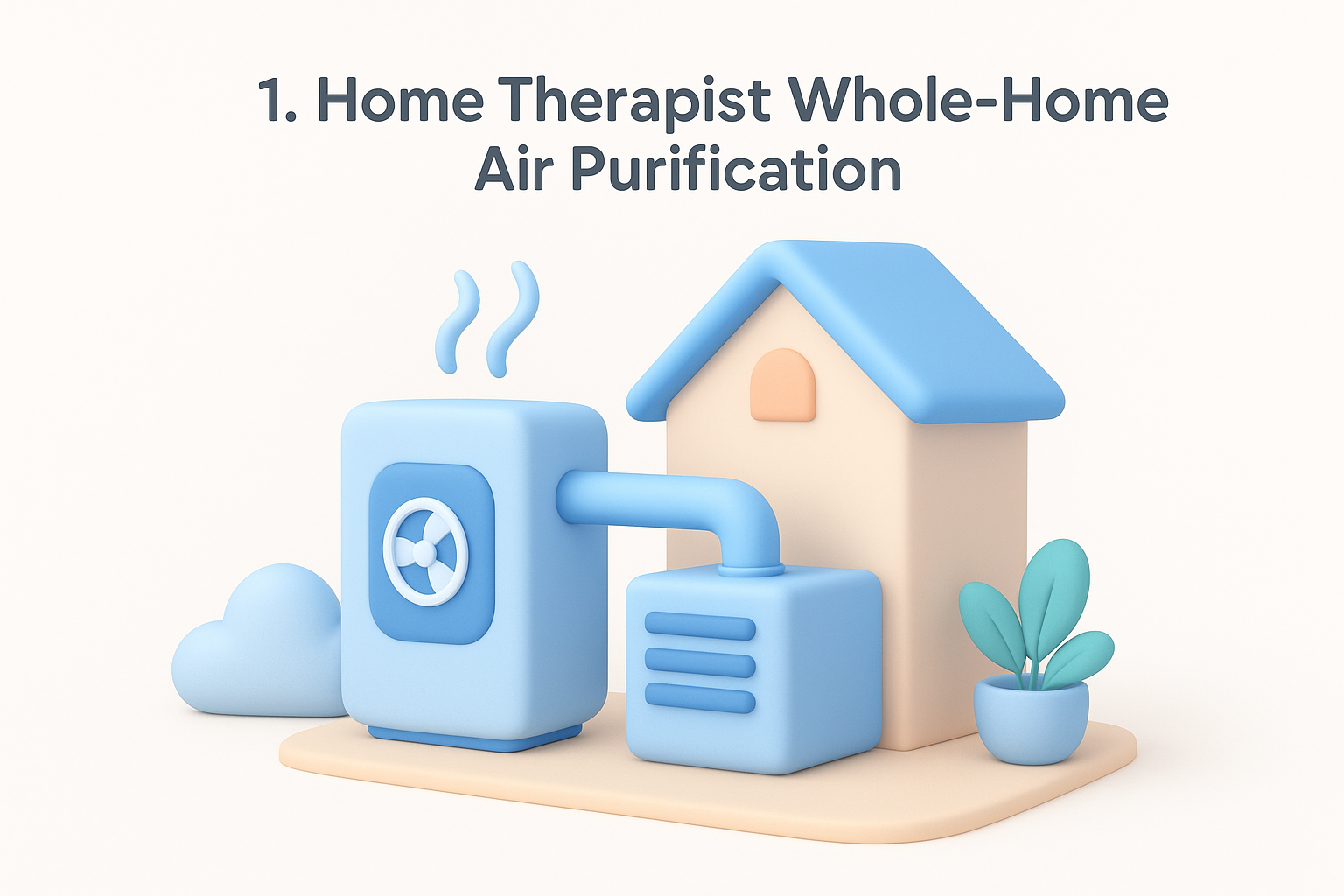
1. Home Therapist Whole-Home Air Purification
Home Therapist installs whole-home air purification systems that connect directly to your existing HVAC system, treating every cubic foot of air that moves through your home. Unlike portable units that cover one room, these systems work across your entire living space every time your air handler runs. For Tampa Bay homeowners dealing with pollen, mold spores, and high humidity year-round, this approach delivers consistent air quality throughout the house without managing multiple devices on different schedules.
What It Does Well
A whole-home system from Home Therapist combines HEPA-grade filtration, UV-C germicidal technology, and activated carbon into a single integrated solution mounted inside your air handler. This multi-stage approach targets particulates, airborne pathogens, and chemical odors simultaneously. Because the system processes all the air circulating through your home rather than just one room, you get uniform air quality improvement across every bedroom, kitchen, and living area without repositioning equipment or juggling filter replacement dates across multiple units.
Whole-home integration means you treat the air in every room on every HVAC cycle, not just where you remember to run a portable unit.
What to Watch Out For
Installation requires a licensed HVAC technician and a compatible air handler with sufficient space for the added components. If your existing HVAC system is old or undersized, the additional filtration resistance can reduce airflow and strain the blower motor over time. Your technician needs to evaluate static pressure and filter slot dimensions before installation to avoid compounding existing system problems. This is not a DIY project, and skipping the pre-installation assessment often leads to avoidable callbacks.
Ideal Use Cases
This system works best for homeowners who want whole-house coverage without the clutter and noise of portable units scattered through their rooms. It’s particularly valuable in Florida homes where mold, pollen, and humidity-driven allergens cycle through central air systems year-round. The following households get the most return from this setup:
- Families with allergy or asthma sufferers who need consistent filtration in every room
- Homes with pets where dander and odors accumulate across multiple spaces
- Homeowners who run their HVAC continuously due to Florida’s heat and want every cycle to double as an air cleaning cycle
- Anyone who has already tried portable units and found coverage gaps frustrating
Typical Costs and Upkeep
Installation costs typically range from $800 to $2,500 depending on system complexity and the components selected. Filter replacement schedules vary by component: HEPA media filters generally need replacement every 12 months, UV-C bulbs every 12 to 24 months, and carbon elements every 6 to 12 months depending on odor load. Annual maintenance runs roughly $150 to $300 when bundled with your regular HVAC service visit.
Sizing and Setup Tips
Your air handler’s CFM rating and duct configuration determine which components fit and perform correctly in your specific system. A technician calculates your home’s square footage, ceiling heights, and existing duct layout to match the purification system to your actual airflow needs. Homes over 2,500 square feet may require blower motor upgrades or zoning adjustments to maintain proper airflow with the added filtration resistance. Home Therapist completes this evaluation during a free estimate, so you know exactly what the system will do before any work begins.
2. Whole-Home Media Filter Upgrade MERV 13 to 16
A MERV 13 to 16 media filter upgrade replaces your standard 1-inch HVAC filter with a thicker, denser filtration media that captures significantly more airborne particles on every cycle. This upgrade sits inside your existing filter slot or a dedicated filter cabinet and works passively every time your air handler runs, making it one of the more practical whole-home improvements for allergy sufferers without a major installation project.
What It Does Well
Media filters rated MERV 13 and above capture particles as small as 0.3 microns, including fine dust, pollen, pet dander, mold spores, and some bacteria. Unlike standard 1-inch filters, 4 to 5-inch media filters hold significantly more debris before needing replacement, which means better sustained performance between service visits.
Upgrading to a MERV 13 or higher filter is one of the fastest improvements you can make to indoor air quality without replacing your entire system.
What to Watch Out For
Higher MERV ratings create more airflow resistance, and not every HVAC system can handle it without strain. Running a MERV 16 filter on an undersized or aging blower motor can reduce airflow, cause the system to work harder, and shorten equipment life. Always have a technician verify your system’s static pressure tolerance before specifying a filter rating.
Ideal Use Cases
This upgrade suits homeowners who want a straightforward improvement without a large investment. It works especially well for:
- Households with mild to moderate allergy symptoms driven by dust and pollen
- Homes where odors are not a primary concern, since media filters don’t address VOCs or gases
- Renters or owners looking for a lower-cost entry point into better air quality
Typical Costs and Upkeep
A filter cabinet installation runs between $200 and $500 installed. The media filter itself costs $20 to $60 and needs replacement every 6 to 12 months depending on your home’s dust load and how often the system runs.
Sizing and Setup Tips
Your filter cabinet dimensions and blower CFM rating determine which MERV level is safe for your system. A technician measures static pressure across the filter to confirm the upgrade won’t restrict airflow in your specific air handler configuration.
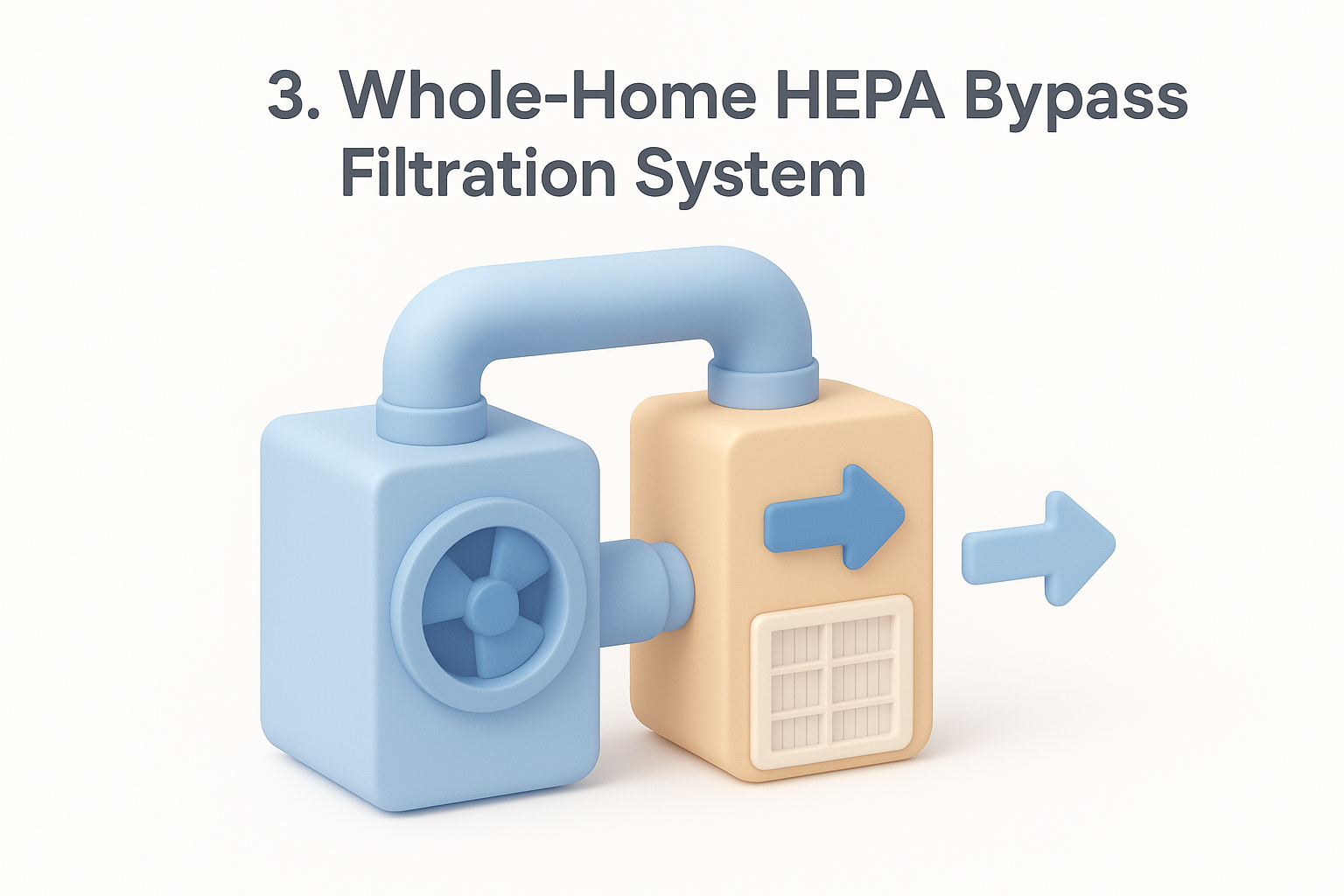
3. Whole-Home HEPA Bypass Filtration System
A whole-home HEPA bypass system installs alongside your existing HVAC equipment and routes a portion of your return air through a true HEPA filter before rejoining the main airflow. Unlike a standard filter upgrade, the bypass design lets your air handler maintain normal static pressure while still achieving hospital-grade filtration on a continuous portion of your home’s air supply.
What It Does Well
HEPA filtration captures 99.97% of particles at 0.3 microns, which includes fine dust, mold spores, pet dander, and many airborne bacteria. Because the bypass loop runs separately from the main duct, it doesn’t restrict airflow through the primary system. This makes it one of the most effective particle-removal solutions available without replacing your air handler or upgrading your blower motor.
A bypass HEPA system gives you true HEPA performance across your whole home without putting strain on your existing HVAC blower.
What to Watch Out For
A bypass system does not address odors, VOCs, or gaseous pollutants on its own. If chemical smells or cooking odors are your primary concern, you need to pair this setup with activated carbon. Additionally, proper installation requires careful duct tapping and sealing, and a poor installation can result in air leaks that reduce system efficiency and pull unconditioned air into the return path.
Ideal Use Cases
This setup works best for homeowners with serious allergy or asthma conditions where particle removal is the top priority. It’s also well-suited to:
- Homes in high-pollen environments like Florida where airborne allergens are a persistent problem
- Households with immunocompromised residents who need consistent, high-efficiency air cleaning
- Properties where the existing HVAC system cannot handle the added resistance of a MERV 16 upgrade
Typical Costs and Upkeep
Installed costs typically fall between $1,000 and $2,500 depending on duct configuration and unit size. True HEPA filters need replacement every 12 to 24 months, and each replacement filter costs between $60 and $150 depending on the unit model.
Sizing and Setup Tips
Your home’s square footage and HVAC airflow rate determine what bypass unit size you need. A technician calculates the correct bypass volume to ensure the system turns over enough air each hour to deliver meaningful filtration results in every room.
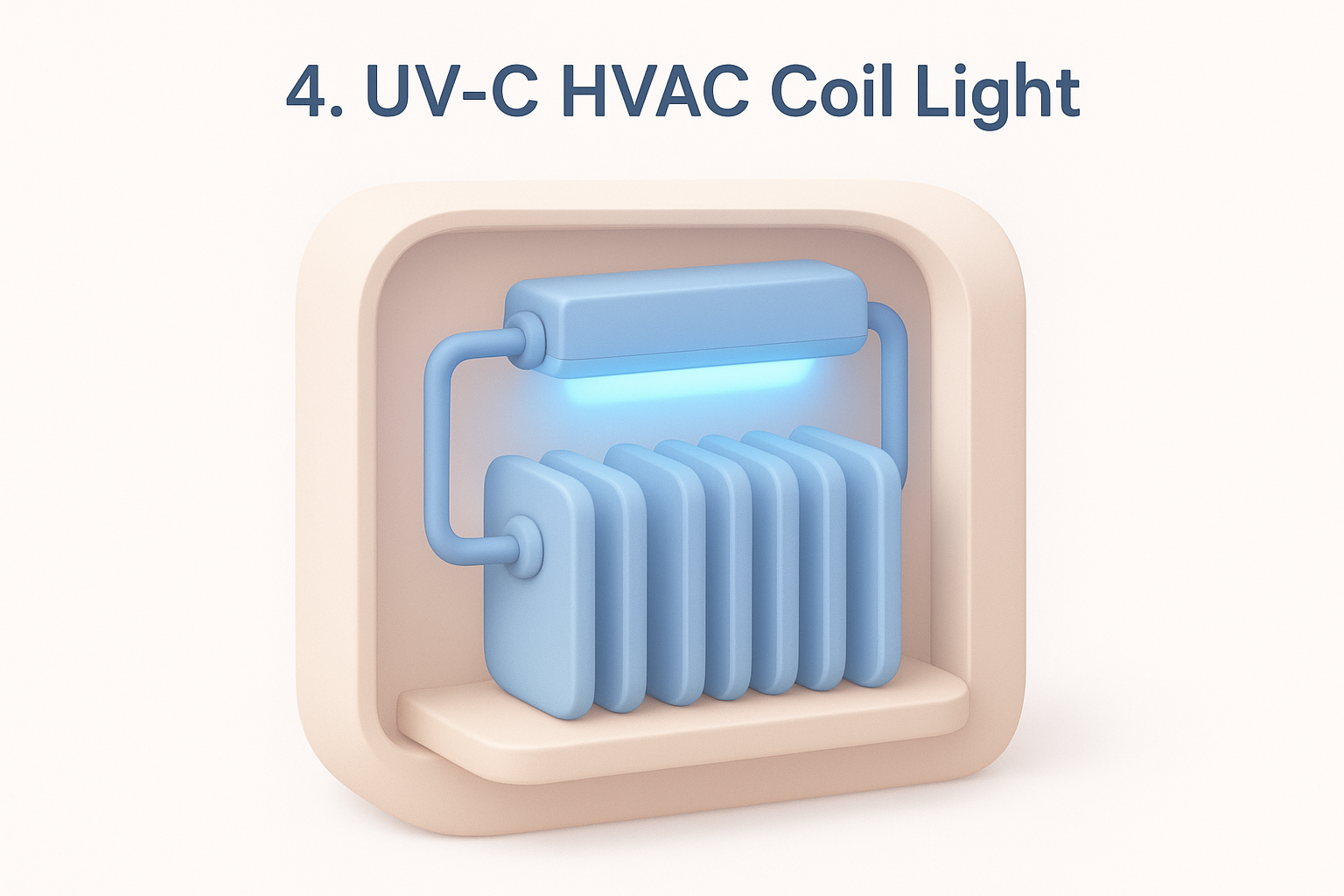
4. UV-C HVAC Coil Light
A UV-C HVAC coil light mounts inside your air handler, directly above or below the evaporator coil, and uses ultraviolet-C radiation to break down organic material on contact. The light runs continuously, targeting mold, bacteria, and viruses that accumulate on wet coil surfaces. In Florida’s humidity, evaporator coils stay damp for much of the year, making them a consistent breeding ground for microbial growth that your blower then distributes through every room in the house.
What It Does Well
This component keeps your evaporator coil cleaner between maintenance visits by continuously irradiating the coil surface. That reduces mold and bacterial buildup that would otherwise enter your airstream. Cleaner coils also transfer heat more efficiently, which can improve overall system performance and lower energy costs over time.
UV-C coil lights address microbial growth at the source rather than waiting to filter it out downstream.
What to Watch Out For
UV-C light does not capture particulates like dust, pollen, or pet dander. If allergens are your primary concern rather than mold or bacteria, this component alone won’t resolve the problem. You also need to replace the UV-C bulb every 12 to 24 months because output degrades with use, even when the bulb still glows visually.
Ideal Use Cases
This addition works best for homeowners who want targeted microbial control at the most contaminated point in their system. It pairs effectively with media filter upgrades or bypass HEPA systems to create layered protection against both particles and pathogens.
- Homes with recurring mold issues on HVAC coils or in ductwork
- Properties in high-humidity climates like Tampa Bay where coils stay wet nearly year-round
- Homeowners who want to extend time between coil cleanings while reducing microbial contamination in their airstream
Typical Costs and Upkeep
Installation typically runs between $150 and $400 depending on your air handler configuration and the UV-C unit selected. Replacement bulbs cost $30 to $80 each and should be swapped out annually as part of your routine HVAC maintenance visit.
Sizing and Setup Tips
Your technician positions the lamp based on coil dimensions and air handler depth to ensure full coil exposure. Improper placement leaves shadowed sections of the coil untreated, so professional lamp positioning matters more than wattage rating alone.
5. HVAC Activated Carbon Add-On for Odors and VOCs
An HVAC activated carbon add-on installs directly in your air handler or ductwork and uses a bed of porous carbon media to trap gaseous pollutants that standard particulate filters completely miss. While HEPA and media filters catch dust and allergens, activated carbon targets VOCs, cooking odors, smoke, and chemical off-gassing from paint, cleaning products, and building materials. For Tampa Bay homeowners, this add-on addresses a category of indoor air pollution that no fiber filter can touch.
What It Does Well
Activated carbon works through adsorption, binding gas molecules to the surface of millions of tiny pores in the carbon media. This process effectively reduces odors, formaldehyde, benzene, and other airborne chemicals before they recirculate through your living space. Because it integrates with your central system, it treats air from every room on every HVAC cycle rather than targeting a single space.
If chemical smells or persistent cooking odors are driving your air quality concerns, activated carbon is the only filtration method that actually removes them.
What to Watch Out For
Carbon media has a finite adsorption capacity, meaning it saturates over time and stops working without any visible sign that it needs replacement. Skipping scheduled filter swaps on time means you’re circulating untreated air while assuming the system is still performing. This add-on also does not capture particulates, so pairing it with a media filter upgrade or HEPA system gives you complete coverage across both pollutant categories.
Ideal Use Cases
This add-on works best for homeowners whose primary complaint is smell-based rather than particle-based. Common situations where it delivers strong results include:
- Homes with frequent cooking odors that linger in connected living areas
- Properties near highways or industrial areas where VOC infiltration is a concern
- New construction or recently renovated homes off-gassing paint, adhesives, or flooring materials
Typical Costs and Upkeep
Installed costs run between $300 and $700 depending on the carbon media volume and your existing duct configuration. Replacement carbon media costs $40 to $100 and needs swapping every 6 to 12 months based on your home’s odor load.
Sizing and Setup Tips
Your technician selects carbon bed depth and surface area based on your HVAC system’s CFM rating to ensure adequate contact time between the air and the carbon media. Insufficient contact time reduces adsorption efficiency, so sizing this component correctly matters as much as choosing the right media type.
6. Coway Airmega ProX
The Coway Airmega ProX is a large-room portable air purifier built for spaces up to 1,560 square feet, making it one of the most capable standalone units you’ll find in any serious air purification system reviews roundup. It runs a three-stage filtration process that combines a pre-filter, a Max2 filter combining activated carbon and True HEPA media, and an air quality indicator that adjusts fan speed automatically based on real-time pollution levels in the room.
What It Does Well
The ProX delivers strong particle capture and odor reduction in a single unit without requiring any installation work. The True HEPA layer removes 99.97% of particles at 0.3 microns, while the integrated carbon layer handles odors and light VOC loads simultaneously. The auto-mode feature responds to changing air quality without any manual adjustment on your part.
The ProX handles both particle and odor filtration in one machine, which sets it apart from portable units that only address one pollutant category.
What to Watch Out For
This unit is physically large and relatively heavy, which limits how easily you can move it between rooms. At full fan speed, it generates noticeable noise that some users find disruptive in sleeping areas. Filter replacement costs add up quickly if you run the unit continuously in a high-dust environment.
Ideal Use Cases
The ProX works best if you have a large open-concept living space where a whole-home system isn’t feasible or you need portable supplemental coverage alongside your HVAC. It also suits homeowners who want combined particle and odor control without committing to a permanent installation.
Typical Costs and Upkeep
The unit retails for around $600 to $700. Replacement Max2 filters cost roughly $80 to $100 per set and need changing approximately every 6 to 12 months depending on usage and air quality in your space.
Sizing and Setup Tips
Place the ProX in the center of the room rather than against a wall to maximize airflow intake from all directions. For rooms under 800 square feet, running it on medium speed provides adequate air changes without unnecessary noise or filter wear.
7. Levoit Vital 200S
The Levoit Vital 200S is a mid-size portable air purifier designed for rooms up to 380 square feet, sitting in a practical middle ground between compact bedroom units and oversized machines like the Coway ProX. It uses a three-stage filtration system combining a washable pre-filter, an H13 True HEPA layer, and an activated carbon filter. If you’ve read through other air purification system reviews looking for something quiet and app-connected at a reasonable price, this unit comes up frequently for good reason.
What It Does Well
The Vital 200S connects to the VeSync app, letting you schedule run times, monitor filter life, and adjust fan speed from your phone without walking across the room. Its H13 True HEPA filter captures 99.97% of particles at 0.3 microns, covering dust, pollen, pet dander, and mold spores reliably. At its lowest fan setting, it runs at approximately 24 decibels, which is quiet enough for most people to sleep through without issue.
The app integration makes the Vital 200S noticeably easier to manage day-to-day compared to units that require manual adjustments at the machine.
What to Watch Out For
The 380 square foot coverage rating is based on ideal room conditions, and real-world performance in irregularly shaped or high-traffic spaces often falls short of that number. The activated carbon layer in this unit is relatively thin compared to dedicated odor-control systems, so if heavy cooking smells or VOCs are your main concern, this unit won’t resolve them on its own.
Ideal Use Cases
This unit works best in bedrooms, home offices, or nurseries where consistent quiet operation and smart scheduling matter more than raw coverage area. It suits:
- Allergy sufferers who want automated overnight filtration without manual intervention
- Small apartments or single rooms where whole-home integration isn’t an option
Typical Costs and Upkeep
The Vital 200S retails for $100 to $130. Replacement filter sets cost approximately $20 to $30 and need changing every 6 to 8 months with regular use.
Sizing and Setup Tips
Position the unit away from walls and furniture to allow unrestricted airflow on all sides. For rooms between 250 and 380 square feet, running it on medium speed balances effective air changes with filter longevity.
8. Winix 5510
The Winix 5510 is a mid-size portable air purifier rated for rooms up to 360 square feet, combining True HEPA filtration with an activated carbon washable pre-filter and the brand’s proprietary PlasmaWave technology. If you’ve compared this unit against others in various air purification system reviews, you’ll notice it consistently earns solid marks for balancing performance and value in a compact footprint.
What It Does Well
The 5510 runs a four-stage filtration process that handles particles and odors in a single pass through the machine. Its True HEPA filter captures 99.97% of particles at 0.3 microns, including dust, pollen, and pet dander, while the washable pre-filter extends the life of the main filter by catching larger debris before it reaches the HEPA layer.
The washable pre-filter is a practical advantage that reduces your ongoing filter replacement costs compared to units with fully disposable filter stacks.
What to Watch Out For
PlasmaWave generates a small amount of ozone as a byproduct, which some users prefer to disable. You can turn the feature off independently without affecting the HEPA and carbon stages, but it’s worth knowing before you buy. The carbon layer is relatively thin, so it manages light odors effectively but won’t fully address heavy cooking smells or high VOC loads on its own.
Ideal use cases
This unit works well in bedrooms and mid-size living rooms where consistent allergen reduction is the priority. It suits households that want a reliable portable option without a large upfront investment, particularly for:
- Allergy sufferers dealing with dust and pet dander in a single room
- Renters who need a portable solution they can move between apartments
Typical Costs and Upkeep
The Winix 5510 retails for $130 to $160. Replacement HEPA and carbon filter sets cost approximately $30 to $50 and need changing roughly every 12 months with regular use.
Sizing and Setup Tips
Place the unit at least 12 inches from walls on all sides to allow unrestricted airflow intake. For rooms closer to 360 square feet, running it on high speed during peak activity hours and dropping to medium overnight gives you effective air changes without excessive filter wear.
9. Coway Airmega AP-1512HH Mighty
The Coway Airmega AP-1512HH Mighty is one of the most consistently recommended compact air purifiers across multiple air purification system reviews, rated for rooms up to 360 square feet. It runs a four-stage filtration process that includes a pre-filter, a deodorization filter, a True HEPA filter, and an ionizer you can disable independently. For the price point, few portable units deliver this level of particle capture reliability in a footprint this small.
What It Does Well
The Mighty’s True HEPA filter captures 99.97% of particles at 0.3 microns, including fine dust, pollen, mold spores, and pet dander. Its built-in air quality indicator uses a color-coded LED to give you real-time feedback on your room’s pollution level, which helps you decide when to raise or lower fan speed without guessing.
The Mighty’s combination of real-time air quality monitoring and strong HEPA performance makes it one of the most reliable compact units available at this price.
What to Watch Out For
Its ionizer produces a small amount of ozone, and while you can switch it off without losing HEPA and carbon performance, it’s worth checking before you run the unit in a small, poorly ventilated room. The deodorization layer handles light odors adequately but won’t eliminate heavy cooking smells or high VOC concentrations on its own.
Ideal Use Cases
This unit works best in bedrooms and smaller living spaces where consistent allergen reduction is your primary goal. It suits:
- Allergy and asthma sufferers who need reliable overnight particle removal in a single room
- Homeowners who want a proven, low-maintenance unit without a large upfront cost
Typical Costs and Upkeep
The AP-1512HH Mighty retails for $100 to $130. Replacement filter sets cost approximately $30 to $45 and need changing every 6 to 12 months depending on how often you run the unit and how heavy your home’s dust load is.
Sizing and Setup Tips
Place the Mighty at least 12 inches from walls on all sides to allow full airflow intake. For rooms near the 360 square foot maximum, running it on high during the day and medium overnight gives you adequate air changes without burning through filters prematurely.
10. Honeywell HPA250B
The Honeywell HPA250B is a large-room portable air purifier rated for spaces up to 600 square feet, which puts it in a practical middle tier between compact bedroom units and heavy-duty machines like the Coway ProX. It runs a two-stage filtration process combining a pre-filter for larger debris and an activated carbon pre-filter paired with a True HEPA filter for fine particle and light odor removal. If you’ve been comparing options across multiple air purification system reviews, the HPA250B earns attention for its coverage area relative to its price.
What It Does Well
The HPA250B’s True HEPA filter captures 99.97% of particles at 0.3 microns, which covers dust, pollen, pet dander, and mold spores reliably across a larger room. Its five fan speed settings give you fine control over noise level and air circulation, letting you match the unit’s output to the activity level in your space.
The five-speed fan control makes the HPA250B more flexible than comparably priced units that only offer two or three settings.
What to Watch Out For
The carbon pre-filter on this unit is thin relative to the HPA250B’s room coverage rating, which means it handles light odors but won’t resolve heavy cooking smells or persistent VOC loads. Replacement filters are sold separately for each layer, so your ongoing filter costs can add up if you run this unit continuously in a high-traffic room.
Ideal Use Cases
Your best use case for this unit is a larger bedroom, home office, or open-plan living area where consistent allergen removal matters more than odor control. It suits allergy sufferers who need reliable particle filtration across more square footage than most compact units can handle.
Typical Costs and Upkeep
The HPA250B retails for $150 to $200. Replacement HEPA and pre-filter sets cost approximately $30 to $50 combined and need changing every 6 to 12 months depending on how hard you run the unit.
Sizing and Setup Tips
Position the unit at least 12 inches from walls on all sides to allow full airflow intake. For rooms near the 600 square foot upper limit, run it on the highest speed setting during peak activity hours and step down to medium when the room is less occupied.
11. IQAir HealthPro Plus
The IQAir HealthPro Plus is a premium portable air purifier rated for rooms up to 1,125 square feet, placing it firmly at the high end of any serious air purification system reviews list. It runs a three-stage filtration process combining a pre-filter, a HyperHEPA layer that captures particles as small as 0.003 microns, and an activated carbon and pellet filter for odor and gas removal. That particle capture threshold goes well below the 0.3-micron standard that most HEPA units advertise, making this one of the few portable systems that genuinely targets ultrafine particles.
What It Does Well
The HealthPro Plus delivers class-leading particle filtration across a large room without requiring any duct connection or HVAC integration. Its HyperHEPA filter captures ultrafine particles, including combustion byproducts and virus-carrying aerosols, at a removal efficiency that exceeds what standard True HEPA units achieve. The build quality on this machine is noticeably better than most consumer-grade alternatives, which contributes to its long service life when you maintain it on schedule.
If ultrafine particle removal is your top priority, the HealthPro Plus captures smaller particles than any standard HEPA portable unit in this guide.
What to Watch Out For
This unit carries a significantly higher price tag than every other portable option in this list, which makes it harder to justify for casual use or single-room applications where a $150 machine would perform adequately. The replacement filters are expensive, and skipping scheduled changes defeats the purpose of buying a premium filtration system in the first place.
Ideal Use Cases
The HealthPro Plus suits homeowners who need high-performance portable filtration for a large room and are unwilling to compromise on particle capture depth. It works particularly well for immunocompromised individuals or households dealing with wildfire smoke, chemical sensitivities, or ultrafine particulate exposure.
Typical Costs and Upkeep
The unit retails for $900 to $1,000. Replacement filter sets cost approximately $150 to $250 depending on which stage you’re replacing, with the HyperHEPA filter needing replacement every two to four years.
Sizing and Setup Tips
Position the HealthPro Plus centrally in the room rather than tucked in a corner to maximize its intake coverage. For rooms near the 1,125 square foot upper limit, run it on speed four or five during peak occupancy hours.
12. Austin Air HealthMate
The Austin Air HealthMate is a heavy-duty portable air purifier built around a 360-degree intake design that draws air in from all sides simultaneously. Rated for rooms up to 1,500 square feet, it’s one of the few portable units in any serious air purification system reviews list that pairs true HEPA filtration with a substantial activated carbon and zeolite bed in a single canister. Its build quality leans industrial, and it’s designed for long filter life rather than frequent replacement cycles.
What It Does Well
The HealthMate uses a four-stage filtration process that includes a pre-filter, a medium-particle filter, a true HEPA layer, and a deep bed of activated carbon mixed with zeolite that targets VOCs, odors, and chemical gases more aggressively than the thin carbon layers found in most consumer portable units. That carbon bed is the real differentiator here. It holds significantly more adsorptive capacity than competitors at a similar price, which means it keeps working longer between replacements.
The HealthMate’s carbon-to-zeolite blend gives it a meaningful edge over standard portable units when chemical odors or VOCs are your main concern.
What to Watch Out For
The HealthMate is heavy and difficult to move between rooms, so treat it as a permanent fixture rather than a portable solution. Its fan speed options are limited to three settings, which gives you less fine-grained control over noise and airflow compared to units with five or more speed options.
Ideal Use Cases
This unit suits homeowners who want combined particle and chemical filtration in a single large-room machine without committing to a whole-home installation. It works particularly well for:
- Homes with persistent VOC exposure from renovation materials, cleaning products, or nearby traffic
- Large bedrooms or open living areas where a smaller unit simply can’t keep up
Typical Costs and Upkeep
The HealthMate retails for $700 to $800. Replacement filter sets cost approximately $200 to $250 and last up to five years with regular use, which brings the long-term cost per year down considerably compared to units requiring annual replacements.
Sizing and Setup Tips
Position the unit at least 18 inches from walls on all sides to take full advantage of its 360-degree intake design. For rooms near 1,500 square feet, run it on high speed during occupied hours and step down to medium when the room is empty overnight.
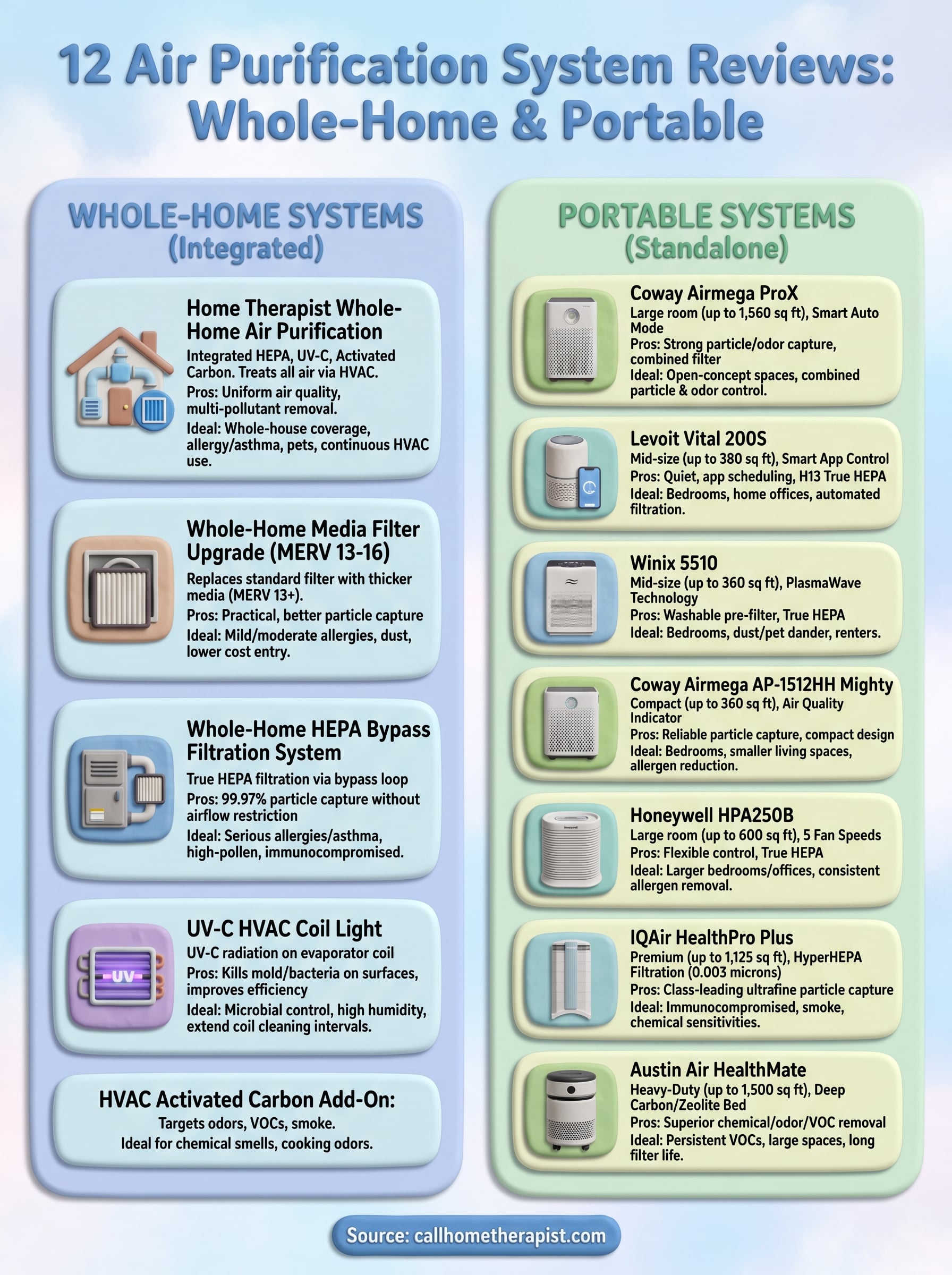
Final Thoughts
These air purification system reviews cover a wide range of options, but the right choice comes down to what you’re actually dealing with in your home. If you have allergens, mold, odors, or chemical pollutants affecting multiple rooms, a whole-home system will outperform any portable unit you place in a single space. Portable units like the Coway Mighty or Austin Air HealthMate work well when you need targeted coverage in one area without a permanent installation.
Your budget, your HVAC setup, and your specific air quality concerns should drive the decision. Spending more on a whole-home system makes sense if you run central air year-round and want every room treated on every cycle. Spending less on a quality portable unit makes sense if you just need one room handled well. If you’re ready to explore a whole-home solution for your Tampa Bay home, contact Home Therapist for a free estimate.
More Indoor Air Quality Articles
- Blown-In Insulation Estimate in Plant City, FL 33567: What $2,640 Covers on a Ragins Ln R30 Job
- R30 Blown-In Insulation in Thonotosassa, FL 33592: What Coordinating With Roofers Actually Requires
- Coil Clean, UV Light Install, and AC Diagnosis on Half Moon Lake Road, Tampa, FL 33625
- Why Balancing Home Humidity Matters for Tampa Bay Comfort
- Mini Split Installation for Florida Rooms and Garages in Tampa, FL: What to Expect


