

How your AC’s expansion valve keeps Tampa Bay cool
TL;DR:
- The expansion valve in your AC controls refrigerant flow, crucial for efficient cooling and dehumidification. A malfunction can cause poor airflow, temperature swings, frost, or increased energy bills, especially in humid Tampa Bay. Regular professional inspections and maintenance help prevent costly repairs and ensure optimal system performance year-round.
When your home feels muggy and uncomfortable despite a running air conditioner, most people immediately suspect the thermostat or the compressor. But there’s a smaller, lesser-known component quietly doing some of the heaviest lifting in your entire cooling system: the expansion valve. This part controls how refrigerant moves through your AC, and when it’s working correctly, you barely notice it. When it’s not, you’ll feel every degree of Tampa Bay’s brutal summer heat and humidity. Understanding what this valve does and how to protect it can save you from a preventable and expensive breakdown.
Table of Contents
- What does the expansion valve do in your AC?
- Why the expansion valve matters in Tampa Bay homes
- Common expansion valve issues and symptoms
- Protecting your expansion valve: maintenance and care
- Our take: Why expansion valves are more than tiny parts
- Need expert help with your AC? Home Therapist is here
- Frequently asked questions
Key Takeaways
| Point | Details |
|---|---|
| Expansion valve’s role | It regulates refrigerant flow for optimal cooling and dehumidification. |
| Humidity impacts | Expansion valves work harder in Tampa Bay’s humid climate to ensure comfort. |
| Signs of trouble | Watch for warm air, hissing, or frost to catch expansion valve issues early. |
| Regular maintenance | Annual inspections and filter changes keep your AC’s expansion valve healthy. |
| Professional help | Licensed HVAC experts should handle valve repairs for safe, efficient AC operation. |
What does the expansion valve do in your AC?
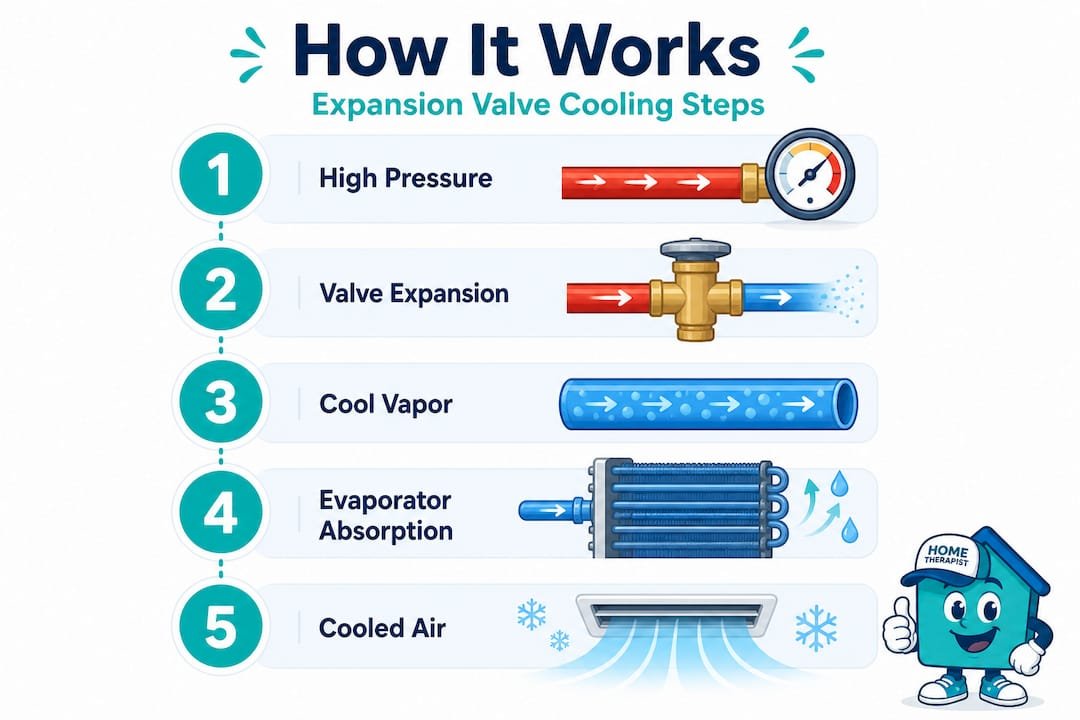
Your air conditioner works by moving refrigerant through a closed loop. That refrigerant shifts between high pressure and low pressure states, absorbing heat from inside your home and releasing it outside. The expansion valve sits at the boundary between those two pressure zones, and its job is to control exactly how much refrigerant flows from the high-pressure side to the low-pressure side.
Think of it like the nozzle on a garden hose. When you squeeze the nozzle, water pressure drops and the stream expands. That same principle applies to refrigerant. As it passes through the expansion valve, pressure drops sharply, and the refrigerant cools dramatically. This cold refrigerant then flows into the evaporator coil, where it absorbs heat from your indoor air, cooling your home down.
There are two main types of expansion valves you’ll find in residential AC systems:
- Thermostatic expansion valves (TXV): These adjust refrigerant flow automatically based on temperature readings from a sensing bulb near the evaporator outlet. They’re the most common type in Tampa Bay homes.
- Electronic expansion valves (EEV): These use electronic sensors and a motor to adjust flow with even more precision, often found in newer, high-efficiency systems.
What makes modern valves impressive is their adaptability. According to HVAC engineering research, expansion valves improve efficiency by adapting to load changes, preventing evaporator flooding or starvation, protecting the compressor from liquid slugback, and enhancing dehumidification in humid areas like Tampa Bay.
If you’ve had trouble with your TXV and need reliable support, TXV replacement in Spring Hill is one of the services we provide for homeowners who need fast, accurate repairs. For units in the southern part of the metro, our evaporator coil and TXV service covers both components together, since they work so closely.
Why the expansion valve matters in Tampa Bay homes
Tampa Bay is one of the most humid metro areas in the entire country. Summer humidity regularly sits above 80%, and that moisture in the air creates extra work for your AC. Your system doesn’t just cool the air; it also removes water vapor from it. That dehumidification process depends heavily on the expansion valve working correctly.
When the valve operates properly, refrigerant enters the evaporator coil at exactly the right flow rate. The coil gets cold enough to cause moisture in your air to condense and drain away, leaving you with air that feels cool and dry. Without that balance, you get an evaporator that’s either too warm to pull moisture out or too frosted over to work at all.
“Enhancing dehumidification in humid areas like Tampa Bay” is one of the core functions of a working expansion valve, and it’s a function that carries extra weight in our climate.
That sticky, clammy feeling you sometimes get even when the AC is running? That’s often a sign that the evaporator isn’t removing moisture efficiently, which frequently traces back to a valve that’s letting too much or too little refrigerant through.
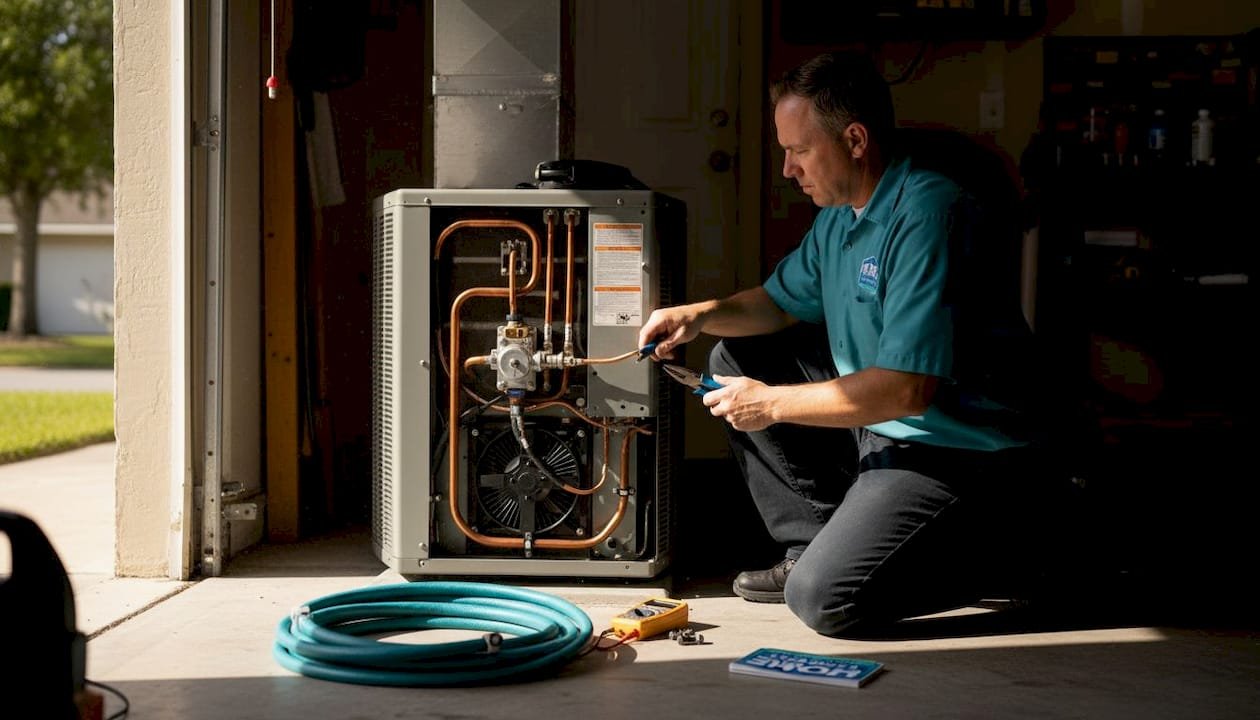
Pro Tip: If your home feels humid indoors even though your AC runs constantly, don’t just assume it needs more refrigerant. A technician should check the expansion valve first, because adding refrigerant to a system with a valve issue can make things worse.
Scheduling a HVAC leak inspection in Tampa is a smart move if your system seems to be working hard without results. A thorough air handler inspection in Tampa can identify whether the valve, coil, or another component is the root cause of your comfort issues.
Tampa Bay homes also face long cooling seasons, sometimes running AC for nine or ten months out of the year. That continuous use puts more strain on every part of your system, including the expansion valve. A valve that might last fifteen years in a northern climate can show wear much sooner here.
Common expansion valve issues and symptoms
Recognizing the early signs of a failing expansion valve gives you time to act before the problem grows into a major repair. The symptoms fall into two main categories depending on whether the valve is stuck closed or stuck open.
Here’s a quick comparison of what you can expect from each failure type:
| Failure type | What it feels like | What’s happening inside |
|---|---|---|
| Valve stuck closed | Warm air from vents, weak cooling | Too little refrigerant reaches the evaporator |
| Valve stuck open | Swings between cold and warm | Too much refrigerant floods the evaporator |
| Partial restriction | Inconsistent cooling, frost on coil | Refrigerant flow is irregular and unpredictable |
| Sensor bulb failure | System short-cycles frequently | Valve can’t read evaporator temperature accurately |
According to expansion valve symptom research, failure signs include warm air when the valve is stuck closed, fluctuating temperatures and icing when stuck open, hissing noises, abnormal pressures such as low suction or high head pressure, and frost forming on the evaporator coil.
Here’s a practical list of symptoms to watch for in your home:
- Warm or barely cool air blowing from vents even after the system has been running for 15 to 20 minutes.
- Temperature swings where rooms cycle between cold and warm without obvious reason.
- Frost or ice on the indoor unit or visible on the refrigerant line near the air handler.
- Hissing or bubbling noises coming from inside the air handler cabinet.
- Frequent short-cycling, where the compressor kicks on and off in rapid succession.
- Higher-than-normal energy bills with no change in usage habits, suggesting the system is working harder than it should.
Some of these signs overlap with other AC problems, which is why professional diagnosis matters. A technician can read pressure gauges on both the high and low sides of the refrigerant circuit to confirm whether the valve is the actual culprit.
If you suspect a problem, HVAC service in Sun City Center and surrounding areas is available through our team. For systems showing refrigerant-related symptoms, our HVAC leak repair services cover the full diagnostic and repair process. You can also review our HVAC maintenance tips for a broader look at keeping your system in top shape.
Protecting your expansion valve: maintenance and care
The good news is that expansion valves rarely fail without warning. Most valve problems develop gradually, and consistent maintenance gives you the best chance of catching issues early before they become costly.
Here are the most effective steps Tampa Bay homeowners can take to protect the expansion valve and the rest of their AC system:
- Schedule professional inspections annually. A certified technician will check refrigerant pressures, inspect the valve, and verify the evaporator coil is clean and functioning. Annual service is the single most effective thing you can do for long-term AC health.
- Change your air filter every one to three months. A clogged filter restricts airflow across the evaporator coil. When airflow drops, refrigerant doesn’t absorb heat properly, which throws off the pressure balance that the expansion valve depends on.
- Listen for new noises. Hissing, gurgling, or clicking sounds from the air handler should prompt a service call. Catching valve issues early means repair rather than full replacement.
- Watch for ice or frost. Visible ice on the refrigerant line or indoor unit is never normal during regular operation. Shut the system off and call a technician to inspect.
- Keep the outdoor condenser unit clear. Blocked airflow around the condenser raises system pressure, which directly stresses the expansion valve. Trim vegetation at least two feet away from all sides of the outdoor unit.
- Don’t skip maintenance after a long winter. Even Tampa Bay has cooler months where AC use drops. A spring checkup before heavy cooling season starts ensures the valve and refrigerant charge are ready for the demand ahead.
As HVAC research confirms, expansion valves improve efficiency by adapting to load changes, preventing evaporator flooding or starvation, and protecting the compressor. Keeping the valve healthy protects the entire refrigerant circuit, not just one component.
Pro Tip: Ask your technician to specifically check expansion valve operation during your annual visit. Some routine checkups focus only on refrigerant charge and filter condition, skipping a closer look at valve performance. A simple pressure reading before and after the valve tells a technician a lot.
Our spring HVAC maintenance tips walk through what homeowners should be doing at the start of cooling season. If you want a longer view on system longevity, our guide on how to extend HVAC lifespan covers practical habits that add years to your equipment.
Our take: Why expansion valves are more than tiny parts
After years of working on AC systems across Tampa Bay, we’ve developed a strong opinion about expansion valves: they are consistently the most underestimated part in a residential cooling system. Homeowners invest in new thermostats, upgraded compressors, and whole-system replacements, while a $100 to $300 valve repair could have solved the problem years earlier.
Here’s what we’ve seen repeatedly. A homeowner notices their home isn’t cooling as well as it used to. They tolerate it for a season. The compressor starts short-cycling because of the pressure imbalance the failing valve creates. Eventually, the compressor fails, and the homeowner is facing a $2,000 or higher repair, sometimes a full system replacement. The original issue? A valve that was showing early symptoms years before.
This matters even more in Tampa Bay because of our humidity levels. The dehumidification function of the expansion valve isn’t a bonus feature here. It’s a necessity. When that function degrades, your home doesn’t just feel warm. It feels oppressive, the kind of indoor air that affects sleep, health, and daily comfort in real, measurable ways.
We’d also push back on the idea that expansion valve maintenance is “just preventive.” It’s actually curative in many cases. Catching a valve that’s beginning to stick or lose calibration before it fails completely isn’t just avoiding a repair cost. It’s actively restoring efficiency, improving dehumidification, and reducing strain on the compressor right now. Our team that handles TXV repair for homeowners regularly finds valves operating at 60 to 70 percent of normal capacity, causing bills to climb and comfort to slip, all without the system breaking down enough for the homeowner to call for help.
Pay attention to this part. It’s small, but it’s doing more for your comfort than almost anything else inside your AC.
Need expert help with your AC? Home Therapist is here
If this article has you thinking about your own system, that’s a good sign. The expansion valve is something most homeowners never hear about until something goes wrong, but now you know what to watch for and why it matters.

At Home Therapist Cooling, Heating, and Plumbing, we’ve built our reputation in Tampa Bay on helping homeowners understand their systems and stay comfortable year-round. Whether you need a full inspection, a valve replacement, or just a second opinion on what’s causing poor cooling, our certified technicians are ready to help. Start with our AC maintenance for Tampa Bay homes resource to see what a thorough seasonal service looks like. If you’re already experiencing issues, our HVAC troubleshooting guide can help you identify what’s going on before you call. And for those who want to get ahead of problems before they start, our HVAC maintenance guide is built specifically for homeowners who want to take a proactive approach to AC care.
Frequently asked questions
How does an expansion valve improve AC efficiency in Tampa Bay?
It adapts to changing loads and humid conditions, preventing evaporator flooding or starvation and enhancing dehumidification, which directly cuts energy waste in our climate.
What are the warning signs of a failing expansion valve?
Symptoms include warm air from vents, temperature swings, hissing noises, abnormal refrigerant pressures, and frost forming on the evaporator coil.
Can homeowners maintain the expansion valve themselves?
Regular filter changes and keeping the outdoor unit clear help reduce valve strain, but technical valve diagnostics and repairs require a licensed HVAC technician with proper tools and refrigerant certification.
How often should expansion valve inspection be scheduled?
Annual AC maintenance is the standard recommendation, and you should specifically request an expansion valve pressure check before Tampa Bay’s humid summer season begins.
Recommended
- Role of refrigerant in AC systems for Tampa homeowners
- Air Conditioning Maintenance Guide for Tampa Bay Homes Home Therapist Cooling, Heating, and Plumbing
- Evaporator Coil & TXV Replacement for Leaking AC in Tampa, FL 33629
- Evaporator Coil & TXV Replacement in Tampa, FL 33629 | AC Leak Repair
- Step-by-Step AC Maintenance: Keep Your Florida Home Cool – Lucas Air Conditioning and Heating


