

Boost AC Efficiency and Cut Cooling Costs in Tampa Bay
TL;DR:
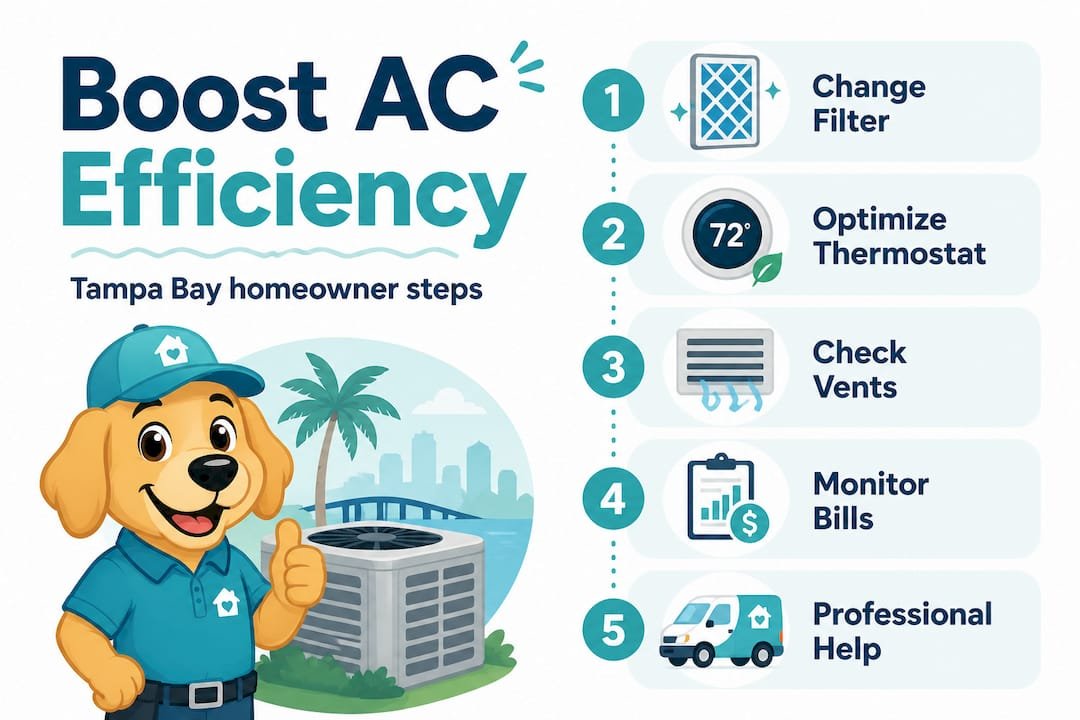
- Regularly replacing filters and optimizing thermostat settings significantly improve AC efficiency in Tampa Bay homes.
- Most cost-effective habits include monthly filter changes, maintaining outdoor unit clearance, and smart scheduling.
- Consistent basic maintenance exceeds high-tech upgrades, especially in Tampa’s humid climate, ensuring better cooling and lower bills.
Your AC runs all day, the air feels thick and sticky, and your power bill just hit a record high. Sound familiar? Tampa Bay homeowners deal with this frustration every summer, and often the culprit isn’t a broken system but a neglected one. The good news is that small, consistent habits can dramatically improve how your air conditioner performs, without replacing expensive equipment. This guide walks you through practical, proven steps to get better cooling, more stable indoor temperatures, and meaningfully lower energy bills, even during the most brutal Florida summers.
Table of Contents
- What you need to improve AC efficiency in Tampa Bay homes
- Step 1: Clean or replace your AC air filter regularly
- Step 2: Set and optimize your thermostat settings
- Common mistakes Tampa homeowners make and how to avoid them
- How to verify AC efficiency improvements
- A smarter approach to AC efficiency most guides overlook
- Get expert help to maximize cooling and energy savings
- Frequently asked questions
Key Takeaways
| Point | Details |
|---|---|
| Change filters monthly | Dirty or clogged filters can slash AC efficiency. Replace or clean them every month in Tampa Bay. |
| Set right thermostat | Keep thermostats at 78°F when home and raise while away to save up to 10% annually. |
| Avoid common mistakes | Don’t use high-MERV filters unless your system allows; regular checks matter more than fancy gadgets. |
| Check your results | Look for faster cooling and lower bills, then stay consistent or upgrade with a pro if issues linger. |
What you need to improve AC efficiency in Tampa Bay homes
Before you dive into specific steps, make sure you have everything needed for effective and safe AC efficiency improvement. Tampa Bay’s unique climate throws a lot at your HVAC system. High humidity, fine pollen, coastal dust, and months of near-constant operation all accelerate wear on your system faster than in drier, cooler parts of the country. The right tools and materials make a real difference.
Here’s what you’ll need on hand before getting started:
- Replacement air filters rated MERV 8 to 11 (appropriate for most Tampa residential systems)
- A flat-head or Phillips screwdriver to access filter housing and vent covers
- A flashlight to inspect hard-to-reach ducts or filter slots
- Thermostat access (login credentials if you have a smart thermostat)
- A calendar or phone reminder app to track maintenance dates
- A notepad or app to log filter change dates, energy bills, and temperature readings
Tampa’s combination of high humidity and airborne particles means your system works harder, and filters clog faster than in most U.S. cities. Incorporating HVAC energy-saving tips into your routine from the start helps you stay ahead of the problem rather than always catching up. Pairing that with essential cooling methods gives you a well-rounded strategy for the whole home.
| Requirement | Why it matters in Tampa Bay | Recommended action |
|---|---|---|
| MERV 8-11 air filter | Traps dust, pollen, and humidity-related debris | Replace monthly during peak season |
| Thermostat access | Enables smart scheduling | Set up weekly or daily programs |
| Duct inspection | Leaks reduce system efficiency fast | Check annually or after major storms |
| Coil cleaning | Dirty coils reduce heat transfer | Schedule professional cleaning annually |
| Outdoor unit clearance | Debris blocks condenser airflow | Clear vegetation every 2-3 months |
Reducing energy bills starts with having the right setup. Don’t underestimate how much easier the whole process becomes when you’re organized from the beginning.
Pro Tip: Mark your calendar on the first day of every month as “filter check day.” You don’t need a fancy app. A sticky note on your breaker box works just as well, and you’ll never forget again.
Step 1: Clean or replace your AC air filter regularly
Now that you know what you’ll need, start with the single most impactful habit for AC efficiency. Nothing affects your system’s performance more consistently than the state of your air filter. A clogged filter forces your AC to strain against restricted airflow, which wastes energy, reduces cooling power, and shortens the lifespan of your equipment.
Filter maintenance is not a quarterly chore in Tampa Bay. It’s a monthly one, and sometimes more frequent during periods of heavy pollen or after construction nearby. Regular filter replacement reduces energy use by 5 to 15% by keeping airflow moving freely. That’s a meaningful number on a Florida power bill.
“Keeping your air filter clean is the single easiest action a homeowner can take to recover lost cooling efficiency and lower energy use immediately.” – Based on U.S. Department of Energy guidance on home cooling systems.
Here’s how to check and replace your filter the right way:
- Locate your filter slot. It’s usually in the return air vent (a large vent on the wall or ceiling) or in the air handler unit itself.
- Turn off your AC. This prevents dust from being pulled into the system while the filter is out.
- Remove the filter carefully. Slide it out slowly to avoid shaking debris back into the system.
- Inspect the filter. Hold it up to the light. If you can’t see light through it easily, it’s time to replace it.
- Clean or replace. Washable filters can be rinsed gently and dried completely before reinserting. Disposable filters should be replaced, not cleaned.
- Note the date. Write the replacement date on the filter’s cardboard frame with a marker, then log it in your app or notebook.
- Record your observations. Note how dirty the filter was. Over time, you’ll see patterns that tell you how often your specific home needs attention.
One common mistake Tampa homeowners make is buying high-MERV filters thinking “better filtration equals better air quality equals a better system.” That logic breaks down quickly. High-MERV filters above MERV 13 can restrict airflow in systems not designed for that resistance, essentially mimicking the effect of a dirty filter. For most Tampa Bay homes, MERV 8 to 11 is the sweet spot: enough filtration for dust, pet dander, and pollen without choking your system.

If you’re unsure whether your system can handle a higher-MERV filter, check the owner’s manual or ask your HVAC technician. Learning how to replace your filter properly the first time saves you from undoing the benefits with the wrong product. It’s also a great starting point for building out a full set of HVAC maintenance basics for your home.
Pro Tip: If you have pets or live near a busy road, check your filter every three weeks instead of every month. Tampa’s humidity causes pet hair and dander to clump and clog filters faster than in dry climates.
Step 2: Set and optimize your thermostat settings
After fixing your filter routine, put your thermostat to work maximizing efficiency. Most homeowners either set their thermostat and forget it, or constantly adjust it chasing comfort. Both approaches waste money. The real strategy is smarter programming, not more fiddling.
The U.S. Department of Energy recommends setting your thermostat to 78°F when you’re home and raising it by 7 to 10°F when you’re away. This approach saves 1 to 3% per degree per eight-hour period, which adds up to roughly 10% in annual cooling savings with a programmable or smart thermostat.
| Thermostat type | Annual savings potential | Best for |
|---|---|---|
| Manual | Minimal (relies on user discipline) | Budget-conscious homeowners willing to adjust manually |
| Programmable | Up to 10% | Homeowners with predictable daily schedules |
| Smart (Wi-Fi connected) | 10% or more with learning features | Tech-savvy homeowners who travel or have variable schedules |
Smart thermostats like the Ecobee or Nest learn your schedule over time and adjust automatically, which removes the temptation to crank the AC down to 68°F when you walk in the door sweating. That kind of sudden extreme adjustment doesn’t cool your home faster. It just runs your system at full blast longer than necessary, burning more energy without improving comfort speed.
Here are key thermostat habits that work especially well for Tampa homeowners focused on cutting cooling costs:
- Set your AC to 78°F while home and 85 to 88°F while away
- Use your thermostat’s “away” or “vacation” mode when traveling
- Avoid setting your thermostat below 75°F, even on the hottest days, unless medically necessary
- Enable fan-only mode in the morning to pull in cooler outside air before temperatures rise
- Schedule cooling to begin 20 minutes before you arrive home rather than running all day
A consistent thermostat strategy, paired with clean filters, is where most Tampa Bay homeowners find the biggest and fastest impact on their monthly bills.
Common mistakes Tampa homeowners make and how to avoid them
Knowing what not to do is just as important as knowing best steps. Avoid these common pitfalls that silently drain your AC’s efficiency.
The most widespread mistake is ignoring the air filter entirely until something goes wrong. By the time your system’s cooling capacity noticeably drops, the filter may have been restricting airflow for months. Remember, neglected filters cost you 5 to 15% more energy every month they stay dirty. That’s a slow, invisible drain on your budget.
Other common mistakes to watch for:
- Using the wrong MERV rating. Too high and you choke the system. Too low and you let debris build on the coil.
- Cranking the thermostat down to cool the house faster. AC systems cool at a fixed rate. Extreme settings just mean longer run cycles, not faster results.
- Blocking vents with furniture or curtains. Every blocked vent forces your system to redistribute airflow inefficiently.
- Ignoring humidity. Tampa’s relative humidity regularly sits above 70%. Running your AC without addressing humidity means your system is fighting moisture as well as heat. A whole-home dehumidifier can significantly reduce the load on your AC.
- Skipping outdoor unit maintenance. Overgrown shrubs, fallen leaves, or grass clippings blocking the condenser reduce heat exchange efficiency dramatically.
A solid HVAC checklist helps you stay on top of all these points without relying on memory. For additional air circulation improvements, attic fan installation can also relieve some of the burden on your AC by reducing attic heat that radiates into living spaces.
Pro Tip: Do a quick “vent walk” once a month. Walk through every room and confirm that all supply and return vents are open, unblocked, and clean. It takes five minutes and can noticeably improve airflow balance across your home.
How to verify AC efficiency improvements
Finally, measuring your results helps cement new habits and shows when to seek expert support. It’s easy to make changes and assume they’re working. But without tracking, you won’t know whether your efforts are actually paying off or whether a bigger issue is hiding beneath the surface.
Signs your AC efficiency improvements are working:
- Your home reaches your set temperature faster after the AC kicks on
- Your power bill drops even during comparable heat levels to the previous year
- Indoor humidity feels more manageable, not just cooler but less sticky
- Your AC cycles off and on normally, rather than running almost continuously
- There’s consistent airflow from all vents throughout the home
Here’s a realistic timeline of what to expect from consistent filter changes and thermostat optimization:
| Timeframe | Expected improvement |
|---|---|
| First 2 weeks | Noticeably stronger airflow after filter replacement |
| First billing cycle | 5 to 10% reduction in energy use if filter was previously clogged |
| 1 to 3 months | Stabilized indoor temps and reduced system cycling |
| 6 months | Measurable annual savings trend visible in billing history |
| 1 year | Full picture of cost savings and system stress reduction |
Consistent HVAC maintenance, combined with airflow efficiency improvements, creates a compounding effect over time. Each small step builds on the last.
If you’re doing everything right and your bills stay high or your home still won’t cool properly, that’s your signal to call a professional. Refrigerant leaks, failing compressors, and duct leaks all require hands-on diagnosis and repair.
A smarter approach to AC efficiency most guides overlook
Here’s what we’ve learned working with Tampa Bay homeowners for years: most people want to solve their AC problems by buying something. A new smart thermostat. A premium MERV 16 filter. A whole new unit. And marketers are happy to sell them on it.
But the truth is, a $12 MERV 9 filter replaced every four weeks beats a $40 “smart” filter left in for six months every single time. Consistency always outperforms equipment. We’ve seen homes with outdated systems run beautifully because the homeowners stayed disciplined about basic maintenance. We’ve also seen brand-new units perform poorly because nobody checked the filter in eight months.
Tampa’s climate demands a customized approach, not a cookie-cutter one. What works in Arizona or Minnesota doesn’t necessarily apply here. Your system faces humidity that accelerates biological growth inside ducts, pollen seasons that clog filters in weeks, and a summer that lasts five or six months. Treating your AC like a seasonal concern rather than a year-round system is one of the most expensive mistakes you can make.
The other thing most guides skip is the psychological side of efficiency. Building a habit is the real challenge. The Tampa HVAC upgrades that actually move the needle for most homeowners aren’t the flashiest ones. They’re the boring, repeatable ones: check the filter, set the thermostat correctly, keep the outdoor unit clear, and book an annual tune-up before June. That’s it. That’s the real secret.
Get expert help to maximize cooling and energy savings
You’ve got the foundation now, but sometimes DIY maintenance uncovers something bigger, or you want the confidence of knowing a certified technician has checked everything from refrigerant levels to duct integrity.
At Home Therapist Cooling, Heating, and Plumbing, we serve Tampa Bay homeowners with the kind of thorough, honest HVAC service that a family-owned business is proud to put its name on. Whether you’re looking to learn about local HVAC systems, schedule local AC maintenance before the summer heat peaks, or just want a beginner-friendly explanation through our HVAC beginners guide, we’ve got you covered. Our certified technicians know Tampa’s climate inside and out and will make sure your system runs at its best all year long. Call us today and stop guessing at your comfort.
Frequently asked questions
How often should I replace my AC filter in Tampa Bay?
Check and replace your AC filter every month during peak use. Tampa’s high dust and humidity cause filters to clog faster than in most other U.S. cities, and monthly replacement keeps airflow strong and energy use low.
What’s the ideal thermostat setting for AC efficiency?
Keep your thermostat at 78°F when you’re home and raise it 7 to 10°F when you leave. This saves up to 10% annually when used consistently with a programmable or smart thermostat.
Can using a high-MERV filter hurt my AC efficiency?
Yes. Filters above MERV 13 can restrict airflow in systems not designed for them, creating the same problems as a clogged filter. Stick with MERV 8 to 11 for most Tampa Bay home systems.
How soon will I notice lower energy bills after making these changes?
Most homeowners notice improved cooling and lower energy costs within one to two billing cycles after consistently replacing filters and using optimal thermostat settings.
Should I get professional AC maintenance in Tampa Bay?
Annual professional inspections are strongly recommended, especially scheduled before the peak summer months. A technician can catch refrigerant issues, duct leaks, and coil buildup that DIY checks will miss.
Recommended
- Top Ways to Reduce Cooling Costs for Tampa Bay Homes
- Clean AC Coils: Boost Efficiency 30% in Tampa Bay
- Energy Saving HVAC Tips for Lower Tampa Bay Home Bills
- Essential Home Cooling Methods 2025 for Tampa Homeowners
- Energy efficient pools: cut costs & boost comfort in FL
More AC Maintenance Articles
- Copper Refrigerant Line Reinstall on W Mississippi Ave: AC Repair Visit in Tampa, FL 33629
- Clean Bill of Health for a 7-Year-Old System: AC Maintenance in Clearwater, FL 33756
- Mini Split Running Fine on 49th St N: First Premium Plan AC Maintenance in St. Petersburg, FL 33710
- Four Systems, One Capacitor Flag: AC Maintenance on Brentwood Dr, Tampa, FL 33618
- Blower Motor Dead, Float Switch Gone, Drain Line Cracked: Alejandro Restores a Rooftop HVAC System on Johns Rd, Tampa FL 33634


