
Tampa Floridan Aquifer and Why Our Water Is Hard
Tampa draws drinking water from three sources: the Tampa Bypass Canal, the Hillsborough River, and the Floridan Aquifer. The Floridan Aquifer sits beneath roughly 100,000 square miles of Florida and Georgia, and that water filters through deep limestone before it ever reaches a faucet. Limestone is calcium carbonate. As groundwater moves through it, the water dissolves calcium and bicarbonate ions, which is exactly why Tampa Bay water runs hard straight out of the tap.
Typical hardness across the City of Tampa and Hillsborough County utilities runs 7 to 10 grains per gallon (gpg). That puts us squarely in the “hard” range by USGS classification. Pinellas County customers on Tampa Bay Water see similar numbers, usually 6 to 9 gpg depending on blend ratios that month.
Well water is a different story. Homes in Lutz, Odessa, Plant City, Valrico, and unincorporated Pasco pull directly from the aquifer without any municipal softening or blending. We regularly test private wells in those areas at 12 to 15 gpg, which the USGS classifies as “very hard.” A few Odessa wells have tested above 18 gpg.
Here is the USGS scale in plain numbers:
| Classification | Grains per Gallon | Where You See It |
|---|---|---|
| Soft | Under 1 gpg | Rainwater, RO output |
| Moderately Hard | 1 to 3.5 gpg | Rare in Tampa Bay |
| Hard | 3.5 to 7 gpg | Some blended municipal zones |
| Very Hard | Over 7 gpg | Most Tampa city water, all well water |
Ready to get this fixed? FREE diagnosis. No trip charge.
You only pay if you approve the repair. Same-day service across Tampa Bay.
Call (813) 343-2212 Book OnlineLicensed CAC1819196 (HVAC) | CFC1431159 (Plumbing) | 1,300+ Five-Star Reviews
Hardness itself is not a health issue. The EPA does not regulate it as a contaminant. What it does is dump calcium scale on your water heater element, fog your shower glass, leave white crust on faucets, and cut the lifespan of every appliance that touches water. That is the real cost of Tampa hard water, and it is why cloudy water complaints are so common here compared to cities with softer supply.
Air Bubbles vs Mineral Haze vs Particulate: The 2-Minute Glass Test
Before you call anyone, run this simple diagnostic. It takes two minutes and tells you exactly what is going on. FREE diagnosis from our side is always available, but most homeowners can figure out the category themselves with a clear glass.
Fill a clear drinking glass from your kitchen cold tap. Set it on the counter. Watch for 2 minutes, specifically watching how the cloudiness moves.
Clears from the bottom up (air bubbles)
You will see a line of clarity rise from the bottom of the glass while the top stays milky. The water becomes fully clear within 30 to 90 seconds. This is dissolved air coming out of suspension as pressure releases. Totally harmless. Extremely common after the utility does main line work, after a water heater was just refilled, or after a home sat empty. No treatment needed.
Settles to the bottom as sediment (particulate)
The water clarifies from the top down, and you see visible specks, grit, or rust colored settlement at the bottom. This is physical debris: pipe scale, galvanized rust, construction sediment from utility flushing, or sand from a failing well pump. Do not drink it until it is flushed and identified. Run every cold tap for 3 to 5 minutes and check again. If it persists, call the utility first (free), then a plumber.
Stays uniformly cloudy (mineral or colloidal)
After 2 full minutes, the glass looks the same as when you poured it. No bubbles rising, no sediment settling. This is dissolved or colloidal mineral content, usually calcium carbonate precipitating as temperature changes. This is the classic Tampa hard water haze. It is safe to drink, but it is telling you that your water has a heavy mineral load and softening or filtration will pay for itself in appliance lifespan.
Call the City of Tampa utility at (813) 274-8811 for suspected main line issues or boil water advisories. Call us at (813) 343-2212 for in-home diagnosis of softener, filtration, or pipe scale issues.
Water Softener Sizing for Tampa Households
Picking the right grain capacity is the difference between a softener that regenerates twice a week (wastes salt and water) and one that regenerates every 10 to 14 days (efficient). The formula is straightforward:
Daily grain removal = people in home × 75 gallons per day × water hardness in gpg
Then you multiply daily grain removal by the days between regenerations you want (most systems target 7 days) to get total grain capacity needed.
For a Tampa home with city water at 9 gpg and a family of 4: 4 × 75 × 9 = 2,700 grains per day. Over 7 days that is 18,900 grains. You size up to the next stocked capacity, which gives us 32,000 to 40,000 grain capacity.
| Household Size | City Water (8-10 gpg) | Well Water (12-15 gpg) |
|---|---|---|
| 1 to 2 people | 24,000 to 32,000 grain | 32,000 to 40,000 grain |
| 3 to 4 people | 40,000 to 48,000 grain | 48,000 to 64,000 grain |
| 5 or more | 64,000+ grain | Twin-tank or 80,000+ grain |
Rheem Preferred Plus R3 vs Halo 5 vs Halo 6
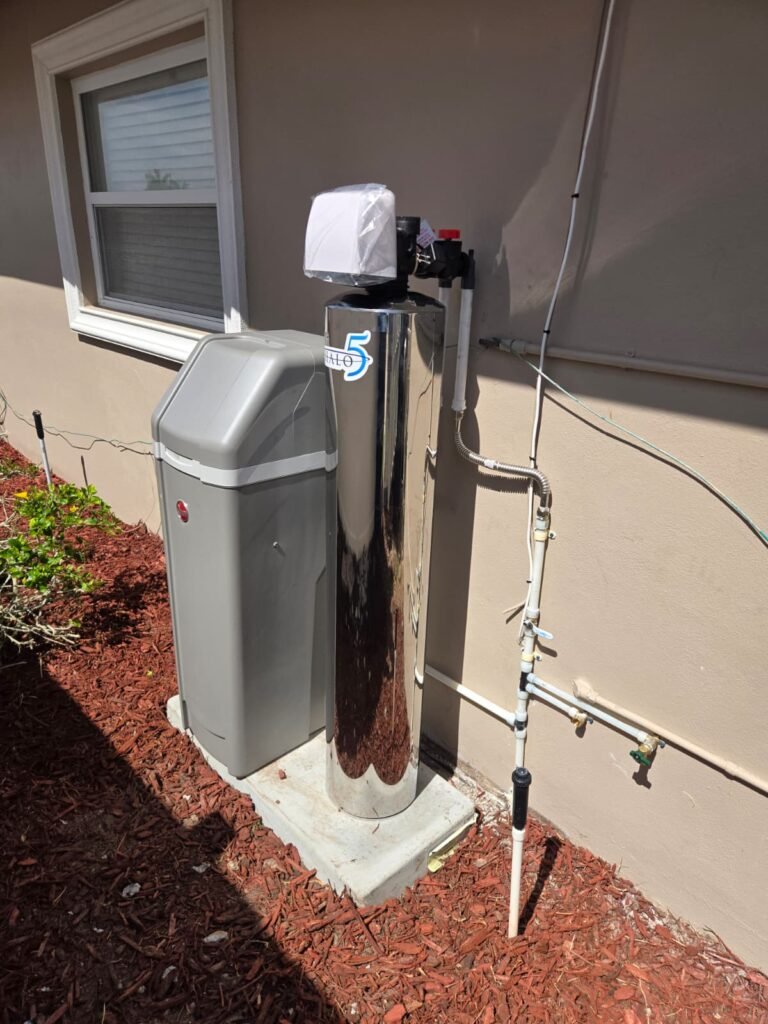
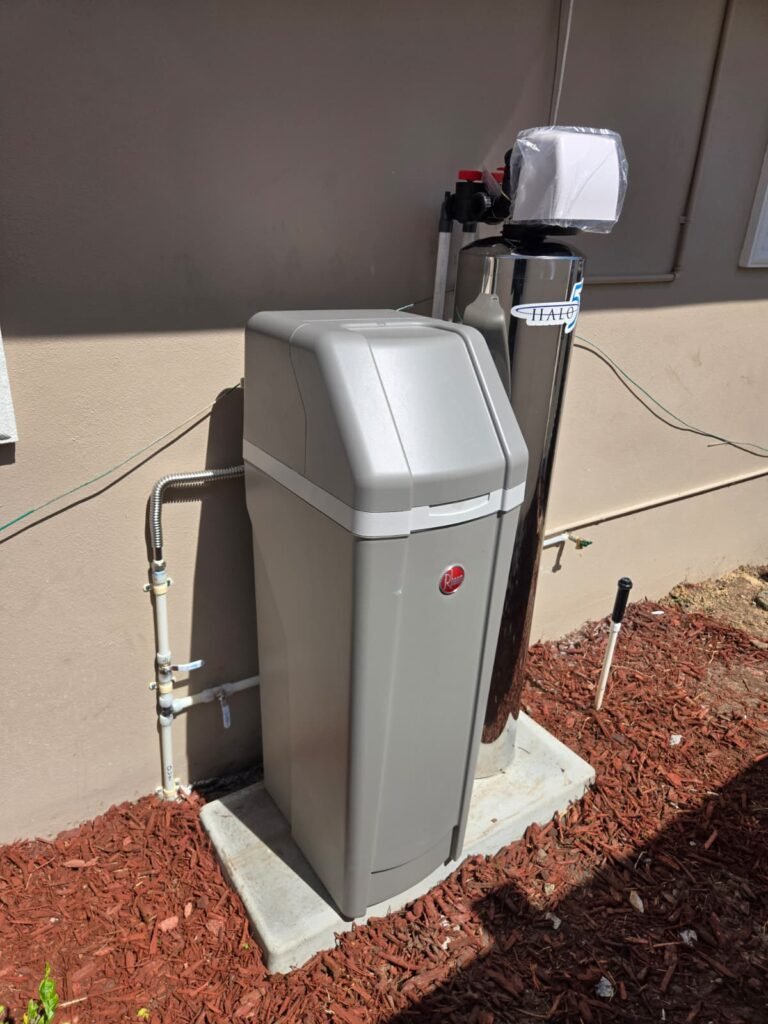
Our preferred installs are Rheem and Halo. All three are excellent, and all three carry real warranties we can honor locally.
- Rheem Preferred Plus R3: 32,000 or 42,000 grain options. Digital head, metered regeneration, 10-year tank warranty. Good fit for city water homes of 2 to 4 people.
- Halo 5: Hybrid softener plus carbon filtration in one tank. Handles chloramines plus hardness. Best value when you want one system doing both jobs.
- Halo 6: The step up. Adds UV and finer filtration media. Right for well water homes in Lutz, Odessa, Plant City, or homes with infants.
Salt-based vs salt-free for Tampa
Salt-based ion exchange is the only technology that actually removes hardness minerals from your water. Salt-free TAC (template assisted crystallization) changes the mineral structure so it does not stick to surfaces as easily, but the minerals are still there. TAC media degrades quickly above 10 gpg, which means it is not a reliable choice for Tampa well water and marginal for city water. If your hardness tests above 10 gpg, go salt-based. If you are under 10 gpg and salt restriction matters, TAC is an option worth discussing during your free in-home diagnosis.
Coastal Salt-Water Intrusion Cloudy Water
Homes in South Tampa, Davis Islands, Apollo Beach, and coastal Pinellas occasionally report cloudy water that also tastes slightly salty or metallic. This is not the same problem as hard water haze. This is saltwater intrusion, where chloride from the Gulf pushes into the freshwater aquifer, usually during drought periods or heavy pumping.
Signs you are dealing with intrusion rather than hardness:
- Mild salty or brackish taste at the tap
- Cloudiness with a faint brown or yellow tinge
- Faucets, fixtures, and water heater anode rods corrode noticeably faster than friends inland
- Higher than expected TDS readings (over 500 ppm)
A softener will not fix this. Softeners exchange calcium and magnesium for sodium, so running salty water through a softener actually adds more sodium. The correct solution is reverse osmosis. A point-of-use RO system at the kitchen sink runs $1,200 to $2,400 installed and gives you clean drinking and cooking water. Whole-home RO is a larger investment but the right call if every tap is affected.
Post-Hurricane Cloudy Water
3 to 7 days after a major storm, aquifer turbidity spikes and municipal utilities push sediment through the lines as they repressurize and flush. Boil water advisories are common across Tampa Bay after any named storm that causes power loss at treatment plants.
After the advisory is lifted:
- Flush every cold tap in the house for 3 to 5 minutes, starting with the tap closest to the main and working outward.
- Flush hot taps for 5 minutes (expect some discoloration as the heater stirs up sediment).
- Unscrew and clean every faucet aerator. Hurricane sediment clogs them first.
- Replace the cartridge on any whole-home filter you have installed.
- If you have a tank water heater, consider a flush once pressure stabilizes.
Even after cloudy water visually clears, contaminant residue can remain in pipes and fixtures for days. If taste or smell persists past a week, call us for testing.
AC repairI need to move a condenser from the wall due renovation, and HOA hire licenses company to do that and estimate 10 min job, i decide to do that Home Therapist Cooling…
Good and friendly service. Tech was on time and very professional.
PlumbingJandiel did a great job. Very professional and got the job done quick. He also gave me great information on using my unit in the hotter months to prevent my unit from…
David and all other staff I had been in contact with at AC therapist are excellent. David did not try to sale me nothing he showed me my option and I made…
Water heaterI had a great experience with Home Therapist Cooling, Heating, and Plumbing. We were getting our house ready to sell and the home inspection identified several plumbing issues that needed to be…
AC installI was in need of air conditioning for my detached garage. My AI search for the most trustworthy mini-split AC installer led me to Home Therapist; my expectations were exceeded. Scheduling a…
AC installExcellent service from Richard! He was professional, courteous, and very knowledgeable. He fixed my A/C problem quickly and explained everything clearly. I highly recommend Richard for anyone needing A/C service. had a…
AC repairI had a great experience with Home Therapist AC Repair. Alejandro arrived on time to diagnose why my AC wasn't cooling and quickly found the problem that the previous company had missed.…