
Open 24 hours, 7 days a week
FREE estimates and FREE diagnosis
Troubleshooting guide
Sump Pump Running Constantly
Sump pump running nonstop in Tampa Bay? A plumber can check the float switch, check valve and pump size and fix the cause before the motor burns out.
Home Therapist serves Tampa Bay, Florida. In the area? FREE estimates and FREE diagnosis.
- Licensed CAC1819196 & CFC1431159
- 4.8 stars from 1,404 reviews
- Background-checked, drug-tested techs
- Hablamos español
At a glance
- Normal cycle
- Runs 1 to 3 minutes, then rests 10 to 30 minutes in rain
- Most common cause
- A float switch stuck in the ON position
- Quick restarts
- Back on 30 to 60 seconds after shutoff: a failed or missing check valve
- Float switch fix
- $299 to $379
- Check valve fix
- $299
- Undersized or burned-out pump
- Replacement $1,019 to $1,250 installed
- First step
- Turn off power to the pump before you touch anything in the pit
- Diagnosis
- FREE on every sump pump call

Reviewed by Richard Morales, Co-Owner & FL Class B Air Conditioning Contractor (FL license CAC1819196)
If your sump pump runs every few minutes or never shuts off, something is wrong. A healthy sump pump cycles on for one to three minutes, then rests for ten to thirty minutes between rain events. Constant running means either water keeps entering faster than the pump can handle, the float switch is stuck, or the pump is sending water right back into the pit. Free diagnosis: call (813) 343-2212.
Why Sump Pumps Run Constantly: The Most Common Causes
Most homes in Tampa Bay that have sump pumps are sitting in crawl spaces or garage pits in low-elevation areas of Hillsborough, Pasco, and Pinellas counties. Coastal neighborhoods like Apollo Beach, Ruskin, Gibsonton, and Shore Acres near Tampa Bay sit at or just above sea level. The water table there is high year-round, and during our June-September rainy season it can rise within a foot of the surface. That means your pump is doing real work, but if it never stops, something specific is broken.
Here are the six most common reasons a sump pump runs constantly in this area.
1. Float Switch Stuck in the ON Position
The float switch is a small plastic component that floats on the water surface inside your pit. When water rises, the float rises with it and tells the pump to kick on. When the water drops, the float drops and the pump shuts off. If the float gets wedged against the side of the pit, tangled in the power cord, or the switch mechanism inside it fails, the pump gets a permanent “on” signal and runs forever, even in dry weather.
This is the single most common cause of constant running we see on service calls throughout Tampa Bay. The float is inexpensive, but it still requires draining the pit, inspecting the switch travel, and verifying proper installation height. A stuck float that gets ignored will burn out your pump motor within days.
2. Failed Check Valve: Water Siphons Back and Re-Triggers the Pump
A check valve sits on the discharge line and acts as a one-way door: water pumped out stays out. When the check valve fails or is missing entirely, every time the pump shuts off, the water column in the vertical discharge pipe flows backward into the pit. That refills the pit, the float rises again, and the pump kicks right back on. You end up with a pump that runs for one minute, shuts off for thirty seconds, and runs again: endlessly.
You can hear this happening. If your pump shuts off and about ten to fifteen seconds later you hear a gurgling rush of water back into the pit, the check valve is either failed, installed backwards, or missing. This is an easy repair but it will destroy your pump if ignored because the motor is not built for that duty cycle.
3. Undersized Pump for the Pit Volume and Water Table
A pump rated for a low-volume pit in a dry climate is not the right pump for a coastal Tampa Bay home with a high water table. If the pump is moving water slower than groundwater is entering the pit, it will run continuously without ever winning. This happens after a pump replacement where the homeowner bought a lower-capacity unit to save money, or in older homes where the original pump was sized for a different drainage condition than what the lot has today.
A properly sized residential sump pump for most Tampa Bay conditions needs a pumping capacity of at least 1,800 to 2,400 gallons per hour at a ten-foot head height. If you have a 1/4 HP economy unit in a coastal neighborhood, you probably need a 1/2 HP or 3/4 HP pump.
4. High Water Table: Common in Low-Elevation Tampa Bay Neighborhoods
Some homes in this region are in areas where the water table is genuinely high enough that during rainy season the pump runs frequently by design. Hillsborough County’s elevation ranges from sea level along the bay and river corridors up to about 50 feet in the Brandon and Temple Terrace areas. Neighborhoods like Ruskin, Sun City Center, Apollo Beach, and coastal Pinellas often have water tables within two to four feet of the surface after a heavy rain event.
If your pump runs constantly only during and after heavy rain, that may be normal. If it runs constantly even during dry weather in January, the water table alone is not the cause: you have a mechanical problem on top of it.
5. Cracked Pit Allowing Groundwater Infiltration
Sump pits in Florida are typically concrete or plastic. Concrete pits crack over time from soil movement and root intrusion. A cracked pit essentially turns into a collection point for groundwater regardless of surface rainfall. Water seeps in through the cracks constantly, and your pump can never keep up because it is fighting groundwater pressure, not just surface drainage.
You can identify this by checking whether the pit has visible cracks or seeping stains on the walls, and by monitoring whether the pump runs even during extended dry spells. A cracked pit needs to either be sealed with hydraulic cement or replaced entirely.
6. Discharge Line Problems: Too Long, Too Much Elevation, or Blocked
If the discharge line is extremely long, has too many horizontal runs, or terminates at a point much higher than the pump, the pump has to work harder and takes longer per cycle. A partially blocked or frozen (unlikely in Tampa but possible in cold snaps) discharge line can cause back-pressure that reduces pump output, causing it to run longer. Also verify the discharge outlet is at least ten feet from the foundation and not dumping water back toward the house or into a low point that drains back to the pit.
How to Time Your Pump Cycle (Normal vs. Problem)
The easiest first diagnostic you can do yourself is to time the cycles. During or right after rain:
- Normal: pump runs one to three minutes, shuts off, stays off for ten to thirty minutes or longer
- Check valve problem: pump runs one to two minutes, shuts off, restarts within thirty to sixty seconds
- Float stuck: pump runs continuously with no shutoff at all
- Undersized pump or cracked pit: pump runs four to six minutes per cycle with very short rest periods
Time three full cycles and write down the on-time and off-time. That information tells our technicians a lot before we even open the pit.
Diagnosis and Repair Cost Breakdown
| Problem | Symptom | Repair Cost (Tampa Bay) |
|---|---|---|
| Float switch stuck or failed | Pump never shuts off; runs during dry weather | $299 – $379 |
| Check valve failed or missing | Pump cycles on every 30-60 sec after shutoff | $214 – $299 |
| Undersized pump | Runs constantly but water never fully clears | $950 – $1,250 (pump replacement) |
| Cracked pit wall | Runs in dry weather; visible seeping on walls | $350 – $600 (seal) or $800 – $1,400 (replace pit) |
| High water table only | Runs frequently during rainy season only | No repair needed; possibly upgrade pump capacity |
| Discharge line restriction | Longer run times, reduced output flow at outlet | $299 – $379 |
What Happens If You Ignore a Constantly Running Sump Pump
A sump pump motor is designed for intermittent duty, not continuous operation. Running nonstop will burn out the motor in days to weeks depending on the pump quality. A burned-out pump in the middle of a Tampa rainy season with standing water under your house or in your garage is a much bigger problem (and a much bigger bill) than the repair would have been.
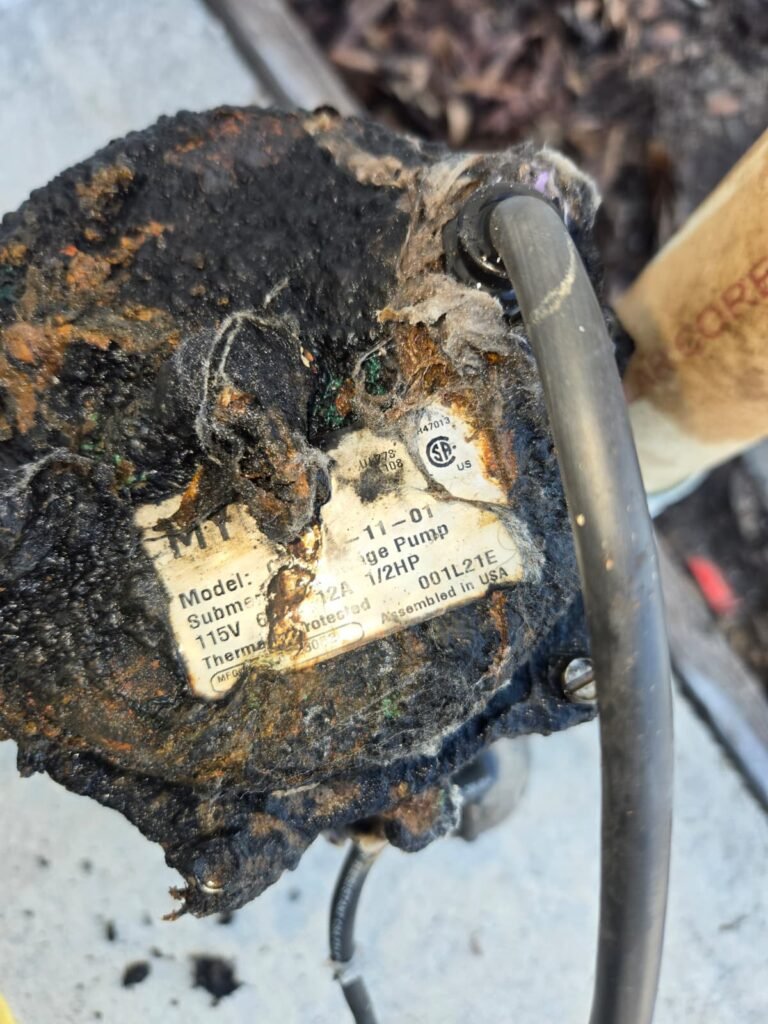
In crawl space homes common in older Tampa neighborhoods and in Hillsborough County’s flatlands, a failed pump during hurricane season can flood the crawl space, soak insulation, and create mold conditions within 48 to 72 hours. This is not a problem to postpone.
Steps to Inspect the Float Switch Yourself
If your pump never shuts off and the pit water level looks normal or low, the float switch is the first thing to check. Here is what to do safely:
- Turn off power to the pump at the circuit breaker or unplug it before touching anything inside the pit.
- Lift the pump out of the pit (most residential units are not bolted down).
- Check whether the float arm moves freely through its full range of motion without hitting the pit wall or power cord.
- Manually position the float in the down (off) position and plug the pump back in momentarily to see if it starts immediately: if it does, the switch is failed and needs replacement.
- Check the position of the float arm against the power cord. If the cord is wrapped around the float, the cord itself is holding the float in the up (on) position.
If the float moves freely and the switch still fails, the internal mechanism is faulty and the float assembly should be replaced. This is a $43 to $80 part at any hardware store but requires correct sizing for your pump model.
How to Test a Check Valve
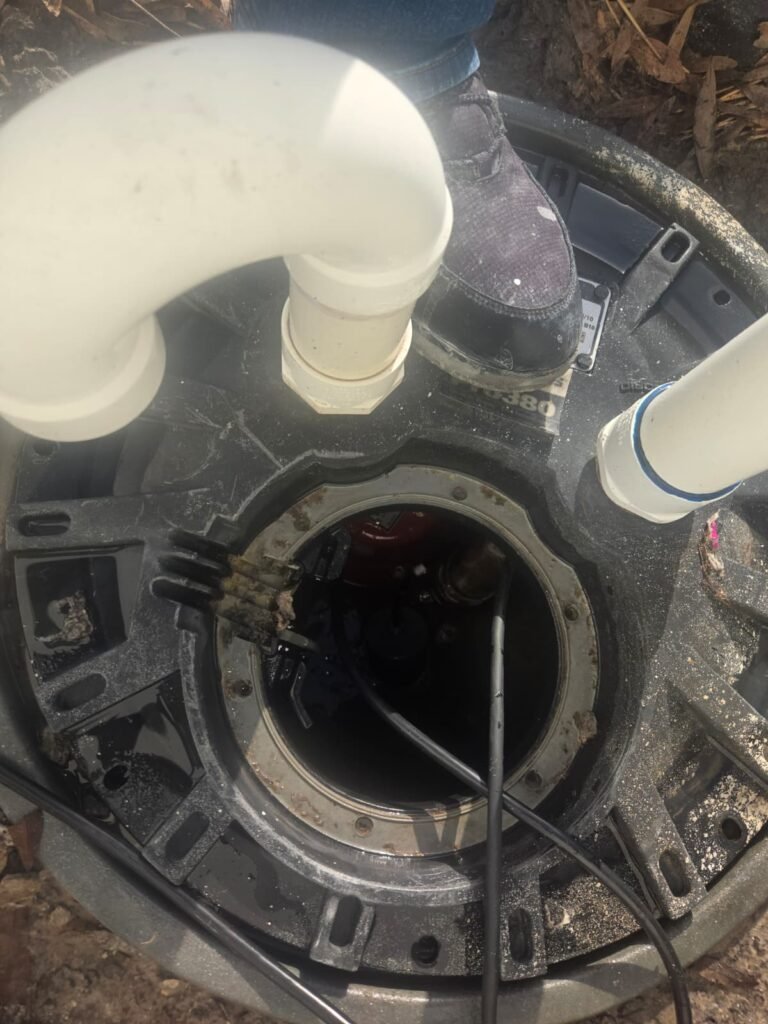
With the pump running, watch the discharge line. When the pump shuts off, put your hand near the inlet pipe inside the pit (not touching it) and listen. You should hear the pump stop and then silence. If you hear a rush of water flowing back into the pit within ten to twenty seconds of the pump stopping, the check valve is either bad or missing. Visually inspect the discharge line above the pit for a check valve: it will look like a thickened section of pipe with an arrow indicating flow direction. If there is no check valve at all, that is your problem.
When to Call a Plumber
Call us when:
- The pump runs during dry weather with no rain in the last 48 hours
- You can see or hear water flowing back into the pit after the pump shuts off
- The pump runs but the water level in the pit never drops
- You smell burning from the pump (motor overheating)
- The pump is more than seven to ten years old and showing any constant-run behavior
We provide a free diagnosis on every sump pump service call. You never pay a fee just for us to look.
Tampa Bay Rainy Season Prep for Sump Pump Owners
Before June hits, test your sump pump by pouring five gallons of water slowly into the pit and watching the float rise and trigger the pump. The pump should start, clear the water within two to three minutes, and shut off cleanly. Do this in May every year. Also check the discharge line outlet for debris, wasp nests, or blockages: these are surprisingly common in Florida where insects love to nest in pipes during the dry season.
If your home is in a flood-prone area of Hillsborough County (particularly anywhere along the Hillsborough River corridor, near Tampa Bay, or in low areas of Ruskin and Gibsonton) a battery backup sump pump is worth considering. Power outages during the same storms that flood your yard will leave you without a functioning pump at exactly the wrong moment.
What Tampa Bay customers say
“Excellent service, quick response, and I already have air conditioning!”
“I love the communication this company has and they work with your schedule. The tech is knowledgeable and does a great job. I highly recommend AC Therapist.”
“They have been amazing from the quote to the installation. They were able to accommodate us last minute. Made all the updates needed and in less than 5hrs we had a new HVAC unit installed. We'll be using them for all of our upgrades”
4.8 from 1,404 reviews · Read more reviews
Frequently Asked Questions
- Is it bad for a sump pump to run continuously?
Yes, continuous running burns out the motor prematurely and voids most manufacturer warranties. A sump pump is designed for intermittent cycles, not non-stop operation. If yours never shuts off, a stuck float switch, failed check valve, or overwhelmed pump capacity is likely the cause and needs same-day diagnosis before the motor fails completely.
- Is it normal for a sump pump to run every 30 minutes?
During heavy Tampa Bay rainfall or in low-elevation neighborhoods with a naturally high water table, cycling every 30 minutes can be normal. Outside of active storms, that frequency usually signals a stuck float switch, a leaking discharge line recycling water back into the pit, or a pump that is undersized for your home's water intrusion rate.
- What does it mean when your sump pump won't shut off?
A sump pump that won't shut off almost always has a float switch that is stuck in the "on" position, tangled against the pit wall, or failed electrically. A cracked or missing check valve on the discharge line can also let water drain back into the pit and trigger endless re-cycling. Home Therapist offers FREE diagnosis on every visit to pinpoint the exact cause.
- How long can a sump pump run without stopping?
Most residential sump pumps are rated for intermittent duty and can sustain continuous operation for roughly six to twenty-four hours before heat buildup risks motor damage, though exact limits vary by model. If your pump has been running non-stop for more than a few hours with no active flooding, call (813) 343-2212 for a FREE diagnosis before the motor burns out.
- What should I do if my sump pump is overheating?
Unplug it or switch off its breaker, let it cool, then check for a stuck float, a clogged intake or a jammed impeller. Overheating usually means it is running dry or fighting a blockage. Call us 24/7 at (813) 343-2212 for a FREE diagnosis before restarting it.
- Will a sump pump burn out if it runs continuously?
Yes, a pump that runs nonstop can overheat and burn out its motor, especially if it runs dry or the float is stuck. Constant running is a warning sign, not normal. Our FREE diagnosis finds the cause, and you approve a written quote before any repair begins.
- Why does my sump pump keep running every few minutes?
Short, repeated cycles usually mean a failed check valve letting water flow back into the pit, a high water table after Tampa Bay summer storms, or a float switch that is sticking. Each cause has a different fix, so a FREE diagnosis from our team, open 24/7, pins down which one it is.
- Can I pour bleach in my sump pump pit?
No, avoid pouring bleach into the pit. It can corrode pump parts and seals, and the discharge may carry it into your yard or drainage. For odors, clean the pit with plain water and a mild soap. If the smell persists, we can inspect the pump and pit for free.
Is it normal for a sump pump to run every few minutes?
No. A healthy pump in active rain should cycle on for one to three minutes and then rest for at least ten to thirty minutes. Cycling every few minutes indicates either a failed check valve that allows water to flow back, an undersized pump, or a cracked pit with constant groundwater infiltration. Call us for a free diagnosis.
My sump pump runs constantly but the pit looks empty. What does that mean?
This almost always means the float switch is stuck in the ON position. The pit is empty because the pump is working, but the float is wedged or broken so it never sends the shutoff signal. Turn off power to the pump immediately: running it dry will burn out the motor within hours.
How long should a sump pump run during a heavy rainstorm in Tampa?
During a serious Florida rainy season storm, running cycles of three to five minutes with rest periods of five to fifteen minutes is reasonable. Continuous operation during an active storm is a red flag: it typically means the pump is undersized for the water volume entering the pit, especially in low-elevation coastal areas of Hillsborough and Pinellas counties.
Can a high water table cause constant sump pump running in Tampa Bay?
Yes, in certain neighborhoods it can. Areas near Tampa Bay, the Hillsborough River, and low-elevation coastal communities in Ruskin, Apollo Beach, and Shore Acres have water tables close to the surface year-round. A pump in these areas will run more often than average. But running continuously without stopping, even during dry weather, still indicates a mechanical problem on top of the water table conditions.
What does a failed check valve sound like?
When the pump shuts off, you will hear a rush or gurgling of water flowing backward into the pit within about ten to twenty seconds. Sometimes there is a clunking or thud as the water column drops back. This is the most tell-tale sound of a failed check valve and it is easy to identify once you know what to listen for.
How much does it cost to fix a constantly running sump pump?
The most common fix (a float switch replacement) runs $299 to $379. A check valve replacement is $299. If the pump itself is undersized or burned out from running constantly, a replacement pump installed runs $1,019 to $1,250 for a standard residential unit. We diagnose for free before any work begins.
How do I know if my sump pump is undersized?
An undersized pump runs continuously during rain events but the water level in the pit never drops below a certain point. You can check the pump’s gallons-per-hour rating on the label or model number: it should be at least 1,800 to 2,400 GPH for most Tampa Bay residential conditions. Homes in coastal, low-elevation areas often need a 1/2 HP or 3/4 HP pump rather than a standard 1/4 HP economy unit.
Will a constantly running sump pump burn out?
Yes, and faster than you might think. Sump pump motors are rated for intermittent duty: cycles of a few minutes on and several minutes off. Continuous operation generates heat that the motor cannot shed fast enough, and most residential pumps will fail within two to fourteen days of constant running. Stop the cause immediately and get the pump inspected before that happens.
Should I install a battery backup sump pump in Tampa Bay?
For homes in flood-prone areas or low-elevation neighborhoods, yes: we strongly recommend it. The storms that raise your water table high enough to flood are the same storms that knock out power. A battery backup unit keeps pumping for eight to twelve hours on a full charge. It is an add-on alongside your primary pump, not a replacement for it. Ask us about options when we’re on site.
Can I run my sump pump without a check valve?
Technically the pump will run without one, but you should not. Without a check valve, every shutoff allows the water column in the discharge line to drain back into the pit, re-triggering the float and restarting the pump immediately. This dramatically shortens the pump’s life and wastes electricity. A check valve is a required part of any properly installed sump pump system.
Get Your Sump Pump Diagnosed Today: Free
If your sump pump is running constantly, do not wait. The problem is not going to resolve itself, and a burned-out pump in the middle of Tampa’s rainy season creates a cascade of water damage problems that cost far more than the original repair. Our licensed plumbers (CFC1431159) serve all of Tampa Bay including Hillsborough, Pasco, and Pinellas counties: same-day appointments available.
Call us at (813) 343-2212 or visit our plumbing services page to book online. No surprises.
Had a great experience with Home Therapist. They worked with me to stay within a budget, they communicated great, and they got the job done when they said they would. Will use…
Archer was super nice and was very helpful in explaining the process. No gimmicks and pure professionalism. They were super responsive and it was easy to get a hold of them to…
PlumbingLester is a great plumber. He is friendly, professional, and his work is outstanding. The plumbing lines were placed perfectly in the garage and the area was left clean and neat. Certainly…
Excellent service, quick response, and I already have air conditioning!
I love the communication this company has and they work with your schedule. The tech is knowledgeable and does a great job. I highly recommend AC Therapist.
Water heaterI had a great experience with Home Therapist Cooling, Heating, and Plumbing. We were getting our house ready to sell and the home inspection identified several plumbing issues that needed to be…
AC installI was in need of air conditioning for my detached garage. My AI search for the most trustworthy mini-split AC installer led me to Home Therapist; my expectations were exceeded. Scheduling a…
AC installExcellent service from Richard! He was professional, courteous, and very knowledgeable. He fixed my A/C problem quickly and explained everything clearly. I highly recommend Richard for anyone needing A/C service. had a…
AC repairI had a great experience with Home Therapist AC Repair. Alejandro arrived on time to diagnose why my AC wasn't cooling and quickly found the problem that the previous company had missed.…
Where we work
We serve the three counties of Tampa Bay from our shop at 1408 W Linebaugh Ave in Tampa.
Hillsborough County
Tampa, Brandon, Riverview, Carrollwood, Town ’n’ Country, Plant City, Ruskin, Sun City Center, Apollo Beach, Valrico, Lutz, Seffner
Pinellas County
St. Petersburg, Clearwater, Largo, Dunedin, Oldsmar, Safety Harbor, Pinellas Park, Seminole, Tarpon Springs, Treasure Island, St. Pete Beach
Pasco County
Wesley Chapel, Land O’ Lakes, New Port Richey, Holiday, Hudson, Trinity, Zephyrhills, Dade City
Get a FREE diagnosis from a licensed Tampa Bay tech
Open 24 hours, 7 days a week. The diagnosis and the estimate are FREE, and you approve the price before any work starts.
Hablamos español. Llámenos o envíenos un texto al (813) 343-2212.