
Open 24 hours, 7 days a week
FREE estimates and FREE diagnosis
Troubleshooting guide
Mini-Split Iced Up or Frozen Coil
Short answer: A mini-split ices up when the evaporator coil gets too cold to prevent moisture from freezing on it: caused most often by a dirty filter, low refrigerant, or restricted airflow. The fix is to turn the unit off and let it thaw completely before diagnosing the cause. In Tampa Bay, icing is most common on the hottest summer days, not cold nights: the irony of Florida HVAC.
Mini-split iced up? Turn it off and let it thaw. Our Tampa Bay techs find the cause, from a dirty filter to a refrigerant leak.
Home Therapist serves Tampa Bay, Florida. In the area? FREE estimates and FREE diagnosis.
- Licensed CAC1819196 & CFC1431159
- 4.8 stars from 1,404 reviews
- Background-checked, drug-tested techs
- Hablamos español
At a glance
- What it means
- The indoor coil dropped below freezing and the moisture on it turned to ice
- Most common causes
- A dirty filter, low refrigerant, or a slow or failing fan
- First step
- Turn it off and let it thaw 1 to 3 hours, on Fan Only if it has it
- Do not
- Use a hair dryer or heat gun, or keep running it frozen
- Filter cleaning
- Every 2 to 3 weeks in summer
- Call right away
- Ice on the copper lines, or on the indoor and outdoor units at once
- Refrigerant leak repair
- $1,179 plus refrigerant; finding the leak is FREE
- Diagnosis
- FREE; a dirty filter is handled on the visit at no extra cost

Reviewed by Richard Morales, Co-Owner & FL Class B Air Conditioning Contractor (FL license CAC1819196)
Why Mini-Splits Ice Over in Florida’s Heat
Ice on a mini-split in Tampa Bay during a 95°F July afternoon seems impossible. Yet it is one of the most common service calls Home Therapist receives all summer. Understanding why requires understanding how refrigeration works.
The evaporator coil inside the indoor head is designed to operate at approximately 40 to 45°F while cooling your home. When something reduces the heat load on that coil: dirty filter blocking warm room air, low refrigerant reducing the coil’s ability to absorb heat properly, or a fan running too slowly: the coil surface drops below 32°F. Tampa Bay’s high humidity means there is always abundant moisture in the air flowing over that coil. When the coil goes below freezing, that moisture freezes on contact.
According to the U.S. Department of Energy, a 10 percent refrigerant undercharge causes approximately 20 percent reduction in cooling capacity and can cause coil temperatures to drop well below the freezing point of water. In Tampa Bay’s summer heat, a system that has slowly lost refrigerant over two or three years will often run without obvious problems during mild spring weather: then start icing up the moment outdoor temperatures push past 90°F and the system has to work at full capacity.
The ASHRAE HVAC Systems and Equipment Handbook notes that evaporator icing is one of the top causes of compressor failure in residential systems: the ice restricts airflow to the point where the compressor runs with insufficient heat load, which can cause liquid refrigerant to slug back to the compressor and cause catastrophic damage. A frozen coil is never a “wait it out” situation.
Six Causes of Mini-Split Coil Icing
1. Dirty or Clogged Air Filter (Most Common)
The air filter is the first line of defense and the most common cause of icing. A filter clogged more than 50 percent by dust, pet hair, and Florida pollen reduces the volume of warm room air flowing over the coil. Less warm air means less heat for the coil to absorb, so the coil temperature drops. Filters in Tampa Bay homes should be cleaned every 2 to 3 weeks during summer, not the 30-day interval on the packaging. If you have pets or live near a construction zone, every 10 to 14 days is appropriate.
2. Low Refrigerant (Refrigerant Leak)
Refrigerant is the fluid that carries heat from inside your home to the outdoor unit. When the charge is low from a leak, the remaining refrigerant expands more aggressively in the indoor coil, dropping coil temperature below the freezing point of water. This is the most serious cause of icing because it requires EPA-certified repair, not just a recharge. Home Therapist technicians locate the leak, repair it, and recharge the system to factory specification. Running a leaking system causes compressor damage that can total $800 to $1,500 in repairs.
3. Fan Speed Too Low or Fan Motor Failing
The indoor fan motor moves room air across the evaporator coil continuously. If the fan is set to its lowest speed on a hot day, or if the motor is beginning to fail and running below rated RPM, airflow drops below the minimum required for proper heat exchange. The coil temperature falls and icing begins. This can also happen if someone covers the indoor unit’s vents with curtains or places furniture directly in front of it.
4. Outdoor Temperature Below Mini-Split’s Cooling Operating Range
Most standard mini-splits are not designed to run in cooling mode when outdoor temperatures drop below approximately 60°F. In Tampa Bay this matters most during January cold fronts: if a homeowner runs the mini-split on Cool mode during a 55°F night, the refrigerant cannot reject heat properly at the outdoor unit, coil temperatures plunge, and icing occurs. Use the unit’s Auto mode or switch to Fan Only during cooler weather.
5. Blocked Return Air or Closed Vents
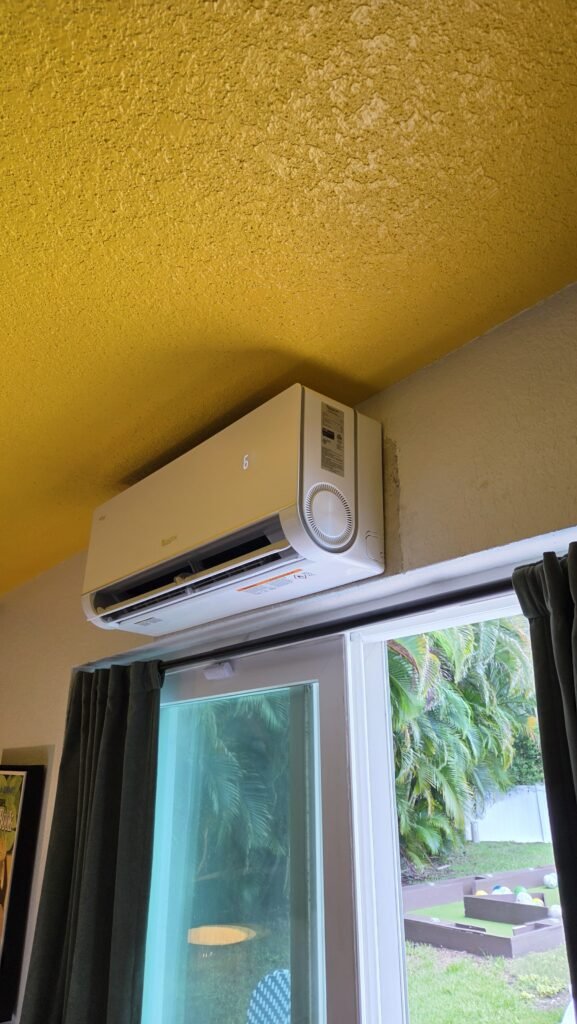
Unlike central AC, mini-splits pull return air directly from the room through the indoor head. Objects blocking the intake (a bookshelf pushed too close, curtains draped over the unit, or even the unit mounted too close to a ceiling) create the same effect as a dirty filter: insufficient warm air contact with the coil.
6. Metering Device or TXV Failure
The thermal expansion valve (TXV) or metering device controls how much refrigerant enters the evaporator coil. When it sticks open, it floods the coil with too much refrigerant at too low a pressure: the coil runs dramatically colder than designed and ices immediately. This is less common than the causes above but requires professional diagnosis and component replacement.
Ice Location Triage Table
| Ice Location | Likely Cause | Fix | Call Threshold |
|---|---|---|---|
| Ice on the indoor coil visible through the louvers | Dirty filter, low refrigerant, or low fan speed | Turn unit OFF; clean filter; let thaw completely (1 to 3 hours) | Icing returns after thaw and clean filter: refrigerant or fan issue |
| Ice at the bottom of the indoor head, water dripping | Coil freeze-thaw cycle; drain pan overwhelmed by melt water | Turn unit OFF; place towels; let thaw; check filter | Repeat icing within 24 hours of thawing |
| Ice on the refrigerant line set (copper lines running to outdoor unit) | Low refrigerant causing suction line to drop below freezing | Turn unit OFF immediately: do not run | Always call: this indicates active refrigerant issue |
| Ice on the outdoor unit coil during winter | Normal defrost cycle during heating mode; OR outdoor unit running in cooling mode during cold snap | Check operating mode; if in heat mode, wait: defrost cycle is automatic and normal | Heavy ice accumulation that does not clear after 30 minutes in defrost cycle |
| Ice on both indoor and outdoor units simultaneously | Severe refrigerant undercharge or TXV failure | Turn unit OFF at breaker immediately | Always call: compressor damage risk is high |
What To Do When Your Mini-Split Is Frozen
- Turn the unit off immediately. Do not keep running a frozen system. Running the compressor with a frozen coil risks liquid refrigerant reaching the compressor: the single most expensive failure mode in HVAC.
- Switch to Fan Only mode if your unit allows it. Running the fan without cooling speeds the thaw process by circulating room-temperature air across the coil.
- Allow 1 to 3 hours for complete thawing. Do not use a hair dryer, heat gun, or any external heat source on the coil: thermal shock can damage the fins and refrigerant tubing.
- Place towels under the indoor head. Significant melt water will drain from the unit as the ice clears. See our mini-split leaking water page for more on protecting your home during a thaw event.
- Clean or rinse the air filter while the unit is thawing.
- Restart and monitor closely. If the coil begins icing again within an hour of restarting (even with a clean filter) turn the unit off and call Home Therapist. The cause is refrigerant-related or mechanical and requires professional service.
Mini-split iced up in Tampa Bay heat?
Call (813) 343-2212 or book online for FREE diagnosis. Do not keep running a frozen unit: call us first. Licensed CAC1819196. Serving all of Tampa Bay.
The Florida Irony: More Icing in Summer Than Winter
Homeowners from northern states are often surprised to learn that mini-split icing is a summer problem in Florida, not a winter one. The mechanism is straightforward: a system with a slow refrigerant leak may operate acceptably during the mild 75°F days of March. When July arrives and the outdoor temperature hits 96°F, the system must run at maximum capacity all day. The marginal refrigerant charge that was “just enough” in spring is now clearly insufficient. The indoor coil drops below freezing within hours of maximum-demand operation: on the hottest afternoon of the year.
This is why Home Therapist recommends a spring maintenance visit every April before peak cooling season. Catching a slow refrigerant leak or a partially restricted filter in April costs far less than an emergency service call in July.
New Mini-Split Installs: How to Avoid Icing Problems
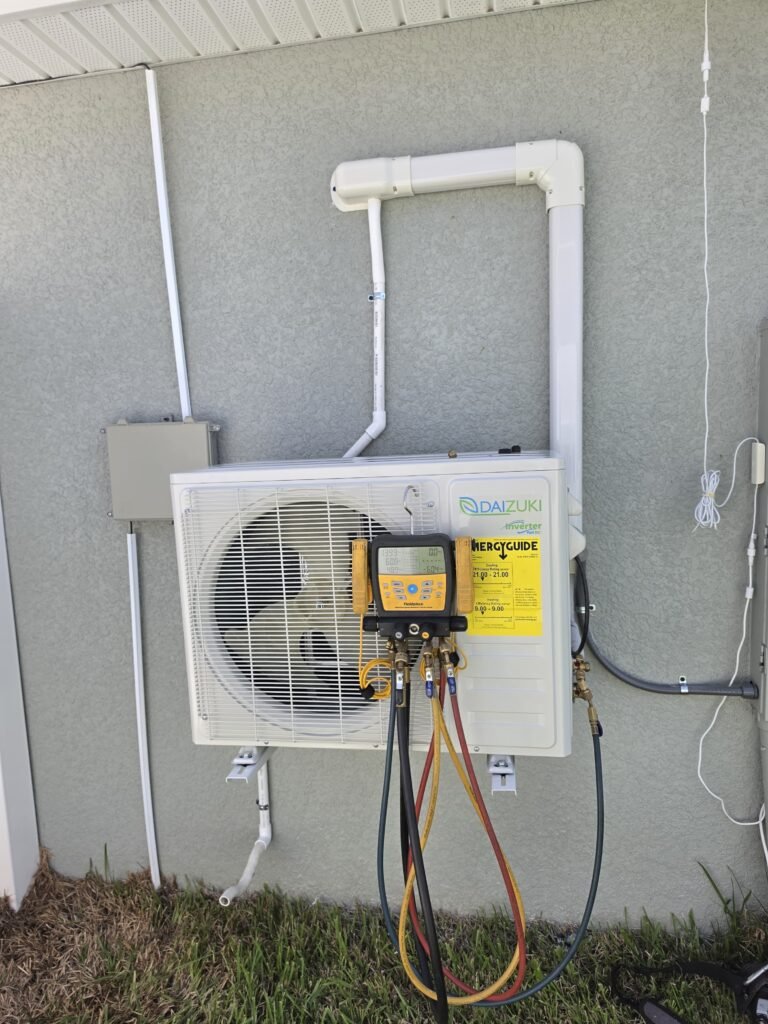
Icing is almost entirely preventable with proper installation and maintenance. Home Therapist installs TGM or Daizuki mini-split systems on our Value and Premium lines (2-year parts, 5-year compressor warranty) and Daikin on our Elite line (10-year parts warranty, 12 years on Elite Max). Proper installation includes correct refrigerant charge verified by gauges, properly sloped line sets, and airflow clearance confirmation. For full details on our ductless mini-split installation services, see our main mini-split page.
Frozen coil, repeat icing, or not sure what caused it?
Call (813) 343-2212 or book online for FREE diagnosis. 1,300+ five-star reviews. Home Therapist: Licensed CAC1819196. Hillsborough, Pinellas, and Pasco counties.
Related Pages
- Ductless Mini-Split Installation in Tampa Bay
- Mini-Split Not Cooling
- Mini-Split Leaking Water
- AC Repair Tampa
Home Therapist Cooling, Heating & Plumbing · License CAC1819196 (HVAC) · 1,300+ five-star reviews across Tampa Bay · (813) 343-2212
What Tampa Bay customers say
“Excellent service, quick response, and I already have air conditioning!”
“I love the communication this company has and they work with your schedule. The tech is knowledgeable and does a great job. I highly recommend AC Therapist.”
“They have been amazing from the quote to the installation. They were able to accommodate us last minute. Made all the updates needed and in less than 5hrs we had a new HVAC unit installed. We'll be using them for all of our upgrades”
4.8 from 1,404 reviews · Read more reviews
Frequently Asked Questions
- Is it normal for a mini split to freeze up?
No, a frozen mini-split coil is never normal and always signals a problem. The most common causes in Tampa Bay's high-humidity climate are low refrigerant, a dirty air filter restricting airflow, or a failing blower fan. A frozen coil stops cooling entirely and can damage the compressor if ignored. Call a licensed technician for a FREE diagnosis.
- Will frozen AC fix itself in summer?
No. Turning the unit off and letting the ice melt clears the ice temporarily, but the underlying cause remains. In Tampa Bay's summer heat, the coil will refreeze within hours if low refrigerant, blocked airflow, or a dirty filter is not corrected. A FREE diagnosis from a licensed HVAC tech identifies the root cause before compressor damage occurs.
- How often should a mini split go into defrost mode?
Defrost mode applies mainly to heating, where the outdoor unit briefly melts frost, so it varies with conditions and the manufacturer's controls. In cooling mode during a Florida summer, a mini split should not need defrost. Ice on the indoor coil while cooling points to a problem, such as airflow or refrigerant.
- What is the average lifespan of a mini split?
A well-maintained mini-split gives many years of service. In Tampa Bay's coastal environment, salt air accelerates corrosion on outdoor coil fins and electrical connections, which can shorten that lifespan without annual maintenance. Regular filter cleaning, coil inspections, and prompt repair of refrigerant leaks are the biggest factors in reaching the upper end of that range.
- Why is my split system freezing up?
A mini-split freezes when airflow is restricted or refrigerant is low. Dirty filters, blocked return air, or a failing blower are the most common culprits in Tampa's humid summers. Salt-air corrosion near the coast can also damage coils and cause refrigerant leaks. Home Therapist offers FREE diagnosis on every visit: (813) 343-2212.
- Why does my mini split freeze over?
A mini split freezes when the indoor coil gets too cold to shed moisture as water, usually from weak airflow (dirty filter or blower) or low refrigerant. Humid Tampa air makes it worse. Turn it off to thaw, then call us. Diagnosis is FREE, open 24/7.
- Why is my Senville mini split not cooling my home?
A Senville that is not cooling is often iced over, so the frozen coil blocks airflow. Other causes include dirty filters, a clogged drain, low refrigerant or a failing fan. Switch to fan mode to thaw it, and if cooling stays weak we service all brands with a FREE diagnosis.
- what causes mini split to ice up
The main causes are a dirty filter or coil, a weak indoor fan, low refrigerant from a leak, and running the unit in cool, humid conditions. Each one drops the coil below freezing. A tech can pinpoint which with a FREE diagnosis, open 24/7.
- why is my mini split freezing up inside
Ice on the indoor unit means the coil is running below 32 degrees, usually because of restricted airflow or low refrigerant. Dirt on the filter or coil is the easiest cause to check. Turn it off and let it thaw fully before restarting, then book a FREE diagnosis.
- how much does this usually cost to fix?
The cost depends on the cause, from a simple cleaning to a refrigerant leak repair, so we do not guess by phone. We give a FREE diagnosis and FREE estimate at any hour, and you approve a written quote before any repair begins. Call or text (813) 343-2212.
- How do I stop my mini split from icing up?
Turn the unit to fan only to melt the ice, then fix the cause. Clean the washable filters, clear anything blocking the indoor head, and check that the condensate drain is running. If ice returns, low refrigerant or a failing part is likely. We diagnose it FREE, open 24/7.
- Should I leave my mini split on all the time in summer?
In Tampa Bay's heat and humidity, most homeowners leave a mini split on and set a steady temperature, because constant on and off cycling lets humidity build. Use a moderate setpoint and keep filters clean. Heavy runtime makes dirty filters and clogged drains more likely to cause icing, so keep up with maintenance.
Why is my mini-split freezing up in the middle of summer?
This is the most common question we receive about frozen mini-splits in Tampa Bay. The answer is almost always one of three things: the air filter is dirty and restricting airflow to the coil, the refrigerant charge has dropped due to a slow leak that became critical under summer demand, or the outdoor unit’s condenser is dirty and cannot shed heat fast enough. All three are more likely to become problems in summer (when the system runs at maximum capacity for hours at a time) than in mild weather. A spring maintenance visit before peak season is the best prevention.
How long does it take for a frozen mini-split coil to thaw?
With the unit turned off and the fan running on Fan Only mode, most indoor coils fully thaw within 1 to 3 hours. Thaw time depends on how much ice accumulated and how warm the room is. Do not attempt to speed thawing with external heat sources: the goal is to let the ice melt at its own pace so no thermal stress damage occurs to the coil fins or refrigerant tubing. Have towels ready; the melt water can be significant, especially after a heavy freeze cycle.
Can I recharge the refrigerant myself to stop the icing?
No, for two important reasons. First, EPA Section 608 regulations require technician certification for refrigerant handling: adding refrigerant to a mini-split yourself is illegal without certification. Second, recharging without finding and repairing the leak accomplishes nothing; the refrigerant will leak out again, and the icing will return. Home Therapist technicians locate the leak source, repair it, and recharge the system to factory specification. Attempting a DIY recharge can also damage the system by overcharging it, which causes a different set of failures.
My mini-split iced up once and I thawed it. It’s cooling fine now. Do I still need service?
Yes. A single icing event that resolves after thawing a clean filter is a warning, not a resolved problem. If the filter was dirty, clean it and monitor closely: if it freezes again within a week, the filter was not the root cause. If the filter was clean when it froze, the cause is almost certainly a refrigerant undercharge or a mechanical airflow issue that will cause the system to freeze again under the right conditions. Catching and repairing a refrigerant leak before it becomes a compressor failure is always worth the diagnostic visit.
How much does it cost to fix a mini-split that keeps icing up?
Home Therapist provides FREE diagnosis: there is no charge to diagnose a frozen mini-split. If the cause is a dirty filter, that is resolved during the visit at no extra cost. If the cause is a refrigerant leak, the repair cost depends on where the leak is located and how much refrigerant is needed. A copper refrigerant leak repair is $1,179 plus the refrigerant, far less than a compressor replacement ($1,339 labor plus the compressor and refrigerant) when icing damage goes unaddressed. We quote before we start any work.
Had a great experience with Home Therapist. They worked with me to stay within a budget, they communicated great, and they got the job done when they said they would. Will use…
Archer was super nice and was very helpful in explaining the process. No gimmicks and pure professionalism. They were super responsive and it was easy to get a hold of them to…
PlumbingLester is a great plumber. He is friendly, professional, and his work is outstanding. The plumbing lines were placed perfectly in the garage and the area was left clean and neat. Certainly…
Excellent service, quick response, and I already have air conditioning!
I love the communication this company has and they work with your schedule. The tech is knowledgeable and does a great job. I highly recommend AC Therapist.
Water heaterI had a great experience with Home Therapist Cooling, Heating, and Plumbing. We were getting our house ready to sell and the home inspection identified several plumbing issues that needed to be…
AC installI was in need of air conditioning for my detached garage. My AI search for the most trustworthy mini-split AC installer led me to Home Therapist; my expectations were exceeded. Scheduling a…
AC installExcellent service from Richard! He was professional, courteous, and very knowledgeable. He fixed my A/C problem quickly and explained everything clearly. I highly recommend Richard for anyone needing A/C service. had a…
AC repairI had a great experience with Home Therapist AC Repair. Alejandro arrived on time to diagnose why my AC wasn't cooling and quickly found the problem that the previous company had missed.…
Where we work
We serve the three counties of Tampa Bay from our shop at 1408 W Linebaugh Ave in Tampa.
Hillsborough County
Tampa, Brandon, Riverview, Carrollwood, Town ’n’ Country, Plant City, Ruskin, Sun City Center, Apollo Beach, Valrico, Lutz, Seffner
Pinellas County
St. Petersburg, Clearwater, Largo, Dunedin, Oldsmar, Safety Harbor, Pinellas Park, Seminole, Tarpon Springs, Treasure Island, St. Pete Beach
Pasco County
Wesley Chapel, Land O’ Lakes, New Port Richey, Holiday, Hudson, Trinity, Zephyrhills, Dade City
Get a FREE diagnosis from a licensed Tampa Bay tech
Open 24 hours, 7 days a week. The diagnosis and the estimate are FREE, and you approve the price before any work starts.
Hablamos español. Llámenos o envíenos un texto al (813) 343-2212.