


Reviewed by Richard Morales, Co-Owner & FL Class B Air Conditioning Contractor (FL license CAC1819196)
Grandaire AC condenser coil corrosion is a real service issue in Tampa Bay. Salt air from Tampa Bay and the Gulf, high ambient humidity, and long seasonal run cycles all accelerate corrosion on aluminum and copper fin stock faster than in inland climates. If your Grandaire outdoor unit has been running fine for 6 or 7 years but now leaks refrigerant, cools poorly, or shows visible rust or white oxidation on the coil fins, this guide explains what our technician looks for, what it costs to address, and when the corrosion damage tips the repair-versus-replace decision.
Key Takeaways: Grandaire AC Condenser Coil Corrosion in Tampa Bay
- Condenser coil corrosion on Grandaire systems in Tampa Bay typically appears as pinhole refrigerant leaks or visible aluminum fin oxidation, often between years 6 and 12 of operation.
- Salt air exposure within 5 miles of Tampa Bay or the Gulf accelerates formicary and galvanic corrosion on copper and aluminum coil materials.
- A corroded coil that is leaking refrigerant usually costs more to repair than the remaining system value if the unit is over 10 years old.
- We offer FREE estimates and FREE diagnosis.
- For replacement, our preferred installs are Goodman and Daikin systems, with a coastal coil coating quoted in writing for coastal Tampa Bay properties.
- Annual coil cleaning and inspection significantly extends coil life even in salt-air environments.
What causes grandaire ac condenser coil corrosion in Tampa Bay, FL?
Condenser coil corrosion in Tampa Bay happens through several overlapping mechanisms. Understanding which type is present matters because it affects both the repair options and the replacement timeline.
The most common mechanism in coastal areas is galvanic corrosion. Most residential condenser coils pair aluminum fins with copper refrigerant tubing. Aluminum and copper have different electrochemical potentials, and in the presence of an electrolyte like salt-laden humid air, they form a galvanic couple. The aluminum acts as the anode and slowly oxidizes. Over several years, the fins weaken, become brittle, and eventually allow the coil structure to fail. This process is measurably faster within five miles of open saltwater, which includes much of St. Petersburg, Clearwater, and coastal Hillsborough County.
A second mechanism is formicary corrosion, which creates pinhole leaks in copper refrigerant tubing. Formicary corrosion requires the presence of organic acids, moisture, and oxygen. Inside a home or near construction materials, formaldehyde off-gassing from certain building products can supply the organic acid component. The Air Conditioning Contractors of America (ACCA) has documented formicary corrosion as a persistent issue in Florida residential HVAC systems. Pinhole leaks from this mechanism are often too small and numerous to repair economically; coil replacement is typically the correct response.
How does our technician identify condenser coil corrosion on a Grandaire system?
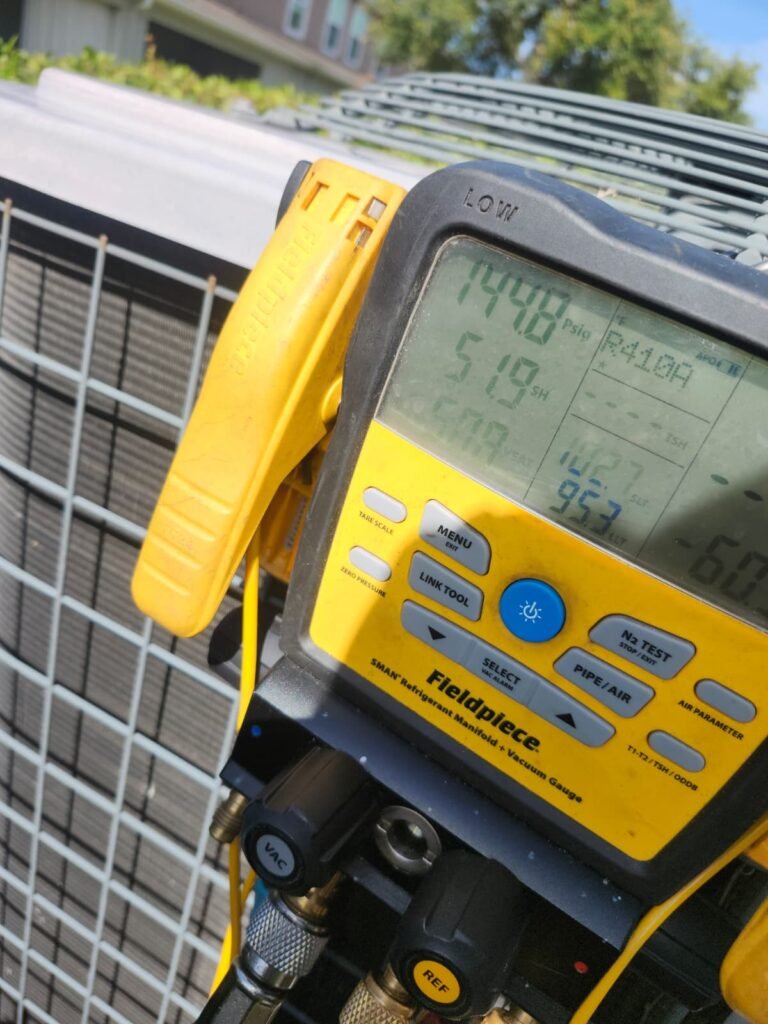
Step 1: We start with the refrigerant readings
Before we open the condenser cabinet, we check system pressures and subcooling values. A system that is low on refrigerant without a documented recent charge is almost always leaking somewhere. Low refrigerant in Tampa Bay summer heat causes the compressor to run hot, the system to cool poorly, and eventually the suction line to ice over. If the pressures indicate refrigerant loss, we proceed to leak detection.
Step 2: We perform a refrigerant leak search
We use an electronic leak detector and UV dye to locate the source. Condenser coil leaks on Grandaire systems typically appear at the base of the U-bends in the copper tubing, along the fin rows where aluminum-to-copper contact points are exposed, or at brazed joints that have experienced thermal cycling stress. In coastal locations, we often find multiple pinhole leak sites distributed across the lower coil section, which is the zone with the highest moisture retention and salt deposit accumulation.
Step 3: We inspect the fin condition and cabinet for corrosion indicators
Healthy condenser fins are uniformly spaced, have a slightly oily appearance from refrigerant oil contact, and show no white oxidation powder. Corroded fins show whitish or gray powdery deposits at the aluminum surface, bent or compressed fin rows from softening of the metal, and in severe cases, visible holes through the fin material where the aluminum has dissolved away entirely. We photograph significant corrosion for the homeowner’s record and to document the condition for any applicable warranty review.
Step 4: We measure refrigerant loss rate to assess repair viability
A small isolated leak at a single joint may be repairable. Distributed formicary pinholes across multiple coil sections are not. We also factor in system age, compressor condition, and overall refrigerant circuit integrity before recommending repair versus replacement. A Grandaire system with moderate corrosion, a 9-year-old compressor, and a 14 SEER rating in today’s 14.3 SEER2 minimum environment is often a candidate for full replacement rather than coil patch repair.
Grandaire condenser coil repair vs replacement: cost comparison
| Scenario | Typical Cost Range | Best When |
|---|---|---|
| Refrigerant top-off (single leak, brazed joint) | $400 to $650 | Single isolatable leak, system under 8 years old |
| Condenser coil replacement (OEM or aftermarket) | $800 to $1,400 parts, plus labor on the written quote | Coil confirmed damaged but compressor healthy and system under 10 years |
| Full system replacement (Goodman 3-ton heat pump) | Written quote; new heat pump systems run $7,161 to $18,540 installed | System over 10 years, multiple leak sites, or compressor also stressed |
| Full system replacement with coastal coil coating | Written quote; the coastal coil coating is priced on top of the system | Coastal property within 3 to 5 miles of open water |
Coil replacement on older Grandaire units can be complicated by parts availability. Grandaire does not have the same distributor network as Goodman, and OEM replacement coils may require longer lead times. We evaluate aftermarket coil compatibility but always inform the homeowner when a genuine OEM part is preferred.
Coastal coil protection options for Tampa Bay replacements
When we install a replacement system at a Tampa Bay property with documented salt-air exposure, we discuss coil coating options. Epoxy-coated evaporator and condenser coils add a protective barrier between the aluminum fin material and the corrosive environment. Coastal coil coatings on the Goodman and Daikin systems we install are quoted in writing as an upgrade for coastal applications. Field-applied coatings like Heresite or Blygold are also options for existing systems after professional cleaning.
For homeowners in Clearwater Beach, St. Pete Beach, Tierra Verde, or anywhere with direct Gulf or bay exposure, coil protection should be part of every replacement conversation. An unprotected aluminum coil in those locations may begin showing corrosion damage in 3 to 5 years instead of the more typical 8 to 12 years in an inland Tampa neighborhood.
How does condenser coil corrosion compare between Grandaire and Goodman in Tampa Bay?
Aluminum fin and copper tube construction is standard across virtually all residential condenser brands at the entry and mid tier, including Grandaire and Goodman. The vulnerability to galvanic and formicary corrosion exists in both. What differs is the protective finish quality on the fin stock and the availability of factory coil coating upgrades.
Goodman’s mid-tier and higher-tier models offer fin-coated options and are more readily paired with coastal protection upgrades through our distributor network. Daikin Elite systems include enhanced corrosion-resistant features that make them a strong choice for properties within a mile of the water. See our full Goodman vs Daikin comparison for Tampa Bay homeowners who want to factor coastal durability into the decision.
What happens to a Grandaire system when coil corrosion is ignored?
A condenser coil with a slow refrigerant leak that goes unaddressed follows a predictable path. As refrigerant level drops, the system cools less effectively. The compressor works harder and runs hotter to compensate for the low suction pressure. Over weeks or months, the compressor can experience thermal breakdown of the motor windings or the internal valve system. At that point, the repair cost escalates significantly. A compressor replacement on a Grandaire unit can easily exceed the value of the remaining system, pushing the total repair cost above the cost of a new replacement installation.
The same progressive damage scenario applies to any brand when a refrigerant leak is left unaddressed. We see it regularly on Grandaire systems in Tampa Bay because budget-tier equipment owners sometimes defer service calls in the hope that the cooling problem resolves itself. It does not. Our AC repair service is available across Tampa Bay with FREE diagnosis on every call.
Annual maintenance and condenser coil protection for Grandaire owners
The most effective thing a Grandaire owner in Tampa Bay can do to extend condenser coil life is annual professional cleaning. A soft-brush and low-pressure coil cleaning removes salt deposits, organic matter, and dirt that accumulate in fin rows over the season. Removing those deposits eliminates the electrolyte layer that accelerates galvanic corrosion. It also restores heat rejection capacity, reduces compressor amp draw, and lowers summer electricity costs.
Our AC maintenance service in Tampa Bay includes condenser coil inspection and cleaning as part of the standard tune-up. We also document fin condition with each visit so the homeowner has a baseline for tracking coil health over time.
Pro tips for Tampa Bay homeowners with Grandaire AC systems
- If you live within 3 miles of Tampa Bay or the Gulf, have your condenser coil professionally cleaned and inspected every spring without exception.
- Never use a high-pressure hose to wash condenser fins. High pressure bends the thin aluminum fin stock and accelerates damage.
- If you smell a faint chemical or sweet odor near the outdoor unit, call for refrigerant leak detection immediately. Refrigerant loss is never self-correcting.
- Ask about coastal coil coating when you get a replacement quote. It is quoted in writing and can add years to coil life in salt-exposed locations.
- Consider our repair vs replace AC decision guide if your Grandaire system is over 10 years old and showing refrigerant loss. The breakeven math often favors replacement earlier than homeowners expect.
Sources: ENERGY STAR.
What Tampa Bay customers say
“My outside unit stopped working over the weekend. I called Home Therapist on a Sunday and was able to book an appointment for the next day;not needing to leave a message and wait for a call back was very refreshing. Roberto came on time. He was very thorough and quick. He did the repair , educated me on some recommendations but never pressured me to do more . Companys number stored . Any future AC issues , I’ll be calling them again.”
“They were quick and available, when my AC was completely out they were able to come out within 24 hours and quickly found the issue and resolved it same day. Their preventative maintenance program is cost effective and the cost evened out with the repairs I needed. I was recommended to them by a neighbor and I would recommend them to my neighbors”
“They have been amazing from the quote to the installation. They were able to accommodate us last minute. Made all the updates needed and in less than 5hrs we had a new HVAC unit installed. We'll be using them for all of our upgrades”
4.8 from 1,399 reviews · Read more reviews
Frequently asked questions about Grandaire AC condenser coil corrosion
- Is it worth repairing an AC condenser?
Repairing a condenser coil is worth it when the unit is under ten years old, the refrigerant charge is healthy, and the leak is isolated to one section. In Tampa Bay's salt-air climate, corrosion often spreads, so our licensed techs (CAC1819196) inspect the full coil before recommending repair over replacement. We provide a FREE diagnosis on every visit so you get an honest answer before spending anything.
- How much is an AC condenser repair?
Condenser coil repair costs vary widely based on leak severity, refrigerant type, and whether the coil can be patched or must be replaced. Because Tampa Bay's coastal humidity accelerates formicary and salt corrosion, a coil that looks like a small leak can require full coil replacement. Home Therapist provides FREE estimates so you see the exact cost before any work begins. Call (813) 343-2212.
- What are signs of a bad AC condenser?
Common signs include warm air from supply vents, ice buildup on the outdoor unit, refrigerant hissing or bubbling sounds, higher-than-normal electric bills, and oily residue on the coil fins. In Tampa Bay's high-humidity environment, pitting or greenish corrosion on Grandaire coil fins is a specific early warning sign that salt-air formicary corrosion has begun. Home Therapist has completed 1,203 jobs in Tampa in the last 12 months and sees this pattern regularly.
- Is it possible to repair a coil?
Yes, coil repairs are possible in some cases. Small leaks can sometimes be brazed or patched, but heavily corroded coils common in Tampa Bay's salt-air coastal environment usually need full replacement. Home Therapist provides FREE diagnosis on every visit to determine which option makes sense for your system.
- Where can I get my air conditioner repaired in Tampa, Florida?
Home Therapist serves all of Tampa Bay with same-day AC repair, licensed under HVAC CAC1819196. With 1,300+ five-star reviews and FREE diagnosis on every visit, we are a trusted local choice. Call (813) 343-2212 to schedule.
- Why does my AC rust so fast near the ocean?
Salt air accelerates galvanic corrosion on aluminum and copper coil fins, often attacking coastal Tampa Bay units two to three times faster than inland systems. Formicary corrosion from formic acid compounds the problem. Annual coil cleaning and corrosion-resistant coatings significantly slow the damage.
How do I know if my Grandaire condenser coil is corroded?
Visible signs include white or gray powdery deposits on the fin rows, bent or crumbling fin material, and oil staining at the base of the outdoor unit from refrigerant oil escaping at leak sites. Performance signs include gradually worsening cooling over one to two seasons, higher electricity bills without change in thermostat habits, and the system running longer than it used to reach set temperature.
Can a corroded Grandaire condenser coil be repaired?
An isolated pinhole leak at a single brazed joint can sometimes be repaired by brazing the joint and recharging the system. Distributed formicary pinholes across the coil face cannot be economically repaired. The only options are coil replacement or system replacement. We determine which leak scenario you have with a thorough leak detection before recommending a repair path.
How long does a Grandaire condenser coil typically last in Tampa Bay?
Inland Tampa Bay locations average 8 to 12 years for a standard aluminum-fin coil with regular maintenance. Coastal locations within 3 to 5 miles of open saltwater can see significant corrosion in as few as 5 to 7 years without protective coatings or enhanced maintenance frequency.
Is it worth repairing a Grandaire coil on a 12-year-old system?
Usually not. A coil replacement on a 12-year-old system adds $800 to $1,400 in parts plus labor to a system with a compressor that is already in the second half of its expected life. The same budget applied toward a new Goodman or Daikin installation delivers a full warranty, better efficiency, and a fresh coil with modern corrosion protection options.
Does Home Therapist service Grandaire AC systems in Tampa Bay?
Yes. We service all brands. Diagnosis is FREE. For coastal corrosion situations on older Grandaire units, we provide an honest assessment of whether repair or replacement delivers better long-term value. Call (813) 343-2212.
What does AC drain line cleaning cost in Tampa?
Drain line flushing and algaecide treatment is $279 as a standalone service. It is included at no extra charge during annual maintenance visits. Call (813) 343-2212 for same-day service.
How do I know if my AC evaporator coil needs cleaning in Tampa Bay?
Musty smell from vents, reduced cooling despite normal operation, and ice on the refrigerant lines are the main signs. Annual cleaning prevents these issues in Tampa Bay's humid conditions.
Schedule coil inspection and diagnosis with Home Therapist
Home Therapist serves Tampa Bay homeowners including Tampa, Clearwater, St. Petersburg, Brandon, Riverview, and surrounding areas. HVAC License CAC1819196. Plumbing License CFC1431159. 1,300+ five-star reviews. If your Grandaire AC is cooling poorly, showing refrigerant loss, or you want a condenser coil condition assessment before another Tampa Bay summer, call (813) 343-2212 for FREE diagnosis. We will tell you exactly what the coil looks like and what the honest repair-versus-replace math says for your home.
More Related Articles
- Grandaire vs Goodman AC Installation in Tampa Bay: Which Brand Fits Your Home?
- Furnace Cleaning in Tampa Bay, FL, Why It Matters for Comfort and Safety
- Heat Pump Not Heating Tampa Bay? Reversing Valve and Defrost Failures Explained
- Air Conditioner Installation Repair Tampa FL Bay FL Services Review from Bonnie Wakefield
Tampa Bay's average humidity of 74% means HVAC systems remove more moisture from the air than they remove heat on many days.
AC Service in Tampa: What Local Systems Actually Need
Home Therapist technicians have diagnosed AC systems throughout Tampa long enough to know what the climate does to equipment here. Tampa Bay's heat, humidity, and salt air create failure patterns that national service chains rarely encounter.
- FREE diagnosis and FREE estimates on all AC calls.
- Home Therapist installs Goodman (Value and Premium) and Daikin (Elite) systems, selected for performance in Florida climate conditions.
- Salt air corrosion on fin coils is a documented issue within 5-8 miles of Tampa Bay. Coil-coat application during maintenance extends fin life significantly.