
Reviewed by Richard Morales, Co-Owner & FL Class B Air Conditioning Contractor (FL license CAC1819196)
An HVAC economizer in Tampa is not a simple yes-or-no upgrade. In dry climates, economizers cut cooling costs by pulling in cooler outdoor air instead of running the compressor. In Tampa Bay, outdoor air is often very humid from May through October, and introducing that air into a conditioned space can force your system to work harder, not less. This guide explains exactly when economizers help here, when they cause problems, and what the numbers actually look like for a typical Tampa home.
Key Takeaways
- Economizers work by using outdoor air for free cooling, but only when outdoor conditions are both cool and dry enough.
- Tampa Bay averages roughly 900 hours per year when outdoor air is favorable for economizer use, compared to 2,500+ hours in dry western climates.
- A poorly calibrated economizer in Tampa can increase cooling costs by introducing high-humidity air that the system must then dehumidify.
- Enthalpy (temperature + humidity) economizers are mandatory for any Tampa residential economizer install: dry-bulb-only systems are inappropriate here.
- For most Tampa homeowners, alternative measures (variable-speed systems, proper sizing, smart thermostats, whole-home dehumidifiers) deliver better ROI than economizers.
What Is an HVAC Economizer and How Is It Supposed to Save Energy?
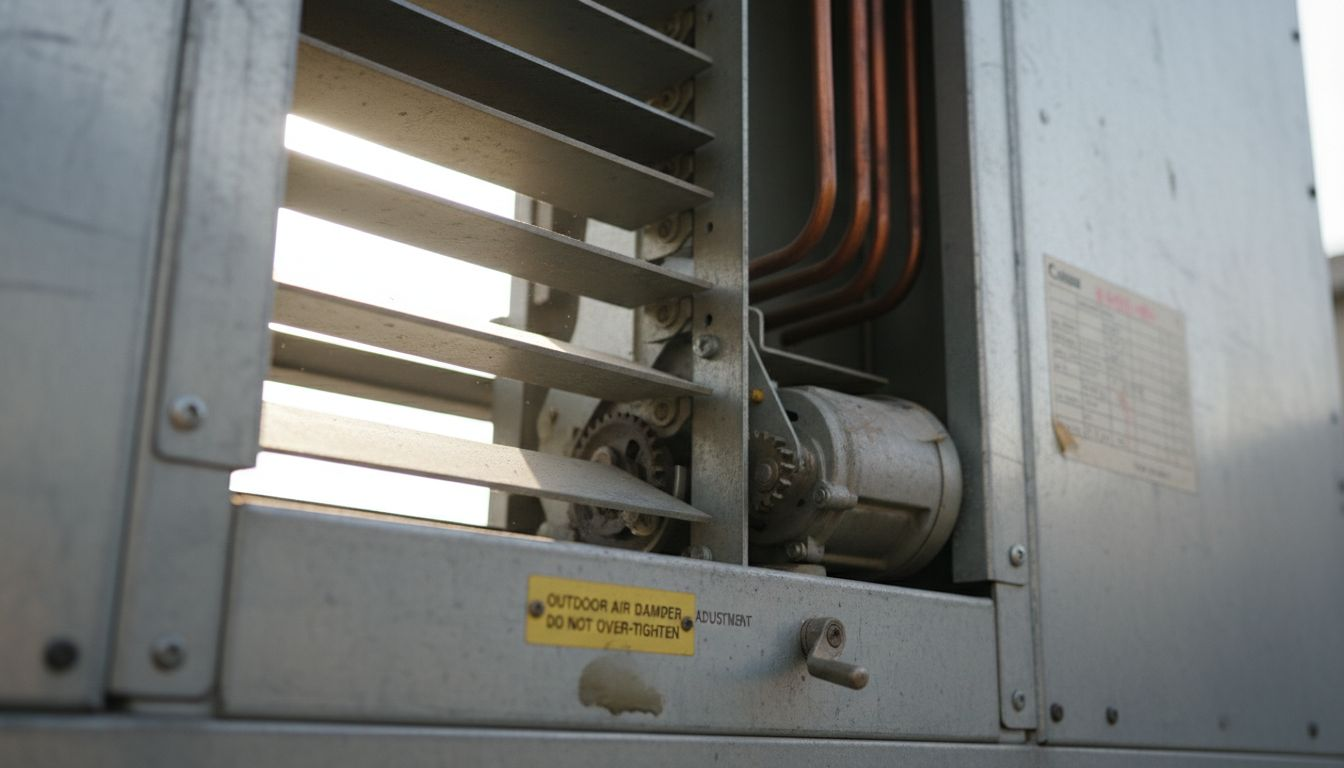
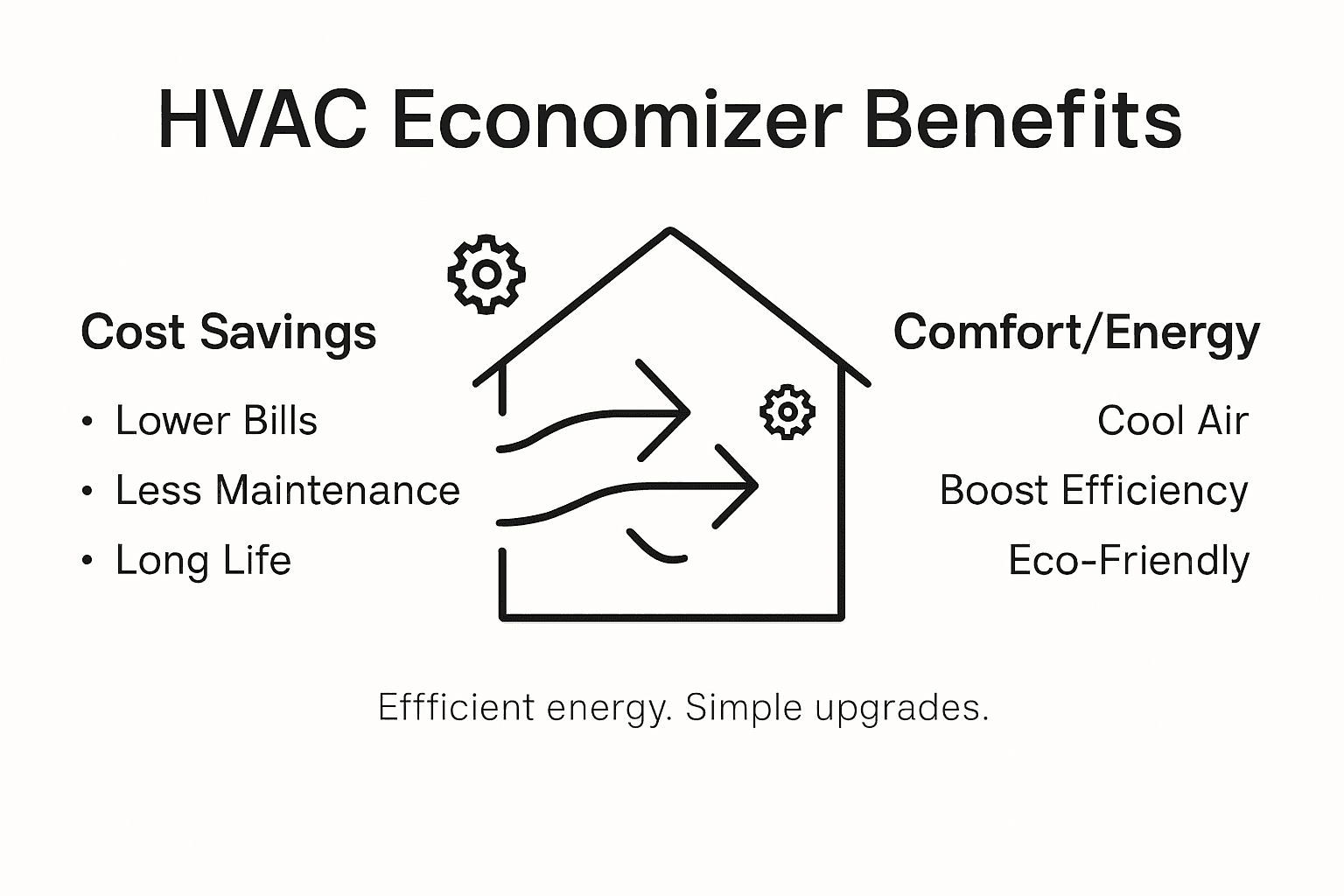
An economizer is a damper-and-sensor system that supplements your AC compressor by pulling in outdoor air when ambient conditions are cool and dry enough to provide free cooling. When conditions are right, the dampers open, the compressor idles, and your air handler circulates outdoor air through the duct system: energy use drops dramatically. The U.S. Department of Energy notes that economizers are most effective in climates with extended mild, dry seasons.
The ASHRAE 90.1 standard classifies climate zones for economizer requirements. Tampa falls in ASHRAE Climate Zone 2A (warm and humid) which is one reason the standard does not mandate economizers for residential applications here. Commercial buildings above a certain size in Florida are still required to consider economizers, but the residential calculus is different.
How Many Economizer Hours Does Tampa Actually Get Per Year?
| Climate | Approx. Annual Economizer Hours | Humidity Profile |
|---|---|---|
| San Francisco, CA | 4,000+ hours | Marine, frequently cool and dry |
| Denver, CO | 2,800+ hours | Semi-arid, low dew point |
| Atlanta, GA | 1,400 hours | Humid subtropical, moderate season |
| Tampa, FL | Approximately 900 hours | Humid subtropical, near-constant summer humidity |
| Miami, FL | Under 600 hours | Tropical, very high year-round humidity |
Those roughly 900 favorable hours are concentrated in November through March: the same months when Tampa’s natural cooling demand is already low and your compressor is barely running. This means the energy savings window for a Tampa economizer is narrow and falls precisely when the savings would have happened anyway.
Why Is Humidity the Specific Problem for Economizers in Tampa Bay?
What Happens When an Economizer Pulls in High-Humidity Tampa Air?
When outdoor air at 85 degrees and 80% relative humidity enters your air handler, your system must remove the latent heat (moisture) before the space feels comfortable. Dehumidification is energy-intensive: a large share of a Tampa AC system’s total energy use goes toward moisture removal, not sensible temperature reduction. A dry-bulb-only economizer that opens dampers based on temperature alone will introduce high-humidity air that the system then spends significant energy dehumidifying. The net result is higher energy use, not lower.
What Is the Difference Between a Dry-Bulb and an Enthalpy Economizer for Tampa?
A dry-bulb economizer opens when outdoor temperature is below a setpoint: it ignores humidity entirely. An enthalpy economizer measures both temperature and dew point (total heat content of the air) and opens only when outdoor air is genuinely less energy-intensive than indoor air. In Tampa, only enthalpy economizers are appropriate. Installing a dry-bulb economizer here would reliably make your system less efficient during large portions of spring and fall when it is cool enough to trigger the economizer but still humid enough to impose a large dehumidification load.
Can an HVAC Economizer Work in Tampa Homes at All?
Yes, under specific conditions. Homeowners who may benefit from an enthalpy economizer in Tampa include:
- Those with large commercial-adjacent installations (server rooms, workshops) that generate significant internal heat loads even during mild outdoor periods.
- Homes with exceptional insulation and tight envelopes where mechanical ventilation is already required: the economizer mode lets you bring in required fresh air without full dehumidification cost during the 900 favorable hours.
- Homeowners running high-efficiency variable-speed systems where the economizer can be paired precisely with the system’s humidity sensing to avoid over-ventilation.
For most standard Tampa Bay single-family homes running a conventional split system, the economics do not favor adding an economizer as a primary efficiency upgrade. A professional HVAC energy audit in Tampa Bay is the right starting point to identify which measures actually pencil out for your specific home.
What Alternatives Deliver Better ROI Than an Economizer in Tampa’s Climate?
Variable-Speed Compressor and Air Handler
A variable-speed system (inverter-driven compressor plus variable-speed air handler) modulates output in 1% increments rather than cycling on-and-off at full capacity. This provides continuous dehumidification at low speeds during Tampa’s humid swing seasons: exactly what an economizer cannot do. It typically uses less energy than a single-stage system. When considering energy-efficient HVAC in Tampa, variable-speed technology consistently delivers the strongest return here.
Whole-Home Dehumidifier
A dedicated whole-home dehumidifier operates independently from your AC, removing moisture without requiring the compressor to run cold cycles. In Tampa’s shoulder seasons (March through May, October through November), this lets you maintain comfort at a setpoint 2 to 4 degrees higher, reducing compressor runtime. See the whole-home dehumidifier cost guide for Tampa Bay for current pricing.
Smart Thermostat With Humidity Sensing
A humidity-sensing smart thermostat triggers your AC based on both temperature and indoor relative humidity rather than temperature alone. It effectively mimics one benefit of an economizer (preventing excess moisture) without the complexity of mechanical dampers. This is a $279 to $350 upgrade with immediate ROI on properly maintained Tampa AC systems.
Proper Sizing and Duct Sealing
An oversized AC system in Tampa short-cycles: it cools the air quickly but does not run long enough to remove humidity. This is one of the most common and costly HVAC mistakes in the region. Correct sizing based on an ACCA Manual J calculation, combined with sealed and insulated ductwork, often reduces cooling energy use with no new equipment purchase.
What Tampa Bay customers say
“My outside unit stopped working over the weekend. I called Home Therapist on a Sunday and was able to book an appointment for the next day;not needing to leave a message and wait for a call back was very refreshing. Roberto came on time. He was very thorough and quick. He did the repair , educated me on some recommendations but never pressured me to do more . Companys number stored . Any future AC issues , I’ll be calling them again.”
“They were quick and available, when my AC was completely out they were able to come out within 24 hours and quickly found the issue and resolved it same day. Their preventative maintenance program is cost effective and the cost evened out with the repairs I needed. I was recommended to them by a neighbor and I would recommend them to my neighbors”
“They have been amazing from the quote to the installation. They were able to accommodate us last minute. Made all the updates needed and in less than 5hrs we had a new HVAC unit installed. We'll be using them for all of our upgrades”
4.8 from 1,399 reviews · Read more reviews
Frequently Asked Questions
- What should my AC humidity be set at in Florida?
In Florida, set your AC to maintain indoor relative humidity between 45% and 55%. Tampa's persistently high outdoor humidity means your system must actively dehumidify, not just cool. If your thermostat has a dehumidification mode, enable it. Home Therapist has completed 1,203 jobs in Tampa in the last 12 months and commonly finds systems running too warm, which lets humidity climb unchecked.
- Is 70% humidity too high in a house?
Yes, 70% indoor relative humidity is too high. At that level, mold can begin colonizing porous surfaces within 24 to 48 hours, and dust mites thrive. In Tampa's climate, 70% indoors typically signals an undersized system, a refrigerant issue, or an economizer operating without enthalpy controls that is pulling in saturated outdoor air. A free diagnosis from Home Therapist can identify the root cause.
- Is 60% humidity high for Florida?
60% indoor humidity is above the recommended range even in Florida. The EPA and ASHRAE both target 30% to 60%, with 55% or below being the practical goal in humid climates. In Tampa, hitting 60% indoors during summer often means your AC is short-cycling or your economizer is introducing uncontrolled outdoor air. Home Therapist offers free estimates and free diagnosis on every visit.
- Is 60% indoor humidity too high?
60% indoor humidity sits at the upper edge of acceptable and is effectively too high for comfort and mold prevention in Tampa. At 60%, condensation can form on cool surfaces and air quality degrades. Dropping to 50% to 55% is the practical target. Common fixes include adjusting fan speed, adding a whole-home dehumidifier, or recalibrating economizer enthalpy controls. Call (813) 343-2212 for a free diagnosis.
Are HVAC economizers worth it in Tampa, Florida?
For most Tampa single-family homes, economizers offer limited ROI due to the climate. Tampa gets roughly 900 economizer-eligible hours per year, mostly in winter when cooling demand is already low. Variable-speed compressors, whole-home dehumidifiers, and proper system sizing typically deliver better returns for Tampa homeowners.
What type of economizer is required in Tampa’s humid climate?
An enthalpy economizer that measures both temperature and dew point (total heat content) is the only appropriate type for Tampa. Dry-bulb-only economizers open based on temperature alone and will introduce high-humidity outdoor air during spring and fall, increasing your dehumidification load and raising energy costs.
How much does an HVAC economizer installation cost in Tampa?
Residential enthalpy economizer systems typically cost $800 to $2,500 installed depending on system size and integration complexity. Given Tampa’s limited economizer hours, payback periods often exceed 10 years, which is why we recommend assessing variable-speed system upgrades or dehumidifiers first. Contact Home Therapist at (813) 343-2212 for a FREE assessment.
Can a poorly installed economizer increase my energy bills in Tampa?
Yes. A dry-bulb economizer, a miscalibrated enthalpy sensor, or a damper that sticks open can all introduce high-humidity outdoor air into your conditioned space. Your AC then expends significant energy dehumidifying that air, resulting in higher cooling costs. Annual professional calibration is essential for any economizer in Florida.
What is the most cost-effective way to reduce HVAC energy use in Tampa?
In order of typical ROI for Tampa homes: (1) proper system sizing with Manual J calculation, (2) duct sealing and insulation, (3) variable-speed compressor upgrade or replacement, (4) humidity-sensing smart thermostat, (5) whole-home dehumidifier. A FREE HVAC energy audit from Home Therapist will rank the options for your specific home.
More Related Articles
- What Is HVAC Short Cycling and Its Impact
- Prepping HVAC for Summer: Homeowner’s Full Checklist
- What a Clean Bill of Health Looks Like on a 3-Year-Old AC in Tampa, FL 33617: Full Tune-Up on E Linebaugh Ave
- Third Maintenance Visit on Lake Bonny Dr W: What Three Clean Data Points Tell Us About a Lakeland AC System
- Air Conditioner Installation Repair Tampa FL Bay FL Services Review from Bonnie Wakefield