


Reviewed by Richard Morales, Co-Owner & FL Class B Air Conditioning Contractor (FL license CAC1819196)
Grandaire AC refrigerant charge problems are behind a significant portion of the “AC not cooling” calls we handle across Tampa Bay each summer. A Grandaire system that was correctly charged at installation can develop refrigerant loss over time through coil pinhole leaks, Schrader valve seeps, or brazed joint micro-cracks. When the charge drops, the system loses cooling capacity, runs longer, consumes more electricity, and eventually strands the household in Tampa’s peak heat. This guide explains what our technician checks, what refrigerant issues cost to address, and how to tell the difference between a fixable charge problem and a system that needs replacement.
Key Takeaways: Grandaire AC Refrigerant Charge Problems in Tampa Bay
- Refrigerant does not deplete on its own. Low charge always means a leak that needs to be found and repaired, not just refilled.
- A Grandaire AC running low on refrigerant in Tampa Bay heat loses a large share of its effective cooling capacity.
- R410A refrigerant is being phased out per EPA mandate; R32 and R454B are the current transition refrigerants for new systems.
- Refrigerant top-off without leak repair is a temporary measure that becomes more expensive with each service call.
- FREE estimates and FREE diagnosis on all service calls.
- We install Goodman and Daikin systems when replacement is the better financial decision.
What are the signs of grandaire ac refrigerant charge problems?
Refrigerant charge problems on a Grandaire system usually show up gradually over one or two cooling seasons rather than all at once. The homeowner often describes it as the house taking longer and longer to reach set temperature, especially on hot afternoons when the outdoor unit runs for 40 or 50 minutes without pulling the thermostat down. Other common descriptions include:
- The supply vents feel less cold than they used to, but the unit seems to be running normally
- Ice visible on the suction line coming out of the air handler or on the outdoor unit
- Higher electricity bills without a change in thermostat settings or occupancy
- Indoor humidity feels higher than it did last summer
- The outdoor unit runs continuously during the hottest part of the afternoon but the house never reaches the set temperature
According to the U.S. Department of Energy, an air conditioner operating with an improper refrigerant charge can reduce system efficiency by 20 percent or more. In Tampa Bay, FL, where systems run roughly 1,500 to 2,000 hours per year, that efficiency loss translates directly to higher summer electricity costs and a system that cannot maintain comfort on the hottest days.
How does our technician diagnose a Grandaire AC refrigerant charge problem?
Step 1: We start with operating pressures, not assumptions
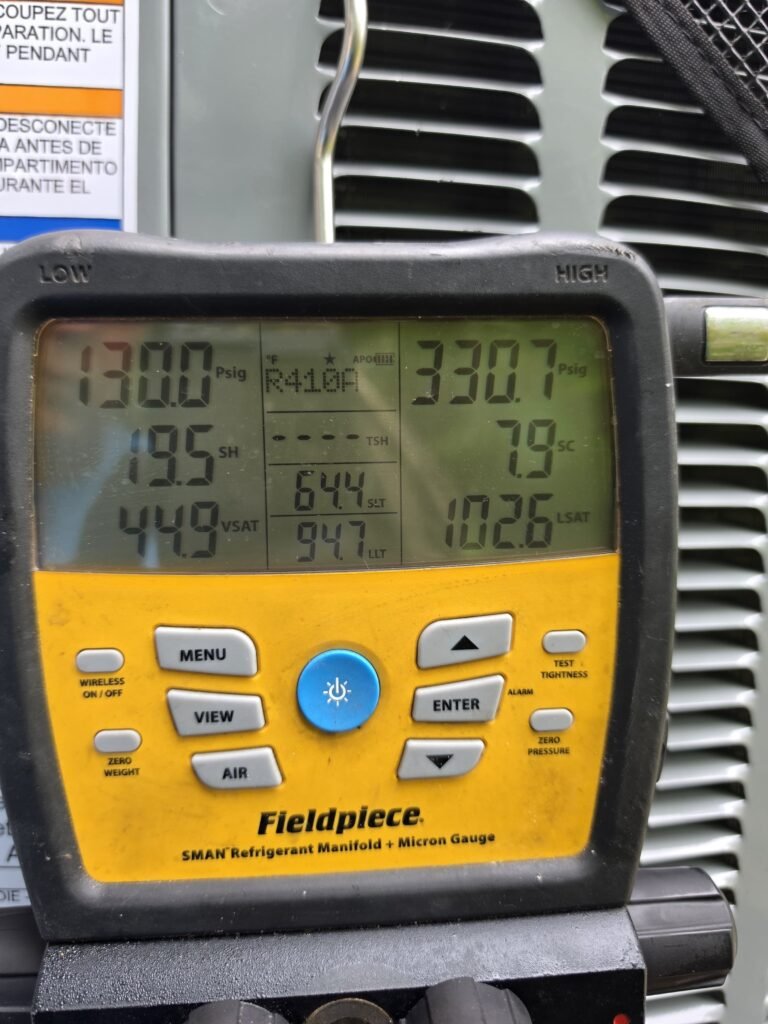
The first thing we do when a Grandaire system is cooling poorly is connect gauges. We measure suction pressure and discharge pressure with the system running under stable conditions. For a properly charged R410A system in Tampa Bay summer conditions, we expect specific suction pressure and discharge pressure ranges based on outdoor ambient temperature and indoor return air temperature. A system significantly outside those ranges is either overcharged, undercharged, or has an airflow restriction masquerading as a refrigerant problem.
Step 2: We measure subcooling and superheat
Pressure readings alone do not confirm correct charge. We also measure subcooling at the liquid line service valve and superheat at the suction line near the outdoor unit. These measurements, combined with the system’s expansion device type, give us an accurate diagnosis of whether the system is correctly charged or not. A Grandaire system with a thermostatic expansion valve (TXV) should be charged to the manufacturer’s subcooling specification. Most standard Grandaire units target a subcooling value in the 10 to 15 degree range at the liquid line, though exact specs vary by model.
Step 3: We perform a full refrigerant leak search
If the system is low on refrigerant, we do not simply add refrigerant and leave. We use an electronic leak detector on every potential leak site: the condenser coil, the evaporator coil, the service valve stems, the Schrader ports, the brazed joints on the line set, and the refrigerant connections at the air handler. If we find a leak site, we document its location and discuss repair options before recharging. Adding refrigerant to a leaking system without addressing the source is a temporary fix that compounds cost over time.
Step 4: We check for compressor damage from extended low-charge operation
A Grandaire compressor that has been running significantly low on refrigerant for a full season has been operating under elevated compression ratios and elevated discharge temperatures. Those conditions accelerate wear on compressor valves and motor windings. Before completing the repair, we check compressor amp draw against its nameplate RLA and listen for abnormal sounds that indicate valve or bearing damage. If the compressor is compromised, we discuss that finding honestly before the homeowner approves any refrigerant work.
Why do Grandaire AC refrigerant charge problems develop in Tampa Bay?
Refrigerant systems are sealed at the factory and should retain their charge indefinitely if the system is leak-free. In practice, Tampa Bay conditions accelerate the development of leak paths through several mechanisms.
Condenser coil corrosion is the most common cause, as detailed in our guide on Grandaire condenser coil corrosion. Formicary pinholes in the copper evaporator tubing are another frequent cause, particularly in homes with higher indoor air concentrations of organic acids from building materials or cleaning products. Schrader valve cores can develop slow seeps after years of thermal cycling. Brazed joints on the line set can develop micro-cracks if the installation used fittings that were not fully cleaned and purged with nitrogen during the original installation.
In budget-tier systems like Grandaire, the quality control on brazed joints and the consistency of refrigerant charge at the factory can be somewhat lower than on premium-tier systems. That is not unique to Grandaire; it is a characteristic of value-segment manufacturing. But it does mean that attentive maintenance and annual professional inspection are especially important for Grandaire owners in Tampa Bay’s demanding climate.
R410A phase-out: what Grandaire owners in Tampa Bay need to know
If your Grandaire system uses R410A refrigerant, you should be aware that the EPA has mandated the phase-down of R410A production under the AIM Act. New residential systems manufactured after January 1, 2025 must use lower-GWP refrigerants such as R32 or R454B. Existing R410A systems can continue to operate and be serviced with R410A refrigerant while supplies remain, but the refrigerant price has risen as production declines and will continue to do so.
For a Grandaire R410A system with significant refrigerant loss, the economics shift. A system that needs 3 to 4 pounds of R410A to top off the charge, combined with a repair for the leak source, may cost $400 to $700 in refrigerant and labor. If the system is 10 or more years old, that repair cost applied toward a new R32 or R454B system may deliver better long-term value. We discuss this tradeoff honestly with every homeowner facing significant refrigerant loss on an older system.
Cost of Grandaire AC refrigerant charge repair in Tampa Bay
| Repair Scenario | Typical Cost Range | Notes |
|---|---|---|
| Leak detection + locate and document leak | FREE with our diagnosis | Electronic detector + UV dye used |
| Minor R410A top-off (1 to 2 lbs, leak repair deferred) | $279 to $450 | Temporary; leak will need repair |
| Single brazed joint leak repair + recharge | $400 to $700 | Nitrogen purge, braze, pressure test, recharge |
| Evaporator or condenser coil replacement + recharge | $900 to $1,600 parts + labor | When coil has distributed pinhole leaks |
| Full system replacement (Goodman 3-ton) | $7,459 to $7,884 installed (Goodman Value), plus the permit fee | Best value when system is 10+ years old with coil corrosion |
When should a Grandaire AC refrigerant problem trigger a replacement conversation?
We recommend a replacement conversation when any of the following are true:
- The system is 10 or more years old and has had two or more refrigerant top-offs in the past three years
- The leak source is distributed formicary pinholes across the evaporator or condenser coil (not economically repairable)
- The compressor shows elevated amp draw or abnormal sounds that indicate thermal stress from extended low-charge operation
- The system uses R410A, the leak repair cost exceeds $700, and a new system qualifies for energy rebates that partially offset the replacement cost
- The home has active humidity complaints that a basic single-stage replacement system will not resolve
Our repair vs replace AC guide walks through the full financial comparison so homeowners can make an informed decision rather than reacting to the immediate repair cost alone.
How does Grandaire compare to Goodman on refrigerant charge retention in Tampa Bay?
Both brands use similar aluminum-fin copper-tube coil construction and similar brazed joint manufacturing methods at the value tier. Neither is immune to the corrosion mechanisms common in Tampa Bay. What Goodman and Daikin offer that partly offsets this is better coil coating availability and a stronger track record of field warranty support when corrosion-related failures occur within the warranty period.
For homeowners replacing a Grandaire system that failed from refrigerant loss, we typically recommend stepping up to a Goodman system with a coastal coil coating if the property is near saltwater, or to a Daikin system if humidity control or premium efficiency is the priority. Our full Goodman vs Daikin comparison is a useful reference for that decision.
Pro tips for Grandaire owners managing refrigerant charge in Tampa Bay
- Annual professional maintenance includes a refrigerant pressure check. Do not skip it. Catching a slow leak early is far less expensive than repairing a compressor damaged by extended low-charge operation.
- If your system is freezing up (ice on the suction line), turn it off immediately and call for service. Running a frozen system can damage the compressor within hours.
- Ask your technician for the actual subcooling and superheat readings at each tune-up visit, not just a pass or fail statement. Those numbers tell you how close to tolerance the charge is.
- Never add refrigerant to a leaking system without locating and repairing the leak first. The refrigerant will escape again, and you will pay for the next top-off too.
- Our AC maintenance service documents refrigerant readings at each visit so you have a trend history if a leak develops gradually.
Sources: ENERGY STAR.
What Tampa Bay customers say
“My outside unit stopped working over the weekend. I called Home Therapist on a Sunday and was able to book an appointment for the next day;not needing to leave a message and wait for a call back was very refreshing. Roberto came on time. He was very thorough and quick. He did the repair , educated me on some recommendations but never pressured me to do more . Companys number stored . Any future AC issues , I’ll be calling them again.”
“They were quick and available, when my AC was completely out they were able to come out within 24 hours and quickly found the issue and resolved it same day. Their preventative maintenance program is cost effective and the cost evened out with the repairs I needed. I was recommended to them by a neighbor and I would recommend them to my neighbors”
“They have been amazing from the quote to the installation. They were able to accommodate us last minute. Made all the updates needed and in less than 5hrs we had a new HVAC unit installed. We'll be using them for all of our upgrades”
4.8 from 1,399 reviews · Read more reviews
Frequently asked questions about Grandaire AC refrigerant charge problems
- Why is my AC not blowing cold air even though it has refrigerant?
Having refrigerant does not guarantee proper cooling if the charge level is off, the coils are dirty, or airflow is restricted. In Tampa's intense summer humidity, a low or overcharged system loses efficiency fast. A licensed technician can diagnose the exact cause, and Home Therapist offers FREE diagnosis on every visit.
- Where can I get emergency AC repair in Tampa?
Home Therapist provides same-day AC repair across Tampa Bay with FREE diagnosis on every visit. Call (813) 343-2212 and a licensed technician (CAC1819196) will troubleshoot refrigerant issues, coil problems, or any other cause of cooling failure, backed by 1,300+ five-star reviews.
Why is my Grandaire AC not cooling even though it runs all the time?
Continuous running with poor cooling is one of the clearest signs of low refrigerant charge in Tampa Bay heat. The system cannot transfer enough heat to meet the load, so it runs without reaching the thermostat set point. Other causes include a dirty evaporator coil restricting airflow or a failing compressor, which is why professional diagnosis is necessary before adding refrigerant.
Can I just add refrigerant to my Grandaire AC without finding the leak?
Technically yes, but it is not a durable repair. Refrigerant does not disappear on its own. If the system is low, it will continue to lose refrigerant at the same rate until the leak is repaired. A top-off without leak repair extends system life by weeks or months, not years. We perform full leak detection on every refrigerant service call.
How much does it cost to recharge a Grandaire AC in Tampa Bay?
A minor top-off typically totals $279 to $450 for 1 to 2 pounds of R410A. Larger refrigerant losses, leak repairs, or coil replacements are additional. We quote before starting any approved repair work.
My Grandaire AC is only 6 years old but losing refrigerant. Is that normal?
A correctly installed leak-free system should not lose refrigerant. If a 6-year-old system is losing charge, there is a leak somewhere. Common causes include formicary pinholes in the evaporator copper tubing, a Schrader valve that has developed a slow seep, or a brazed joint that was not fully sealed at installation. We locate and document the leak source before recommending a repair path.
What refrigerant does a Grandaire AC use and can I still get it serviced?
Most Grandaire systems installed before 2025 use R410A refrigerant. R410A is still available for servicing existing equipment but is being phased down in production. Servicing your existing Grandaire R410A system is fully legal and practical. Replacement systems installed today use R32 or R454B. Call (813) 343-2212 for any refrigerant service in Tampa Bay.
Schedule Grandaire AC refrigerant diagnosis with Home Therapist
Home Therapist serves Tampa Bay homeowners in Tampa, Clearwater, St. Petersburg, Brandon, Riverview, and surrounding communities. HVAC License CAC1819196. Plumbing License CFC1431159. 1,300+ five-star reviews. If your Grandaire system is running all day without cooling, has frozen lines, or you just want a charge verification before peak summer, call (813) 343-2212 for FREE diagnosis. We find the problem, explain the options, and let you decide. No pressure.
More Related Articles
- AC Buying Guide Tampa Bay: What Matters Most When Replacing Your System
- Air Sealing Humidity Control in Tampa: Why Sealing Leaks Fixes the Sticky-Air Problem
- HVAC Emergency Signs Tampa Bay Homeowners Misread: What Is Actually Urgent and What Can Wait
- 9-Year-Old AC on W Lowry Ln: Capacitor Replacement, Refrigerant Top-Off, and AC Maintenance in Tampa, FL 33604
- Air Conditioner Installation Repair Tampa FL Bay FL Services Review from Bonnie Wakefield