

Slab Leak Detection Explained: Protect Your Tampa Bay Home
TL;DR:
- Slab leaks occur beneath home foundations, often causing hidden water damage and foundation issues.
- Early signs include increased water bills, warm spots, and damp flooring, which require prompt detection.
- Professional detection using advanced tools can prevent costly repairs and damage if addressed quickly.
Slab Leak Detection Explained: Protect Your Tampa Bay Home
Your water bill just jumped 200% and you haven’t changed a single habit. No longer showers, no extra loads of laundry, nothing. That spike could be a slab leak quietly flooding the soil beneath your home’s concrete foundation right now. These hidden leaks can waste thousands of gallons of water every single month, and most Tampa Bay homeowners don’t even know they have one until the damage is already severe. This guide walks you through exactly what slab leaks are, how to spot them early, what detection looks like, and why speed matters more than most people realize.
Table of Contents
- What is a slab leak and why does it matter?
- Common signs and symptoms of a slab leak
- How slab leaks are detected: Tools and techniques
- The risks of delaying slab leak detection and repair
- Our experience: The truth about slab leaks most owners miss
- Protect your Tampa home with expert leak detection
- Frequently asked questions
Key Takeaways
| Point | Details |
|---|---|
| Slab leaks pose major risks | Undetected slab leaks can damage foundations and waste thousands of gallons monthly. |
| Early detection saves money | Catching leaks early can save you over $5,000 in costly repairs. |
| Know the warning signs | Unusual water bills, floor spots, or musty odors may signal a slab leak. |
| Professional help is key | Pro inspection uses advanced tools for accurate, noninvasive detection. |
What is a slab leak and why does it matter?
A slab leak is a water leak that happens inside or beneath your home’s concrete foundation slab. The pipes that carry water to your sinks, showers, and appliances run both through and under that slab. When one of those pipes develops a crack, hole, or joint failure, water escapes into the ground and sometimes back up into your home without any visible sign on the surface.
In Tampa Bay, this is a particularly common problem. Nearly all homes built here use slab-on-grade construction, meaning the house sits directly on a concrete slab rather than a raised crawl space or basement. That design is standard for Florida because of our high water table, but it also means every plumbing line runs close to or through concrete, which creates long-term wear and stress on pipes.
Florida’s clay-heavy soils shift noticeably with rainfall and drought cycles, which is something we see a lot here in Hillsborough, Pinellas, and Pasco counties. When soil moves, it puts mechanical stress on pipes. Over years, that constant movement causes small cracks to form in copper or galvanized steel pipes, and those cracks grow into leaks. Add Tampa’s naturally high mineral content in the water supply and the pipe corrosion accelerates further.
The main causes of slab leaks in Tampa Bay homes include:
- Pipe corrosion from acidic or hard water eating away at copper or steel pipes from the inside
- Abrasion damage where pipes rub against gravel, concrete, or other pipes over years of movement
- High water pressure that puts constant mechanical stress on pipe joints and weak spots
- Soil shifting caused by Tampa’s wet and dry seasonal cycles moving the ground beneath the slab
- Poor original installation where pipes were improperly fitted or laid during construction
The consequences go far beyond a higher water bill. A slab leak can quietly erode the soil under your foundation, causing settlement and cracks in your walls and floors. It creates warm, wet conditions that mold absolutely thrives in, and Tampa’s humidity makes that mold spread faster than in drier climates. You can lose flooring, drywall, insulation, and in serious cases, structural integrity.
Catching a slab leak early can save you more than $5,000 compared to waiting until you need a full repipe or foundation repair. The cost difference between early and late detection is enormous, and that gap grows every week a leak continues.
Understanding moisture detection for flooring issues is one of the first steps toward protecting your home, and learning how to locate plumbing leaks gives you a solid foundation before calling in a professional.
Common signs and symptoms of a slab leak
Here’s the problem with slab leaks: they’re designed by circumstance to hide. The leak is under concrete, which means there’s no dripping faucet, no visible wet spot on a wall, and no obvious puddle on the floor. Most homeowners dismiss the early signs as minor inconveniences, and that delay is exactly what turns a $500 fix into a $10,000 nightmare.
Knowing what to look for gives you the edge. These are the real warning signs that a slab leak may be developing under your home:
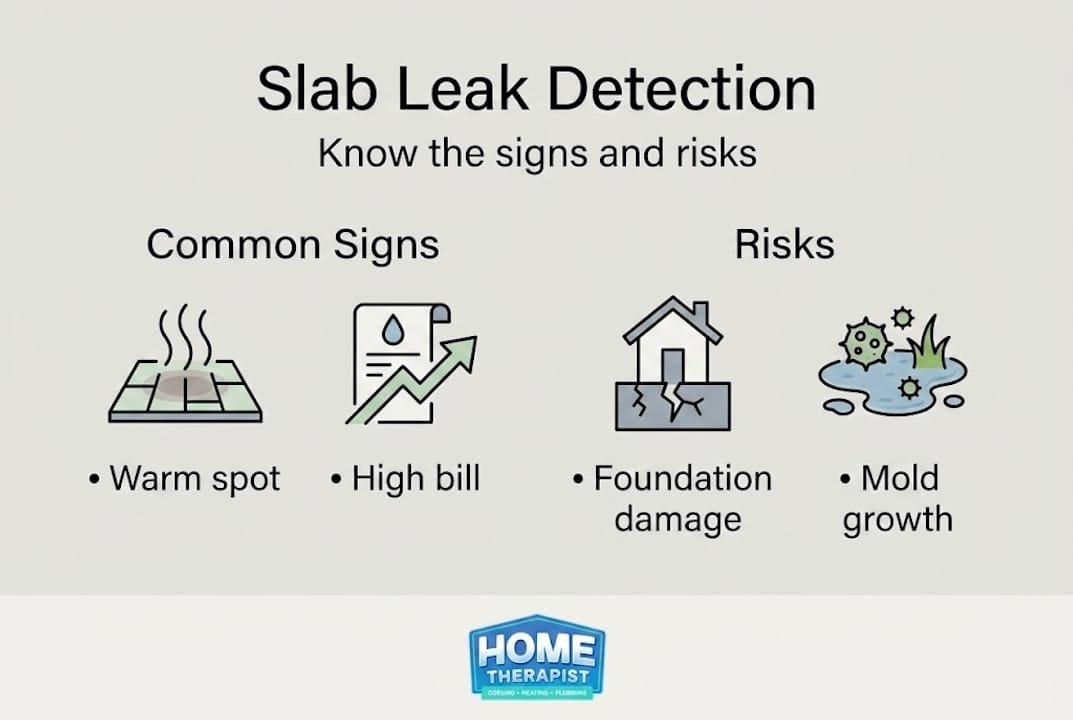
- Unexplained water bill increase. Your usage hasn’t changed but your bill jumped by 50%, 100%, or more. This is often the very first signal.
- Sound of running water with everything off. Stand quietly in your home at night. If you hear water moving, something is leaking somewhere.
- Warm or hot spots on your floor. A hot water line leak under the slab heats the concrete above it. You’ll feel it when walking barefoot.
- Damp or discolored flooring. Carpet that’s mysteriously wet, hardwood that’s buckling, or tile that feels slightly soft underneath are all red flags.
- Mold or mildew smell without visible mold. The leak is feeding mold growth inside your walls or under your flooring where you can’t see it.
- Low water pressure. When water is escaping through a leak, there’s less pressure at your fixtures.
- Cracks in walls or floors. Foundation movement from soil erosion caused by the leak can show up as cracks in drywall or along floor grout lines.
These symptoms often appear gradually. You might notice a slightly warmer spot near the kitchen sink, or your water bill creeps up just $20 or $30 per month at first. The subtle changes are easy to rationalize away, which is exactly why so many Tampa Bay homeowners miss the early window.
Pro Tip: Turn off every water fixture in your home, including the ice maker and any automatic irrigation system, then stand in your hallway or near your water meter late at night. If you hear any movement or flow sound, call a plumber the next morning. Silence should be total when no water is being used.
Professional slab leak detection typically takes between 2 to 4 hours to complete once a technician arrives. That’s a small time investment compared to weeks of rising water bills and growing damage. Reviewing a local leak detection case study shows exactly how fast detection can stop damage in its tracks, and understanding plumbing leak types puts the scope of the problem in perspective.
How slab leaks are detected: Tools and techniques
Once you suspect a slab leak, the next question is how professionals actually confirm it. The process is more involved than most people expect, and understanding what happens during an inspection helps you prepare and know what you’re paying for.
The detection process typically starts with a basic meter and shutoff check. The technician closes your main shutoff valve and checks whether the water meter still shows movement. If the meter keeps spinning with everything closed, water is escaping somewhere in your system. That’s step one confirmation that a leak exists.
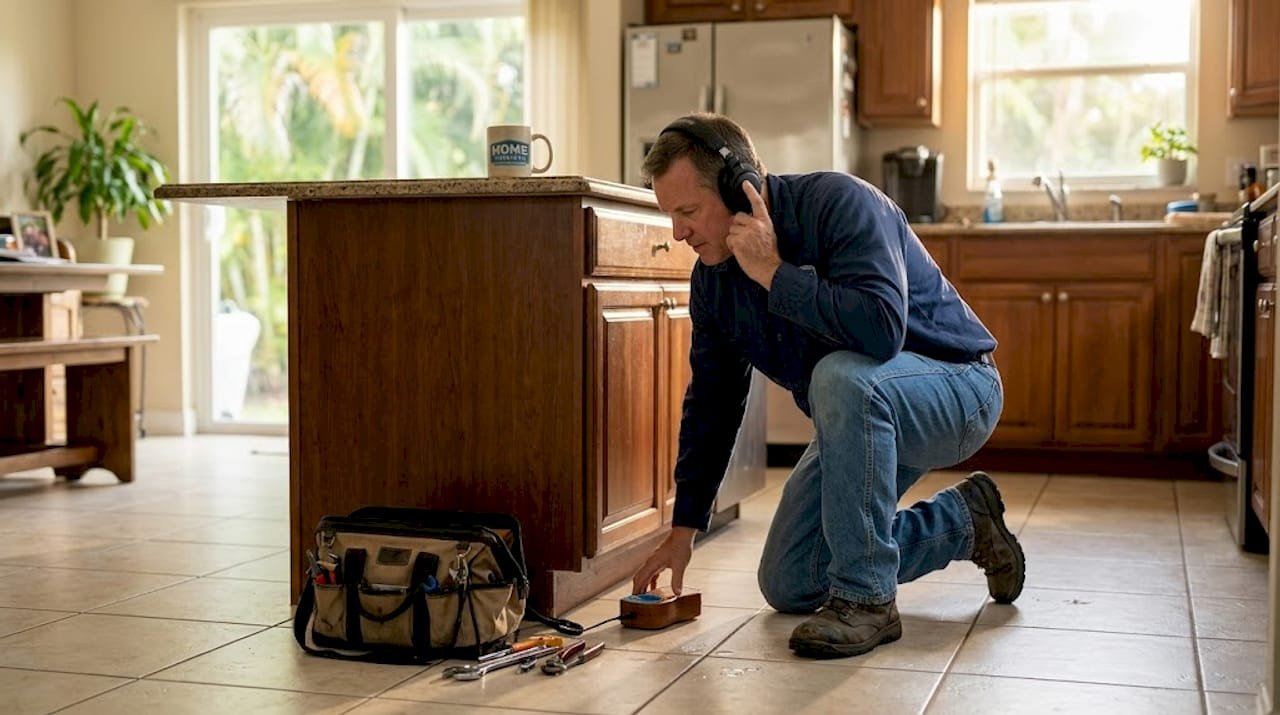
From there, pros use specialized equipment that simply isn’t available at your local hardware store. Here’s a quick look at how DIY checks compare to professional methods:
| Method | DIY Check | Professional Equipment |
|---|---|---|
| Leak confirmation | Meter test, visual check | Pressure testing, meter analysis |
| Locating the leak | Ear to floor, guesswork | Acoustic listening devices |
| Imaging | None | Thermal/infrared cameras |
| Pipe tracing | None | Electronic line tracing |
| Accuracy | Low | Very high |
| Slab access needed | Often unnecessary | Minimal with right tools |
The professional tool set for slab leak detection includes:
- Acoustic microphones that pick up the sound of water escaping under pressure through concrete, pinpointing the leak location to within a few inches
- Thermal imaging cameras that detect temperature differences on the floor surface caused by hot water line leaks beneath the slab
- Electronic line tracers that map the exact path of pipes under your home so the tech knows where to look before any digging starts
- Pressure testing equipment that isolates sections of pipe to confirm where pressure loss is occurring
During a professional inspection, expect some noise from the acoustic equipment and some movement around your home as the technician traces lines. In most cases, detection takes 2 to 4 hours and does not require opening the slab at all. Access holes only become necessary once the leak is confirmed and repair work begins.
One thing many homeowners don’t realize is that insurance companies often require documented professional findings before they’ll process a claim. A written detection report from a licensed plumber protects you and creates the paper trail your adjuster needs. Learning about leak detection services in Tampa and reviewing the step-by-step leak detection process can help you understand exactly what a thorough inspection involves.
The risks of delaying slab leak detection and repair
Let’s be direct: waiting is the most expensive decision you can make when it comes to a slab leak. Every day a leak continues, more water saturates the soil, more mold grows in hidden spaces, and more stress is placed on your foundation. The repair bill compounds quickly.
Here’s what’s at stake when a slab leak goes unaddressed:
- Foundation cracks and settlement as eroded soil can no longer support the slab evenly, causing sections to shift or sink
- Destroyed flooring including warped hardwood, buckled tile, and soaked carpet that typically cannot be salvaged
- Mold and mildew growth that spreads through subfloor materials, wall cavities, and insulation, creating serious indoor air quality problems
- Higher insurance premiums when a claim history shows repeated water damage events
- Declining property value because buyers and inspectors will flag past water damage or active mold during any future sale
- Structural damage to walls as water wicks upward through the slab and into framing, weakening load-bearing elements
Acting fast on a suspected slab leak can save you over $5,000 compared to the cost of full repiping or foundation repair after prolonged damage. Early detection is the single most powerful financial protection available to homeowners.
On the insurance side, most standard homeowner policies do cover the cost of opening the slab to access the leak and repairing damage to flooring, walls, and other structures caused by the leak. What they typically do not cover is the cost of repairing or replacing the pipe itself. That distinction matters a lot when you’re planning a budget for repairs.
Pro Tip: Take photos and document any visible water damage, floor changes, or wall cracks the moment you suspect a leak. Timestamps on those photos can significantly strengthen your insurance claim and help your adjuster understand how quickly you responded to the problem.
Reviewing your plumbing warranty coverage before an issue arises is one of the smartest moves a Tampa Bay homeowner can make. Knowing what your policy covers means no surprises when a claim needs to be filed.
Our experience: The truth about slab leaks most owners miss
After years of working with Tampa Bay homeowners, we’ve seen a pattern repeat itself that is both predictable and completely avoidable. The homeowner notices something small, a slightly higher bill, a faint water sound at night, a floor that feels subtly warmer near the bathroom. They wait for something more obvious before calling anyone. By the time something obvious shows up, the damage is already in the thousands.
The biggest mistake homeowners make isn’t ignoring a giant puddle. It’s ignoring the quiet signals. A $30 increase on your water bill is not “probably nothing.” In Tampa’s climate, where shifting soils and humid conditions accelerate both pipe wear and mold growth, that small signal deserves a quick investigation.
Here’s the truth: a $100 to $200 professional inspection can absolutely prevent $5,000 or more in structural and mold remediation costs. That math is not complicated, but the fear of finding a problem makes people delay calling. We understand it. Nobody wants bad news about their home. But finding the problem early is genuinely good news because it means your options are still affordable and your home is still safe.
Tampa’s soil and seasonal weather make slab leaks a recurring local reality, not a rare event. Homes built in the 1970s through 1990s are especially vulnerable because copper pipes from that era are now at or past their expected lifespan. If your home is older than 25 years and you’ve never had a plumbing inspection, that’s worth addressing now. Emergency leak detection in Tampa is always available when you need it fast, but proactive inspections cost less and cause far less stress.
Protect your Tampa home with expert leak detection
If anything in this article sounded familiar, whether it’s a bill that’s crept up or a floor that feels slightly warm in one spot, don’t wait for bigger proof. The most effective protection for your home and your budget is a professional inspection done sooner rather than later.
At Home Therapist Cooling, Heating, and Plumbing, our certified technicians use advanced acoustic and thermal detection tools to find slab leaks fast and accurately, without unnecessary damage to your home. We offer professional leak inspection services backed by local expertise and customer-first values. We also provide clear warranty options for plumbing work so you know exactly what’s covered after every job. If a repair involves pipe replacement, our team walks you through every option, and you can review full pipe replacement service details before any work begins. Call us today and protect your home before a small leak becomes a big problem.
Frequently asked questions
How long does slab leak detection take?
Professional slab leak detection usually takes between 2 to 4 hours to complete, depending on home size and pipe layout.
Will homeowner’s insurance cover slab leak repairs?
Insurance typically covers access and damage repairs to floors and walls, but not the cost of fixing or replacing the actual pipe that leaked.
What are typical symptoms of a slab leak?
The most common signs include a sudden increase in your water bill, a floor that feels warm or damp in one area, and a persistent musty smell without visible mold.
How much water can a slab leak waste per month?
A slab leak can waste thousands of gallons monthly, often pushing your water bill two to three times higher than normal.
What’s the benefit of early slab leak detection?
Finding and fixing a slab leak early can save you over $5,000 compared to the cost of extensive foundation repair or full repiping after prolonged damage.
Recommended
- How to locate plumbing leaks: step-by-step guide
- Emergency Leak Detection and Plumbing Services in Tampa, FL Home Therapist Cooling, Heating, and Plumbing
- Moisture Detection and Assessment for Flooring Issues in Tampa, FL: What Plumbing Services Can Help? Home Therapist Cooling, Heating, and Plumbing
- Leak Detection Services in Tampa Bay, FL: What You Need to Know Home Therapist Cooling, Heating, and Plumbing
More Leak Detection Articles
- Leak Detection Cost Tampa Bay: What to Expect
- Installing a Customer-Supplied Flo Smart Water Shutoff on W Kensington Ave: Labor-Only Plumbing Service in Tampa, FL 33629
- Plastic Angle Stop Valves Found During Plumbing Inspection on Eagle Feather Dr, Riverview, FL 33578
- Early Signs of Plumbing Problems Tampa Homeowners Must Know
- Low on R-410A With No Obvious Leak: HVAC Refrigerant Recharge on W Fig St, Tampa, FL 33609


