

ERV vs. Whole-Home Dehumidifier in Tampa Bay: Which One Actually Controls Humidity Better?
Tampa Bay’s summer outdoor humidity hovers between 75 and 90% from June through September. If your home feels clammy, smells musty, or your AC runs constantly without reaching comfort, you likely need dedicated humidity control — but the wrong device can make things worse. An ERV (Energy Recovery Ventilator) and a whole-home dehumidifier solve different problems and are not interchangeable. This guide puts both side by side so Tampa homeowners can make the right call.
Key Takeaways
- ERVs address ventilation — they bring in fresh air while recovering energy from exhaust air. They do not remove large amounts of moisture from an already-humid home.
- Whole-home dehumidifiers address moisture load — they actively pull water out of indoor air regardless of outdoor conditions.
- In Tampa Bay, most homes with a humidity problem need a dehumidifier first, not an ERV first.
- ERVs add value in Tampa as a ventilation upgrade for tight, well-sealed homes where CO2 buildup or stale air is a concern — paired with a system that already controls moisture.
- Tampa indoor relative humidity target: 45 to 55%. Above 60% promotes mold growth within 24 to 48 hours on organic surfaces.
- All Home Therapist estimates are FREE. Call (813) 343-2212 for an indoor air quality assessment.
What Is an ERV and What Problem Does It Actually Solve?
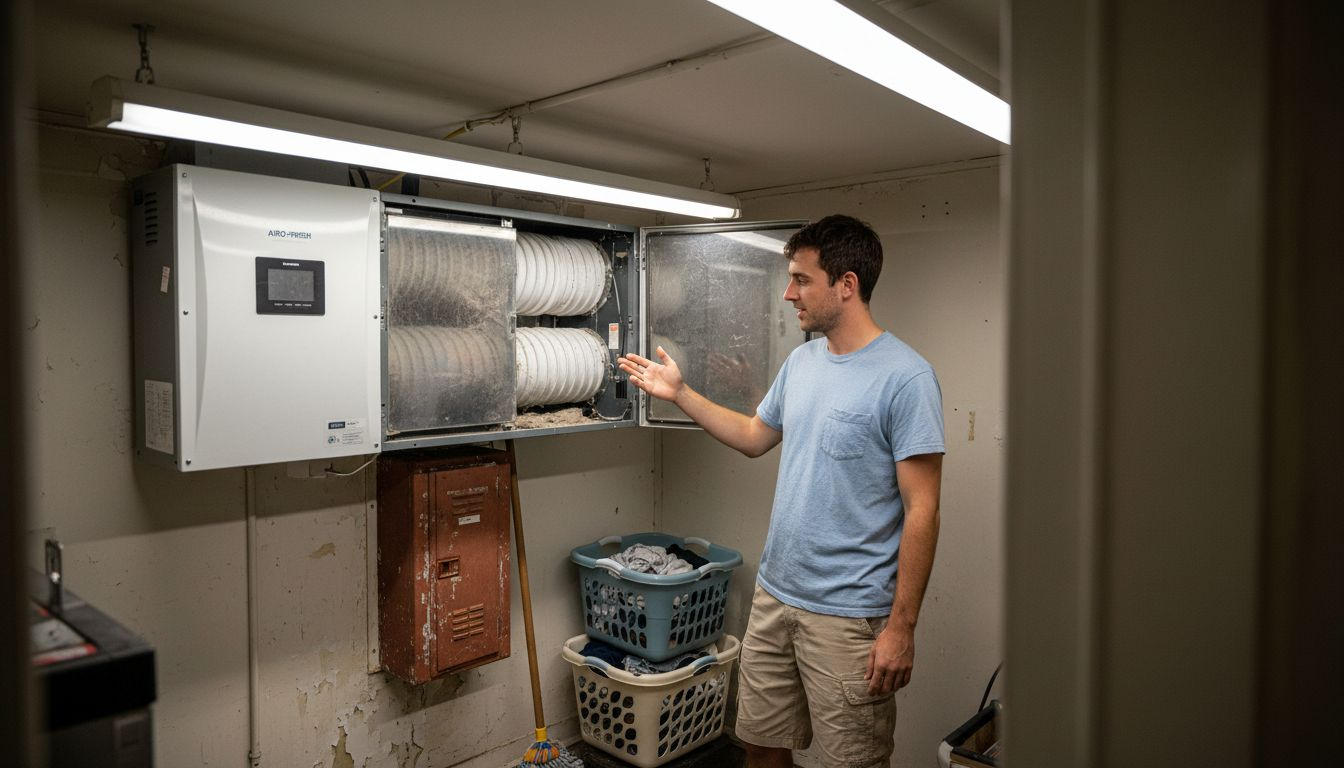
An Energy Recovery Ventilator is a mechanical ventilation system that exchanges stale indoor air for fresh outdoor air while recovering a portion of the energy (both heat and moisture) from the exhaust stream. It solves a ventilation problem: modern energy-efficient homes are sealed tightly enough that CO2, VOCs, and other indoor pollutants accumulate without adequate fresh air exchange. ASHRAE Standard 62.2 defines minimum ventilation rates for residential buildings; in very tight homes, an ERV is often the cleanest way to meet that standard.
The energy recovery component — the enthalpy wheel or membrane core — transfers some heat and moisture from the outgoing air to the incoming air. In winter in northern climates, this means the cold incoming air is pre-warmed before entering the living space, reducing heating load. In Tampa’s summer, it means the hot, humid incoming outdoor air is partially pre-dehumidified before it enters — partially. An ERV in Tampa summer conditions might recover 70 to 80% of the enthalpy from the exhaust stream, but it is still introducing outdoor air that is 80%+ relative humidity. The net result is that the ERV reduces (but does not eliminate) the moisture load the system must handle.
An ERV is not a dehumidifier. It cannot actively remove moisture from air that is already inside your home. It only modulates the moisture transferred during ventilation exchanges.
What Does a Whole-Home Dehumidifier Do That an ERV Cannot?
A whole-home dehumidifier — units like the Aprilaire 1820 or Santa Fe Ultra 98 — actively refrigerates a coil, passes indoor air across it, condenses moisture out of that air, and drains the condensate to a drain line. It operates independently of your AC system and runs whenever indoor humidity exceeds the setpoint, whether the AC is running or not.
This distinction matters enormously in Tampa Bay. During the October-through-March shoulder season, Tampa outdoor temperatures are often comfortable enough that homeowners run their AC infrequently. But outdoor dew points remain high enough (50 to 65 degrees) that indoor humidity climbs steadily every time the front door opens or when the home is well-sealed at night. A whole-home dehumidifier runs during these periods without requiring the AC to cycle. The EPA notes that maintaining indoor relative humidity below 60% is the single most effective mold prevention measure for homes in humid climates.
ERV vs. Whole-Home Dehumidifier: Side-by-Side Comparison
| Feature | ERV | Whole-Home Dehumidifier |
|---|---|---|
| Primary function | Ventilation with energy recovery | Active moisture removal |
| Can reduce indoor humidity below outdoor level? | No | Yes |
| Brings in fresh outdoor air | Yes | No (recirculates indoor air) |
| Effective during Tampa summer? | Limited — still introduces humid outdoor air | Yes — operates regardless of outdoor conditions |
| Works when AC is off? | Yes, but cannot remove existing moisture | Yes — primary use case in shoulder season |
| Typical installed cost in Tampa | $1,500 to $3,500 | $1,200 to $2,500 |
| Energy use | Low (recovery reduces net consumption) | Moderate (active refrigeration cycle) |
| Best Tampa application | Tight new construction needing ASHRAE 62.2 ventilation | Any home with humidity complaints, mold history, or musty odors |
When Does a Tampa Home Need an ERV?
An ERV makes sense in Tampa Bay when all three of the following are true:
- The home is new construction or has been recently air-sealed to the point where natural infiltration is insufficient for ASHRAE 62.2 ventilation requirements (blower door test result below 3 ACH50).
- The home already has a system — either a properly sized AC with a variable-speed compressor or a dedicated dehumidifier — handling the moisture load effectively.
- Occupants are experiencing CO2 buildup (measured with a CO2 monitor), persistent VOC odors from finishes or furniture, or air quality complaints in a sealed space.
If your home is a typical Tampa Bay home built before 2015 with a standard duct system, natural infiltration through the building envelope is almost certainly adequate for ventilation. Adding an ERV to a leaky older Tampa home is like putting a screen door on a barn — the ventilation is already happening without the energy recovery benefit. Learn more about why (and when) to install a heat recovery ventilator in Tampa Bay.
When Does a Tampa Home Need a Whole-Home Dehumidifier?
Does Your Home Stay Humid Even When the AC Is Running?
The most common scenario: the AC runs frequently, the house reaches setpoint temperature, but it still feels humid. This indicates that your AC’s runtime is insufficient to remove the latent load (moisture). Common causes include an oversized single-stage system (cools too fast, short-cycles, doesn’t run long enough to dehumidify) or high infiltration from a leaky building envelope. A whole-home dehumidifier solves this by running independently to pull the remaining moisture out.
Does Your Home Feel Musty in Spring and Fall?
Tampa’s shoulder seasons are the prime mold-growth window. Temperatures drop enough to keep the AC off, but outdoor dew points remain high. Without the AC cycling, nothing is removing moisture from the air. Relative humidity climbs above 60%, and mold begins colonizing damp surfaces within 24 to 48 hours. A whole-home dehumidifier running at a 50% setpoint is the direct solution. Check indoor air quality services in Tampa for a full assessment.
Does Your Home Have a History of Mold in Closets, Under Sinks, or in the Air Handler?
Persistent mold in closets (especially exterior-wall closets), under kitchen or bathroom sinks, or on the evaporator coil of your air handler is a direct signal of chronic high humidity. Air duct cleaning in Tampa followed by a whole-home dehumidifier installation is the standard remediation approach. The dehumidifier prevents recurrence; cleaning removes the existing growth.
Can You Use an ERV and a Dehumidifier Together in Tampa?
Yes, and in new high-performance construction, this is the correct combination. The ERV provides controlled fresh air ventilation (meeting ASHRAE 62.2 without relying on random leaks) while the dehumidifier handles the moisture load from Tampa’s outdoor air and internal sources (cooking, bathing, occupants). The ERV reduces the dehumidifier’s workload during ventilation cycles because the enthalpy core pre-conditions incoming air. This pairing works best in homes where:
- The building envelope is well sealed (spray foam insulation, impact windows, tight penetration sealing).
- The HVAC designer has specified both systems and coordinated their controls so the ERV does not introduce outdoor air when the dehumidifier is cycling against a high-humidity load.
- The homeowner intends to stay in the home long enough to justify the combined $3,000 to $6,000 installation investment.
For homes that are not air-tight new construction, start with a humidity control assessment from Home Therapist before committing to either system. An AC maintenance visit often reveals whether the existing system can be optimized (correctly sized, properly charged, cleaned evaporator coil) to handle more of the dehumidification load before adding new equipment.
What Should You Ask a Tampa HVAC Contractor Before Choosing?
- What is the current measured indoor relative humidity during a typical hot, humid Tampa day? (A hygrometer test before any recommendation is non-negotiable.)
- Is the problem occurring when the AC is running, or only when it is off?
- Has a Manual J load calculation been done to confirm the AC is not oversized?
- If recommending an ERV: what is the measured infiltration rate of the home (blower door test), and does ASHRAE 62.2 actually require supplemental ventilation?
- If recommending a dehumidifier: what is the moisture removal capacity in pints per day, and is it sized for Tampa’s latent load (not just the room square footage)?
Frequently Asked Questions
- Do I need a dehumidifier if I have an ERV?
In Tampa Bay's climate, yes -- most homes need both. An ERV exchanges stale indoor air for fresh outdoor air while recovering some energy, but it does not actively remove moisture. During Tampa's long humid season, outdoor air is so saturated that an ERV alone rarely keeps indoor relative humidity below the recommended 50%. A whole-home dehumidifier paired with the ERV handles the remaining moisture load. Home Therapist has completed 332 jobs in Tampa and routinely installs both systems together for full indoor air quality control. Every visit includes a free diagnosis so you know exactly what your home needs.
- Does an ERV help with mold?
An ERV reduces mold risk indirectly by diluting stale, moisture-laden indoor air with controlled fresh air, which lowers the conditions that allow mold to grow. However, in Tampa Bay's high-humidity environment, an ERV alone is rarely sufficient -- mold thrives above 60% relative humidity, and outdoor air here is frequently above that threshold. Pairing an ERV with a whole-home dehumidifier gives you the ventilation and the active moisture removal needed to keep humidity consistently low enough to suppress mold growth. Home Therapist offers free estimates on whole-home IAQ solutions.
- Will an ERV reduce humidity?
An ERV provides modest humidity reduction by exhausting humid indoor air and using an enthalpy core to transfer some moisture to the drier outgoing air stream, but it does not dehumidify in the way a dedicated unit does. In Tampa Bay, where outdoor humidity is extremely high for much of the year, an ERV can actually introduce more moisture than it removes during peak summer months. For reliable humidity control below 50% RH, a whole-home dehumidifier is the primary tool; the ERV handles ventilation and air quality. Call (813) 343-2212 or request a free estimate to size the right combination for your home.
Does an ERV reduce humidity in Tampa Bay homes?
Partially, during ventilation cycles only. An ERV’s enthalpy core recovers 70 to 80% of moisture from the exhaust air, which reduces the humidity added by ventilation — but it does not actively remove moisture that is already in your home. In Tampa summer with 80%+ outdoor relative humidity, an ERV will not solve a humidity problem. A whole-home dehumidifier is the correct tool for active moisture removal.
What is the best humidity level to maintain in a Tampa home?
Target 45 to 55% relative humidity year-round. The EPA recommends staying below 60% to prevent mold growth. In Tampa’s summer, this requires active intervention — typically a properly sized variable-speed AC and/or a whole-home dehumidifier — because outdoor relative humidity routinely exceeds 80% during afternoon hours.
How much does a whole-home dehumidifier cost in Tampa Bay?
Installed costs in Tampa Bay typically run $1,200 to $2,500 depending on capacity (pints per day) and installation complexity. Units are typically integrated with the existing duct system. See the full whole-home dehumidifier cost guide for current pricing. Home Therapist provides FREE estimates at (813) 343-2212.
Does Tampa Bay’s climate require an ERV in new home construction?
For homes built to 2020+ energy codes with tight building envelopes and spray foam insulation, yes — ASHRAE 62.2 ventilation requirements may not be met by natural infiltration alone, making mechanical ventilation like an ERV necessary. For most existing Tampa homes built before 2015, natural infiltration is typically sufficient and an ERV is optional. Confirm with a blower door test.
Can a whole-home dehumidifier replace an AC system in Tampa?
No. Dehumidifiers remove moisture but provide very limited sensible cooling. In Tampa’s summer with heat indices above 100 degrees, a dehumidifier cannot maintain comfortable temperatures without the AC running. The two systems work together: the AC handles temperature and part of the moisture load; the dehumidifier handles the remaining moisture the AC cannot address due to short cycling or building infiltration.
More Indoor Air Quality Articles
- A $89 Mini-Split Tune-Up on Signet Dr: What 30 Minutes of Maintenance Covers in Apollo Beach, FL 33572
- Mold in a 2003 HVAC Unit on Landstar Way: Indoor Air Quality Maintenance Visit in Tampa, FL 33647
- 11 Filters, One Maintenance Plan: Air Filter Replacement on Eisenhower Blvd N, Tampa, FL 33634
- UV Light Out HVAC: Capacitor Drifting Found on a 4-Year-Old System in Belleair, FL 33756
- Mini Split Installation for Florida Rooms and Garages in Tampa, FL: What to Expect


