

Radiant Floor Heating Tampa Bay: Is It Worth It for Cold Tile Floors?
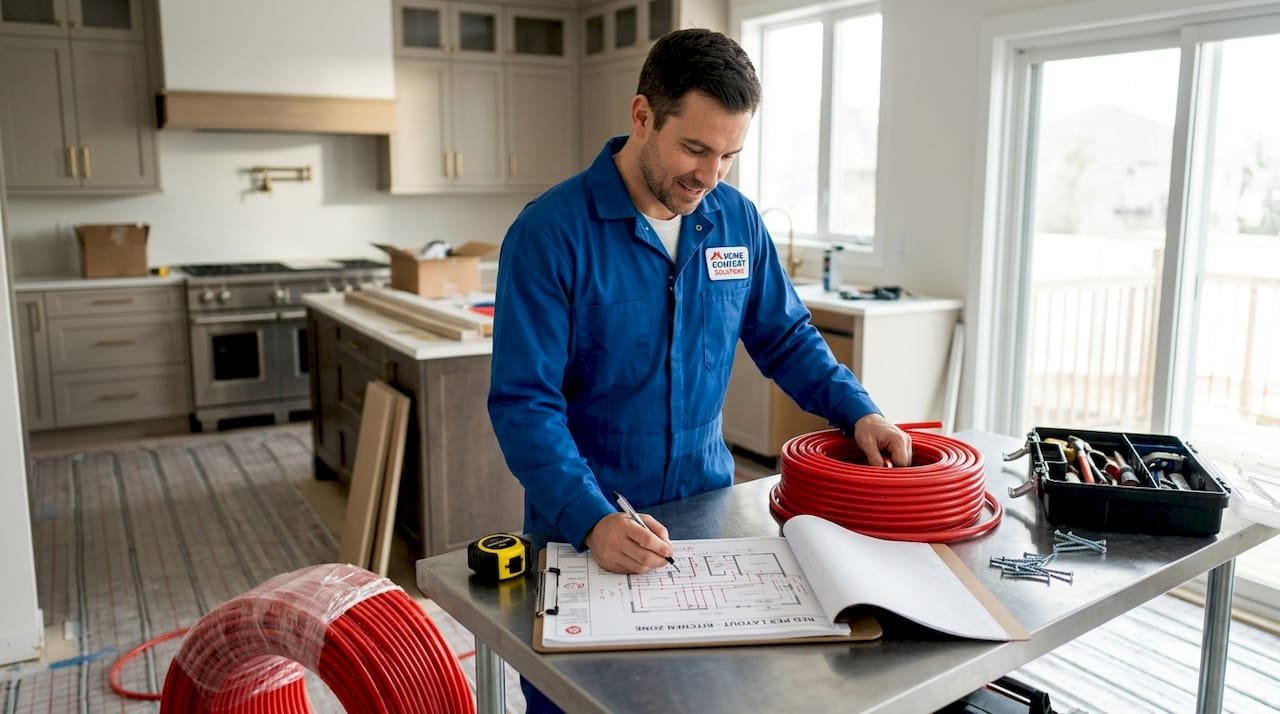
Radiant floor heating Tampa Bay homeowners consider for one main reason: cold tile on a January morning. Florida homes are built for cooling, and tile is everywhere. A forced-air heat strip does nothing about cold tile – radiant warms it directly from below. This guide covers hydronic versus electric costs for Florida slabs and which homes are the right fit.
Key Takeaways
- Cold tile is the main driver for radiant floor heating interest in Tampa Bay, not whole-home heating efficiency.
- Electric radiant mats are the practical choice for 1 to 3 rooms (bathrooms, kitchen, master bedroom) in existing Tampa Bay homes; hydronic is better for whole-home installs during construction or major renovation.
- Hydronic radiant uses 15 to 40 percent less energy than forced-air systems according to the U.S. Department of Energy, but the efficiency benefit is smaller in Tampa Bay’s mild winter than in colder climates.
- Installing electric radiant under tile in a bathroom costs $500 to $1,200 for a typical Tampa Bay bathroom depending on square footage and labor.
- Whole-home hydronic radiant in a new Tampa Bay construction adds $6 to $15 per square foot over standard flooring costs at the time of installation.
- Slab insulation beneath hydronic tubing is the most commonly missed detail in Florida installs; without it, you heat the ground, not your home.
Why Tampa Bay Homeowners Consider Radiant Floor Heating
The reasons homeowners in Hillsborough, Pinellas, and Pasco counties ask about radiant heating are more specific than the national narrative suggests. In northern states, radiant heating is about whole-home energy efficiency through a long, cold winter. In Tampa Bay, the motivations are different:
- Cold tile on January and February mornings: Tampa Bay averages 13 to 18 nights per year below 45 degrees F. That is not enough to justify a major whole-home heating upgrade on its own, but it is more than enough to make tile floors genuinely uncomfortable for 6 to 8 weeks each year.
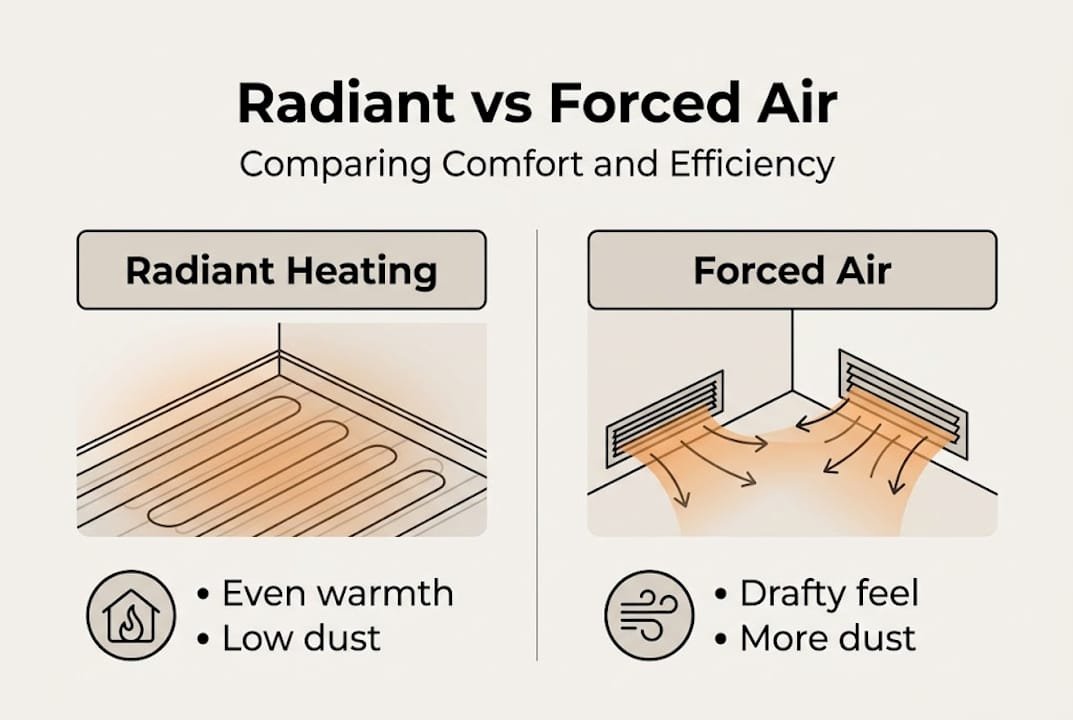
- Allergy and air quality concerns: Radiant systems have no ducts and no blower. If your household struggles with dust, pet dander, or seasonal allergies, a radiant heat source does not circulate any of those particles. It simply warms the floor surface.
- New construction or major renovation: When a Tampa Bay homeowner is building or completely renovating a home with tile throughout, adding hydronic radiant at the slab stage costs far less than retrofitting later and delivers a genuinely different comfort experience.
- Luxury bathroom upgrade: Electric radiant mats under bathroom tile are the single most requested heating upgrade in Tampa Bay for existing homes. The cost is manageable, the installation is straightforward during a bathroom remodel, and the comfort improvement on a January morning is immediate and obvious.
Hydronic vs. Electric Radiant Floor Heating: Which Makes Sense for Tampa Bay?
| System Type | Best Application in Tampa Bay | Installation Cost Estimate | Operating Cost | Key Advantage |
|---|---|---|---|---|
| Electric radiant mat (240V) | Bathroom, kitchen, or master bedroom retrofit | $500 – $1,200 per room (150-300 sq ft) | Higher per BTU, but low usage hours in FL | No boiler needed; installs under tile during remodel |
| Hydronic (PEX tubing + heat pump or boiler) | Whole-home new construction or gut renovation | $6 – $15 per sq ft added to construction cost | Lower per BTU; 15-40% more efficient than forced air | Best long-term efficiency; pairs well with heat pump |
| Electric film (thin mat, low profile) | Under luxury vinyl plank or engineered wood | $300 – $800 per room | Similar to standard electric mat | Thinner profile; less height addition than cable systems |
| Hydronic retrofit (existing home, raised floor) | Existing homes with accessible crawlspace or subfloor | $10 – $20 per sq ft | Lower per BTU once installed | Possible without full gut renovation if subfloor is accessible |
The U.S. Department of Energy on radiant heating efficiency confirms that hydronic radiant is more efficient than forced-air systems because there are no duct losses and the system operates at lower temperatures. However, in Tampa Bay’s climate zone 2, where the heating season is short (roughly December through February), the efficiency advantage is smaller than it would be in a northern climate. For most Tampa Bay homeowners, the decision comes down to whether the comfort improvement justifies the cost, not whether the energy savings will pay for the installation.
Is a Tampa Bay Slab-on-Grade Home a Good Candidate for Radiant?
Most Tampa Bay homes built after 1970 are on concrete slabs. This is actually ideal for hydronic radiant if you are building new or doing a major renovation, because the PEX tubing can be embedded directly in the concrete pour. The slab becomes a thermal mass that stores heat and releases it gradually – which is exactly how hydronic radiant is designed to work.
However, there is one detail that our technicians emphasize when consulting on Tampa Bay radiant installs: slab insulation beneath the tubing is not optional. Without a layer of rigid foam insulation between the PEX tubing and the ground beneath the slab, a significant portion of the heat is conducted downward into the soil rather than upward into the living space. In Florida’s mild soil temperatures, this is less severe than in a northern climate, but it still represents wasted energy and reduced system performance. Any contractor who skips this detail is cutting a corner that will affect your comfort and operating costs for the life of the system.
For existing Tampa Bay slab homes, retrofitting hydronic radiant means:
- Removing all flooring down to the slab concrete
- Adding a thin sleeper layer or using a low-profile PEX-in-panel system that minimizes height addition
- Reinstalling all flooring material over the tubing
This is genuinely disruptive and expensive for a whole home. For existing homes, electric radiant mats in 1 to 3 high-value rooms (bathrooms and kitchen primarily) is almost always the more practical path. Explore our HVAC retrofitting guide for Tampa Bay for a full framework on when retrofit upgrades make sense versus waiting for a natural replacement cycle.
What Does Electric Radiant Floor Heating Cost to Run in Tampa Bay?
Electric radiant mats typically draw 10 to 15 watts per square foot at full power. For a 150 square foot bathroom running 3 to 4 hours per morning during Tampa Bay’s 8-week heating season:
- 150 sq ft x 12 watts/sq ft = 1,800 watts = 1.8 kW
- 1.8 kW x 3.5 hours/day = 6.3 kWh per day
- 6.3 kWh x $0.12/kWh (Tampa Electric approximate rate) = $0.76 per day
- $0.76/day x 56 days (8-week season) = approximately $43 per year in operating cost
For most Tampa Bay homeowners, $40 to $60 per year in additional electricity to have warm bathroom tile every January morning is an easy value calculation. The upfront cost of $500 to $1,200 for installation during a bathroom remodel pays back in perceived comfort, not just energy savings, which is the honest frame for this climate.
For whole-home hydronic systems paired with a high-efficiency heat pump in Tampa Bay, the operating economics improve significantly because a heat pump coefficient of performance of 3.0 or higher means every watt of electricity delivers 3 watts of heating. The ENERGY STAR guidance on efficient heating systems recommends heat pump pairing as the most efficient option for hydronic radiant in mild climates like Tampa Bay’s.
What Flooring Types Work Best with Radiant in Tampa Bay Homes?
Flooring thermal conductivity determines how well radiant heat transfers from the system into your living space. In Tampa Bay, where tile is the dominant flooring material, this is good news:
- Ceramic and porcelain tile: Excellent thermal conductor. Warms quickly and retains heat well. This is the ideal pairing for radiant heating and the most common scenario in Tampa Bay bathrooms and kitchens.
- Luxury vinyl plank (LVP): Good thermal conductivity, especially the thinner profiles. Compatible with most electric mat systems. Check the manufacturer’s maximum surface temperature rating before installing radiant under LVP.
- Engineered hardwood: Compatible with low-temperature radiant systems if the temperature is kept below the manufacturer’s threshold (usually 80 degrees F surface temperature maximum).
- Thick carpet: Poor thermal conductor. Carpet acts as insulation between the radiant system and the room. If your primary concern is cold tile, carpet is not the issue – but if you have carpeted rooms where you want radiant, expect significantly reduced performance and higher operating costs.
- Solid hardwood: Generally not recommended for in-slab hydronic systems due to moisture cycling concerns. Electric mats under solid hardwood require careful temperature control.
For more on types of home heating systems and how radiant compares to other options for Tampa Bay homes, our heating guides cover the full comparison. If you want to improve heating in an existing home without a full radiant install, our team can also assess whether your hydronic heating options in Tampa Bay include anything short of a full floor system.
How Do You Get a Radiant Floor Heating Tampa Assessment?
The right answer for radiant floor heating depends on your specific home: slab type, existing flooring, construction phase, and what specific comfort problem you are trying to solve. Our licensed technicians (Florida HVAC license CAC1819196, Plumbing license CFC1431159) can assess your home and give you a straight recommendation on whether electric mat, hydronic, or a different heating approach makes the most sense for your situation.
Call (813) 343-2212 for a FREE assessment. We do not push a particular solution; we tell you what will actually work in your home. If radiant floor heating is the right answer, we will quote it honestly. If a different approach – like adding a mini-split for the master bedroom or improving heat strip performance – solves your problem at lower cost, we will tell you that instead.
Is radiant floor heating worth it in Tampa Bay’s mild climate?
For whole-home use, the payback period is longer than in colder climates because Tampa Bay only uses heat for 8 to 12 weeks per year. The comfort and air quality benefits are real, but the energy savings alone rarely justify the installation cost in existing homes. For new construction or major renovation, it is a strong upgrade. For a bathroom tile floor in an existing home, electric radiant mats are generally worth it given the low installation cost and the immediate comfort improvement on cold January mornings.
How much does it cost to install radiant floor heating under bathroom tile in Tampa Bay?
Expect $500 to $1,200 for a typical Tampa Bay bathroom of 150 to 300 square feet, including materials and labor, when done as part of a bathroom remodel. If the tile is already installed and the project is radiant-only, costs increase due to tile removal and reinstallation. A standalone radiant-under-existing-tile project runs $900 to $1,800 for the same room size.
What is the difference between hydronic and electric radiant floor heating?
Hydronic systems circulate hot water through PEX tubing embedded in the slab or subfloor. They are more energy-efficient for large areas and are the right choice for whole-home radiant. Electric systems use resistance heating cables or mats installed under flooring. They are simpler to install in existing homes and are the practical choice for 1 to 3 rooms. In Tampa Bay’s mild heating season, electric radiant for bathrooms and kitchen is the most common upgrade.
Does radiant floor heating work on a concrete slab in Florida?
Yes, and a concrete slab is actually the ideal substrate for hydronic radiant because the concrete acts as thermal mass. The critical requirement is proper rigid foam insulation beneath the PEX tubing to prevent heat loss into the soil below. Any contractor who installs hydronic radiant on a Florida slab without this insulation layer is delivering a system that will underperform.
Can radiant floor heating be added to an existing Tampa Bay home?
Yes, but the cost and disruption depend on the method. Electric radiant mats can be installed during any flooring replacement project at moderate cost. Whole-home hydronic retrofit requires removing existing flooring down to the slab and is best reserved for complete renovations. For most existing Tampa Bay homes, electric radiant in bathrooms and kitchens is the most practical approach.
More Heating & Heat Pumps Articles
- Heat Pump Not Heating Tampa Bay? Reversing Valve and Defrost Failures Explained
- Furnace Cleaning in Tampa Bay, FL, Why It Matters for Comfort and Safety
- Furnace Repair in Tampa Bay, FL: Common Problems, Repairs, and What to Expect
- 50-Gal. Power Vent Water Heater Replacement on Voyagers Pl: Plumbing Service in Apollo Beach, FL 33572
- Rental Property Heat Pump Replacement in Tampa: Repair or Replace?


