

Ductwork Damper Balancing: How to Fix That One Hot Room in Your Tampa Home
Ductwork damper balancing solves the most common comfort complaint Tampa Bay techs hear: one room stays hot no matter what the thermostat says. A balanced system redistributes conditioned air so every room reaches its target temperature. Most imbalances are fixed in a single visit with a damper adjustment, not a new system. Home Therapist offers FREE diagnosis on every call. If repair is needed, approved work is $279 labor.
Why Is One Room in My Tampa Home Always Hot?
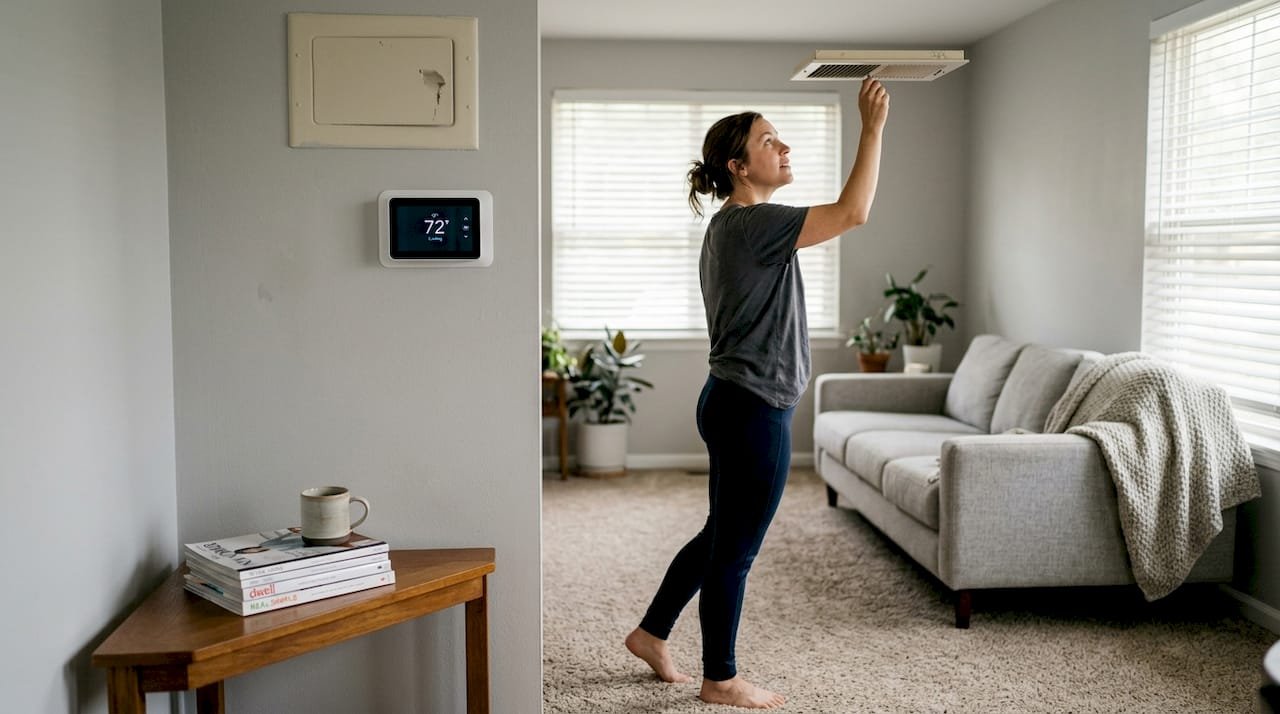
Tampa homes built before 2005 were often designed with a single-zone duct system and no dampers at all. The air handler pushes the same volume to every branch regardless of load. South-facing bedrooms, second-floor rooms, and spaces with large windows gain far more heat than the duct system was sized to counteract. The result is a room that runs 5 to 12 degrees above the thermostat setting even when the AC runs continuously.
Three root causes cover roughly 90 percent of hot-room complaints our techs diagnose in Hillsborough County:
- Missing or closed damper on the supply branch: The duct feeding that room was never balanced after installation, or a manual damper was closed by a previous owner and never reopened.
- Undersized supply duct: The original Manual J load calculation was off, or the room was converted from a garage or porch after the duct system was designed.
- Leaking return air path: Without a dedicated return, the room pressurizes and the supply air stalls before it can cool the space.
Our tech Marcus found exactly this on a Carrollwood home last summer: a guest bedroom had a 5-inch flex duct feeding it while every other room in the house had a 7-inch duct. The occupant had been running the thermostat at 70 just to keep that room at 78. A damper on the adjacent branch redirected extra flow, and the room dropped 6 degrees within 20 minutes of the adjustment.
What Does Ductwork Damper Balancing Actually Involve?
Ductwork damper balancing is a systematic process of measuring and adjusting airflow at each supply register until every room receives its design CFM (cubic feet per minute). Here is the step-by-step process our techs follow on a balancing call:
- Static pressure measurement at the air handler: High external static pressure (above 0.5 in. w.c.) indicates a restricted duct system. This must be resolved before balancing makes sense.
- Register flow readings: Using a flow hood or anemometer, the tech measures actual CFM at each supply register and compares it to the calculated design CFM for that room’s square footage and orientation.
- Locate existing dampers: The tech traces each branch duct and locates any manual balancing dampers. Many homes have them and they are simply stuck or forgotten.
- Adjust or install dampers: Dampers on oversupplied rooms are partially closed, redirecting pressure to undersupplied rooms. If no damper exists on a problem branch, one is cut in during the visit.
- Verify and repeat: After adjustments, airflow is re-measured at every register until the distribution matches the load calculation within an acceptable tolerance.
A standard balancing visit on a 1,500 to 2,500 square-foot Tampa home takes one to two hours. The cost depends on whether new dampers need to be installed or whether the existing ones simply need adjustment.
What Is the Difference Between Manual and Automatic Dampers in Tampa Homes?
| Damper Type | How It Works | Best For | Approximate Cost (Installed) |
|---|---|---|---|
| Manual round damper | Lever rotates a blade inside the duct; set once and left | Single-zone homes needing a one-time balance | $80 to $150 per damper |
| Manual rectangular damper | Sliding plate reduces duct cross-section; adjusted by hand | Rectangular main trunk branches | $100 to $200 per damper |
| Motorized (automatic) damper | 24V actuator opens or closes on a thermostat signal | Multi-zone systems; rooms with very different loads | $250 to $450 per damper installed |
| Fire damper | Fusible link closes blade at 165 degrees F | Required at fire-rated wall or floor penetrations | $200 to $400 installed |
For most Tampa Bay single-story homes, manual dampers solve the balancing problem permanently with no ongoing maintenance. Motorized dampers make sense when a two-story home has a significant day-night thermal shift between floors, or when a sunroom needs independent control.
Key Takeaways
- A hot room is almost always a duct airflow problem, not a failing compressor or an undersized AC unit.
- Damper balancing is measured work: flow readings before and after confirm the fix is real, not a guess.
- Manual dampers cost $80 to $200 each installed and solve most single-zone imbalances permanently.
- Motorized dampers ($250 to $450 each) make sense for multi-zone setups or rooms with extreme solar gain.
- Tampa homes built pre-2005 are the most likely to have no dampers at all and benefit most from a balancing visit.
- Home Therapist provides a FREE diagnosis to determine whether a damper adjustment, new damper installation, or a duct modification is the right fix.
How Does Tampa’s Climate Make Damper Balancing More Important Than in Other States?
Florida’s cooling season runs roughly March through October, with the AC operating 12 to 16 hours a day during peak summer. According to the U.S. Department of Energy, air conditioning accounts for about 12 percent of U.S. home energy use nationwide, but in Florida that share is significantly higher because of the length of the cooling season. An unbalanced system forces the blower to run longer to satisfy the hottest room, which raises runtime across the whole house even when most rooms are already comfortable.
Tampa’s humidity adds a second layer: stagnant rooms with poor airflow hold moisture, which accelerates mold growth inside duct liners and on supply registers. A room that gets inadequate airflow is also a room that gets inadequate dehumidification. The U.S. EPA recommends keeping indoor relative humidity below 60 percent to prevent mold growth – something that is only achievable room by room if the duct system is actually delivering conditioned air to every space.
What Are the Signs Your Ductwork Dampers Need Adjustment?
You do not need a flow hood to spot a balancing problem. These are the field-verified indicators our techs use to triage a home before pulling out the instruments:
- Temperature differential greater than 3 degrees F between rooms with the same thermostat setting.
- One register blowing noticeably harder or weaker than the others when you hold your hand over it.
- The AC runs longer than 15 to 20 minute cycles but the problem room never reaches setpoint.
- Humidity feels higher in one room even with the whole-house system running.
- Dust accumulates faster in one room than anywhere else in the house, indicating pressure-driven infiltration.
If you see three or more of these, a damper balance is almost certainly the fix. A ductwork inspection can confirm whether the duct itself is the bottleneck or whether a simple damper adjustment will do the job.
Can I Adjust Ductwork Dampers Myself?
You can turn a manual damper lever yourself if you can access it – most are on the duct near the air handler or at major branch points in the attic. The challenge is that you will not know whether you made things better or worse without flow measurements. Closing one damper raises static pressure on the remaining branches, which can overload the blower motor over time. Our techs have repaired several blower motors on systems where a well-meaning homeowner partially closed half the dampers trying to cool one room.
The right approach is to measure first, adjust once, and verify. That is exactly what a professional balancing visit provides. It takes the guesswork out and gives you a documented before-and-after so you know the work is done correctly.
Frequently Asked Questions About Ductwork Damper Balancing in Tampa
How much does ductwork damper balancing cost in Tampa Bay?
A diagnostic visit to identify the airflow problem is FREE with Home Therapist. If balancing requires only adjusting existing dampers, the labor typically falls under the $279 repair charge. If new dampers need to be cut in and installed, expect $80 to $200 per damper in materials plus labor, usually completed in one visit.
Will balancing my dampers help my energy bill?
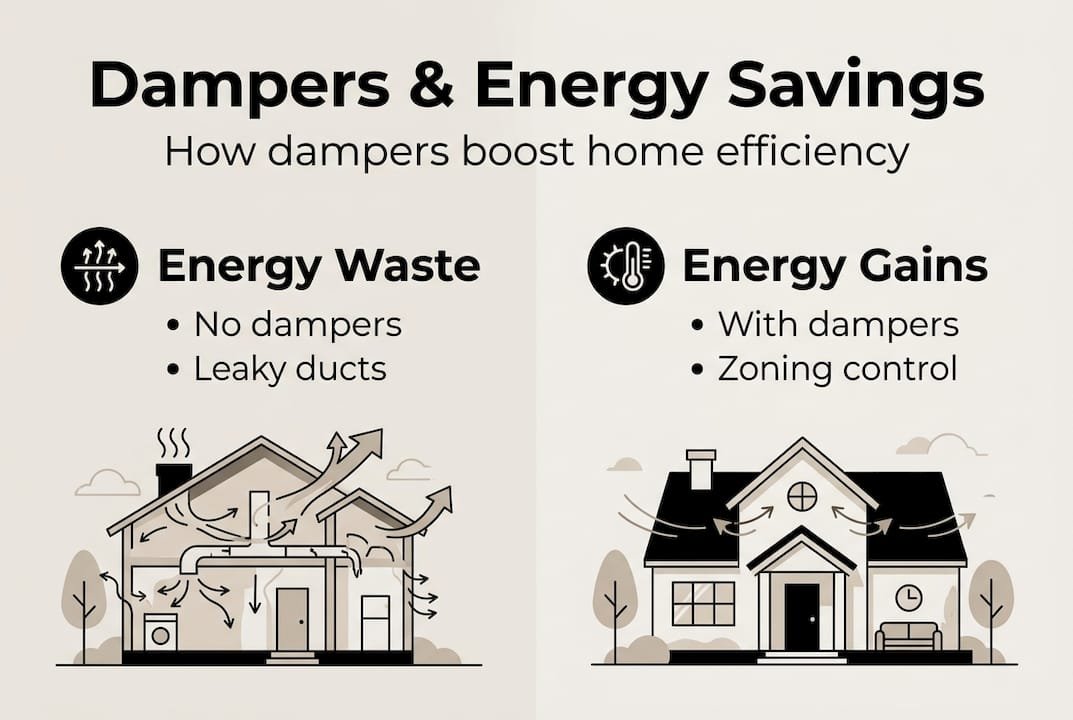
Yes, in most cases. When one room is oversupplied and another is undersupplied, the thermostat in the oversupplied room calls for less cooling than the home actually needs. Balancing ensures the thermostat location is representative of the whole house, reducing unnecessary runtime. Many Tampa homeowners report a 10 to 20 percent reduction in AC runtime after a balancing visit.
Do I need HVAC zoning or just damper balancing?
Damper balancing is a single set-and-done adjustment. HVAC zoning adds motorized dampers, multiple thermostats, and a zone controller so different parts of the house can be cooled independently on demand. Most Tampa homes with one or two problem rooms need balancing, not a full zoning system. Full HVAC zoning installation makes more sense for two-story homes or homes with a sunroom or converted garage.
How long does a damper balancing visit take?
Typically one to two hours for a 1,500 to 2,500 square-foot home. Larger homes or systems with many branch ducts in the attic may take up to three hours. The tech will give you a time estimate after the initial walk-through.
Can duct leaks cause the same symptoms as a damper problem?
Yes. A leaking flex duct in the attic loses conditioned air before it reaches the register, producing the same symptom as a closed damper. Our diagnostic process checks for leaks during the balancing visit. If a major leak is found, sealing the duct takes priority over adjusting the dampers. See our air duct repair service for more information.
If your Tampa Bay home has a room that never reaches the right temperature, call Home Therapist at (813) 343-2212 for a FREE diagnosis. Our licensed HVAC techs (FL CAC1819196) measure airflow, locate the restriction or imbalance, and fix it the same day. We install Goodman and Daikin systems and service all brands. No diagnostic fee, no surprise charges. Approved repair work is $279 labor.
Related reading: What is ductwork and how does it affect your home’s efficiency? | HVAC zoning dampers explained | Ductwork replacement in Tampa | AC repair Tampa FL
More Ductwork & Airflow Articles
- Plumbing Inspection Finds Expansion Tank and Faucet Issues in Riverview, FL 33578: US-301 Visit
- Air Duct Repair Tampa, What Tampa Bay Homeowners Should Know
- Top 6 Best Home Ventilation Systems 2026
- Air duct sealing: improve home air quality by 20%
- AC Tune-Up and Ductwork Inspection on Blossom Ave: What Barbaro Found in Tampa, FL 33614


