

5 Best Water Softener Systems for Sale (2026 Deals)
If you’ve been dealing with scale buildup on your fixtures, dry skin after showers, or spotty dishes no matter how much detergent you use, hard water is probably the culprit. Finding the right water softener system for sale can feel overwhelming when dozens of brands are competing for your attention, each claiming to be the best. The truth is, the right system depends on your home’s water hardness level, household size, and budget.
We put together this list of five water softener systems currently available at solid prices in 2026 to help you cut through the noise. You’ll find options ranging from budget-friendly salt-based units to higher-end smart systems, with a clear breakdown of what each one actually delivers. No fluff, no filler, just the details you need to make a confident purchase.
At Home Therapist, we install and service water softeners across the Greater Tampa Bay Area and have been doing so since 2011. Tampa’s water supply is notoriously hard, so we’ve seen firsthand which systems hold up and which ones cause headaches a year down the road. That hands-on experience shaped every recommendation below, and if you need professional installation or a free estimate, our team is a phone call away.
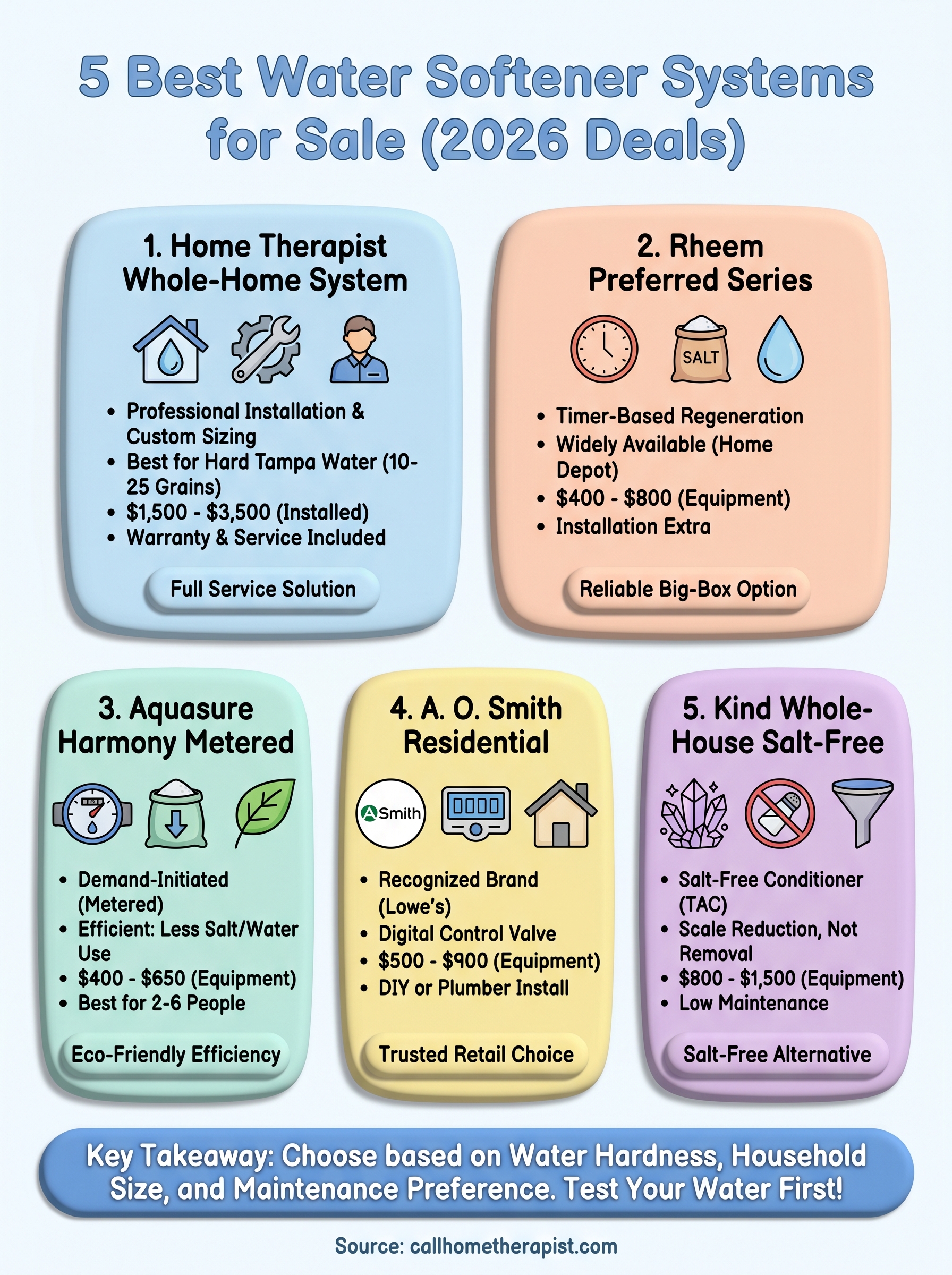
1. Home Therapist whole-home water softener system
When you purchase a water softener system for sale through Home Therapist, you’re not just buying equipment off a shelf. You get a licensed technician who evaluates your home’s specific water hardness, selects the right grain capacity, and handles the full installation from start to finish.
What you get when you buy through a local installer
Buying through a local company like Home Therapist means you get a system sized and installed correctly for your home from day one. Custom sizing and professional installation eliminate the guesswork that causes early system failure or undersized performance. You also get a single point of contact for any questions, repairs, or follow-up service.
Your installer handles everything: water testing, equipment selection, plumbing integration, and post-installation checks. That level of service is difficult to replicate with a big-box purchase and a separate contractor.
Best for
Home Therapist’s whole-home system is best suited for Tampa Bay homeowners dealing with Florida’s notoriously hard water, typically ranging from 10 to 25 grains per gallon depending on your specific municipality.
This is an ideal fit for households that want one company responsible for installation, maintenance, and any future repairs.
Typical price range in 2026
Expect to pay $1,500 to $3,500 installed, depending on your home’s size, existing plumbing setup, and the specific system selected. This range covers both the equipment and labor.
Salt-based ion exchange systems in this tier typically carry a grain capacity between 32,000 and 64,000, which is appropriate for most Tampa Bay households.
Installation, permits, and warranty considerations
Florida does not universally require a permit for water softener installation, but Hillsborough and Pinellas County may require one depending on the scope of work. Home Therapist handles permit verification and pulls any necessary permits on your behalf.
Warranty coverage typically runs 5 to 10 years on the tank and 1 to 3 years on the control valve, and Home Therapist backs its labor separately.
Add-ons that matter in Florida water
Florida water often carries chlorine, sulfur, and sediment in addition to high hardness levels. Pairing your softener with a whole-home carbon filter or sediment pre-filter extends equipment life and improves water taste.
Iron content is another common issue in Florida wells; a dedicated iron filter keeps your softener resin from fouling prematurely.
2. Rheem preferred series salt-based softeners
Rheem is a well-known name in water treatment, and their Preferred Series salt-based softeners are widely available at Home Depot. These units use standard ion exchange technology to remove calcium and magnesium from your water supply.
What the system does and how it regenerates
The Rheem Preferred Series runs on a timer-based regeneration cycle, meaning it regenerates on a fixed schedule rather than based on actual water usage. It pushes hard minerals out of the resin bed using a brine solution, then flushes and returns to service.
Best for
This system suits homeowners with predictable water usage who want a reliable, widely serviced brand. It works best in areas with moderate hardness, roughly 10 to 20 grains per gallon.
Typical price range in 2026
Rheem Preferred Series units typically sell for $400 to $800 for equipment alone at big-box retailers. Budget separately for installation labor, which adds a significant portion to your total cost.
What to check before you buy from a big-box store
When you search for a water softener system for sale at a retail store, confirm the grain capacity matches your household size. 48,000-grain models are common, but Florida’s harder water may require a larger unit.
Always test your water before buying so you select the right grain capacity from the start.
Installation and upkeep costs to plan for
Professional installation typically adds $200 to $500 to your total cost. You’ll also spend roughly $5 to $10 per month on salt, plus occasional resin cleaning if your water contains elevated iron.
3. Aquasure Harmony metered softener systems
Aquasure’s Harmony series uses demand-initiated regeneration, meaning it regenerates based on actual water usage rather than a fixed schedule. This makes it one of the more efficient water softener systems for sale at this price point.
How metered regeneration helps reduce salt and water use
Metered systems track actual water consumption and regenerate only when the resin bed nears capacity. This cuts salt use and wastewater compared to timer-based models that regenerate on a fixed schedule regardless of how much or how little water your household uses.
Demand-initiated regeneration can reduce salt consumption by 25 to 50 percent compared to timer-based models, which is a meaningful difference over a full year of operation.
Best for
The Harmony series suits households of two to six people with moderate to moderately hard water. It handles up to 25 grains per gallon, which covers most municipalities across the Tampa Bay area.
Typical price range in 2026
Aquasure Harmony units sell for $400 to $650 on Amazon depending on grain capacity. The 48,000-grain model is the most practical option for the average-sized home.
When to pair it with a sediment or carbon pre-filter
Florida well water often carries iron and sediment that foul resin beds prematurely. Adding a dedicated pre-filter upstream of the softener extends resin life and keeps your system running at full capacity longer.
Installation details that affect performance
Proper bypass valve installation and drain line routing directly affect regeneration performance. Keep the unit away from extreme heat or cold, which degrades the control valve and shortens its overall lifespan.
4. A. O. Smith residential water softeners at Lowe’s
A. O. Smith makes some of the most widely recognized water treatment equipment in the residential market. Their softeners are available at Lowe’s locations across the country, making them easy to source if you want to inspect a unit before purchasing.
What you get at this price tier
At this price level, you get a salt-based ion exchange softener with a digital control valve and a single-tank design. The build quality is solid for the category, though the components are not as serviceable as systems installed by a licensed contractor.
Best for
A. O. Smith softeners work well for homeowners with moderate hardness levels who are comfortable coordinating their own installation or have a plumber lined up.
This is a practical choice if you want a recognizable brand backed by a national retailer’s return policy.
Typical price range in 2026
Equipment prices at Lowe’s typically run $500 to $900 depending on grain capacity. Installation costs vary but generally add $300 to $600 on top of that.
Sizing the grain capacity for your household
For most Tampa Bay households of three to five people, a 40,000 to 48,000-grain unit covers daily demand without frequent regeneration cycles. Larger homes or higher hardness readings above 20 grains per gallon should move up to a 64,000-grain model.
Maintenance and part availability
Replacement parts like brine tanks and control valves are stocked at most Lowe’s locations, which simplifies routine upkeep. Salt consumption runs roughly the same as other salt-based water softener systems for sale in this tier, around 6 to 9 pounds per regeneration cycle.
5. Kind whole-house salt-free softener and filter combo
Kind Water Systems offers a salt-free conditioning system that combines scale prevention with whole-home carbon filtration in a single unit. This is a different category of product than the salt-based water softener system for sale options listed above.
How salt-free conditioning differs from true softening
Salt-free systems use template-assisted crystallization (TAC) to convert hard minerals into crystals that pass through your plumbing without sticking to surfaces. They do not actually remove calcium or magnesium from your water, which means water test results will still show hardness after treatment.
Best for
This system suits homeowners who want to reduce scale buildup without maintaining a salt supply or dealing with brine discharge. It works well in areas with moderate hardness levels below 25 grains per gallon.
Typical price range in 2026
Kind whole-house systems typically run $800 to $1,500 for equipment. Installation is generally simpler than salt-based systems, which can bring labor costs down compared to other options.
What results to expect on scale, spots, and soap use
You will see reduced scale buildup on fixtures and appliances over time, but water spots on dishes and glass surfaces may persist. Soap lather will also be less noticeable than with a true ion exchange softener.
Salt-free conditioning works best as a scale prevention measure, not as a replacement for softening in high-hardness areas.
When to choose salt-free vs salt-based
Choose salt-free if your hardness is moderate and you want low maintenance. Opt for salt-based if you need full mineral removal for sensitive skin, appliance protection, or Florida’s harder water conditions.
Next steps
Each of these five options gives you a real starting point when searching for a water softener system for sale, but the right choice ultimately comes down to your household size, water hardness level, and how much maintenance you want to take on. Salt-based systems remove minerals completely and work best for Florida’s hard water conditions, while salt-free options suit moderate hardness with minimal upkeep.
Before you buy anything, test your water to confirm your actual hardness reading. That single number determines which grain capacity you need and whether a salt-based or salt-free system makes more sense for your home. Skipping this step leads to undersized equipment and ongoing frustration.
If you’re in the Greater Tampa Bay Area and want a licensed technician to handle water testing, system selection, and installation in one visit, contact Home Therapist for a free estimate. We’ve been solving Tampa’s hard water problems since 2011.


