How long to thaw?
3 hours minimum with fan ON. For thick ice: 6 hours.
Can I hair dryer the ice?
Don’t. Uneven heat damages coils + copper. Let it thaw naturally.
Why does ice form?
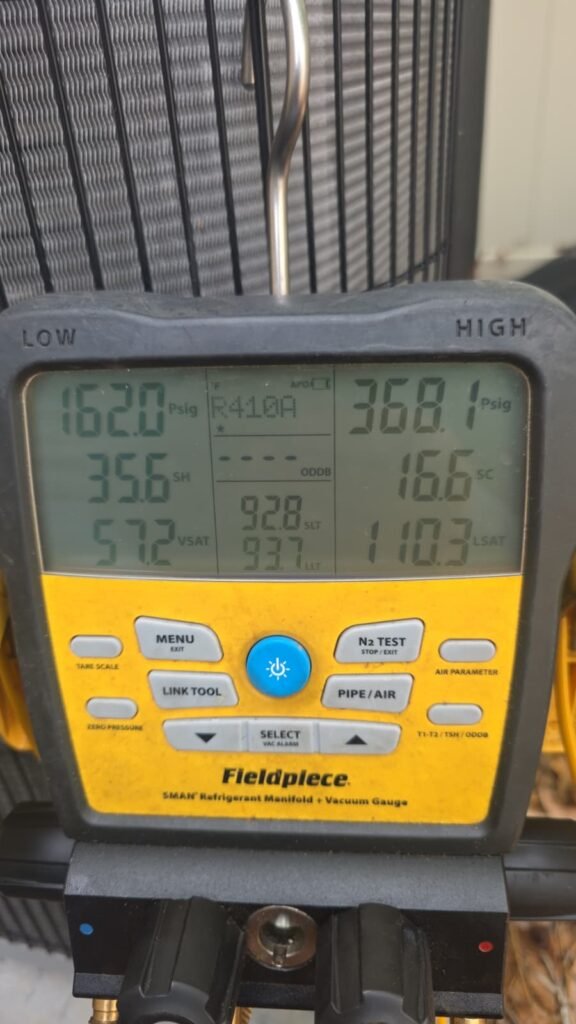
Coil gets below 32°F, moisture in Tampa humidity freezes on contact. Airflow or refrigerant shortage = coil overcools.
Will ice damage my AC?
Brief freeze usually OK. Repeat freezes OR running while frozen = compressor damage ($1,248 labor plus the compressor to replace).
Why does it keep refreezing?
Root cause not fixed. Filter needs monthly checks in Tampa. Refrigerant leak needs repair (won’t self-heal).
How long to thaw?
Allow at least two hours with the system in fan-only mode or completely off. Thick ice accumulation on the evaporator coil may take three to four hours to fully thaw. Do not use a heat gun or hair dryer on the copper lines. The refrigerant inside is under pressure and the copper tubing is thinner than it looks. Let it thaw naturally and place towels under the air handler to catch overflow water from the drain pan during the melt.
Can I hair dryer the ice?
No. Using a heat source on refrigerant lines risks damage to the tubing and can create a dangerous pressure spike inside the sealed system. It also does nothing to fix the underlying cause, so the system will freeze again on the next cycle. The correct approach is fan-only mode for two or more hours, then a diagnostic run with a tech on-site. Call (813) 343-2212 for same-day service in Hillsborough County.
Why does ice form?
Ice forms on the evaporator coil when its surface temperature drops below 32 degrees Fahrenheit and moisture from indoor air is present. Normal coil operating temperature is 35 to 45 degrees, well above freezing. Two things push it below freezing: low refrigerant charge (which causes over-expansion and excessive coil cooling) and restricted airflow (which reduces the warm air passing over the coil, allowing it to get too cold). Tampa’s high humidity means there is always enough moisture in the air to freeze quickly once the coil surface hits freezing temperature.
Will ice damage my AC?
It can if you continue running the system in cooling mode while frozen. Liquid refrigerant from the iced coil travels back to the compressor, causing liquid slugging that bends compressor valves. The damage is cumulative and may not present immediately. Shut the system off, thaw completely, and call for diagnosis. If the freeze is caught quickly and the system is shut down promptly, most systems survive without compressor damage.
Why does it keep refreezing?
Repeat freezing after a thaw means the underlying cause is still present. Refreezing within 15 to 20 minutes of restarting in cooling mode almost always indicates low refrigerant charge, because low charge is a persistent condition that does not resolve between cycles. Refreezing that takes an hour or two to develop after restart is more commonly a dirty coil or partially blocked return that builds up ice gradually. Either way, do not keep cycling between freeze and thaw. Each freeze event risks compressor damage. Call (813) 343-2212. Licensed CAC1819196.
Does a refrigerant recharge require a permit in Hillsborough County?
A refrigerant recharge alone does not require a separate mechanical permit in Hillsborough County if no refrigerant circuit components are replaced. However, the technician must hold EPA Section 608 certification and must not vent refrigerants to the atmosphere. If a coil, lineset, or other refrigerant-circuit component is replaced as part of addressing the leak, a mechanical permit is required for the component replacement. Call (813) 343-2212. Licensed CAC1819196.
My system froze up right after I replaced the filter with a higher MERV-rated one. Did the new filter cause it?
Yes, this is a very common cause of freeze-ups in Tampa. A MERV-13 filter installed in a system designed for MERV-8 can roughly double the static pressure on the return side, cutting airflow significantly. The evaporator coil depends on a steady volume of warm indoor air to keep its surface temperature above freezing. Reduce your airflow enough with a high-MERV filter on a system not designed for it, and the coil drops below 32 degrees and begins to ice over within one cooling cycle. If you upgraded to a MERV-13 and froze up shortly after, switch back to MERV-8. If you want better filtration, ask us about a 4-inch media filter cabinet, which provides higher filtration without the airflow restriction. Licensed CAC1819196.
How does R-410A being phased out affect me if my system freezes and needs a recharge?
R-410A production is being phased out as of January 2025 in the U.S. under EPA regulations. Existing supplies will remain available for service for several more years, but prices are rising as the supply shrinks. If your R-410A system has a leak causing freeze-ups, the cost of refrigerant for the recharge will be higher now than it was in 2022 or 2023. New systems installed from 2025 forward use R-454B. If your R-410A system is over 12 years old and freezing from a confirmed refrigerant leak, factor the rising recharge cost into the repair-versus-replace decision. We provide upfront refrigerant pricing before any work begins. Licensed CAC1819196.
Can the blower wheel being dirty cause the line set to freeze even if the filter is clean?
Yes. Tampa’s high humidity means blower wheels accumulate dust, pollen, and mold growth on their blades over time, even when the filter is being changed regularly. A blower wheel that is coated with a layer of debris spins less efficiently and moves less air per revolution, reducing total airflow across the evaporator coil. A clean filter helps but cannot fully compensate for a dirty blower wheel. If your system is freezing and the filter is clean and new, ask about a blower wheel cleaning during the diagnostic visit. This is separate from coil cleaning and is often overlooked as a freeze-up cause in systems over 5 years old. Licensed CAC1819196.