
Air Handler Leaking Water? St. Petersburg Leak Detection Guide
Quick answer: An air handler leaking water in St. Petersburg is usually caused by a clogged condensate drain, a cracked pan, or a refrigerant leak in the coil that causes ice buildup and overflow. On a recent St. Pete call, a loud outdoor compressor and zero refrigerant on the gauges led straight to a leak on a 13 year old air handler coil. Free diagnosis with leak detection equipment finds the exact source before you pay for parts you don't need.
On this page: Why Is My Air Handler Leaking Water · What We Found on This St. Petersburg Call · Should I Turn Off My AC If It's Leaking Water · How Much Does It Cost to Replace an Air Handler · Why Is the Pan Under My Air Handler Full of Water · Does Homeowners Insurance Cover HVAC Leaks · What Are the Common Causes of Air Handler Leaks in Tampa Bay Homes · How Do We Detect Refrigerant Leaks in an Air Handler · FAQ
Why Is My Air Handler Leaking Water?
Most of the time, an air handler leaking water comes down to one of three things: a clogged condensate drain line, a cracked or rusted drain pan, or a refrigerant leak that causes the coil to ice over and then dump water everywhere when it thaws.
The condensate drain is the most common culprit across Tampa Bay because of our humidity. Algae and gunk build up inside that PVC line year round, and once it clogs, the water has nowhere to go but back into the pan and over the edge. That is a maintenance issue, not usually an equipment failure, and it is one of the easiest problems to prevent with a yearly flush.
A refrigerant leak is a different animal. When a system loses gas, the evaporator coil inside the air handler gets too cold and starts icing over. Run the system long enough and that ice eventually melts faster than the pan and drain can handle, and you get water pouring out of the cabinet, sometimes through the ceiling if the air handler is in an attic or closet above living space. This is exactly what we found on a recent call in St. Petersburg, where the actual complaint was poor cooling, not water, but the underlying issue was a coil leak.
A cracked or rusted pan is more common on older secondary (attic) pans made of galvanized metal, which corrode over time in Florida’s heat and humidity. Once the metal rusts through, water leaks straight through the pan itself no matter how clean the drain line is.
Because these three causes look almost identical from the homeowner’s side (water where it shouldn’t be), we always start with free diagnosis. We hook up gauges, check refrigerant pressure, inspect the pan and drain, and if needed, run an electronic leak detector across the coil and line set. That is the only way to know if you need a $20 drain cleaning or a full coil replacement. If you are in the St. Petersburg or greater Tampa Bay area, our leak detection service covers all of this in one visit.
| Location | St. Petersburg, Florida |
| Reported issue | AC not cooling the home |
| First sign on startup | Loud noise from the outdoor compressor |
| Gauge reading | No refrigerant found on the system |
| Leak location | Found on the air handler coil using a leak detector |
| Indoor unit age | About 13 years old |
| Outdoor unit age | About 2 years old |
| Interim fix and plan | Refrigerant added to hold the system over, equal replacement air handler scheduled for next day |
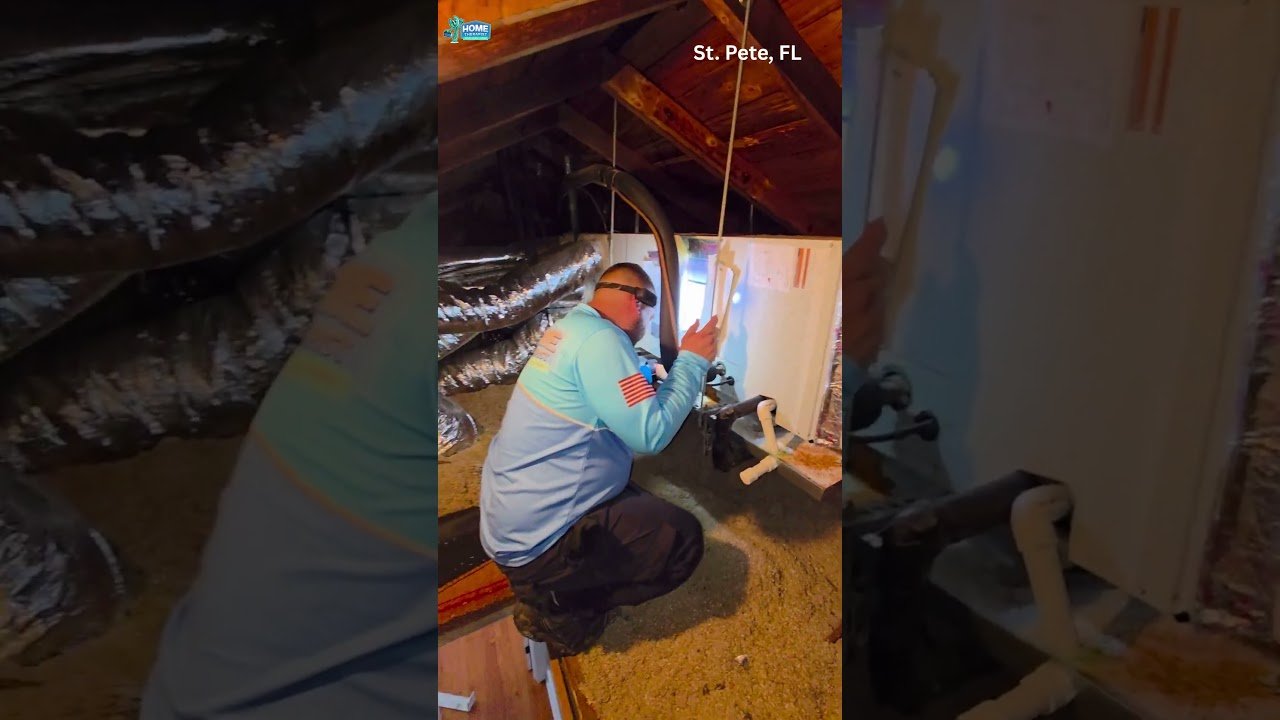
What the video shows
- 0:00 Technician arrives in St. Petersburg, homeowner reports the AC is not cooling
- 0:05 System is powered on, loud noise heard from the outdoor compressor
- 0:10 Gauges connected, reading shows no refrigerant left in the system
- 0:15 Leak detector used, leak pinpointed on the air handler coil
- 0:20 Technician notes the indoor unit is about 13 years old versus the 2 year old outdoor unit
- 0:25 Refrigerant added as a temporary fix, replacement air handler scheduled for the next day
What We Found on This St. Petersburg Call
The homeowner in St. Petersburg called because the AC wasn’t cooling the house, and what we found was a refrigerant leak on the air handler coil, not the outdoor unit most people suspect first.
When we arrived, the first thing we did was turn the system on to hear what it was doing. Immediately there was a loud noise coming from the compressor outside, which told us the system was struggling under abnormal pressure, a classic sign of low or zero refrigerant. We hooked up our gauges next, and the reading confirmed it: there was no gas left in the system at all. A system does not lose all its refrigerant on its own. It leaks out somewhere, and our job at that point was to find exactly where.
We broke out the electronic leak detector and went coil by coil, line by line. It did not take long. The leak was on the air handler coil itself, inside the indoor unit. That is an important distinction for homeowners to understand: the outdoor condenser and the indoor air handler are two separate pieces of equipment, and a leak in one does not mean the other is bad. In this case, the indoor unit was about 13 years old, right around when coils commonly start to fail from age and corrosion, while the outdoor unit was only about 2 years old and in good shape.
Because the outdoor unit was newer and in good condition, replacing the entire system would have been a waste of money. We located an equal matching air handler so the new indoor unit would pair correctly with the existing 2 year old outdoor condenser. In the meantime, to keep the family cool for the night, we added refrigerant to get the system running again, and we scheduled the air handler replacement for the next day. This is the kind of call where a full and correct diagnosis on day one saves the homeowner from paying for the wrong repair.
| Likely cause | Telltale sign | Safe to DIY? |
|---|---|---|
| Clogged condensate drain line | Water pooling in the pan or dripping from the unit | Partial, a wet/dry vac can help but a full flush is best left to a technician |
| Refrigerant leak on the coil | Ice on the coil, hissing sound, loss of cooling, loud compressor noise | No, requires gauges and an electronic leak detector |
| Rusted or cracked condensate pan | Water leaking from the bottom of the air handler cabinet even after the drain is clear | No, pan needs professional inspection and replacement |
| Failed condensate pump | Water leaking near the unit when the pump fails to discharge water | Limited, testing is okay but wiring repairs are a pro job |
| Dirty air filter causing coil freeze | Coil ices over, then melts and overflows the pan | Yes, replacing a filter regularly is an easy DIY task |
| Aging coil or pan from corrosion | Recurring leaks on equipment over 10 to 15 years old | No, needs professional evaluation of remaining equipment life |
Should I Turn Off My AC If It's Leaking Water?
Yes, if you see standing water around your air handler or dripping from the ceiling near it, turn the system off at the thermostat until a technician looks at it.
Running the system while water is actively leaking does two things, and neither is good. First, it lets the water damage spread. Air handlers are often installed in closets, attics, or garages above drywall, and a leak that keeps running can soak insulation, stain ceilings, warp cabinets, and in worst cases lead to mold growth inside walls. Second, if the leak is refrigerant related and the coil is icing over, continuing to run the system usually makes the ice worse, which means more water once it melts, and it can also strain the compressor the way we saw on the St. Petersburg call where the outdoor unit was making a loud noise from running with no refrigerant.
There is one exception worth knowing. If the water is coming from a full but not yet overflowing condensate pan, and you have a wet/dry shop vac handy, some homeowners will vacuum out the pan and the accessible part of the drain line themselves as a stopgap while waiting on a technician. That is a reasonable temporary step. What you should not do is keep running the AC for days with visible water leaking, hoping it resolves itself, or try to open up the coil compartment yourself. Refrigerant systems are sealed and pressurized, and diagnosing them correctly requires gauges and a leak detector, not guesswork.
If you are not sure whether what you are looking at is a simple drain clog or something more serious like a coil leak, that is exactly what a free diagnosis is for. Shutting the system off protects your home while you wait for a technician, and it does not cost you anything to be cautious for a day.
How Much Does It Cost to Replace an Air Handler?
Air handler replacement cost depends on the size of the unit, the efficiency rating, and whether it needs to match an existing outdoor condenser, so pricing is confirmed with a free, in-home estimate rather than a phone quote.
As a general industry range, homeowners in Florida typically see air handler replacement costs land somewhere in the low thousands, with the final number driven by tonnage (the cooling capacity needed for the home), SEER2 efficiency rating, whether the ductwork or electrical needs modification, and whether the replacement is a straightforward equal match to the outdoor unit or requires a different pairing. A job like the St. Petersburg call, where the outdoor condenser was only about 2 years old and in good shape, is on the more favorable end because you are only replacing one half of the system with a matching unit rather than a full system changeout.
This is also why a proper diagnosis matters before you get a price. If a homeowner assumes the whole system needs replacing when really it is just a 13 year old air handler coil that failed while the outdoor unit is fine, they could end up spending far more than necessary. On the flip side, if the outdoor unit is also old or mismatched, patching just the indoor unit might not make sense long term. Our technicians walk through both scenarios on site and give straight numbers before any work starts.
We install Goodman and Daikin air conditioning equipment, so if your air handler needs replacing, that is what we would be pricing and installing, matched to work correctly with your existing outdoor unit where possible. Every estimate is free, and we do not charge to come look at the problem and explain the options.
Why Is the Pan Under My Air Handler Full of Water?
A full drain pan almost always means the condensate drain line is clogged, but it can also mean the safety float switch has already shut the system down as it is designed to do.
Here is how it is supposed to work. As your AC runs, it pulls humidity out of the air and that moisture collects on the evaporator coil, drips down into the drain pan below, and flows out through a PVC drain line, usually to the outside of the house or into a household drain. In Tampa Bay’s humidity, that pan can be handling a genuinely large amount of water on a hot, humid day, so the drain line has to stay clear.
When algae, dust, or debris clog that line, water backs up into the pan faster than it can drain, and eventually it overflows. Most systems installed in the last decade or so have a float switch sitting in the pan or the line that senses rising water and shuts the AC off automatically to prevent overflow and ceiling damage. If your system just stopped cooling and you find the pan full, that switch may have done exactly its job. That is a good thing. It means a clogged drain got caught before it became a water damage claim.
- Clear drain line: pan should be dry or have only a small amount of water
- Slow drain: pan fills gradually, may trip float switch intermittently
- Fully clogged drain: pan stays full, AC shuts off and stays off
- Cracked pan: water present even after the line is cleared
If clearing the line does not stop the water, or the pan stays full again within a day or two, the pan itself may be cracked or the coil above it may be leaking water from ice melt, which points back to a refrigerant issue like the one found on the St. Petersburg job. Either way, a technician can flush the line, test the float switch, and inspect the coil in one visit.
Does Homeowners Insurance Cover HVAC Leaks?
Homeowners insurance typically covers sudden, accidental water damage caused by an HVAC leak, but it generally does not cover the cost of repairing or replacing the HVAC equipment itself, and it usually excludes damage from neglect or lack of maintenance.
This distinction trips people up. If an air handler leaks and water damages your ceiling drywall or flooring, that resulting damage is often covered under a standard homeowners policy, similar to how a burst pipe would be handled. But the actual air handler, the coil, the compressor, none of that is typically covered as HVAC equipment failure, because insurance treats equipment breakdown as a maintenance and wear issue, not a covered peril.
Insurers also look closely at how long a leak was going on. If an adjuster determines that a slow drain clog or a known refrigerant leak was left unaddressed for months and caused ongoing damage, that can be classified as neglect and denied, even if the same claim would have been approved for a sudden, one-time event. This is one more reason not to ignore water around your air handler and to get it diagnosed quickly rather than waiting.
- Usually covered: resulting water damage to drywall, ceilings, flooring from a sudden leak
- Usually not covered: the HVAC unit or coil replacement itself
- Usually denied: damage tied to long-term neglect or a known unresolved leak
- Check your policy: coverage details and exclusions vary by insurer and policy type
Because coverage varies by policy and carrier, we always tell homeowners to call their insurance company directly with specific documentation, photos, and a technician’s diagnosis in hand. We can provide a written summary of what we found on a service call, which is often exactly what an adjuster asks for when evaluating a water damage claim tied to an HVAC leak.
What Are the Common Causes of Air Handler Leaks in Tampa Bay Homes?
The most common causes we see across Tampa Bay are clogged condensate drains, aging or corroded coils and pans, dirty filters that cause coil freezing, and failed condensate pumps, and most of these show up more often once equipment passes the 10 to 15 year mark.
Florida’s climate is tough on HVAC equipment because the system is fighting constant humidity, not just heat. That means condensate lines see more moisture volume and more algae growth than in drier climates, coils run wetter and corrode faster, and pans made of thinner galvanized metal have a shorter useful life before rust sets in. The 13 year old air handler on the St. Petersburg job fits right into that pattern, since coil failures from age related corrosion commonly start showing up in that range.
Dirty air filters are an underrated cause. A clogged filter restricts airflow across the coil, which lets the coil get too cold and ice over even with a fully charged, leak-free system. Once that ice melts, it can overwhelm the pan just like a refrigerant leak would, which is why we always check filter condition as part of any leak diagnosis.
Below is a quick reference for what tends to cause a leaking air handler, and whether it is something a homeowner can reasonably handle themselves.
How Do We Detect Refrigerant Leaks in an Air Handler?
We detect refrigerant leaks using gauges to check system pressure first, then an electronic leak detector to pinpoint the exact location on the coil or line set, the same process used on the St. Petersburg call.
The process starts with turning the system on and just listening and watching. A loud or straining noise from the outdoor compressor, like we heard on the St. Petersburg job, is often a sign the compressor is running under abnormal conditions, commonly low refrigerant. From there, we connect manifold gauges to the system to get an actual pressure reading. If the gauges show little or no refrigerant at all, that confirms the system has a leak somewhere, since refrigerant does not simply run low from normal use the way engine oil might. A sealed system either holds its charge or it has a leak.
Once low or no refrigerant is confirmed, the electronic leak detector comes out. This tool senses refrigerant vapor in the air and gets more sensitive the closer it gets to the actual leak point, letting a technician walk the coil, the line set, and every joint and connection until the exact spot lights up. On the St. Petersburg job, that process led straight to the air handler coil itself rather than anything on the outdoor unit, which is valuable information because it tells you exactly which component needs replacing instead of guessing.
This matters because refrigerant is not cheap to keep topping off, and a system that keeps losing its charge will keep losing cooling performance and putting extra strain on the compressor, exactly the strain that was audible on this call. Finding the precise leak location means we can recommend the correct fix, whether that is a coil replacement, a line set repair, or in cases where the coil is old and failing, a full air handler replacement matched to the existing outdoor unit. All of this diagnostic work, gauges and leak detection included, is part of our free service call.
For general guidance that lines up with what we do on a service call, see the U.S. Department of Energy and ENERGY STAR maintenance guidance.
Frequently asked questions
- Why is my air handler leaking so much water?
A heavily leaking air handler usually means a clogged condensate drain line. In St. Petersburg's high-humidity climate, the evaporator coil pulls large amounts of moisture from the air, and a blocked drain causes the overflow pan to fill and spill. Other causes include a frozen coil thawing rapidly, a cracked drain pan, or a dirty coil that disrupts condensate flow. Home Therapist offers free diagnosis on every visit to pinpoint the exact cause.
- Does homeowners insurance cover HVAC leaks?
Homeowners insurance typically covers sudden, accidental water damage caused by an HVAC leak but generally excludes damage from long-term neglect or lack of maintenance. The cost to repair the air handler itself is usually not covered. Document the leak immediately, stop the water source if possible, and contact your insurer before beginning repairs. A licensed technician's written diagnosis report helps support your claim.
- Can I still run my AC if it's leaking water?
No. Running an air handler that is actively leaking water risks water damage to ceilings, walls, and flooring, and a frozen or flooded evaporator coil can burn out the blower motor. Turn the system off at the thermostat and call for service. Home Therapist provides free diagnosis so a licensed technician can confirm whether it is safe to restart before you run the system again.
How do I know if it's a refrigerant leak versus a simple condensate clog?
A condensate clog usually means water only, with the system still cooling until the float switch trips it off. A refrigerant leak usually comes with poor cooling, ice on the coil, and sometimes a loud compressor noise like we heard on the St. Petersburg call, and it requires gauges and a leak detector to confirm.
Can a leaking air handler be repaired instead of replaced?
Sometimes, if the leak is a small, accessible line set connection, but a leak directly on an older coil, especially one over 10 to 13 years old, is often more practical to replace than repair since the coil itself is failing from age and corrosion.
Do I need to replace both the air handler and outdoor unit if one leaks?
Not necessarily. On the St. Petersburg job, only the air handler coil had failed while the 2 year old outdoor unit was fine, so we sourced an equal matching air handler instead of replacing the whole system.
Want the raw footage and full transcript? Watch the original video and read the transcript.
Key takeaways
- Water at an air handler usually means a clogged drain, a cracked pan, or a coil refrigerant leak, and each needs a different fix.
- A loud outdoor compressor noise combined with weak cooling is a strong sign refrigerant has leaked out somewhere in the system.
- On a real St. Petersburg call, the leak was traced to a 13 year old air handler coil while the 2 year old outdoor unit was still good, so only the indoor unit needed replacing.
- Turn the AC off if you see standing water and get a free diagnosis rather than letting the system keep running.
- Insurance may cover water damage from a leak but rarely covers the HVAC equipment itself, so document everything with a technician's report.
Related reading: why an AC leaks water.
Need help in St. Petersburg? See our leak detection in St. Petersburg, or all of our air conditioning services across Tampa Bay.
Home Therapist Cooling, Heating, and Plumbing is the local Tampa Bay team for leak detection in St. Petersburg and across the bay. We answer the phone fast, give FREE estimates and a FREE diagnosis on service calls, carry common parts on every van, and stand behind the work with real warranties. We service every brand and install Goodman and Daikin systems. Licensed HVAC CAC1819196 and plumbing CFC1431159.
Call (813) 343-2212 or book leak detection in St. Petersburg.


